
Report Feature
Carbon Fiber Market Trends and Forecast
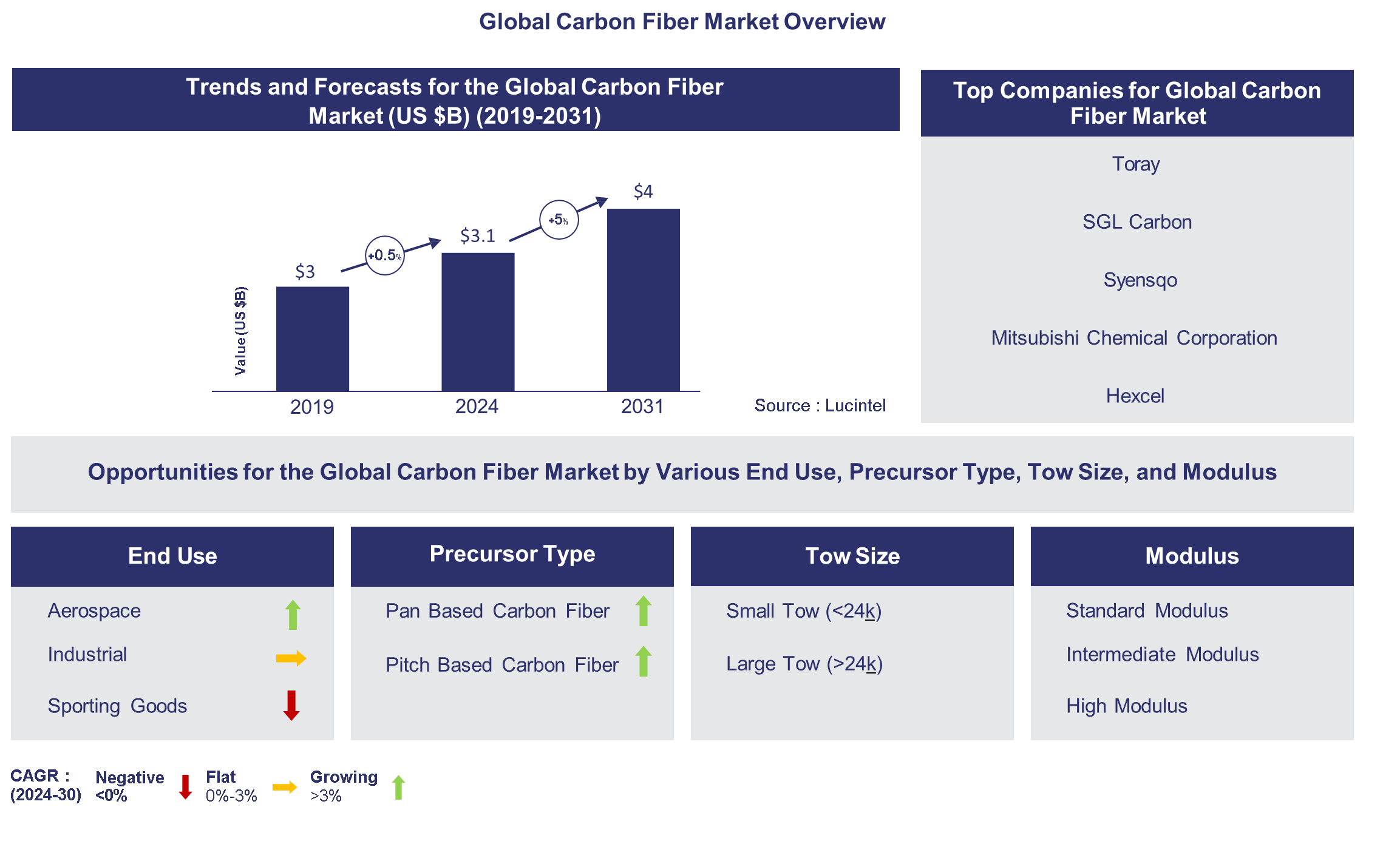
Lucintel finds that the future of the global carbon fiber market looks promising with opportunities in the aerospace, industrial, and sporting goods end uses. The global carbon fiber market is expected to reach an estimated $4 billion by 2031 with a CAGR of 5% from 2024 to 2031. The global carbon fiber market has experienced substantial growth, owing to factors such as increasing demand for lightweight and fuel-efficient vehicles, aerospace advancements, wind energy expansion, and growing applications in sports and leisure sectors. Carbon fiber is widely used in industries such as automotive, aerospace, wind energy, sports equipment, construction, and marine, among others. The major drivers for market growth are growing demand for high performance and lightweight composite materials and increasing performance requirements in the end uses.
This 306-page report includes a total of 119 figures and charts, as well as 113 tables, to assist in your business decisions.
This 306-page report includes a total of 119 figures and charts, as well as 113 tables, to assist in your business decisions.
Explore the untapped potential of adjacent growth opportunities in the composites industry. Discover how strategic expansion beyond core markets can drive innovation, profitability, and long-term success.

The main raw materials in carbon fiber are synthetic polymer fibers made from polyacrylonitrile (PAN) and pitch. PAN, which is a result of petroleum derivatives, is formed into long strings through wet spinning process before being treated through stabilization and carbonization to form continuous filaments. Pitch which can be obtained from refining petroleum or distilling coal tar is also used and subjected to similar heat processing that allows the production of carbon fibers with desired thermal/mechanical properties. These fibers find use in lightweight high strength applications for the aerospace, automotive, and sports industries. Carbon fiber generally costs more than traditional materials like steel, aluminum, and fiberglass. The cost of carbon fiber can vary greatly because there so many things that affect it including but not limited to: type of carbon fiber, grade of carbon fiber manufacturing process demand for number produced etc.. Apart from suppliers, location could also determine prices alongside dynamics within markets.
- Lucintel forecasts that industrial will remain the largest end use segment and aerospace is expected to witness highest growth over the forecast period.
- PAN based carbon fiber will remain the largest segment and pitch based is expected to witness the highest growth over the forecast period.
- APAC is expected to remain the largest market and North America expected to witness the highest growth over the forecast period due to demand from the industries of aerospace, automotive, and construction.

Country wise Outlook for the Carbon Fiber Market
The carbon fiber market is witnessing substantial growth globally, driven by increased demand from various industries such as aerospace, automotive, wind energy, and construction. Major players in the market are expanding their operations and forming strategic partnerships to strengthen their positions. Below image highlights recent developments by major carbon fiber producers in key regions: the USA, EU, China, India, Japan, and South America.

Emerging Trends in the Carbon Fiber Market
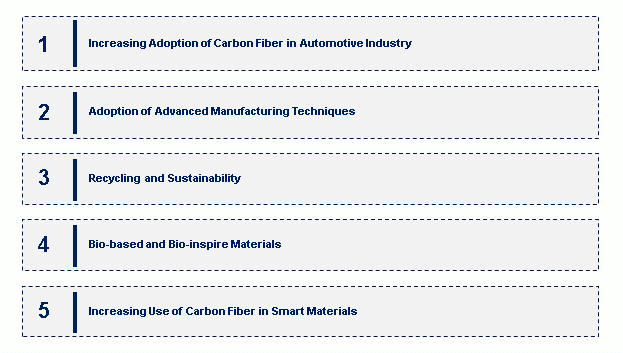
Emerging trends in the carbon fiber market shaping its future applications and market dynamics:- Increasing Adoption in Automotive: Increasing use of carbon fiber in mainstream automotive applications to reduce vehicle weight, improve fuel efficiency, and extend electric vehicle range.
- Advanced Manufacturing Techniques: Innovations in automated layup, additive manufacturing (3D printing), and resin transfer molding (RTM) to enhance production efficiency, reduce costs, and enable complex geometries.
- Recycling and Sustainability: Development of recycling technologies and sustainable manufacturing practices to address environmental concerns and improve lifecycle sustainability of carbon fiber materials.
- Smart Materials: Incorporation of sensors, actuators, and functional coatings into carbon fiber composites for applications in structural health monitoring, adaptive structures, and smart textiles.
- Bio-based and Bio-inspired Materials: Exploration of bio-based precursors and bio-inspired structural designs to enhance sustainability and reduce dependency on fossil fuels in carbon fiber production.
Recent Developments in the Carbon Fiber Market
Ongoing innovations and advancements in various sectors of the carbon fiber market which have been highlighted by recent developments:
- Increasing Demand in Automotive Sector: Carbon fibers use has been gradual but consistent in automobiles. The manufacturers are now taking up carbon fiber composites due to their lightweight properties that will result in fuel efficient electric cars or increased range for EVs.
- Manufacturing Processes Advancements: There have been improvements in manufacturing processes that aim at reducing costs associated with production and increasing scalability of carbon fiber production. These include precursor materials, spinning techniques, and curing methods.
- Growing Demand of Carbon Fiber Applications in Aerospace: Carbon fiber is commonly used in structural components of aircraft as it possesses a high strength-to-weight ratio and durability. Attempts have also been made to create new grades of carbon fibers specific for aerospace applications.
- Renewable Energy Emerging Uses: Wind turbine blades and other renewable energy infrastructure make use of carbon fiber composites because of their light weight nature as well as ability to tolerate harsh environments.
- Market Consolidation & Strategic Partnerships: Mergers and acquisitions among major players were observed along with some consolidation within the industry that was followed by strategic partnerships between material suppliers, manufacturers and end users seeking innovation breakthrough or wider area coverage.
- Recycling & Sustainability Initiatives: Consequently, people are becoming more concerned about how the environment is affected by these products; especially recycling technologies improvement is being put into consideration while minimizing environmental impacts during all stages involved in making this material.
- R&D: This ongoing effort aims at developing next-generation carbon fibers with better properties such as higher tensile strength, improved impact resistance, ease of processability etc.

Strategic Growth Opportunities for Carbon Fiber Market
The carbon fiber market is very dynamic due to its unique properties of being lightweight, strong and thermally stable. Some key strategic growth opportunities for this market include:
Expanding Adoption in Existing Industries:
- Automotive: The production of lighter cars that meet stringent fuel consumption standards will require the use of carbon fibers for car body, chassis parts, wheels.
- Aerospace & Defense: Commercializing airplanes with low weight are more likely to encourage the application of carbon fibers on wings, fuselage components and control surfaces.
- Wind Energy: Long-lasting lightweight wind turbine blades will still depend on carbon fiber applications.
- Reduced Production Costs: Devising cheaper processes of manufacturing carbon fiber can see it find wider application in various industries.
- Recyclable Carbon Fiber: Developing efficient and cost effective recycling process for carbon fiber will address sustainability issues and potentially bring down the material price levels.
- Multifunctional Composites: The incorporation of functionality such as conductivity or self-repair capabilities in carbon fiber composite materials creates new usage possibilities and adds value to them.
New Market Penetration:
- Construction: This material can be used as a substitute for concrete reinforcing steel to make bridges more durable, improve the resilience of buildings during earthquakes and increase the life span of infrastructure projects.
- Consumer Goods: Premium sporting gear like bicycles, tennis rackets, golf clubs etc., can benefit from lightness feature and good mechanical performance derived from this type of fiber.
- Biomedical Applications: Biocompatibility and lightweight features make it suitable for prosthetic limbs, inserts into human bodies among other medical devices
Regional Market Expansion:
- Emerging Economies: Accelerating industrialization as well as infrastructure development in countries such as China, India and Southeast Asia is expected to create fresh demand for carbon fibers.
- Government Initiatives: Government initiatives aimed at promoting energy efficiency along with green materials could serve as incentives towards the use of carbon fiber in a range of industries.
Collaboration and Partnerships:
- Collaboration between Material Scientists and End Users: Joint research by different groups can lead to development of custom carbon fiber solutions based on specific industry needs.
- Partnerships with Automotive and Aerospace Manufacturers: Carbon fiber producers could collaborate closely with key players within the automotive as well as aerospace industries thereby speeding up the integration of carbon fiber composites into new vehicle or aircraft models.
By taking advantage of these strategic growth opportunities, the carbon fiber market can realize its full potential and transform numerous industries through strength, lightness, versatility. Also explore how AI can accelerate innovation, reduce costs, and unlock new competitive advantages across the entire carbon fiber value chain.

Carbon Fiber Market Driver and Challenges
Carbon fiber has a very important role in many industries including aerospace, automotive and renewable energy. The changing market dynamics are being driven by the demand for high performance materials, improvements in manufacturing technologies and stringent environmental regulations. However, challenges like production costs highlight strategic solutions to sustain growth and innovation in the carbon fiber sector.

The factors responsible for driving the carbon fiber market include:
- High Demand for Lightweight Materials: There is an increase in need for light weight materials in industries such as aerospace, automotive and wind energy to achieve fuel efficiency, reduced emissions and improved performance. Carbon fiber with its high strength-to-weight ratio is preferred for use in these applications.
- Advancements in Manufacturing Technologies: Continuous improvement of manufacturing processes such as automated fiber placement (AFP) and resin transfer molding (RTM) have been used to reduce production costs and expand the applicability of carbon fiber composites. These advancements will enable therefore make carbon fibers accessible even to small scale industrial users given that it would become cheap.
- Growth in Wind Energy Sector: Increased production of wind energy leads to higher demand for carbon fiber used during turbine blades manufacturing. High material strength as well as lightweight attributes ease construction of longer plus more efficient blades resulting into overall increased power output.
- Increasing Consumption of Carbon Fiber in Automotive Industry: As the auto industry moves towards electric or hybrid vehicles there is a growing requirement for lighter materials that can extend battery life while enhancing vehicle performance at large. Use of carbon fiber composites helps engineers lower vehicle weight without sacrificing their safety features or mechanical properties.
Challenges in the carbon fiber market are:
- High Production Costs: Carbon fiber manufacturing process is complex and expensive due to high energy consumption and expensive raw material like polyacrylonitrile (PAN). This makes it costlier than other traditional materials thus negating its widespread acceptance.
- Processing and Handling Difficulties: It requires special handling since this material tends to be brittle. Carbonized fibers thus require specialized equipment and knowledge to work with them which is a barrier for other industries that do not have these materials in place.
Innovations in material science and manufacturing processes have led to a strong demand for carbon fiber. There has been unique developments such as biobased precursors and novel resin systems that improve on sustainability and performance metrics. Applications are expanding into emerging sectors such as space exploration, unmanned aerial vehicles etc., pointing up the position of carbon fiber in high-tech areas. Besides, increased investments in infrastructure projects globally are driving the demand for durable lightweight materials hence establishing carbon fiber as an imperative solution within the construction and transportation industries.
Carbon Fiber Suppliers and Their Market Shares
In this globally competitive market, several key players such as Toray Industries, Inc., Teijin Limited, Mitsubishi Chemical Holdings Corporation, SGL Carbon SE, Hexcel Corporation, etc. dominate the market and contribute to industry’s growth and innovation. These players capture maximum market share. To know the current market share of each of major players contact us. If you wish to deep dive in competitive positioning of these players then you can look into our other syndicated market report on “carbon fiber leadership report".
Companies in the market compete based on the quality of products offered. Major players in this market focus on expanding their manufacturing facilities, investing in R&D, developing infrastructure, and leveraging integration opportunities across the value chain. Through these strategies, carbon fiber companies address increasing demand, ensure competitive effectiveness, develop innovative products and technologies, reduce production costs, and expand their customer base. Some of the carbon fiber companies profiled in this report include:
- Toray Industries Inc.
- Hexcel Corporation
- Mitsubishi Chemical Corporation
- Syensqo
- SGL Carbon
- Teijin Limited
- Formosa Plastics Corporation
- DowAksa
- Hyosung
- Nippon Graphite Fiber Corporation
- Kureha Corporation
These companies have established themselves as leaders in the carbon fiber industry, with extensive product portfolios, global presence, and strong research and development capabilities. They continually strive to enhance their market positions through strategic partnerships, mergers and acquisitions, and product innovations.
The market share dynamics within the carbon fiber market are evolving, with the entry of new players and the emergence of innovative carbon fiber technologies. Additionally, collaborations between material suppliers, manufacturers, and end-users are fostering technological advancements and expanding market opportunities.

The market share dynamics within the carbon fiber market are evolving, with the entry of new players and the emergence of innovative carbon fiber technologies. Additionally, collaborations between material suppliers, manufacturers, and end-users are fostering technological advancements and expanding market opportunities.
Carbon Fiber Market by Segment
Major segments of carbon fiber experiencing growth include aerospace for lightweight aircraft components, automotive for reducing vehicle weight and enhancing fuel efficiency, wind energy for durable turbine blades, sports equipment for performance enhancements, and industrial applications for infrastructure and marine uses due to its strength and corrosion resistance. These segments reflect increasing demand driven by technological advancements and sustainability goals across diverse industries.
This carbon fiber market report provides a comprehensive analysis of the market's current trends, growth drivers, challenges, and future prospects in all major segments like above. It covers various segments, including carbon fiber types, manufacturing processes, applications, and end-user industries. The report offers insights into regional dynamics, highlighting the major markets for carbon fiber and their growth potentials. The study includes trends and forecast for the global carbon fiber market by end use, precursor type, tow size, modulus, and region as follows:
This carbon fiber market report provides a comprehensive analysis of the market's current trends, growth drivers, challenges, and future prospects in all major segments like above. It covers various segments, including carbon fiber types, manufacturing processes, applications, and end-user industries. The report offers insights into regional dynamics, highlighting the major markets for carbon fiber and their growth potentials. The study includes trends and forecast for the global carbon fiber market by end use, precursor type, tow size, modulus, and region as follows:
By End Use [Value ($M) and Volume (M lbs) Analysis for 2019 – 2031]:
- Aerospace
- Commercial
- Regional Jets
- General Aviation
- Helicopter
- Defense
- Space
- Industrial
- Wind Energy
- Marine
- Transportation/Automotive
- Civil/Construction
- Electrical and Electronics (E&E)
- Others
- Sporting Goods
- Golf
- Rackets
- Skis, snowboards and other winter sports equipment
- Fishing poles
- Others
By Precursor Type [Value ($M) and Volume (M lbs) Analysis for 2019 – 2031]:
- PAN Based
- Pitch Based
By Tow Size [Value ($M) and Volume (M lbs) Analysis for 2019 – 2031]:
- Small Tow (<=24k)
- Large Tow (>24k)
By Modulus [Value ($M) and Volume (M lbs) Analysis for 2019 – 2031]:
- Standard Modulus
- Intermediate Modulus
- High Modulus
By Region [Value ($M) and Volume (M lbs) Analysis for 2019 – 2031]:
- North America
- Europe
- Asia Pacific
- The Rest of the World
Features of the Carbon Fiber Market
- Market Size Estimates: carbon fiber market size estimation in terms of value ($M) and volume (M lbs)
- Trend and Forecast Analysis: Market trends (2019-2024) and forecast (2025-2031) by various segments and regions.
- Segmentation Analysis: Market size end use, precursor type, tow size, modulus, and region
- Regional Analysis: Carbon fiber market breakdown by North America, Europe, and the Rest of the World.
- Growth Opportunities: Analysis of growth opportunities in different end use, precursor type, tow size, modulus and regions for the carbon fiber market.
- Strategic Analysis: This includes M&A, new product development, and competitive landscape for the carbon fiber market.
- Analysis of competitive intensity of the industry based on Porter’s Five Forces model.
If you are looking to expand your business in carbon fiber or adjacent markets, then contact us. We have done hundreds of strategic consulting projects in market entry, opportunity screening, due diligence, supply chain analysis, M & A, and more.

Frequently Asked Questions (FAQ)
Q1. What is the carbon fiber market size?
Answer: The global carbon fiber market is expected to reach an estimated $4 billion by 2031.
Answer: The global carbon fiber market is expected to reach an estimated $4 billion by 2031.
Q2. What is the growth forecast for carbon fiber market?
Answer: The carbon fiber market is expected to grow at a CAGR of 5% from 2024 to 2031.
Q3. What are the major drivers influencing the growth of the carbon fiber market?
Answer: The major drivers for market growth are growing demand for high performance and lightweight composite materials and increasing performance requirements in the end uses.
Q4. Who are the biggest consumers of carbon fiber?
Answer: The carbon fiber market is expected to grow at a CAGR of 5% from 2024 to 2031.
Q3. What are the major drivers influencing the growth of the carbon fiber market?
Answer: The major drivers for market growth are growing demand for high performance and lightweight composite materials and increasing performance requirements in the end uses.
Q4. Who are the biggest consumers of carbon fiber?
Answer: Industrial and aerospace sectors are the major end uses for carbon fiber.
Q5. What are the emerging trends in carbon fiber market?
Answer: Emerging trends, which have a direct impact on the dynamics of the carbon fiber industry, includes the production of low cost carbon fiber, joint ventures of carbon fiber manufactures with OEMs and part fabricators, and growing initiatives for recycling of carbon fiber.
Q6. Who are the key carbon fiber companies?
Answer: Some of the key carbon fiber companies are Toray, Hexcel, Mitsubishi Chemical, Syensqo, SGL, Teijin, Formosa Plastics, DowAksa, Hyosung, Nippon Graphite Fiber Corporation, Kureha Corp. etc.
Answer: Emerging trends, which have a direct impact on the dynamics of the carbon fiber industry, includes the production of low cost carbon fiber, joint ventures of carbon fiber manufactures with OEMs and part fabricators, and growing initiatives for recycling of carbon fiber.
Q6. Who are the key carbon fiber companies?
Answer: Some of the key carbon fiber companies are Toray, Hexcel, Mitsubishi Chemical, Syensqo, SGL, Teijin, Formosa Plastics, DowAksa, Hyosung, Nippon Graphite Fiber Corporation, Kureha Corp. etc.
Q7.Which carbon fiber precursor segment will be the largest in future?
Answer: Lucintel forecasts that, PAN based carbon fiber will remain the largest segment and it is also expected to witness the highest growth due to its wide application area in transportation, aerospace/defense, and wind energy industries.
Q8. In carbon fiber market, which region is expected to be the largest in next 7 years?
Answer: North America is expected to remain the largest region over next 7 years
Q9. What is the Price of Carbon Fiber?
Answer:The price of carbon fiber ranges from $6 to $40 per pound, it is mainly influenced by grade of carbon fiber. Aerospace grade is at the higher end of the price spectrum due to its superior strength, stiffness, and stringent quality standards required for aerospace applications. While industrial grade is generally less expensive, this grade is used in applications like automotive parts, sporting goods, and construction materials.
Q10. Do we receive customization in this report?
Answer: Yes, Lucintel provides 10% Customization Without any Additional Cost.
Answer: Lucintel forecasts that, PAN based carbon fiber will remain the largest segment and it is also expected to witness the highest growth due to its wide application area in transportation, aerospace/defense, and wind energy industries.
Q8. In carbon fiber market, which region is expected to be the largest in next 7 years?
Answer: North America is expected to remain the largest region over next 7 years
Q9. What is the Price of Carbon Fiber?
Answer:The price of carbon fiber ranges from $6 to $40 per pound, it is mainly influenced by grade of carbon fiber. Aerospace grade is at the higher end of the price spectrum due to its superior strength, stiffness, and stringent quality standards required for aerospace applications. While industrial grade is generally less expensive, this grade is used in applications like automotive parts, sporting goods, and construction materials.
Q10. Do we receive customization in this report?
Answer: Yes, Lucintel provides 10% Customization Without any Additional Cost.
This report answers following key questions
Q.1 What are some of the most promising potential, high growth opportunities for the global carbon fiber market by end use (aerospace, industrial, and sporting goods), precursor type (Pan and Pitch), tow size (small tow (<=24k) and large tow(>24k)), modulus (standard, intermediate, and high), and region (North America, Europe and the Rest of the World)?
Q. 2 Which segments will grow at a faster pace and why?
Q.3 Which regions will grow at a faster pace and why?
Q.4 What are the key factors affecting market dynamics? What are the drivers and challenges of the market?
Q.5 What are the business risks and threats to the market?
Q.6 What are the emerging trends in this market and the reasons behind them?
Q.7 What are the changing demands of customers in the market?
Q.8 What are the new developments in the market? Which companies are leading these developments?
Q.9 Who are the major players in this market? What strategic initiatives are being implemented by key players for business growth?
Q.10 What are some of the competitive products and processes in this area and how big of a threat do they pose for loss of market share via material or product substitution?
Q.11 What M & A activities have taken place in the last 5 years in this market?
For any questions related to carbon fiber market or related to PAN based carbon fiber, pitch based carbon fiber, carbon fiber in automotive, carbon fiber in aerospace, carbon fiber in industrial, carbon fiber manufacturers, carbon fiber top companies, carbon fiber suppliers, write Lucintel analyst at email: helpdesk@lucintel.com. We will be glad to get back to you soon.
Q. 2 Which segments will grow at a faster pace and why?
Q.3 Which regions will grow at a faster pace and why?
Q.4 What are the key factors affecting market dynamics? What are the drivers and challenges of the market?
Q.5 What are the business risks and threats to the market?
Q.6 What are the emerging trends in this market and the reasons behind them?
Q.7 What are the changing demands of customers in the market?
Q.8 What are the new developments in the market? Which companies are leading these developments?
Q.9 Who are the major players in this market? What strategic initiatives are being implemented by key players for business growth?
Q.10 What are some of the competitive products and processes in this area and how big of a threat do they pose for loss of market share via material or product substitution?
Q.11 What M & A activities have taken place in the last 5 years in this market?
For any questions related to carbon fiber market or related to PAN based carbon fiber, pitch based carbon fiber, carbon fiber in automotive, carbon fiber in aerospace, carbon fiber in industrial, carbon fiber manufacturers, carbon fiber top companies, carbon fiber suppliers, write Lucintel analyst at email: helpdesk@lucintel.com. We will be glad to get back to you soon.
|
Adjacent Markets |
Table of Contents
1. Executive Summary
7.1 Toray Industries Inc.
7.2 Hexcel Corporation
7.3 Mitsubishi Chemical Corporation
7.4 Syensqo
7.5 SGL Carbon
7.6 Teijin Limited
7.7 Formosa Plastics Corporation
7.8 DowAksa
7.9 Hyosung
7.10 Nippon Graphite Fiber Corporation
7.11 Kureha Corporation
7.12 Osaka Gas Chemical Corporation Ltd.
7.13 Dalian Xingke Carbon Fiber Co.
7.14 Jilin Jiyan High-Tech Fibers
7.15 Anshan Sinocarb Carbon Fibers Co., Ltd.
7.16 Sinosteel Jilin Carbon Co., Ltd.
7.17 Weihai Tuozhan Fiber
7.18 Zhongheng New Material
7.19 Zhongfu Shenying Carbon Fiber Co., Ltd.
7.20 Jiangsu Hengshen Fiber Materials Co., Ltd.
Methodology
Lucintel has been in the business of market research and management consulting since 2000 and has published over 1000 market intelligence reports in various markets / applications and served over 1,000 clients worldwide. This study is a culmination of four months of full-time effort performed by Lucintel's analyst team. The analysts used the following sources for the creation and completion of this valuable report:
- In-depth interviews of the major players in this market
- Detailed secondary research from competitors’ financial statements and published data
- Extensive searches of published works, market, and database information pertaining to industry news, company press releases, and customer intentions
- A compilation of the experiences, judgments, and insights of Lucintel’s professionals, who have analyzed and tracked this market over the years.
Extensive research and interviews are conducted across the supply chain of this market to estimate market share, market size, trends, drivers, challenges, and forecasts. Below is a brief summary of the primary interviews that were conducted by job function for this report.

Thus, Lucintel compiles vast amounts of data from numerous sources, validates the integrity of that data, and performs a comprehensive analysis. Lucintel then organizes the data, its findings, and insights into a concise report designed to support the strategic decision-making process. The figure below is a graphical representation of Lucintel’s research process.

Buy Now
Choose a license that fits your team. Instant PDF delivery.
Prices exclude taxes. Instant delivery. Custom licensing available on request.


