
Market Report · July 22, 2026

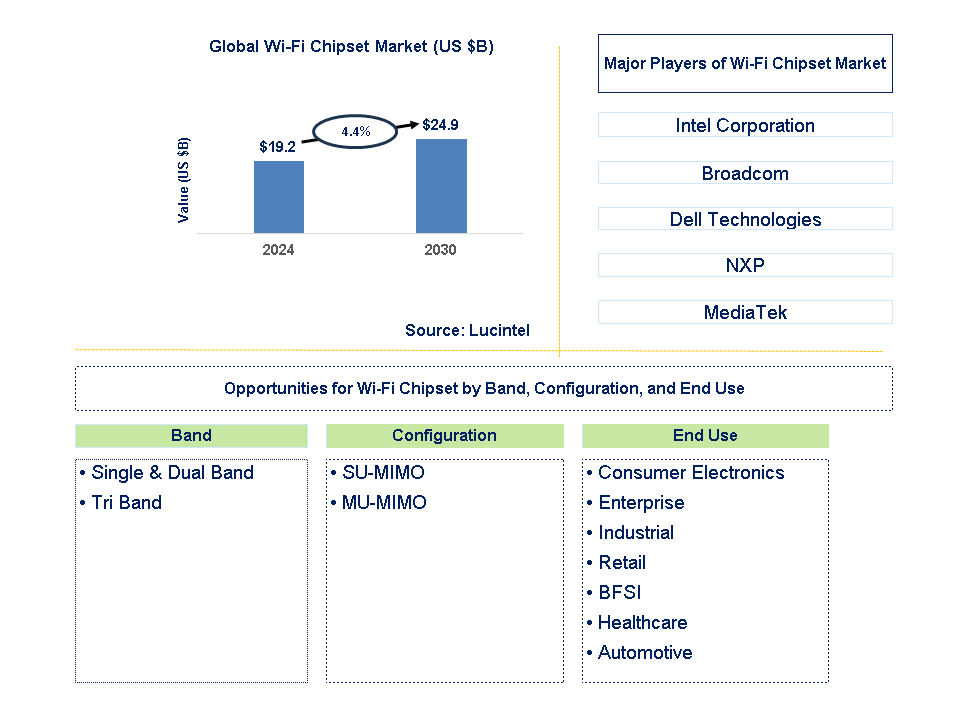
Key data points: The market size in 2030 = $24.9 billion, growth forecast = 4.4% annually for the next 6 years. Scroll below to get more insights. This market report covers trends, opportunities, and forecasts in the global Wi-Fi chipset market to 2030 by band (single & dual band and tri band), configuration (SU-MIMO and MU-MIMO), end use (consumer electronics, enterprise, industrial, retail, BFSI, healthcare, and automotive), and region (North America, Europe, Asia Pacific, and the Rest of the World)
We'll send your sample report shortly.
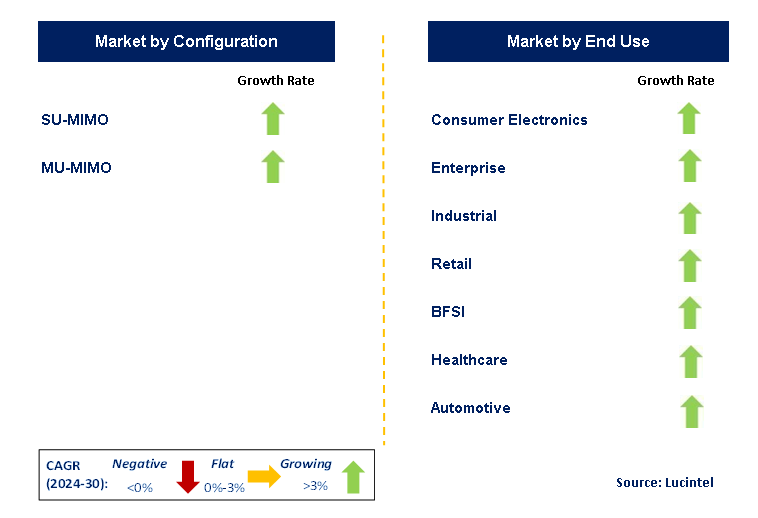
• Lucintel forecasts that, within the configuration category, MU-MIMO is expected to witness the highest growth over the forecast period.
• In terms of regions, APAC is expected to witness the highest growth over the forecast period due to the large number of consumer electronics OEMs and low cost production of Wi-Fi chipsets in China. Gain Valuable insights for your business decisions with our comprehensive 150+ page report.
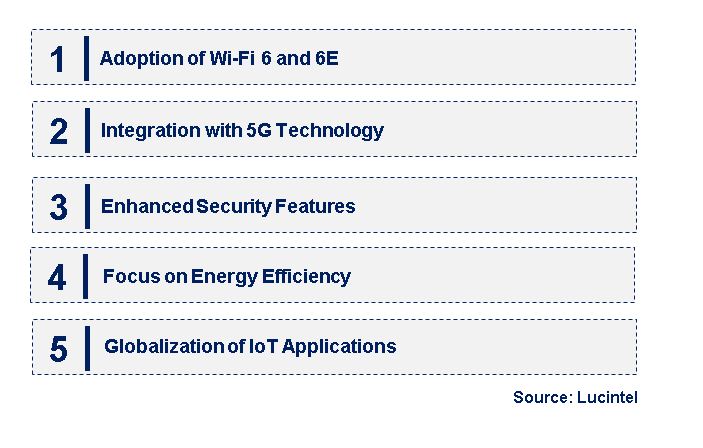
• Adoption of Wi-Fi 6 and 6E: Among the notable transformations evident the adoption of Wi-Fi 6 and 6E technology is overwhelming. In every aspect, Wi-Fi 6E offers superior level of evolution where it was speed, capacity and efficiency. Wi-Fi 6E here brings the 6 GHz band to the table where it helps minimize interference and provide better throughput for densely populated areas. It is a trend that is changing the face of the market in that it is making room for new chipsets to be developed as well as extending the application areas from consumer electronics to enterprise networks.
• Integration with 5G Technology: The fusion of Wi-Fi chipsets and 5G technology is improving the effective connectivity and utilization. This trend lets user transforms from Wi-Fi to 5G very seamlessly and vice versa, leading to better and quicker connections. It meets the increasing demand for high data rates and low delay rates for the likes of IoT, AR/VR, smart cities and many applications. The coming together of Wi-Fi and 5G is taking the chipset design and networking infrastructure to the next level.
• Enhanced Security Features: With the increase in cybersecurity threats, thus there is an ongoing trend of having advanced security measures for Wi-Fi chipsets such as anti-hacking and data theft mechanisms. There is also much emphasis on multi tiered encryption protocols for data biomarkers, secure authentication and member identity protocols and more. The market is further being shaped by such trends as there is the growing need for secure Wi-Fi solutions in areas such as health and financial transaction purposes.
• Focus on Energy Efficiency: Energy efficiency is increasingly becoming an important requirement in the design of Wi-Fi chipsets. Manufacturers are producing chip sets that require less power but still provide high performance as concerns about by the technology to the environment and the rationale for green technology grow. This trend is beneficial for the market as it leads to the development of low-power chipsets and more optimal solutions in the wrappers and a variety of devices and applications.
• Globalization of IoT Applications: Growth of IoT Applications. As the IoT applications are expanded, the requirement for advanced Wi-Fi chipsets is on the rise. More connected devices mean that there is a need for chipsets that can cater to mass connectivity and ensure that the connections are maintained. This is causing a change in the dynamics of the industry by pushing for the development of chipsets that are specific for IoT applications such as smart homes, industrial appliances, wearable devices etc. More recently, the changes in Wi-Fi chipset markets have predominantly been technological, have been in-line with the prevailing industry standards, and have been fueled by the consumer’s desire. The evolution of new chipset functionalities, new standards, and new strategies by the major players are factors influencing the Wi-Fi technology uptake in diverse applications and are defining the market forces.
• Innovation Toward Integrated Solutions: Innovation Toward Integrated Solutions It is more common for companies to combine Wi-Fi modules with other standards instead of adding them as separate trims or options, like Bluetooth 5 or 5G, into a Wi-Fi device. This facilitates better performance and consistent level of operation across technologies. The use of integrated solution is changing the industry by streamlining the construction of devices and improving user experience especially on the consumer and industrial markets.
• Artificial Intelligence and Machine Learning Application: ‘What does the Client says’ Artificial Intelligence and Machine Learning Application Furthermore, to allow for optimized performance and better traffic management on the WLAN, artificial intelligence and other machine learning capabilities are being developed into the WiFi chipsets. Such features driven by AI include self-healing, channel steering and power control. This advancement is changing the landscape by improving performance and making Wi-Fi networks more reliable, especially where there are many devices with different use cases situated in the same location.
• Enhancing Low-power Chipsets: Owing to the increasing demand for energy-saving technologies, the development of the low-power Wi-Fi chipsets is becoming important. Battery-efficient designs that are meant for hand-held and Internet of Things devices are being implemented in these chipsets thus making them save energy and last longer. This has a meaning in the sense that the trend is facilitating the increase in the number of interconnected devices as well as encouraging development of sustainable technologies.
• Enhanced Security Features: New “WPA3” standards and other advanced security measures are deployed – this is an important development in line with security, security being one of the most important rules It must be taken into account. These security improvements are targeted to the problems and are statistically aimed at the observations through not-having the exposure. In that regard the need for a secure encryption scheme is generating an increasing interest in chipsets that offer such protective means from point of security of data and applications. Over the last few years, various Wi-Fi 6E chipsets, more integrated solutions, application of AI and machine learning and combatting the expansion of low power chipsets technologies and improving security protocols adding to those of the particular makers of the various systems have developed with the improvements in the Wi-Fi chipset market, in the review of the most recent developments of the Wi-Fi chipset market. These developments add up to the achievement of connectivity+performance+ security + other drivers which define and impact the factors of growth in Wi-Fi technology.
• IoT Applications: As the generation of connected devices, the IoT have constraints multiplied the opportunities available to manufacturers of Wi-Fi chipsets. With the increase in the number of connected devices, a reliable and efficient Wi-Fi IService is becoming a greater necessity. IoT focused chipsets have large scale installation, improve the quality of service delivery and create new service opportunities. This opportunity is fueling the development of low-cost, high-performance IoT chipsets.
• Smart Home Devices: The smart home market is one of the most promising markets for Wi-Fi chipsets. Due to the increasing use of smart home appliances, smart home security, and smart home automation products there is a need for chipsets with reliable connectivity. Such opportunities are while trying to create chipsets that will make smart home systems usable and include functionalities such as voice control, compatibility, and security.
• Enterprise Solutions: With enterprise solutions, here is what we have found out more or less. In the enterprise sector there is a felt need for strong and scalable Wi Fi solutions. In most cases, a high capacity and high performance chipset is needed to cater for many users and devices. The prospects here involve the development of chipsets that improve the overall performance of the networks, incorporate better security features, and work with wireless networking hardware and devices targeting enterprises in making the experience better.
• Automotive Connectivity: Increasingly, the use of in-vehicle Wi Fi has become commonplace in the automotive industry for applications such as in car infotainment systems and V2X features. In this industry, the opportunities include the design of chipsets that support fast data rates, dependable functionality, and interfacing with other systems in the vehicle. The increasing movement towards connected vehicles is a huge opportunity for the advanced Wi Fi chipsets market.
• Healthcare Systems: With the particular focus and attention on improving the patient support service delivery, institutions within the health care sector are tracing Wi-Fi technology adoption. Such technologies are used by medical devices, telemedicine applications and even hospital networks. Such applications/exploitation models in which the security and performance characteristics are provided for and not compromised will boost the development of the Telemedicine and other connectivity driven segments, where real time monitoring and data sharing are essential. Major growth opportunities in the Wi-Fi chipset industry include IoT functions, smart home devices, business solutions, automobile connectivity, and i.e. systems in health care. These segments offer potential for development and growth in the market through the technological advancement and rising need for highly efficient and safe communication systems. Engaging in these perpetrated marketing opportunities will help the stakeholders to grow their market standing and satisfy the changing consumer and business requirements.
• The regular Use of New Wifi Standards: The regular implementation of new Wifi frameworks such as Wi-Fi 6 and Wi-Fi 6E changes the dynamics of the market in a big way. The said standards are more efficient in terms of performance, capacity and even in utilization of resources as compared to earlier versions. Wii Fi 6E, which uses the 6GHz band, enhances performance and eliminates congestion thus increasing speeds. This causes an upsurge in the demand for modern chipsets that can withstand such standards for better connectivity in both consumer and enterprise applications.
• The Need for Greater Bandwidth: Also known as bandwidth or data rate, the speed at which information may be transferred increases bandwidth, thus enabling the new technologies to work smoothly. With the rising presence of applications with high bandwidth capabilities such as; video watching, online gaming, and home-working activities now users and businesses need fast-speed chipsets which do not take much time to transfer data. This movement makes it necessary for chipset manufacturers to concentrate on chipset innovation because of the consistently changing requirements of the customers for higher data capacities and better performance.
• Incorporation with New Generation Technologies: The incorporation of the Wi-Fi chipsets with 5G technology, Internet of Things (IoT) and Artificial Intelligence (AI) is one of the essential factors driving the growth of the market. Wi-Fi chipsets that are also integrated with the 5G network and IoT are more widely applicable and use attention. Channels capable of performing advanced functions focusing on its application for instance channel management by AI are a plus in performance. This merger of technologies expedites the development of more advanced chipsets and broadens their applicability in many industries.
• Expanding smart home market: The rise of smart home concepts plays a key role in the upliftment of the Wi-Fi chipset industry. A steady rise in the number of smart appliance, smart security, and smart home automation usage in many households increases chip demands that are capable of satisfying the connectivity needs of these devices. Also, expansion of smart home devices increases the demand for further development of Wi-Fi chipsets innovative solutions that would make a harmonious and high-performance work within intelligent home systems and seamless integration.
• Economic Growth and Digital Transformation: The reasons for the proliferation of new generation Wi-Fi chip sets are economic growth and digital transformation. The more businesses and economies go digital result in the increasing demand for enhanced and flexible Wi-Fi solutions. Expansion plans and technological innovations tend to create a demand for high performance chipsets that would aid corporate networks and digital services. This economic factor enhances the growth of the market by promising chipset developers a chance to meet the emerging market challenges. Challenges in the Wi-Fi chipset market are:
• Spectrum Limitations: The absence of spectrum broadcast hinders the development of the Wi-Fi chipset industry market with regard to the rising number of users using Wi-Fi. Newer standards like Wi-Fi 6E increase the bandwidth spectrum as they avail the 6 GHz band. However, the bandwidth spectrum availability has however been limited. This makes some areas of the wifi band congested and at times inefficient, which affects Wi-Fi capabilities and hence continues to challenge chipset producers in optimizing the connectivity offer.
• Security Concerns: Security challenges constitute a productive challenge to the Wi-Fi set industry market. The more the coverage, the more exposed one is to various online attacks and possibilities of information being stolen. It is important to include high-level security features in the chipsets so as not to pose let their guard down while using the Wi-Fi technology which is exposed to risks. Solving these challenges is necessary in order to satisfy users and to enable the usage of Wi-Fi technology in different areas and applications without fear.
• Regulatory Barriers: There are interesting insights that can be drawn regarding the development and use of Wi-Fi chipsets regarding the rule making. Different legislative regimes across different markets have the ability to interpose themselves in the manufacturing and slow the introduction of potential new technologies. Spectrum, device certification and environmental regulations are factors to be considered and accounted for. Such regulatory constrains may also not allow the dynamics of the market and the possibility of the manufacturers putting new advancements on the market. Factors such as technology, economy, and regulatory policies and issues play a role in shaping the Wi-Fi chipset market. Some of the main drivers are the implementation of new Wi-Fi standards, the need for faster connectivity, and the seamless integration of new technologies. Other factors that limit or shape the market such as spectrum out of reach, security issues and regulatory barriers shape such development of the Wi-Fi chipsets. It is important for the actors in the market to be aware of such trends and factors in order to successfully maneuver through the market and seize opportunities for expansion in the rapidly transforming technology environment.
• Intel Corporation
• Broadcom
• Dell Technologies
• NXP
• MediaTek
• Cisco System
• Texas Instrument
• Hewlett Packard
• Qualcomm
• Single & Dual Band
• Tri Band
• SU-MIMO
• MU-MIMO
• Consumer Electronics
• Enterprise
• Industrial
• Retail
• BFSI
• Healthcare
• North America
• Europe
• Asia Pacific
• The Rest of the World
• United States: However, while in FSM focus of the recent Wi-Fi chipsets developments is to move to Wi-Fi 6E and Wi-Fi 7, such standards have not been deployed in America. For instance, Qualcomm has come up with new chipsets that will enable faster data rates and higher efficiency, especially for mobile users. Such chipsets focus on improving performance in populated places and on new features such as augmented reality and virtual reality. In the U.S market however, the other trend is the increased use of Wi-Fi chipsets in devices which traditionally did not utilize such technologies such as smart homes and industrial users.
• China: China has updated its Wi-Fi chipset technology almost exclusively with features related to 5G networks and the in-country production of the equipment. Among other chip producers, Huawei and MediaTek have already introduced new chipsets compatible with new standards WiFi 6 and 6E. Characteristics such as high data rates with low latency were emphasized. However, there is also an increasing trend of developing indigenous technologies to cut off foreign suppliers. The market in China is witnessing rapid proliferation of the usage of Wi-Fi chipsets in smart appliances, the IoT space, and large scale network installations.
• Germany: Germany is also reporting developments of Wi-Fi chipsets with respect to industrial efficiency and smart infrastructure. Also, companies like Infineon Technologies and NXP Semiconductors are making chipsets that are able to support Wi-Fi 6 and 6E for connectivity purposes in manufacturing and automotive industry. At the same time, there is also a quest for energy efficient designs that will conform to the needs of a highly sensitive environment. The German market is experiencing growth in the integration of Wi-Fi chipsets into industrial automation systems and in connected devices within smart cities.
• India: The Wi-Fi chipset industry in India is thriving with the mission of providing internet to the masses in India through cheaper, scalable variants. Low-priced Wi-Fi 6 chipsets are being offered, targeting the high-speed internet market in India including urban as well as semi-urban localities. There is also a thrust in improving connections of IoT devices and developing broadband connectivity. The use of Wi-Fi chipsets in educational institutions, smart cities and consumer electronics is also on the rise in the Indian market.
• Japan: Japan is also leading the way in adoption of new-features Wi-Fi technology in electronics and smart home appliances. Firms like Panasonic and Sony have been utilizing Wi-Fi 6E and are in the works for chipsets to be used in devices that will support Wi-Fi 7. It is also the intention of the stakeholders within the Japanese market to enhance wireless solutions for representatives in both public and private sectors, health care service providers and robotics service enterprises alike. There is no shortage of effort put into ensuring that both homes and businesses enjoy effective and high speed connectivity.


• Intel Corporation
• Broadcom
• Dell Technologies
• NXP
• MediaTek
• Cisco System
• Texas Instrument
• Hewlett Packard
• Qualcomm Q6. Which Wi-Fi chipset market segment will be the largest in future? Answer: Lucintel forecasts that MU-MIMO is expected to witness highest growth over the forecast period. Q7. In Wi-Fi chipset market, which region is expected to be the largest in next 5 years? Answer: APAC is expected to witness highest growth over the forecast period due to the large number of consumer electronics OEMs and low cost production of Wi-Fi chipsets in China. Q.8 Do we receive customization in this report? Answer: Yes, Lucintel provides 10% customization without any additional cost.


Choose a license that fits your team. Instant PDF delivery.
Prices exclude taxes. Instant delivery. Custom licensing available on request.
Market Report · July 22, 2026
Market Report · July 17, 2026
Market Report · July 17, 2026
Trusted partner for strategic intelligence and business growth


Receive a complimentary market analysis tailored to your industry. Our analysts will identify key growth opportunities and competitive dynamics specific to your business.

Market size, growth rate, and key trend analysis for your specific sector.

Top competitor positioning and market share analysis.

Strategic recommendations backed by data-driven insights.
Get curated market intelligence and competitive moves straight to your inbox.
By subscribing, you agree to receive our monthly insights. Unsubscribe anytime.
Receive a complimentary market analysis tailored to your industry. Our analysts will identify key growth opportunities and competitive dynamics specific to your business.
Market size, growth rate, and key trend analysis for your specific sector.
Top competitor positioning and market share analysis.
Strategic recommendations backed by data-driven insights.
Get curated market intelligence, emerging trends, and competitive moves straight to your inbox each month.
By subscribing, you agree to receive our monthly insights. Unsubscribe anytime.
We'll send your sample report shortly.