
Probe Card Market Trends and Forecast
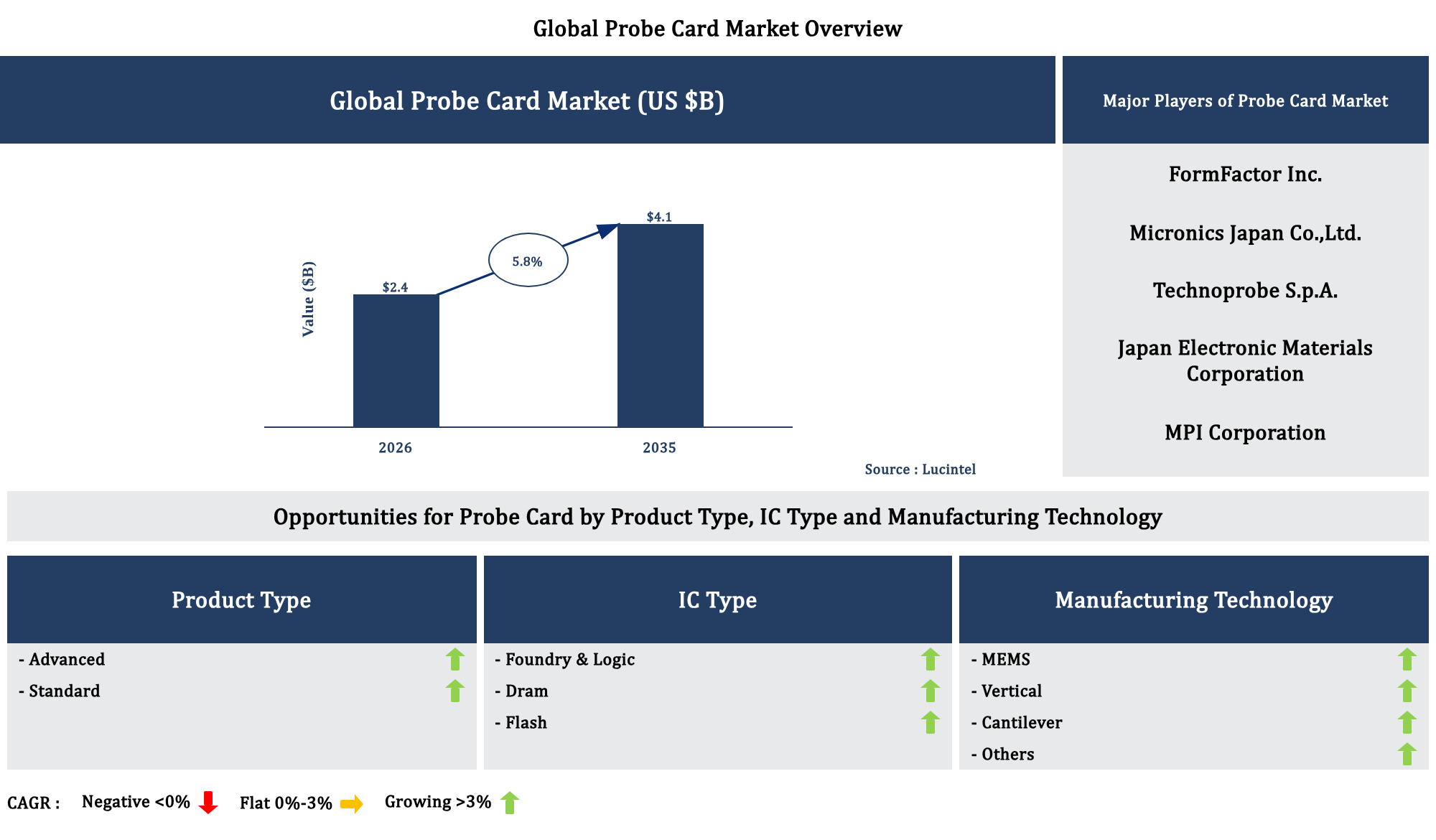
The future of the global probe card market looks promising with opportunities in the MEMS, vertical, and cantilever markets. The global probe card market is expected to reach an estimated $4,187 million by 2035 with a CAGR of 5.8% from 2026 to 2035. The major drivers for this market are the growing demand for consumer electronics & smart devices, the increasing adoption of 5g & iot technologies, and the rising demand for automotive electronics & electric vehicle production.
• Lucintel forecasts that, within the product type category, advanced is expected to witness higher growth over the forecast period.
• Within the manufacturing technology category, vertical is expected to witness the highest growth.
• In terms of region, APAC is expected to witness the highest growth over the forecast period.
Gain valuable insights for your business decisions with our comprehensive 150+ page report. Sample figures with some insights are shown below.
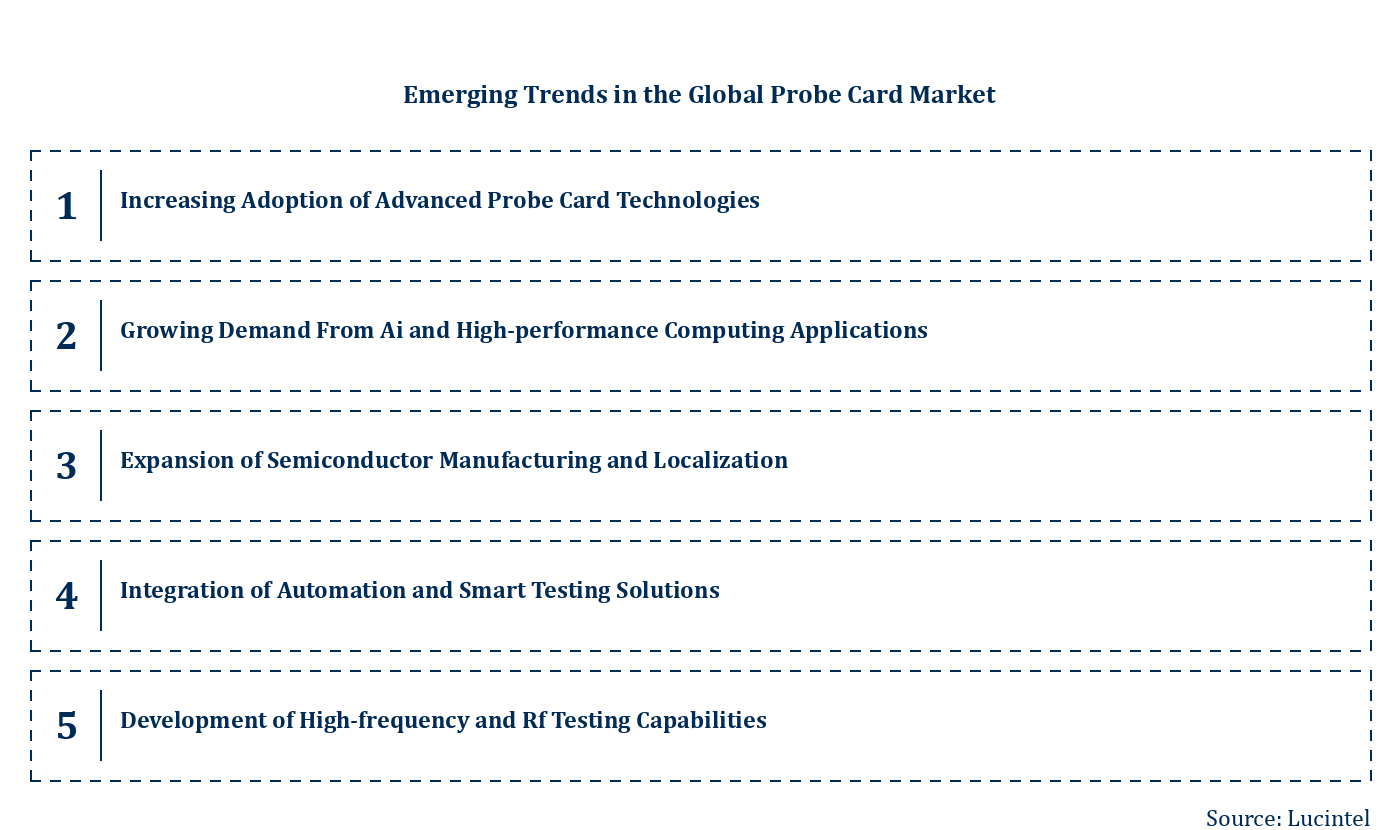
Emerging Trends in the Probe Card Market
The probe card market is undergoing rapid transformation due to continuous advancements in semiconductor technologies and increasing demand for high-performance electronic devices. As chip architectures become more complex with smaller nodes, heterogeneous integration, and higher frequencies, the need for precise and efficient wafer testing solutions is growing significantly. Emerging applications such as artificial intelligence, 5G communication, electric vehicles, and high-performance computing are further accelerating innovation in probe card designs. Additionally, supply chain localization, automation, and cost optimization strategies are influencing market dynamics, prompting manufacturers to adopt new materials, technologies, and testing approaches to remain competitive.
• Increasing Adoption of Advanced Probe Card Technologies: The market is witnessing rising adoption of advanced probe card types such as MEMS and vertical probe cards due to their ability to support high-density and fine-pitch semiconductor devices. These technologies enable accurate testing of complex integrated circuits used in AI, 5G, and high-performance computing applications. As semiconductor nodes shrink, traditional probe cards face limitations, encouraging manufacturers to shift toward advanced solutions. This trend is improving testing efficiency, reducing defects, and enabling faster time to market, making it a critical driver of innovation and competitiveness in the probe card industry.
• Growing Demand from AI and High-Performance Computing Applications: The increasing use of artificial intelligence and high-performance computing is driving demand for advanced semiconductor chips, which in turn is boosting the need for sophisticated probe card solutions. These applications require high-speed, high-frequency, and high-precision testing capabilities, pushing manufacturers to develop specialized probe cards. The trend is also leading to the integration of RF and high-bandwidth testing features. As AI and data-driven technologies continue to expand across industries, the demand for reliable and efficient wafer testing solutions is expected to grow significantly.
• Expansion of Semiconductor Manufacturing and Localization: Governments and private players across major economies are investing heavily in domestic semiconductor manufacturing, leading to increased demand for probe cards. Localization strategies are being adopted to reduce dependence on global supply chains and improve resilience. This trend is particularly evident in regions focusing on building self-sufficient semiconductor ecosystems. As new fabrication facilities are established, the need for advanced testing equipment, including probe cards, is rising. This expansion is creating opportunities for local manufacturers and encouraging innovation in cost-effective and region-specific solutions.
• Integration of Automation and Smart Testing Solutions: Automation and digitalization are becoming key trends in the probe card market, with companies integrating smart testing solutions to enhance efficiency and accuracy. The use of advanced software, data analytics, and machine learning is enabling real-time monitoring and predictive maintenance of probe cards. This reduces downtime and improves yield rates in semiconductor manufacturing. Automated testing systems also help in handling complex testing requirements with minimal human intervention. As Industry 4.0 adoption increases, the integration of intelligent and automated probe card solutions is becoming essential for maintaining competitiveness.
• Development of High-Frequency and RF Testing Capabilities: With the rapid deployment of 5G and future communication technologies, there is a growing need for probe cards capable of handling high-frequency and radio frequency testing. Traditional probe cards are not sufficient for these advanced requirements, leading to the development of specialized RF probe cards. These solutions are designed to ensure signal integrity and accurate measurement at higher frequencies. This trend is crucial for supporting next-generation communication devices and semiconductor components, driving innovation in materials, design, and testing methodologies within the probe card market.
These emerging trends are significantly reshaping the probe card market by driving technological innovation, enhancing testing capabilities, and supporting the evolving needs of the semiconductor industry. The shift toward advanced probe card technologies, increasing demand from AI and high-performance applications, expansion of localized manufacturing, integration of automation, and development of high-frequency testing solutions are collectively transforming the market landscape. These trends are not only improving efficiency and accuracy but also enabling manufacturers to address the challenges posed by next-generation semiconductor devices, ensuring sustained growth and competitiveness in the global market.
Recent Developments in the Probe Card Market
The probe card market is evolving rapidly due to advancements in semiconductor manufacturing and increasing demand for high precision wafer testing. As chip designs become more complex and miniaturized, manufacturers are focusing on improving testing efficiency and accuracy. Recent developments are driven by innovations in probe card technologies, rising investments in fabrication facilities, and the integration of advanced materials. Additionally, growing applications in artificial intelligence, automotive electronics, and high speed communication are accelerating the need for reliable testing solutions across global semiconductor ecosystems.
• Advancements in MEMS Based Probe Card Technology Improving Precision and Scalability: Recent developments in MEMS based probe cards are enhancing testing precision and enabling high density contact for advanced semiconductor devices. These probe cards support fine pitch applications required for smaller nodes and complex chip architectures. Manufacturers are investing in innovative designs that improve durability and reduce signal loss. This development is enabling efficient testing for AI and high performance chips, improving yield rates and lowering operational costs, thereby strengthening overall semiconductor manufacturing capabilities globally.
• Expansion of Semiconductor Fabrication Facilities Increasing Demand for Testing Solutions: The global expansion of semiconductor fabs is significantly driving the demand for probe cards. Governments and private companies are investing heavily in new manufacturing plants to strengthen domestic supply chains. This development is increasing the need for advanced wafer testing equipment to ensure product quality and reliability. As production volumes rise, probe card manufacturers are scaling their capabilities and introducing cost effective solutions, contributing to faster production cycles and supporting the growing demand for electronics worldwide.
• Development of High Frequency and RF Probe Cards Supporting Next Generation Communication: The rise of 5G and future communication technologies is driving innovation in high frequency and RF probe cards. These advanced probe cards are designed to handle complex testing requirements at higher frequencies with improved signal integrity. Manufacturers are focusing on materials and designs that reduce noise and enhance performance. This development is critical for ensuring the reliability of communication chips, enabling faster data transmission and supporting the growth of connected devices and advanced wireless technologies.
• Integration of Automation and Smart Testing Systems Enhancing Efficiency and Accuracy: Automation is becoming a key development in the probe card market, with companies integrating smart testing systems and advanced analytics. These systems enable real time monitoring, predictive maintenance, and improved testing accuracy. Automated probe card solutions reduce human intervention and operational errors while increasing throughput. This development is helping semiconductor manufacturers achieve higher efficiency, reduce downtime, and maintain consistent quality, making production processes more reliable and cost effective in competitive market environments.
• Use of Advanced Materials Improving Durability and Performance of Probe Cards: The adoption of advanced materials such as improved alloys and composites is enhancing the durability and performance of probe cards. These materials offer better conductivity, reduced wear, and longer operational life, which are essential for high volume semiconductor testing. Manufacturers are focusing on material innovation to handle extreme testing conditions and maintain consistent performance. This development is reducing maintenance costs and improving testing reliability, contributing to overall efficiency and sustainability in semiconductor manufacturing processes.
The recent developments in the probe card market are significantly improving testing capabilities, efficiency, and reliability across semiconductor manufacturing. Innovations in MEMS technology, expansion of fabrication facilities, advancements in RF testing, automation integration, and material improvements are collectively driving market growth. These developments are enabling manufacturers to meet the increasing complexity of modern chips while maintaining high quality standards. As demand for advanced electronics continues to rise, these advancements are expected to strengthen the market and support long term industry growth.
Strategic Growth Opportunities in the Probe Card Market
The probe card market is experiencing strong growth driven by the rapid evolution of semiconductor technologies and increasing demand for high performance electronic devices. As industries adopt advanced applications such as artificial intelligence, electric vehicles, and 5G communication, the need for precise wafer level testing is rising significantly. Probe cards play a critical role in ensuring chip quality and reliability, creating multiple growth opportunities across key application areas. Continuous innovation and expansion of semiconductor ecosystems are further accelerating the development of advanced probe card solutions globally.
• Growing Demand for Probe Cards in Artificial Intelligence and High Performance Computing Applications: The increasing adoption of artificial intelligence and high performance computing is creating strong demand for advanced semiconductor chips that require precise testing solutions. Probe cards are essential for ensuring the functionality and performance of these complex chips. As AI workloads grow across industries, manufacturers are focusing on high density and high speed probe cards. This opportunity is driving innovation in testing technologies, improving yield rates, and enabling faster production of powerful processors used in data centers and advanced computing environments.
• Expansion of Automotive Electronics and Electric Vehicles Driving Testing Requirements: The rapid growth of automotive electronics and electric vehicles is creating significant opportunities for probe card manufacturers. Modern vehicles rely on advanced semiconductor components for safety, connectivity, and power management systems. Probe cards are crucial for testing these components to ensure reliability and performance under various conditions. As electric vehicle adoption increases, the demand for high quality semiconductor testing solutions is rising, encouraging manufacturers to develop durable and high precision probe cards tailored for automotive applications.
• Increasing Deployment of 5G and Advanced Communication Technologies Boosting RF Testing Demand: The global rollout of 5G networks and development of next generation communication technologies are driving the need for advanced RF semiconductor devices. Probe cards capable of high frequency testing are essential for validating these components. This growth opportunity is pushing manufacturers to design probe cards with improved signal integrity and reduced interference. As communication technologies continue to evolve, the demand for reliable testing solutions is increasing, supporting innovation and expansion in the probe card market.
• Rising Semiconductor Manufacturing Activities and Localization Initiatives Creating New Opportunities: Governments and private companies are investing heavily in semiconductor manufacturing to strengthen supply chains and reduce dependency on imports. This expansion is creating a growing need for wafer testing solutions, including probe cards. As new fabrication facilities are established, demand for advanced and cost effective probe cards is increasing. This opportunity is encouraging local production, technological advancements, and strategic collaborations, contributing to the overall growth and resilience of the global probe card market.
• Growth in Consumer Electronics and Smart Devices Increasing Need for Efficient Testing Solutions: The continuous growth of consumer electronics such as smartphones, wearables, and smart home devices is driving demand for semiconductor components. Probe cards are essential for ensuring the quality and performance of these devices during manufacturing. As product lifecycles become shorter and production volumes increase, manufacturers require efficient and reliable testing solutions. This opportunity is leading to the development of high throughput probe cards, enabling faster testing processes and supporting the expanding consumer electronics market.
The strategic growth opportunities in the probe card market are significantly shaping its future by driving innovation and expanding application areas. Increasing demand from artificial intelligence, automotive electronics, communication technologies, semiconductor manufacturing, and consumer electronics is creating strong momentum for market growth. These opportunities are encouraging advancements in probe card design, materials, and testing capabilities. As industries continue to evolve and adopt advanced technologies, the probe card market is expected to witness sustained expansion, improved efficiency, and enhanced competitiveness in the global semiconductor ecosystem.
Probe Card Market Driver and Challenges
The probe card market is influenced by a combination of technological advancements, economic expansion, and regulatory developments across the global semiconductor industry. Increasing demand for high performance electronic devices, rapid miniaturization of integrated circuits, and the expansion of advanced applications such as artificial intelligence and 5G are driving growth. At the same time, challenges such as high development costs, supply chain disruptions, and stringent quality requirements are shaping market dynamics. These drivers and challenges collectively impact innovation, investment decisions, and competitive positioning, determining the pace and direction of growth in the probe card market.
The factors responsible for driving the probe card market include:-
• Rising demand for advanced semiconductor devices: The growing adoption of advanced semiconductor devices across industries such as consumer electronics, automotive, and telecommunications is a major driver for the probe card market. As devices become more complex with smaller nodes and higher processing capabilities, the need for precise wafer level testing increases significantly. Probe cards play a critical role in ensuring chip functionality and reliability before packaging. This rising demand is encouraging manufacturers to develop high density and high performance probe cards, thereby driving innovation, improving testing efficiency, and supporting the rapid expansion of the semiconductor ecosystem globally.
• Expansion of artificial intelligence and high performance computing applications: The increasing integration of artificial intelligence and high performance computing in various sectors is significantly boosting demand for advanced semiconductor chips. These chips require sophisticated testing solutions to ensure accuracy and performance. Probe cards are essential for validating these complex circuits, especially those operating at high speeds and frequencies. As AI driven applications continue to expand in data centers, healthcare, and industrial automation, the demand for advanced probe card technologies is rising. This driver is accelerating research and development activities and encouraging the adoption of next generation testing solutions.
• Growth in semiconductor manufacturing and fabrication facilities: The global expansion of semiconductor manufacturing facilities is creating strong demand for probe cards. Governments and private companies are investing heavily in new fabs to strengthen domestic production capabilities and reduce supply chain dependencies. Each new fabrication facility requires advanced testing equipment to ensure product quality and yield optimization. Probe cards are a critical component of this testing process. This growth is encouraging manufacturers to scale production, develop cost effective solutions, and enhance technological capabilities, thereby contributing to the overall expansion of the probe card market.
• Increasing adoption of 5G and high frequency communication technologies: The rapid deployment of 5G networks and development of advanced communication technologies are driving demand for high frequency semiconductor devices. These devices require specialized testing solutions capable of handling complex signal conditions. Probe cards designed for RF and high frequency applications are becoming increasingly important. This driver is pushing manufacturers to innovate in materials and design to ensure signal integrity and accuracy. As communication technologies continue to evolve, the demand for advanced probe cards is expected to grow, supporting the expansion of the global telecommunications sector.
The challenges in the probe card market are:
• High cost of advanced probe card development and maintenance: One of the major challenges in the probe card market is the high cost associated with the development and maintenance of advanced probe cards. As semiconductor technologies become more complex, probe cards require sophisticated designs, high precision materials, and advanced manufacturing processes. These factors significantly increase production costs. Additionally, maintenance and replacement costs are also high due to wear and tear during testing operations. This challenge can limit adoption among smaller manufacturers and impact profitability, making cost optimization a critical concern for industry participants.
• Supply chain disruptions and dependency on specialized components: The probe card market is highly dependent on a complex global supply chain involving specialized materials and components. Disruptions caused by geopolitical tensions, trade restrictions, or global events can impact the availability and cost of these components. Such uncertainties can delay production schedules and increase operational risks for manufacturers. Dependence on a limited number of suppliers further intensifies this challenge. Companies are increasingly focusing on supply chain diversification and localization strategies, but managing these risks remains a significant challenge for sustained growth in the market.
• Stringent quality standards and technical complexities in testing: Probe cards must meet extremely high quality and precision standards to ensure accurate semiconductor testing. The increasing complexity of integrated circuits makes testing more challenging, requiring advanced probe card designs and strict quality control measures. Even minor inaccuracies can lead to defective chips and significant financial losses. Meeting these stringent requirements requires continuous innovation, skilled expertise, and substantial investment in research and development. This challenge places pressure on manufacturers to maintain high standards while controlling costs and improving efficiency in a competitive market environment.
The probe card market is shaped by strong growth drivers and notable challenges that collectively influence its trajectory. Rising demand for advanced semiconductor devices, expansion of AI applications, growth in fabrication facilities, and adoption of 5G technologies are fueling market expansion. However, high development costs, supply chain vulnerabilities, and stringent quality requirements present significant hurdles. Despite these challenges, continuous innovation and strategic investments are helping market participants overcome barriers. Overall, the balance between these drivers and challenges is defining the competitive landscape and ensuring steady growth and technological advancement in the probe card market.
List of Probe Card Companies
Companies in the market compete on the basis of product quality offered. Major players in this market focus on expanding their manufacturing facilities, R&D investments, infrastructural development, and leverage integration opportunities across the value chain. With these strategies probe card companies cater increasing demand, ensure competitive effectiveness, develop innovative products & technologies, reduce production costs, and expand their customer base. Some of the probe card companies profiled in this report include-
• FormFactor Inc.
• Micronics Japan Co.,Ltd.
• Technoprobe S.p.A.
• Japan Electronic Materials Corporation
• MPI Corporation
• Nidec SV TCL
• Microfriend
• Korea Instruments co.,Ltd
• FEINMETALL GmbH
• WILL-Technol
Probe Card Market by Segment
The study includes a forecast for the global probe card market by product type, ic type, manufacturing technology, and region.
Probe Card Market by Product Type [Value from 2019 to 2035]:
• Advanced
• Standard
Probe Card Market by IC Type [Value from 2019 to 2035]:
• Foundry & Logic
• Dram
• Flash
Probe Card Market by Manufacturing Technology [Value from 2019 to 2035]:
• MEMS
• Vertical
• Cantilever
• Others
Probe Card Market by Region [Value from 2019 to 2035]:
• North America
• Europe
• Asia Pacific
• The Rest of the World
Country Wise Outlook for the Probe Card Market
The probe card market has experienced significant transformation in recent years, driven by rapid advancements in semiconductor technologies and increasing demand for high-performance electronic devices. The growing complexity of integrated circuits, including smaller nodes and 3D architectures, has intensified the need for precise wafer testing solutions. Additionally, rising investments in semiconductor manufacturing, expansion of data centers, and the proliferation of 5G, AI, and automotive electronics have accelerated innovation in probe card technologies. Countries such as the United States, China, Germany, India, and Japan are witnessing strong developments, supported by government initiatives, R and D investments, and localized semiconductor ecosystem expansion.
• United States: The United States market is witnessing strong growth due to increasing investments in semiconductor fabrication under national initiatives and rising demand for advanced electronics. The expansion of fabs by major players is driving demand for high-performance probe cards, particularly for advanced nodes and AI chips. There is also growing adoption of radiation-hardened electronics and Industry 4.0 systems, boosting demand for precise testing solutions. Additionally, companies are focusing on innovation through advanced RF probe cards and high-frequency testing solutions to support next-generation communication technologies such as 5G and future 6G applications.
• China: China is focusing on strengthening its domestic semiconductor ecosystem, which is significantly influencing probe card developments. Due to export restrictions on advanced technologies, local manufacturers are investing heavily in indigenous probe card design and production capabilities. The market is largely driven by demand for mature node semiconductor manufacturing and consumer electronics production. Government support and funding initiatives are accelerating local innovation, while domestic companies are improving MEMS-based probe card technologies to reduce dependence on foreign suppliers and enhance supply chain resilience.
• Germany: Germany is experiencing steady growth in the probe card market, supported by strong demand from automotive and industrial electronics sectors. The country focus on electric vehicles, Industry 4.0, and smart manufacturing is driving the need for advanced semiconductor testing solutions. Investments in semiconductor facilities and expansions by key players are further boosting the market. Additionally, strict environmental and quality standards in Europe are encouraging the development of efficient, sustainable, and high-precision probe card technologies tailored for automotive-grade semiconductor testing.
• India: India is emerging as a growing market for probe cards, driven by increasing investments in semiconductor manufacturing and electronics production. Government initiatives aimed at building a domestic semiconductor ecosystem are encouraging global and local players to establish fabrication and testing facilities. The rise of smart cities, digital infrastructure, and consumer electronics manufacturing is further supporting demand. Although the market is still developing, increasing adoption of advanced testing technologies and collaborations with international firms are expected to strengthen India position in the global probe card supply chain.
• Japan: Japan remains a key player in the probe card market, supported by its strong semiconductor manufacturing base and technological expertise. The country is witnessing increased demand due to local content policies and expansion of semiconductor fabs. Japanese companies are actively involved in developing advanced probe card materials and high-precision testing solutions, particularly for memory and automotive semiconductors. Collaborations between industry and academic institutions are also driving innovation, including advancements in EMI shielding and high-density probe card designs, strengthening Japan competitive position in the global market.
Features of the Global Probe Card Market
Market Size Estimates: Probe card market size estimation in terms of value ($M).
Trend and Forecast Analysis: Market trends (2019 to 2025) and forecast (2026 to 2035) by various segments and regions.
Segmentation Analysis: Probe card market size by product type, ic type, manufacturing technology, and region in terms of value ($M).
Regional Analysis: Probe card market breakdown by North America, Europe, Asia Pacific, and Rest of the World.
Growth Opportunities: Analysis of growth opportunities in different product type, ic type, manufacturing technology, and regions for the probe card market.
Strategic Analysis: This includes M&A, new product development, and competitive landscape of the probe card market.
Analysis of competitive intensity of the industry based on Porter’s Five Forces model.
FAQ
Q1. What is the probe card market size?
Answer: The global probe card market is expected to reach an estimated $4,187 million by 2035.
Q2. What is the growth forecast for probe card market?
Answer: The global probe card market is expected to grow with a CAGR of 5.8% from 2026 to 2035.
Q3. What are the major drivers influencing the growth of the probe card market?
Answer: The major drivers for this market are the growing demand for consumer electronics & smart devices, the increasing adoption of 5g & iot technologies, and the rising demand for automotive electronics & electric vehicle production.
Q4. What are the major segments for probe card market?
Answer: The future of the probe card market looks promising with opportunities in the MEMS, vertical, and cantilever markets.
Q5. Who are the key probe card market companies?
Answer: Some of the key probe card companies are as follows:
• FormFactor Inc.
• Micronics Japan Co.,Ltd.
• Technoprobe S.p.A.
• Japan Electronic Materials Corporation
• MPI Corporation
• Nidec SV TCL
• Microfriend
• Korea Instruments co.,Ltd
• FEINMETALL GmbH
• WILL-Technology Co.Ltd
Q6. Which probe card market segment will be the largest in future?
Answer: Lucintel forecasts that, within the product type category, advanced is expected to witness higher growth over the forecast period.
Q7. In probe card market, which region is expected to be the largest in next 8 years?
Answer: In terms of region, APAC is expected to witness the highest growth over the forecast period.
Q8. Do we receive customization in this report?
Answer: Yes, Lucintel provides 10% customization without any additional cost.
This report answers following 11 key questions:
Q.1. What are some of the most promising, high-growth opportunities for the probe card market by product type (advanced and standard), ic type (foundry & logic, dram, and flash), manufacturing technology (MEMS, vertical, cantilever, and others), and region (North America, Europe, Asia Pacific, and the Rest of the World)?
Q.2. Which segments will grow at a faster pace and why?
Q.3. Which region will grow at a faster pace and why?
Q.4. What are the key factors affecting market dynamics? What are the key challenges and business risks in this market?
Q.5. What are the business risks and competitive threats in this market?
Q.6. What are the emerging trends in this market and the reasons behind them?
Q.7. What are some of the changing demands of customers in the market?
Q.8. What are the new developments in the market? Which companies are leading these developments?
Q.9. Who are the major players in this market? What strategic initiatives are key players pursuing for business growth?
Q.10. What are some of the competing products in this market and how big of a threat do they pose for loss of market share by material or product substitution?
Q.11. What M&A activity has occurred in the last 5 years and what has its impact been on the industry?
For any questions related to Probe Card Market, Probe Card Market Size, Probe Card Market Growth, Probe Card Market Analysis, Probe Card Market Report, Probe Card Market Share, Probe Card Market Trends, Probe Card Market Forecast, Probe Card Companies, write Lucintel analyst at email: helpdesk@lucintel.com. We will be glad to get back to you soon.