
Lead Frame Market Trends and Forecast
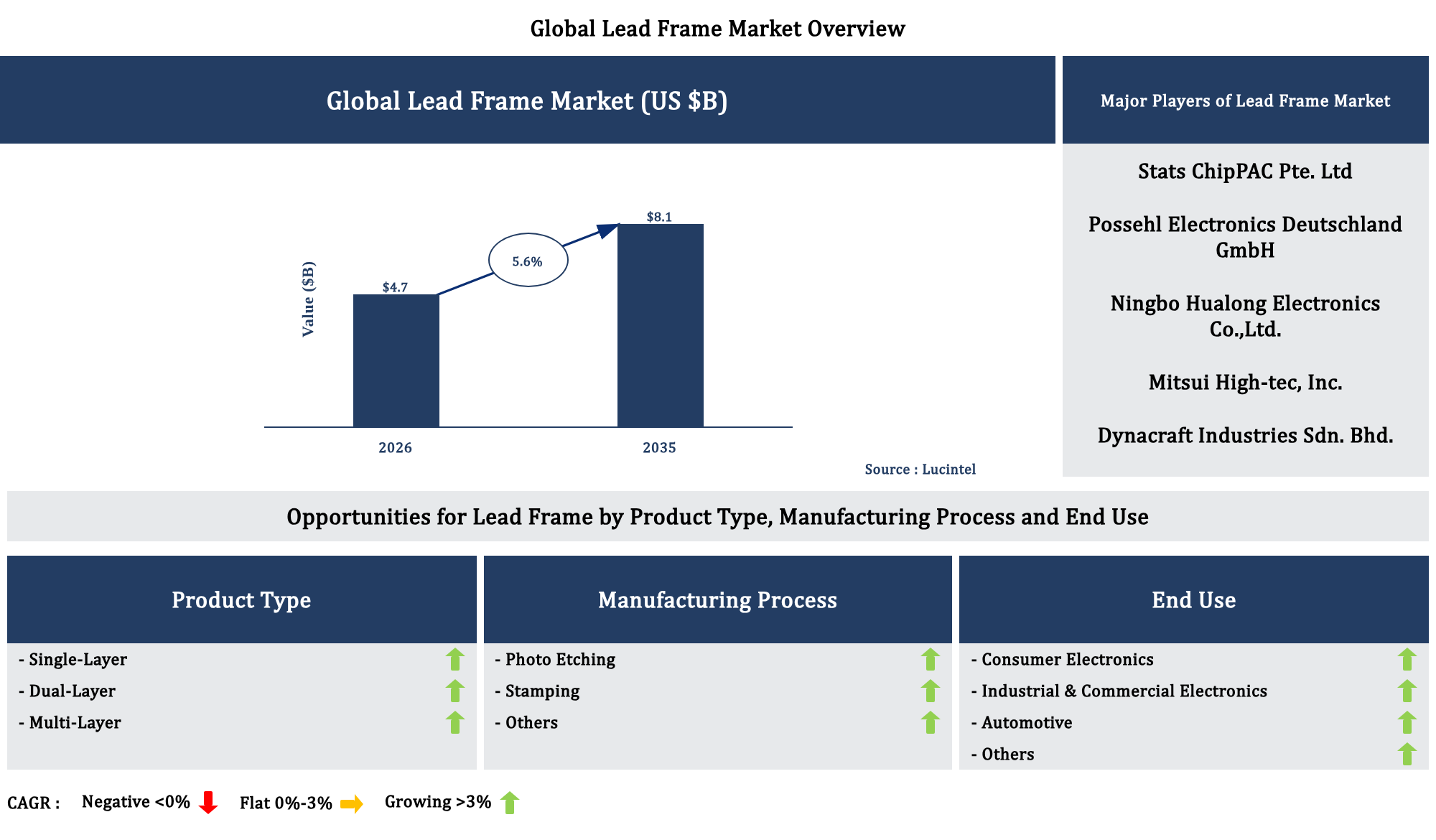
The future of the global lead frame market looks promising with opportunities in the consumer electronic, industrial & commercial electronic, and automotive markets. The global lead frame market is expected to reach an estimated $8,136 million by 2035 with a CAGR of 5.6% from 2026 to 2035. The major drivers for this market are the increasing demand for smartphones & consumer electronics, the growing demand for energy-efficient electronic components, and the rising demand for investment in semiconductor manufacturing facilities.
• Lucintel forecasts that, within the product type category, multi-layer is expected to witness the highest growth over the forecast period.
• Within the end use category, automotive is expected to witness the highest growth.
• In terms of region, APAC is expected to witness the highest growth over the forecast period.
Gain valuable insights for your business decisions with our comprehensive 150+ page report. Sample figures with some insights are shown below.
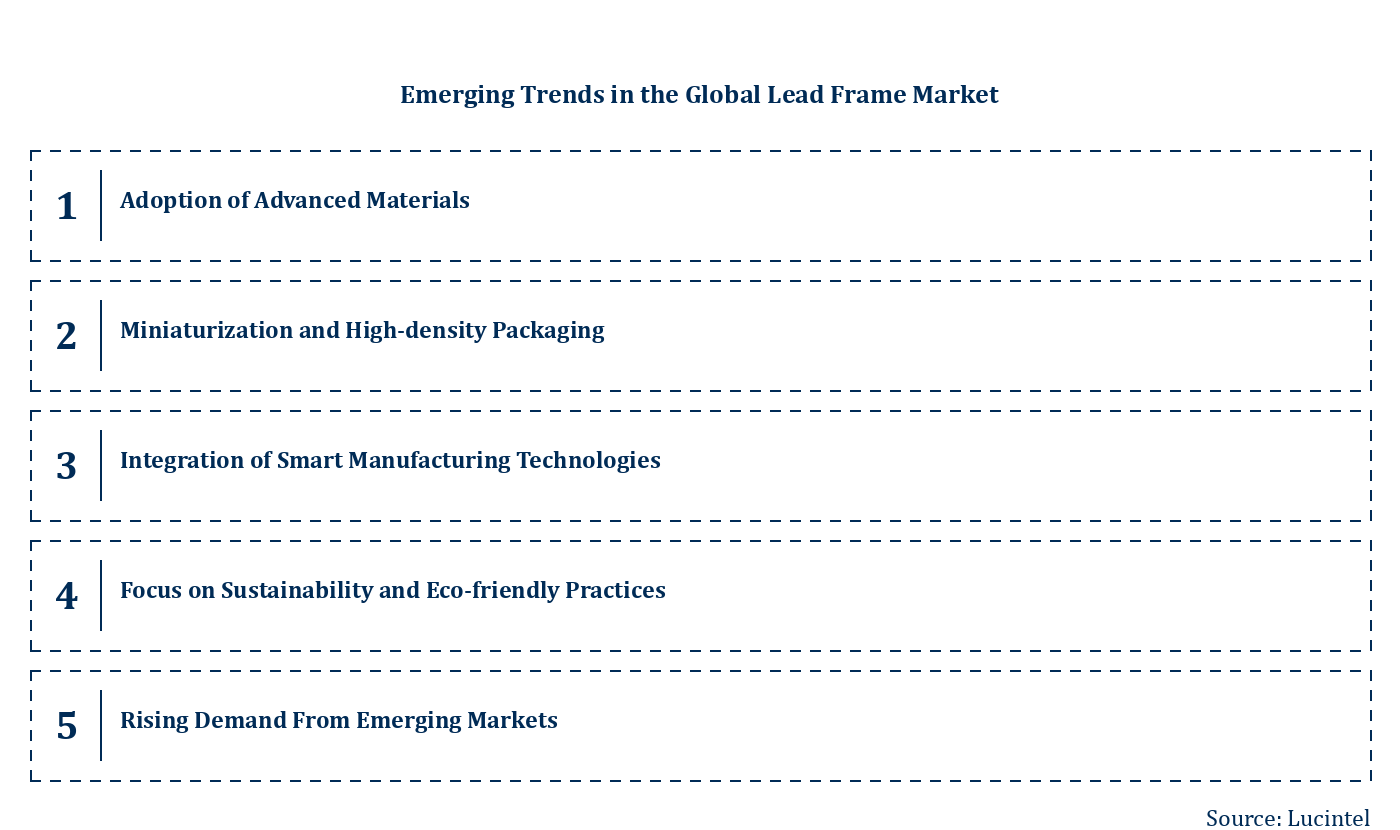
Emerging Trends in the Lead Frame Market
The lead frame market is experiencing significant transformation driven by technological advancements, evolving manufacturing processes, and increasing demand for electronic devices. As the electronics industry continues to grow, the need for more efficient, reliable, and cost-effective lead frames becomes critical. Innovations in materials, miniaturization, and sustainable practices are shaping the future landscape of this market. Companies are investing in research and development to meet the rising quality standards and environmental regulations. These emerging trends are not only enhancing product performance but also redefining competitive dynamics, creating new opportunities and challenges for industry players.
• Adoption of Advanced Materials: The market is shifting towards the use of high-performance materials such as copper alloys, aluminum, and composite materials. These materials offer better electrical conductivity, thermal management, and mechanical strength, which are essential for modern electronic devices. The adoption of advanced materials improves product reliability and enables miniaturization, meeting the demands of compact and high-speed electronics. This trend also supports sustainability efforts by reducing material costs and environmental impact, ultimately enhancing the overall efficiency and lifespan of lead frames.
• Miniaturization and High-Density Packaging: As electronic devices become smaller and more powerful, lead frames are evolving to support high-density packaging solutions. This involves designing ultra-fine pitch lead frames that accommodate smaller chips and increased I/O counts. The miniaturization trend enhances device performance, reduces overall size, and improves energy efficiency. It also enables manufacturers to develop innovative products such as wearable devices, IoT gadgets, and compact smartphones. However, it requires advanced manufacturing techniques and precise quality control, driving innovation and investment in new production technologies.
• Integration of Smart Manufacturing Technologies: Industry 4.0 principles are increasingly being integrated into lead frame manufacturing. Automation, robotics, and real-time data analytics are used to optimize production processes, reduce defects, and improve quality control. Smart manufacturing enhances operational efficiency, reduces lead times, and lowers costs. It also allows for greater customization and flexibility in product design, meeting specific client requirements. This trend is transforming traditional manufacturing setups into highly agile and responsive systems, providing a competitive edge in a rapidly evolving market.
• Focus on Sustainability and Eco-Friendly Practices: Environmental concerns are prompting the lead frame industry to adopt sustainable practices. This includes using recyclable materials, reducing hazardous substances, and implementing energy-efficient manufacturing processes. Companies are also exploring biodegradable coatings and environmentally friendly packaging solutions. These initiatives help comply with stringent regulations and appeal to environmentally conscious consumers. Emphasizing sustainability not only reduces the environmental footprint but also enhances brand reputation and market competitiveness, aligning industry growth with global ecological goals.
• Rising Demand from Emerging Markets: Rapid industrialization and technological adoption in emerging economies are fueling demand for lead frames. Countries in Asia-Pacific, Latin America, and Africa are experiencing increased production of electronic devices, driving market expansion. This trend offers new growth opportunities for manufacturers willing to invest in local production facilities and supply chain infrastructure. It also encourages innovation tailored to regional needs, such as cost-effective solutions for mass-market products. The rising demand from these markets is expected to significantly boost global market size and diversify the competitive landscape.
These trends are collectively reshaping the lead frame market by fostering innovation, enhancing product quality, and promoting sustainable practices. They are enabling manufacturers to meet the evolving needs of the electronics industry, ensuring continued growth and competitiveness in a dynamic global environment.
Recent Development in the Lead Frame Market
The lead frame market is experiencing rapid innovation driven by technological advancements and increasing demand across various industries. As electronic devices become more compact and efficient, the need for high-quality, reliable lead frames grows. Market players are focusing on developing new materials, manufacturing processes, and customization options to meet diverse application requirements. These developments are shaping the future landscape of the industry, offering significant growth opportunities and competitive advantages for companies involved in lead frame production and supply.
• Technological Advancements in Lead Frame Materials: The adoption of new materials like copper alloys and advanced plating techniques enhances durability, thermal management, and electrical performance, leading to improved product reliability. These innovations enable manufacturers to meet the rising demands of high-performance electronics, including smartphones, automotive, and industrial applications. As a result, the market benefits from increased product lifespan and reduced failure rates, fostering customer trust and expanding market share for innovative lead frame solutions.
• Automation and Smart Manufacturing Processes: The integration of automation, robotics, and IoT in lead frame manufacturing has increased production efficiency, reduced costs, and improved precision. These technologies enable real-time monitoring and quality control, minimizing defects and waste. Consequently, companies can scale production rapidly while maintaining high standards, meeting the growing global demand. This shift towards smart manufacturing is transforming the industry, making it more competitive and responsive to market needs.
• Customization and Miniaturization Trends: The demand for customized, miniaturized lead frames is rising due to the proliferation of compact electronic devices. Manufacturers are developing tailored solutions that fit specific device architectures, improving performance and space utilization. This trend allows for better integration of components, reducing overall device size and weight. As a result, the market experiences increased opportunities in consumer electronics, wearables, and IoT devices, driving innovation and customer satisfaction.
• Sustainability and Eco-Friendly Initiatives: The industry is focusing on environmentally sustainable practices, such as using recyclable materials and reducing hazardous substances in lead frames. These initiatives align with global regulations and consumer preferences for greener products. Companies adopting eco-friendly processes can access new markets and enhance brand reputation. Sustainability efforts are also driving innovation in material science, leading to safer, more sustainable lead frame options that support long-term industry growth.
• Expansion into Emerging Markets: Growing electronics manufacturing in regions like Asia-Pacific and Latin America presents significant opportunities for market expansion. Local manufacturers are investing in advanced production facilities and technology transfer to meet regional demand. This expansion enhances supply chain resilience and reduces costs for global companies. As emerging markets develop their electronics sectors, the lead frame industry benefits from increased sales, diversified customer bases, and new growth avenues.
These recent developments are significantly transforming the lead frame market by enhancing product quality, manufacturing efficiency, and sustainability. The focus on innovation, customization, and emerging market expansion is driving growth and competitiveness. As companies adopt advanced materials, automation, and eco-friendly practices, the industry is poised for sustained expansion, meeting the evolving needs of high-tech electronics and global markets. These trends collectively foster a more resilient, efficient, and sustainable lead frame industry.
Strategic Growth Opportunities in the Lead Frame Market
The lead frame market is experiencing significant growth driven by advancements in electronics manufacturing, miniaturization of devices, and increasing demand for reliable interconnect solutions. As industries such as automotive, consumer electronics, and telecommunications expand, the need for high-performance, cost-effective lead frames becomes critical. Innovations in materials and manufacturing processes are opening new avenues for market expansion. Companies that capitalize on these opportunities can strengthen their market position and meet evolving customer requirements efficiently.
• Growing Demand for Miniaturized Electronic Devices: The increasing adoption of compact gadgets and wearable technology necessitates smaller, more efficient lead frames. This trend drives innovation in materials and design, enabling manufacturers to produce thinner, lighter, and more durable components. As consumer preferences shift toward portability and sleek designs, the market for miniaturized lead frames is expected to expand rapidly, supporting the overall growth of electronic device manufacturing.
• Adoption of Advanced Materials for Enhanced Performance: The shift toward high-performance applications requires lead frames made from materials with superior electrical conductivity, thermal stability, and mechanical strength. Innovations such as copper alloys, aluminum, and composite materials are gaining popularity. These materials improve device reliability and efficiency, especially in high-frequency and high-power applications, creating new opportunities for manufacturers to develop specialized lead frames tailored to demanding industry needs.
• Increasing Integration of Lead Frames in Automotive Electronics: The automotive industry’s move toward electric vehicles and advanced driver-assistance systems (ADAS) demands robust, reliable interconnect solutions. Lead frames are essential for managing complex electronic systems within vehicles. The need for high-temperature resistance, vibration durability, and miniaturization in automotive electronics is fueling the development of specialized lead frames, opening substantial growth prospects in this sector.
• Expansion of the Telecommunications Infrastructure: The rollout of 5G networks and the proliferation of IoT devices require sophisticated electronic components, including lead frames, to ensure high-speed data transmission and device connectivity. The demand for high-frequency, high-density lead frames is increasing to support these advanced telecommunications applications. This expansion offers significant growth opportunities for manufacturers capable of delivering innovative, scalable solutions aligned with evolving network standards.
• Rising Focus on Sustainable and Eco-Friendly Manufacturing Practices: Environmental regulations and consumer awareness are prompting companies to adopt greener production methods. The development of lead frames using recyclable materials and energy-efficient processes is gaining importance. This shift not only reduces environmental impact but also appeals to eco-conscious customers, creating a competitive advantage. Embracing sustainability in manufacturing processes is expected to drive innovation and growth within the lead frame market.
The overall market outlook is positively influenced by these growth opportunities, encouraging innovation and investment. Companies that strategically leverage these trends can enhance their market share, meet increasing industry demands, and contribute to sustainable development. As technological advancements continue, the lead frame market is poised for sustained expansion across multiple sectors.
Lead Frame Market Driver and Challenges
The lead frame market is influenced by a variety of technological, economic, and regulatory factors that shape its growth and development. Technological advancements drive innovation in manufacturing processes and product capabilities, while economic conditions impact demand and investment levels. Regulatory frameworks influence compliance requirements and market entry barriers, affecting overall market dynamics. Additionally, global supply chain disruptions and environmental considerations pose significant challenges. Understanding these drivers and challenges is essential for stakeholders to navigate the evolving landscape, capitalize on opportunities, and mitigate risks effectively. The interplay of these factors determines the market’s trajectory and sustainability in a competitive environment.
The factors responsible for driving the lead frame market include:-
• Technological Innovation: The continuous development of advanced manufacturing techniques, such as precision stamping and microfabrication, enhances lead frame quality and performance. These innovations enable the production of smaller, more efficient electronic components, meeting the demands of miniaturization in consumer electronics, automotive, and industrial applications. As technology evolves, manufacturers can offer higher precision, better thermal management, and improved electrical performance, fueling market growth. Moreover, integration of automation and Industry 4.0 practices increases production efficiency, reduces costs, and accelerates time-to-market, further boosting demand for sophisticated lead frames.
• Growing Electronics Industry: The rapid expansion of the electronics sector, driven by increasing adoption of smartphones, tablets, wearables, and IoT devices, significantly propels the lead frame market. As electronic devices become more compact and feature-rich, the need for high-quality, reliable lead frames intensifies. The automotive industry’s shift towards electric vehicles and advanced driver-assistance systems (ADAS) also contributes to increased demand. Additionally, the proliferation of industrial automation and consumer electronics creates a robust market for lead frames, supporting overall industry growth.
• Rising Demand for Miniaturization: The trend toward smaller, lighter, and more efficient electronic devices is a key driver. Miniaturization requires lead frames that can support high-density packaging and fine-pitch components, which in turn demands advanced manufacturing capabilities. This trend is particularly prominent in smartphones, medical devices, and aerospace applications. As consumers and industries prioritize portability and performance, manufacturers are compelled to innovate, leading to increased investment in lead frame technology and expanding market opportunities.
• Environmental and Sustainability Regulations: Stricter environmental standards and regulations regarding the use of hazardous substances, waste management, and energy consumption influence the lead frame industry. Companies are adopting eco-friendly materials and sustainable manufacturing practices to comply with regulations such as RoHS and REACH. These initiatives not only reduce environmental impact but also enhance brand reputation and market competitiveness. The shift towards greener production processes encourages innovation in material science and process optimization, indirectly driving market growth while addressing regulatory compliance.
The challenges facing the lead frame market include:-
• Supply Chain Disruptions: The global supply chain has faced significant disruptions due to geopolitical tensions, pandemics, and logistical challenges. These disruptions lead to shortages of raw materials, increased transportation costs, and delays in production schedules. For the lead frame market, such issues can result in increased costs, reduced product availability, and compromised delivery timelines, affecting customer satisfaction and profitability. Overcoming these challenges requires diversification of supply sources, strategic inventory management, and investment in local manufacturing capabilities.
• Fluctuating Raw Material Prices: The market heavily depends on raw materials like copper, gold, and other precious metals, whose prices are highly volatile. Price fluctuations impact manufacturing costs and profit margins, forcing companies to adjust pricing strategies and manage inventory carefully. Sudden increases in raw material costs can lead to reduced competitiveness and profit erosion, while price drops may affect supplier relationships. Managing this volatility is crucial for maintaining market stability and ensuring sustainable growth.
• Regulatory and Environmental Compliance: Increasing regulatory requirements demand continuous adaptation of manufacturing processes and materials. Compliance with evolving standards such as RoHS, REACH, and other environmental directives involves significant investment in R&D, testing, and certification. Non-compliance can result in legal penalties, product recalls, and damage to brand reputation. Navigating complex regulatory landscapes requires proactive strategies, which can increase operational costs and pose barriers for new entrants, impacting overall market dynamics.
The lead frame market is shaped by rapid technological advancements, expanding electronics demand, and sustainability initiatives, which collectively foster growth. However, challenges such as supply chain disruptions, raw material price volatility, and stringent regulatory compliance pose risks that could hinder progress. The interplay of these drivers and challenges determines the market’s future trajectory, requiring stakeholders to innovate, adapt, and strategize effectively. Overall, the market’s resilience and capacity for innovation will be critical in overcoming obstacles and capitalizing on emerging opportunities.
List of Lead Frame Companies
Companies in the market compete on the basis of product quality offered. Major players in this market focus on expanding their manufacturing facilities, R&D investments, infrastructural development, and leverage integration opportunities across the value chain. With these strategies lead frame companies cater increasing demand, ensure competitive effectiveness, develop innovative products & technologies, reduce production costs, and expand their customer base. Some of the lead frame companies profiled in this report include-
• Stats ChipPAC Pte. Ltd
• Possehl Electronics Deutschland GmbH
• Ningbo Hualong Electronics Co.,Ltd.
• Mitsui High-tec, Inc.
• Dynacraft Industries Sdn. Bhd.
• Ningbo Kangqiang Electronics Co., Ltd.
• Enomoto Co.,Ltd.
Lead Frame Market by Segment
The study includes a forecast for the global lead frame market by product type, manufacturing process, end use, and region.
Lead Frame Market by Product Type [Value from 2019 to 2035]:
• Single-Layer
• Dual-Layer
• Multi-Layer
Lead Frame Market by Manufacturing Process [Value from 2019 to 2035]:
• Photo Etching
• Stamping
• Others
Lead Frame Market by End Use [Value from 2019 to 2035]:
• Consumer Electronics
• Industrial & Commercial Electronics
• Automotive
• Others
Lead Frame Market by Region [Value from 2019 to 2035]:
• North America
• Europe
• Asia Pacific
• The Rest of the World
Country Wise Outlook for the Lead Frame Market
The lead frame market has experienced significant shifts driven by technological advancements, increasing demand for electronic devices, and evolving manufacturing processes worldwide. As industries such as consumer electronics, automotive, and telecommunications expand, countries are adopting innovative strategies to enhance production efficiency and product quality. The competitive landscape is also influenced by geopolitical factors, trade policies, and sustainability initiatives. These developments reflect the dynamic nature of the market, with each country contributing uniquely based on its technological capabilities, manufacturing infrastructure, and market demand. Here is a country-wise overview of recent developments in the lead frame market.
• United States: The US market has seen increased investment in advanced manufacturing technologies such as automation and AI-driven quality control, improving lead frame precision and efficiency. Major players are focusing on sustainable practices, reducing environmental impact through eco-friendly materials and processes. The growth of the semiconductor industry and rising demand for high-performance electronic devices have further propelled market expansion. Additionally, collaborations between tech firms and manufacturers are fostering innovation in lead frame design and application.
• China: China continues to dominate the market with rapid production capacity expansion and technological upgrades. The country is investing heavily in research and development to produce high-quality lead frames suitable for 5G, IoT, and electric vehicles. Government policies favoring domestic manufacturing and export growth are boosting industry competitiveness. Chinese companies are also adopting environmentally sustainable practices, aligning with global standards, and expanding their global footprint through strategic partnerships.
• Germany: Germany‘s market is characterized by a focus on high-precision, high-reliability lead frames for automotive and industrial applications. The country emphasizes innovation through R&D investments and the integration of Industry 4.0 technologies. German manufacturers are adopting sustainable materials and processes to meet stringent environmental regulations. The presence of leading automotive and electronics firms drives demand for advanced lead frame solutions, fostering technological advancements and quality improvements.
• India: India is witnessing rapid growth driven by expanding electronics manufacturing and government initiatives like Make in India. The market is characterized by increasing adoption of automation and modern manufacturing techniques to improve product quality and reduce costs. Local companies are investing in R&D to develop lead frames tailored for emerging applications such as renewable energy and telecommunications. The focus on sustainable manufacturing practices is also gaining momentum, aligning with global environmental standards.
• Japan: Japan maintains a strong position in the lead frame market through its emphasis on innovation, quality, and reliability. The country is investing in advanced materials and manufacturing processes to support high-end applications in consumer electronics, automotive, and industrial sectors. Japanese firms are also exploring eco-friendly materials and energy-efficient production methods. The integration of IoT and smart manufacturing technologies is enhancing product capabilities and operational efficiency, ensuring Japan‘s continued leadership in the global market.

Features of the Global Lead Frame Market
Market Size Estimates: Lead frame market size estimation in terms of value ($M).
Trend and Forecast Analysis: Market trends (2019 to 2025) and forecast (2026 to 2035) by various segments and regions.
Segmentation Analysis: Lead frame market size by product type, manufacturing process, end use, and region in terms of value ($M).
Regional Analysis: Lead frame market breakdown by North America, Europe, Asia Pacific, and Rest of the World.
Growth Opportunities: Analysis of growth opportunities in different product type, manufacturing process, end use, and regions for the lead frame market.
Strategic Analysis: This includes M&A, new product development, and competitive landscape of the lead frame market.
Analysis of competitive intensity of the industry based on Porter’s Five Forces model.
FAQ
Q1. What is the lead frame market size?
Answer: The global lead frame market is expected to reach an estimated $8,136 million by 2035.
Q2. What is the growth forecast for lead frame market?
Answer: The global lead frame market is expected to grow with a CAGR of 5.6% from 2026 to 2035.
Q3. What are the major drivers influencing the growth of the lead frame market?
Answer: The major drivers for this market are the increasing demand for smartphones & consumer electronics, the growing demand for energy-efficient electronic components, and the rising demand for investment in semiconductor manufacturing facilities.
Q4. What are the major segments for lead frame market?
Answer: The future of the lead frame market looks promising with opportunities in the consumer electronic, industrial & commercial electronic, and automotive markets.
Q5. Who are the key lead frame market companies?
Answer: Some of the key lead frame companies are as follows:
• Stats ChipPAC Pte. Ltd
• Possehl Electronics Deutschland GmbH
• Ningbo Hualong Electronics Co.,Ltd.
• Mitsui High-tec, Inc.
• Dynacraft Industries Sdn. Bhd.
• Ningbo Kangqiang Electronics Co., Ltd.
• Enomoto Co.,Ltd.
Q6. Which lead frame market segment will be the largest in future?
Answer: Lucintel forecasts that, within the product type category, multi-layer is expected to witness the highest growth over the forecast period.
Q7. In lead frame market, which region is expected to be the largest in next 8 years?
Answer: In terms of region, APAC is expected to witness the highest growth over the forecast period.
Q8. Do we receive customization in this report?
Answer: Yes, Lucintel provides 10% customization without any additional cost.
This report answers following 11 key questions:
Q.1. What are some of the most promising, high-growth opportunities for the lead frame market by product type (single-layer, dual-layer, and multi-layer), manufacturing process (photo etching, stamping, and others), end use (consumer electronics, industrial & commercial electronics, automotive, and others), and region (North America, Europe, Asia Pacific, and the Rest of the World)?
Q.2. Which segments will grow at a faster pace and why?
Q.3. Which region will grow at a faster pace and why?
Q.4. What are the key factors affecting market dynamics? What are the key challenges and business risks in this market?
Q.5. What are the business risks and competitive threats in this market?
Q.6. What are the emerging trends in this market and the reasons behind them?
Q.7. What are some of the changing demands of customers in the market?
Q.8. What are the new developments in the market? Which companies are leading these developments?
Q.9. Who are the major players in this market? What strategic initiatives are key players pursuing for business growth?
Q.10. What are some of the competing products in this market and how big of a threat do they pose for loss of market share by material or product substitution?
Q.11. What M&A activity has occurred in the last 5 years and what has its impact been on the industry?
For any questions related to Lead Frame Market, Lead Frame Market Size, Lead Frame Market Growth, Lead Frame Market Analysis, Lead Frame Market Report, Lead Frame Market Share, Lead Frame Market Trends, Lead Frame Market Forecast, Lead Frame Companies, write Lucintel analyst at email: helpdesk@lucintel.com. We will be glad to get back to you soon.