
Market Report · July 22, 2026

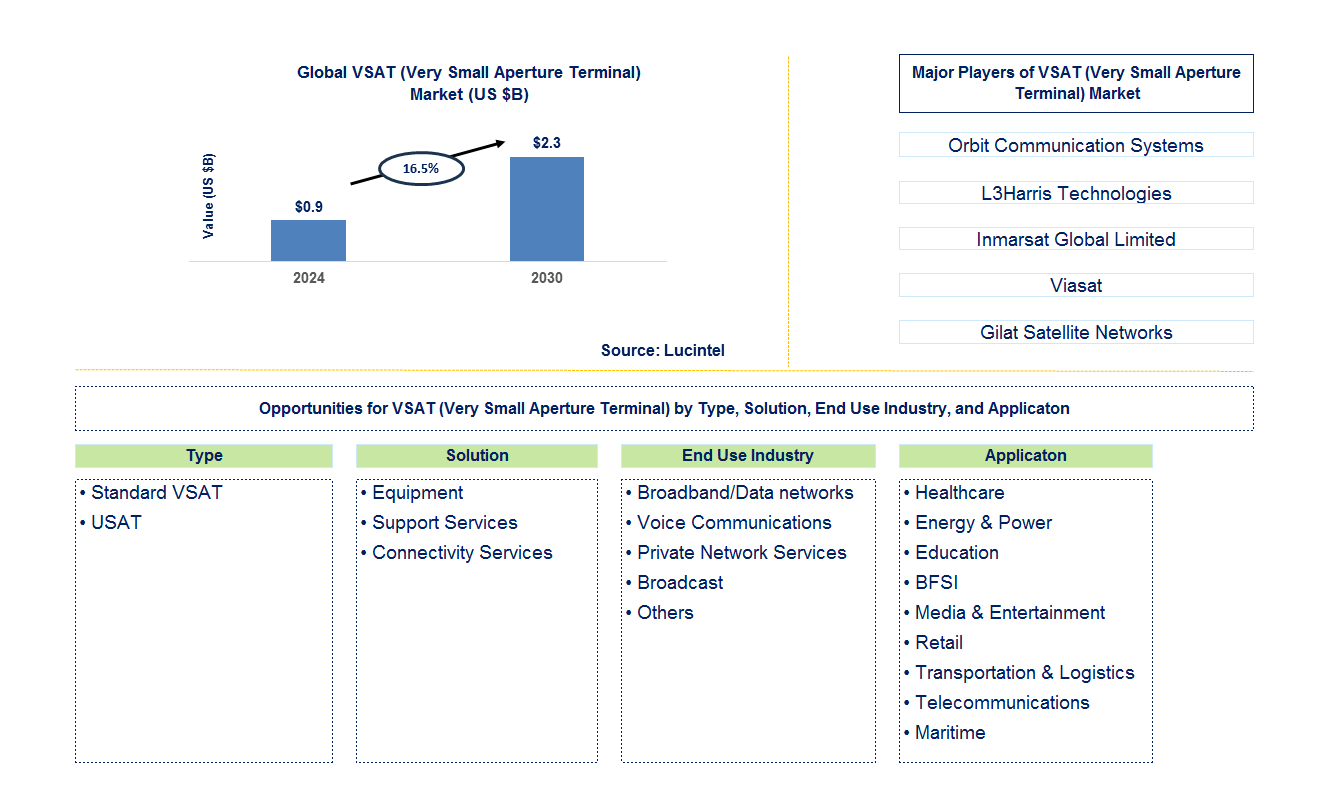
Key data points: The market size in 2030 = $2.3 billion, growth forecast = 16.5% annually next 6 years. Scroll below to get more insights. This market report covers trends, opportunities, and forecast in the global vsat (very small aperture terminal) market to 2030 by type (standard VSAT and USAT), solution (equipment, support services, and connectivity services), end use industry (broadband/data networks, voice communications, private network services, broadcast, and others), application (healthcare, energy & power, education, BFSI, media & entertainment, retail, transportation & logistics, telecommunications, and maritime), and region (North America, Europe, Asia Pacific, and the Rest of the World)
We'll send your sample report shortly.
• United States: In the U.S., growth in the VSAT market is vigorous and the increased demand for broadband services and satellite communications technologies drive it. Investors invest in high-throughput satellites (HTS) for improved satellite communication for broadband services. The advancement of 5G technology is necessitating the use of VSATs in communications to provide a single network even in remote regions where ground backbone cables are limited. The growth of IoT applications for example in agriculture and logistics is also enhancing the market of reliable satellite communication systems.
• China: The VSAT market is gaining momentum in China, as more resources in satellite architecture and satellite technology are being allocated. The insufficiency of communication services in rural areas drives the adoption of VSAT systems. Other results are the operation of low orbit satellites, which are intended to cut down latency and enhance connectivity. In addition, Chinese entities are also looking to create affordable VSAT solutions for the sea, the agriculture industry and several more, which will ensure quality services in many regions.
• Germany: Despite these changes, it is still possible to confirm that Germany leads the hierarchy of countries in Europe in terms of VSAT deployment. The overall market for VSAT is expanding in the countries such as Germany and France due to the oil and gas projects. In terms of development, it has been reported that there is collaboration between telecom and satellite companies to improve service delivery. There is also the introduction of more security enhanced VSAT systems, and there are attempts to improve data protection despite the previous relaxation of these data protection regulations for the sake of business communication.
• India: In India, VSAT is poised to grow multipolar ties thanks to the surge in the accessibility demand from rural and remote regions. In this respect, the governments driven strategies that improve the digital infrastructure and reduce the digital aspect of exclusion are fostering VSAT use in various sectors including education and health. Domestic players are producing low-cost VSAT systems which target SME sector. Recent developments also include forming partnerships with foreign satellite com managers seeking to enhance the service reliability and cover more area of the country.
• Japan: Japan is currently progressing in the VSAT market with a focus on the convergence of the satellite communication and the other systems that the country has. The purpose of the VSAT solutions in the country is to assist the people in rural areas as well as help to meet their needs during emergencies such as disasters. New developments include collaborations of telecommunication operators with satellite operators to provide more advanced VSAT application in transportation, maritime and aviation industry. Moreover, the coming of LEO satellites is expected to lessen the latency and increase the bandwidth for the Japanese users which will even facilitate more acceptance of the VSAT technology.
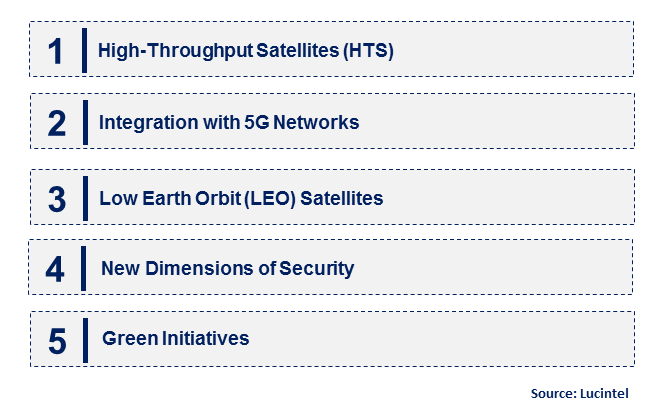
• High-Throughput Satellites (HTS): The deployment of high-throughput satellites is a key trend driving the VSAT market. HTS technology enables expanding the bandwidth and enhancing the data speed of the connections making it possible for service providers to serve even more consumers. This upgrade is quite relevant in the areas that need high data rates, such as broadcasting, telemedicine, and remote working solutions.
• Integration with 5G Networks: The marriage of the VSAT solutions and the 5G networks keeps advancing. Such integration supports a smooth handover from satellite to terrestrial networks eases service provision and availability in areas that are remote. The era of 5G broadband services, together with the Internet of Things, will emerge, all propelled by VSAT and 5G technology.
• Low Earth Orbit (LEO) Satellites: The emergence of low Earth orbit (LEO) satellites has brought fundamental changes in the VSAT market. Compared to geostationary satellites, LEO satellites offer improved real-time interaction and significantly reduce latency. Such tendencies are understandable and may come in very handy when one needs to take immediate action such as online games or video conferencing, or even emergency services.
• New Dimensions of Security: The growing importance of cyber protection has seen an increasing popularity of new security features in VSAT solution. Provider’s companies are purchasing more state-of-the-art systems for encryption and safe transmission of data. This phenomenon is important for those sectors of the economy that cope with severe data security aspects, including but not limited to, finance, health cares and government services.
• Green Initiatives: The focus on sustainability has increased in the VSAT market, resulting in manufacturers looking for better solutions. Energy saving satellite systems are being created and the components made from constructs that can be recycled. Such tendencies are in tandem with the needs and aspirations of the world today to cut down carbon footprint and shift the telecommunications industry towards greener practices. There are several moves that have taken place in the current marketplace in regard to the above mentioned secondary research suggesting the increasing penetration of the VSAT market in terms of enhanced connectivity, performance and user requirements. The dynamics of the industry will be fully established when these changes are implemented.
• Implementation of High-Throughput Satellites: By introducing high-throughput satellites (HTS), the VSAT industry has moved into new levels of evolution offering greater bandwidth and better transmission rate of information. That advances the ability of service providers to reach out to a larger clientele’s particularly in the broadband internet and media broadcasting services. The decrease of cost per megabit as a result of HTS technology has been helpful in improving access to satellite communication for both businesses and consumers.
• Growth of obit Satellite constellations: The new players on the railroad, the LEO constellations like Star link and One Web are set to change the rules of the game in VSAT through elimination of latency and enabling wider global reach. Such able systems require little down time to transmit and are useful even in distant areas where the traditional satellite systems can be hard pressed to offer efficient communication. As more and more LEO satellites will be placed in orbit, better performance of various applications including broadband & IoT connections in remote areas will also be expected.
• Growth of Managed VSAT Services: The adoption of managed VSAT services is on the increase whereby service providers consolidate provision of all equipment, installation and other support services. This is preferable to the businesses needing satellite communication as they do not have to manage the VSAT systems as this is taken care of by specialists. Of particular interest to industries with little technical capabilities, they can engage in managed services where they do not have to worry of sound connectivity as they focus on their primary activities.
• Advancements in VSAT Antenna Technology: The introduction of advanced technologies in VSAT antennas such as phased array antennas and electronically steered antennas bears positive impact on performance. Such technologies make the exponentially increasing the amount of satellites that may be tracked, as well as the quality of the signals received. There are also smaller and more lightweight antennas which would require less installation efforts and more mobility and hence can be adapted for several purposes including marine and military activities.
• Increased Regulatory Support for Satellite Communications: All over the world, governments are appreciating the need for satellite communications and supporting the creation of legislation to enable them. This support has motivated investment in satellite infrastructure hence development of the VSAT market. Changes in regulations have made it easier to allocate the spectrum in a more cost-effective way thus enabling the services providers to improve their services in areas with less competition. All these recent endeavors are breaking new ground in the VSAT market with technological developments, better services and wider reach. As this industry goes on developing, these trends will improve general performance and attractiveness of all VSAT solutions.
• Maritime Communications: There is a growing trend in the maritime industry towards the application of VSAT technology for effective communication in the open sea. Increasing needs for maritime safety and real time information soliciting mean deployment of VSAT systems is beneficial to ship managers. The provision of internet access on board ships enables improved working conditions for the crew and efficient functions in business thereby creating huge potential growth in this particular application.
• Remote and Rural Connectivity: Fuse There is a lot that can be achieved in deploying VSAT solutions especially in the remote and rural environments that lack the conventional broadband frameworks. Governments and organizations are focused on the satellite connection with the aim of helping those who are uneducated and lack the basic resources thereby promoting development and learning and important healthcare. This initiative provides an enormous market for VSAT service providers to offer basic services to people with inadequate access.
• Aviation Connectivity: Implementing VSAT technology in-flight has become a growing trend in the aviation sector. Airlines are trying to improve their customers’ experiences by offering them uninterrupted Internet connection while on flight. With the air travel recovering steadily, it is projected that there will be increased demand for quality Internet coverage in flights which offers a good chance for the VSAT providers to step into partnerships with the airliners and service providers.
• Disaster Recovery and Emergency Services: Communication systems based on VSAT technology are of great importance when it comes to recovery from disasters and emergency services since other forms of communication may be lost during any catastrophe. As the governments and organizations stress on disaster management, accordingly the market opportunity for such portable and durable VSAT systems is increasing. This opens way for the providers of such services to create a way for delivering services that meet the need for emergency operations.
• IoT and Smart Agriculture: There appears to be an increasing interest in the need for effective connectivity as IoT technologies begin to penetrate into the agriculture sector. For instance, with VSAT systems in place, farmers can keep track of livestock or crops from remote locations thereby increasing productivity as well as farming efficiency. As more people adopt smart use of the technology in agriculture, there is likely to be an increase in demand for such agriculture oriented VSAT solutions which will be a good ground for the providers. It can be seen that these particular strategic growth opportunities represent the multitude of environments where the application of VSAT technology is possible. Concentrating on these initiatives these providers will be able to address new markets and increase the scope of their service provision, thus increasing the overall demand in the VSAT market.
• Orbit Communication Systems
• L3Harris Technologies
• Inmarsat Global Limited
• Viasat
• Gilat Satellite Networks
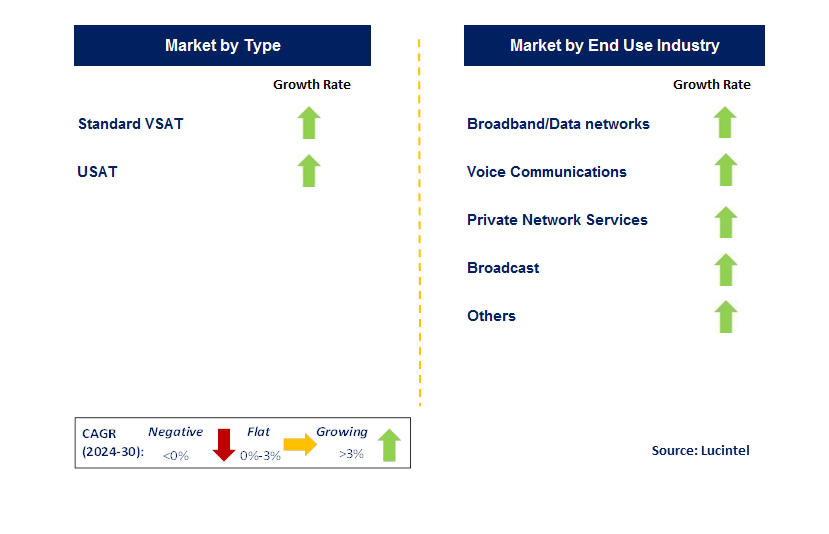
• Standard VSAT
• USAT
• Equipment
• Support Services
• Connectivity Services
• Broadband/Data networks
• Voice Communications
• Private Network Services
• Broadcast
• Others
• Healthcare
• Energy & Power
• Education
• BFSI
• Media & Entertainment
• Retail
• Transportation & Logistics
• Telecommunications
• Maritime
• North America
• Europe
• Asia Pacific
• The Rest of the World


• Orbit Communication Systems
• L3Harris Technologies
• Inmarsat Global Limited
• Viasat
• Gilat Satellite Networks Q6. Which VSAT (very small aperture terminal) market segment will be the largest in future? Answer: Lucintel forecasts that standard VSAT will remain the largest segment over the forecast period. Q7. In VSAT (very small aperture terminal) market, which region is expected to be the largest in next 6 years? Answer: APAC is expected to witness highest growth over the forecast period. Q.8 Do we receive customization in this report? Answer: Yes, Lucintel provides 10% customization without any additional cost.


Choose a license that fits your team. Instant PDF delivery.
Prices exclude taxes. Instant delivery. Custom licensing available on request.
Market Report · July 22, 2026
Market Report · July 17, 2026
Market Report · July 17, 2026
Trusted partner for strategic intelligence and business growth


Receive a complimentary market analysis tailored to your industry. Our analysts will identify key growth opportunities and competitive dynamics specific to your business.

Market size, growth rate, and key trend analysis for your specific sector.

Top competitor positioning and market share analysis.

Strategic recommendations backed by data-driven insights.
Get curated market intelligence and competitive moves straight to your inbox.
By subscribing, you agree to receive our monthly insights. Unsubscribe anytime.
Receive a complimentary market analysis tailored to your industry. Our analysts will identify key growth opportunities and competitive dynamics specific to your business.
Market size, growth rate, and key trend analysis for your specific sector.
Top competitor positioning and market share analysis.
Strategic recommendations backed by data-driven insights.
Get curated market intelligence, emerging trends, and competitive moves straight to your inbox each month.
By subscribing, you agree to receive our monthly insights. Unsubscribe anytime.
We'll send your sample report shortly.