
Market Report · July 22, 2026

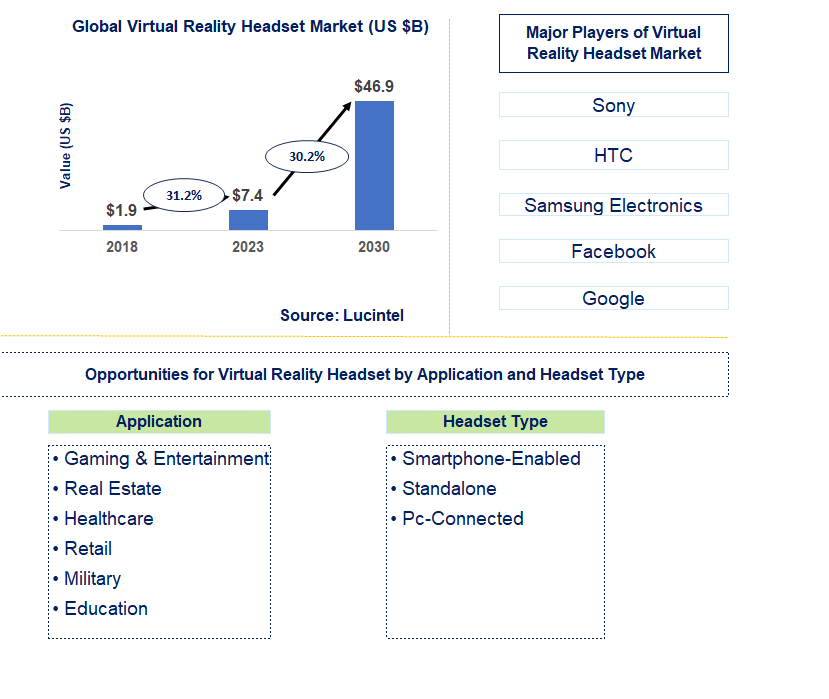
Key data points: The market size in 2023 = $7.4 billion, growth forecast = 30% annually next 7 years. Scroll below to get more insights. This market report covers trends, opportunities, and forecast in the global virtual reality headset market to 2030 by application (entertainment & media, real estate, healthcare , retail, military, and education), headset type (smartphone-enabled, standalone , and pc-connected), and region (North America, Europe, Asia Pacific, and the Rest of the World)
We'll send your sample report shortly.
• Lucintel forecasts that smartphone enabled virtual reality headset will remain the largest segment over the forecast period due to increasing demand for smartphones gaming.
• Within this market, entertainment & media will remain the larger segment due to growth of the gaming industry and increasing development of vr specific games by various gaming enterprises.
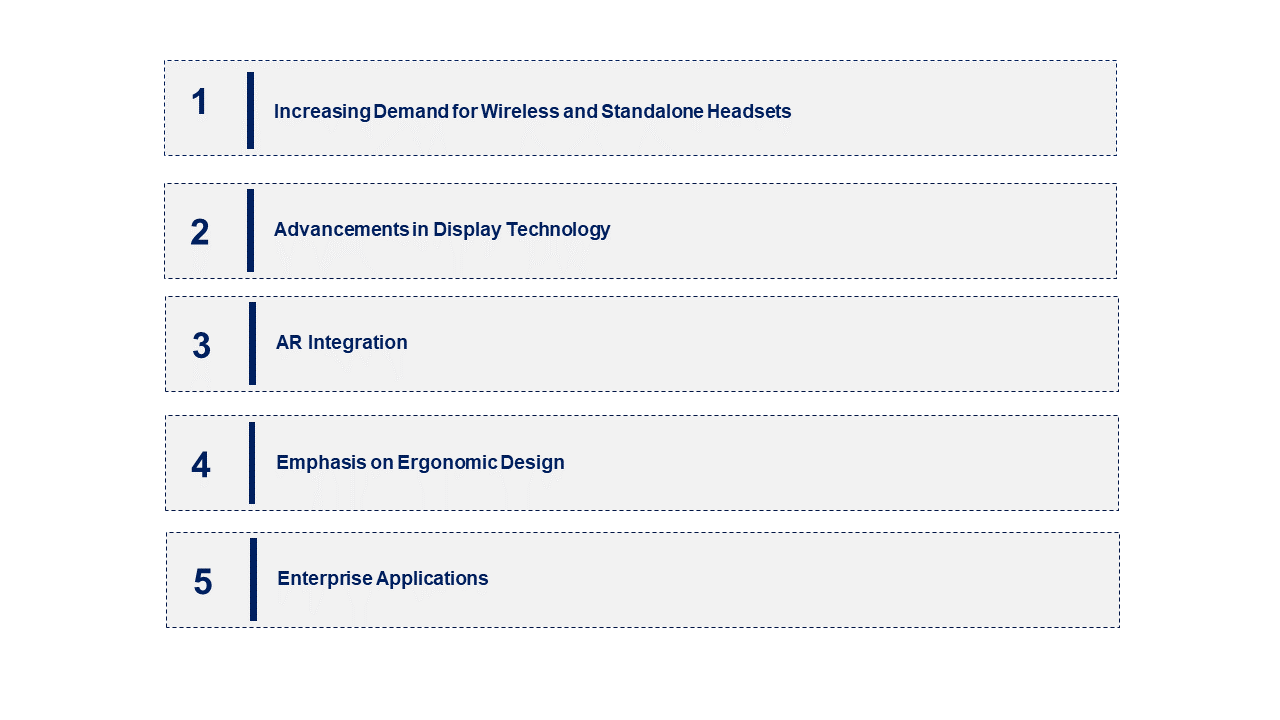
• Increasing Demand for Wireless and Standalone Headsets: More people are buying wireless and standalone VR headsets which offer mobility and convenience without any cables to external devices.
• Advancements in Display Technology: Improved visual fidelity, reduced motion sickness by adopting higher resolution displays, improved FOV, and faster refresh rates.
• AR Integration: Growing integration of augmented reality (AR) features into VR headsets, allowing for mixed reality experiences that blend virtual and real-world elements.
• Emphasis on Ergonomic Design: Comfort during long-term use is now a priority for manufacturers of these gears as this new era calls for more lightweight materials, adjustable head straps and better weight distribution.
• Enterprise Applications: Increased productivity and efficiency through the use of VR headsets in workplaces like corporate training, healthcare simulation, remote collaboration and industrial applications.
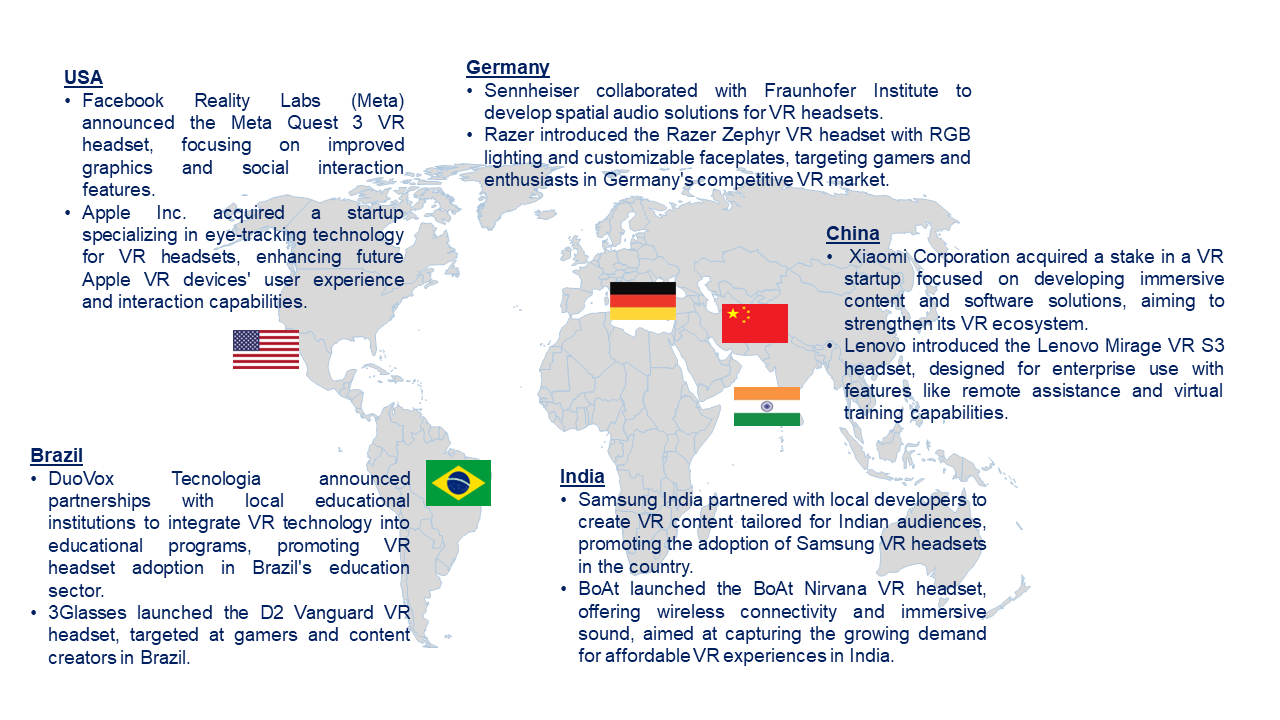
• Ongoing innovations and advancements in various sectors of the virtual reality headset market which have been highlighted by recent developments:
• Progress in Display Technology: Virtual reality (VR) device makers are combining increased display resolution with higher pixels per inch and refresh rates that increase the vividness of pictures and minimize motion sickness hence rendering them a seamless experience.
• Wireless or Standalone Headsets: A shift towards wireless or standalone VR headsets has been observed leading to no need for tethering them to external devices like PCs or gaming consoles. This is useful in that it enables users to move from one point to another while using VR, thus facilitating its adoption across different industries.
• Ergonomics and Comfort Take Centre Stage: The producer of these products gives priority to ergonomics as well as light weight materials which ensure comfort during extended use. These may include adjustable head bands, improvement in weight distribution and breathable fabrics that prevent fatigue and uneasiness.
• Inclusion of Augmented Reality (AR) Capabilities: There have been some VR headsets offering AR facilities allowing users overlay computer data or interact physically with their surroundings. Through this combination, these gadgets can now be used in gaming applications unlike before especially training, education, industrial among others.
• Software Development And Content Creations: Great emphasis is being put on developing high quality V.R content and applications across various sectors such as entertainment, education, healthcare or even corporate training. This also includes partnerships with developers of contents among other things meant to enrich the V.R ecosystem.
• VR Accessibility And Affordability: Besides price reductions for wider accessibility of VR technology, making it affordable is also being attempted. In addition there are several measures aimed at reducing the costs attached to the purchase of this equipment such as financing options and collaborations with telecoms operators for bundling data plans together with VR services.
• Market Expansion into New Industries: Consider other areas such as healthcare, education, real estate, vehicles and retail that could make use of virtual reality technology to train people or create simulations of experience.
• Technological Innovation: Allocate resources in research and development to create better VR headsets including things like haptic feedback systems, improved optics and AI based interfaces that improve the immersive experiences.
• Partnerships and Alliances: Partner with industry leaders software companies and content developers to launch remarkable VR apps and content ecosystem.
• Accessibility and Affordability: Concentrate on reducing costs, making VR more affordable, accessible through financing options, subscription models and working with telecoms companies.
• Global Market Penetration: Enter emerging markets where per capita incomes are increasing rapidly with a strong interest in immersive technologies by customizing products to local preferences as well as regulatory requirements.
• Technology Advancements: Innovation in display resolution, field of view (FOV), and motion tracking technologies continuously enhances immersive experiences and attracts tech-savvy consumers.
• Applications: Simulations, training programs, virtual tours and remote collaborations are some of the areas wherein gaming, entertainment, healthcare, education, real estate and automotive sectors are increasingly adopting.
• Growing Demand for AR Integration: Mixing up both real-world situations and virtual environments in VR headsets has seen an increase of augmented reality (AR).
• Customer Engagement: There is a high demand from consumer for interactive encounters which fuels sales more so among young age groups looking for cutting-edge educational tools besides entertainment.
• Business Investments: Improving operational efficiency as well as customer engagement is why firms invest in virtual reality (VR) for training purposes; product designs marketing promotions amongst other activities. Challenges in the VR Headset Market:
• High Costs: Affordability becomes a major issue when it comes to initial costs of purchasing VR headgear alongside its peripheral devices making mass adoption impossible to be realized.
• Content Quality: Provision of consistently high quality virtual reality content across various applications remains a challenge affecting user engagement on long term basis.
• Technological Barriers: Motion sickness issues including latency arising due to prolonged usage require technological improvements to enhance user experience ever increasing demands today
• Market Fragmentation : Multiple platforms presence along with compatibility problems existing between vr hardware & software could lead to confusions among people concerning what vr gadget should customers purchase thus hindering growth within this sector.
• Legal plus ethical worries: Addressing the privacy, data security and possible psychological effects of getting too much into immersive vr demands regulatory standards as well as industry guidelines. In conclusion, technological advancements and numerous applications across industries benefit the VR headsets market although it also faces problems of cost, content quality, technology barriers, market fragmentation and regulation. Opportunities for growth can be exploited by organizations in this space by addressing these issues strategically through concentrating on innovation, content development and partnerships designed to ensure increased adoption and integration of VR technology within everyday life and business operations. In conclusion, overcoming these challenges is crucial for unlocking the full potential that lies in VR headsets towards transforming digital experiences globally as the market matures.
• Sony
• HTC
• Samsung Electronics
• Google These companies have established themselves as leaders in the VR headset industry, with extensive product portfolios, global presence, and strong research and development capabilities. They continually strive to enhance their market positions through strategic partnerships, mergers and acquisitions, and product innovations. The market share dynamics within the VR headset market are evolving, with the entry of new players and the emergence of innovative VR headset technologies. Additionally, collaborations between material suppliers, manufacturers, and end-users are fostering technological advancements and expanding market opportunities.
• Entertainment & Media
• Real Estate
• Healthcare
• Retail
• Military
• Education
• Smartphone-Enabled
• Standalone
• Pc-Connected
Virtual Reality Headset Market by Region [Value from 2018 to 2030]:• North America
• Europe
• Asia Pacific
• Sony
• HTC
• Samsung Electronics
• Google Q6. Which virtual reality headset market segment will be the largest in future? Answer: Lucintel forecasts that smartphone enabled virtual reality headset will remain the largest segment over the forecast period due to increasing demand for smartphones gaming. Q7. In virtual reality headset market, which region is expected to be the largest in next 5 years? Answer: North America will remain the largest region over the forecast period due to rising demand for vr games, growing investment by leading technology companies. Q8. Do we receive customization in this report? Answer: Yes, Lucintel provides 10% customization without any additional cost.


Choose a license that fits your team. Instant PDF delivery.
Prices exclude taxes. Instant delivery. Custom licensing available on request.
Market Report · July 22, 2026
Market Report · July 17, 2026
Market Report · July 17, 2026
Trusted partner for strategic intelligence and business growth


Receive a complimentary market analysis tailored to your industry. Our analysts will identify key growth opportunities and competitive dynamics specific to your business.

Market size, growth rate, and key trend analysis for your specific sector.

Top competitor positioning and market share analysis.

Strategic recommendations backed by data-driven insights.
Get curated market intelligence and competitive moves straight to your inbox.
By subscribing, you agree to receive our monthly insights. Unsubscribe anytime.
Receive a complimentary market analysis tailored to your industry. Our analysts will identify key growth opportunities and competitive dynamics specific to your business.
Market size, growth rate, and key trend analysis for your specific sector.
Top competitor positioning and market share analysis.
Strategic recommendations backed by data-driven insights.
Get curated market intelligence, emerging trends, and competitive moves straight to your inbox each month.
By subscribing, you agree to receive our monthly insights. Unsubscribe anytime.
We'll send your sample report shortly.