
Market Report · July 15, 2026

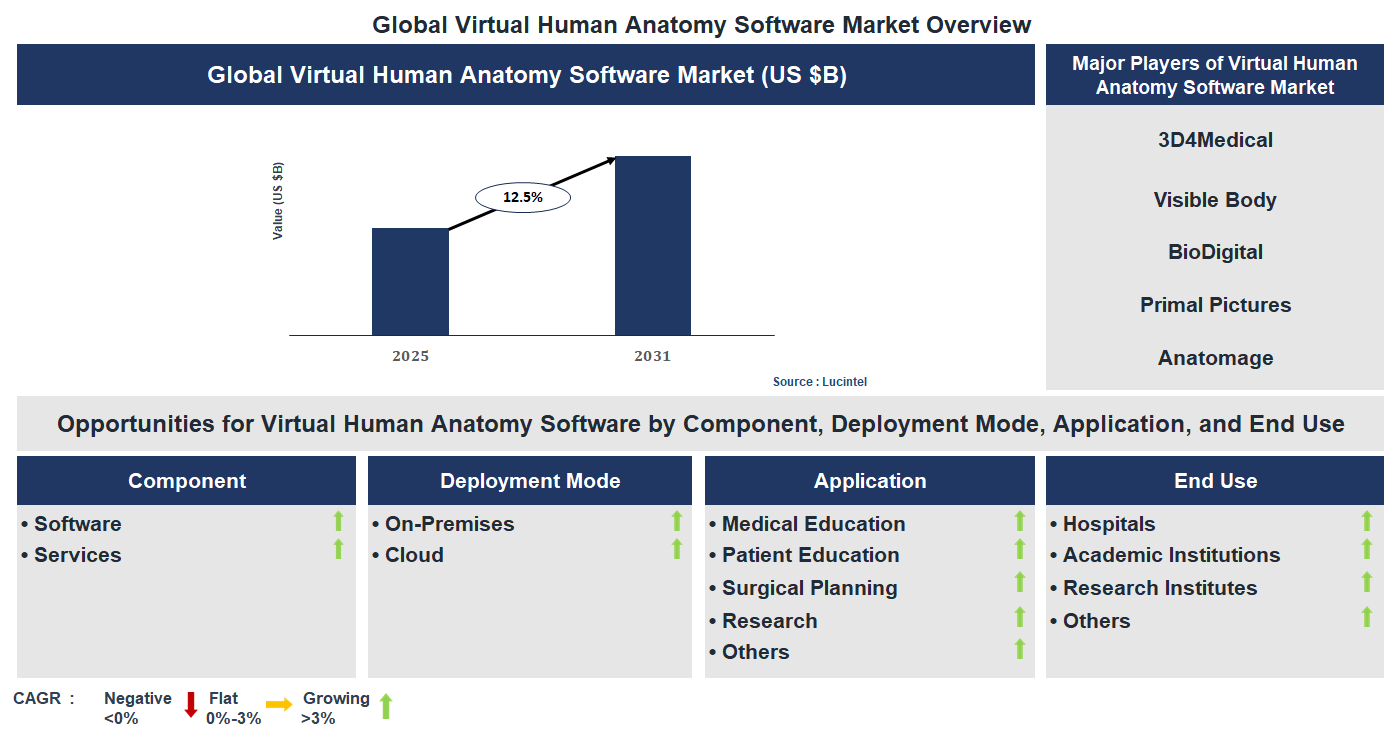
Key data points: The growth forecast = 12.5% annually for the next 7 years. Scroll below to get more insights. This market report covers trends, opportunities and forecasts in virtual human anatomy software market to 2031 by component (software and services), deployment mode (on-premises and cloud), application (medical education, patient education, surgical planning, research, and others), end use (hospitals, academic institutions, research institutes, and others), and region (North America, Europe, Asia Pacific, and the Rest of the World)
We'll send your sample report shortly.
• Lucintel forecasts that, within the component category, software is expected to witness higher growth over the forecast period.
• Within the end use category, hospital is expected to witness the highest growth.
• In terms of region, North America is expected to witness the highest growth over the forecast period. Gain valuable insights for your business decisions with our comprehensive 150+ page report. Sample figures with some insights are shown below.
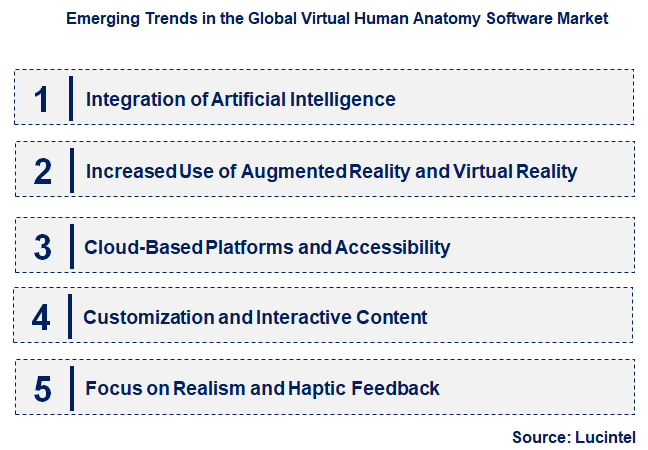
• Integration of Artificial Intelligence: AI-powered virtual anatomy tools are enhancing accuracy and personalization. These systems can adapt to individual learning paces, provide real-time feedback, and simulate complex anatomical variations, improving educational outcomes. AI also enables predictive analytics for better diagnosis and treatment planning, making virtual anatomy software more intelligent and user-centric.
• Increased Use of Augmented Reality and Virtual Reality: AR and VR technologies are creating immersive learning environments that allow users to interact with 3D anatomical models in real-time. This enhances spatial understanding and retention of complex structures. The adoption of AR/VR is expanding beyond education into surgical planning and patient engagement, offering more realistic and hands-on experiences.
• Cloud-Based Platforms and Accessibility: Cloud technology is making virtual anatomy software more accessible and scalable. Users can access detailed models and simulations from any device with an internet connection, facilitating remote learning and collaboration. Cloud platforms also enable easier updates, data sharing, and integration with other healthcare systems, broadening the software’s reach.
• Customization and Interactive Content: The market is shifting towards highly customizable and interactive software solutions. Users can tailor models to specific educational or clinical needs, such as focusing on particular systems or pathologies. Interactive features like quizzes, annotations, and virtual dissections improve engagement and knowledge retention, making learning more effective.
• Focus on Realism and Haptic Feedback: Advances in graphics and haptic technology are increasing the realism of virtual anatomy models. Haptic feedback allows users to feel textures and resistance, simulating real surgical or diagnostic procedures. This trend enhances practical skills training and provides a more authentic experience, bridging the gap between virtual and real-world applications. In summary, these trends are collectively transforming the virtual human anatomy software market by making it more intelligent, immersive, accessible, customizable, and realistic. They are driving innovation in medical education, surgical planning, and patient care, ultimately leading to improved healthcare outcomes and more efficient training methodologies.
• Technological Advancements: Integration of VR and AR technologies has enhanced realism and interactivity in anatomy software, providing immersive learning experiences that improve retention and understanding for students and professionals alike. This innovation has expanded the market by attracting educational institutions and healthcare providers seeking cutting-edge tools.
• Growing Adoption in Medical Education: Increasing adoption of virtual anatomy software in medical schools and training programs has replaced traditional cadaver-based learning, offering safer, more accessible, and cost-effective alternatives. This shift has broadened the market scope and driven demand for advanced, user-friendly platforms.
• Expansion of Clinical Applications: Beyond education, virtual anatomy software is now used in surgical planning, patient education, and clinical diagnostics. This diversification has increased the softwares utility, leading to higher adoption rates among hospitals and clinics, and expanding the market beyond academic institutions.
• Rising Investments and Partnerships: Major tech firms, healthcare providers, and educational institutions are investing heavily in developing and deploying virtual anatomy solutions. Strategic partnerships and funding have accelerated innovation, improved software quality, and expanded market reach.
• Regulatory and Standardization Developments: Governments and regulatory bodies are establishing standards and guidelines for virtual anatomy software, ensuring safety, efficacy, and interoperability. These regulations foster trust and facilitate wider adoption across healthcare and educational sectors. In summary, these developments are significantly impacting the virtual human anatomy software market by enhancing technological capabilities, broadening application areas, increasing adoption, and fostering innovation through investments and regulatory support. This dynamic environment is poised to drive sustained growth and transformation in medical education and healthcare practices.
• Enhanced Learning Tools : Virtual human anatomy software provides immersive, interactive models that improve comprehension and retention for students, leading to better-trained healthcare professionals and reducing educational costs.
• Realistic Practice Environments : The software offers realistic simulations for clinicians to practice procedures, increasing confidence and reducing errors in real-world settings, ultimately improving patient outcomes.
• Accessible Information Tools : These applications help patients understand their conditions through visualizations, fostering better communication, adherence to treatment plans, and informed decision-making.
• Accelerated Innovation : Researchers utilize detailed anatomical models to study diseases, develop new treatments, and conduct virtual experiments, speeding up R&D processes and reducing costs.
• Enhanced Remote Care : Virtual anatomy tools support remote consultations by providing detailed visualizations, enabling accurate diagnoses and treatment planning without physical presence. In summary, these growth opportunities are significantly impacting the virtual human anatomy software market by expanding its applications, improving educational and clinical outcomes, and fostering innovation. The integration of advanced visualization and simulation capabilities is making healthcare more accessible, efficient, and effective, thereby driving sustained market growth and technological adoption across the healthcare ecosystem.
• Technological Advancements: The rapid development of 3D modeling, augmented reality (AR), and virtual reality (VR) technologies has revolutionized medical education and training. These innovations enable highly detailed, interactive, and immersive anatomical simulations, improving learning outcomes. As technology becomes more accessible and affordable, adoption rates increase among educational institutions and healthcare providers. This continuous evolution fosters innovation, enhances user experience, and broadens application scope, ultimately accelerating market growth and expanding the potential for new product development.
• Rising Demand for Medical Education and Training: The increasing need for effective medical training solutions is a significant driver. Medical students, professionals, and researchers require realistic, risk-free environments to learn complex anatomy and surgical procedures. Virtual human anatomy software offers cost-effective, repeatable, and safe training modules, reducing reliance on cadavers and physical models. The growing emphasis on competency-based education and the expansion of medical curricula worldwide further boost demand. Additionally, the COVID-19 pandemic accelerated the adoption of virtual learning tools, reinforcing the importance of digital solutions in medical education.
• Growing Focus on Personalized and Remote Learning: The shift towards personalized education and remote learning modalities is transforming the healthcare training landscape. Virtual human anatomy software allows customization of learning modules tailored to individual needs, enhancing engagement and retention. Remote access to these tools supports distance learning, especially in regions with limited access to traditional resources. This flexibility appeals to educational institutions and healthcare organizations seeking scalable, adaptable training solutions. As digital literacy improves and internet connectivity expands globally, the market benefits from increased adoption driven by the need for accessible, personalized learning experiences.
• Regulatory Support and Healthcare Digitalization Initiatives: Governments and regulatory bodies worldwide are promoting digital health solutions to improve healthcare quality and accessibility. Policies encouraging the integration of virtual training tools into medical education and licensing processes are fostering market growth. Funding programs, grants, and accreditation standards increasingly recognize virtual anatomy software as a valid training modality. These regulatory supports facilitate market entry, encourage innovation, and ensure quality standards, thereby boosting confidence among users and stakeholders, and accelerating adoption across educational and healthcare institutions. The challenges in the virtual human anatomy software market are:-
• High Development and Implementation Costs: Developing sophisticated virtual anatomy software requires significant investment in technology, content creation, and user interface design. These costs can be prohibitive for smaller companies or startups, limiting innovation and market entry. Additionally, integrating these solutions into existing educational frameworks involves substantial expenses related to hardware, software licensing, and staff training. The high costs may slow down widespread adoption, especially in developing regions where budget constraints are prevalent, thereby restricting market expansion and limiting access to advanced training tools.
• Regulatory and Certification Barriers: Despite supportive policies, navigating complex regulatory landscapes remains a challenge. Virtual anatomy software must meet stringent standards for medical accuracy, safety, and efficacy, which vary across regions. Obtaining necessary approvals and certifications can be time-consuming and costly, delaying product launches and market penetration. Moreover, evolving regulatory frameworks require continuous updates and compliance efforts, increasing operational complexity. These barriers can hinder innovation, reduce competitiveness, and create uncertainties for developers and users alike.
• Market Competition and Rapid Technological Changes: The market is highly competitive, with numerous players offering similar solutions. Rapid technological advancements demand continuous innovation, which can be resource-intensive. Companies must invest heavily in research and development to stay ahead, risking obsolescence of existing products. Additionally, the entry of new entrants and the emergence of alternative training methods pose threats to established players. This intense competition can lead to price wars, reduced profit margins, and increased pressure to differentiate products, challenging sustained growth and market stability. In summary, the virtual human anatomy software market is driven by technological innovations, increasing demand for effective medical training, and supportive regulatory initiatives. However, high development costs, regulatory complexities, and fierce competition present notable challenges. These factors collectively influence market dynamics, requiring stakeholders to innovate strategically and navigate regulatory landscapes carefully. Overall, the markets growth potential remains significant, provided that companies can address these challenges effectively and leverage emerging opportunities to enhance medical education and healthcare training worldwide.
• 3D4Medical
• Visible Body
• BioDigital
• Primal Pictures
• Anatomage
• EON Reality
• Zygote Media Group
• BodyViz
• Sectra
• InVivo Therapeutics
• Software
• Services
• On-Premises
• Cloud
• Medical Education
• Patient Education
• Surgical Planning
• Research
• Others
• Hospitals
• Academic Institutions
• Research Institutes
• Others
• North America
• Europe
• Asia Pacific
• The Rest of the World
• United States: The U.S. market has seen rapid adoption of virtual anatomy software in medical schools and hospitals, driven by technological innovation and high healthcare expenditure. Major players are integrating AI and AR to improve realism and interactivity. Government grants and private investments support R&D, fostering new product development. The increasing focus on remote learning and telemedicine has further boosted demand. Additionally, collaborations between tech firms and educational institutions are expanding the softwares capabilities, making it more accessible and user-friendly. The U.S. remains a leader in adopting cutting-edge virtual anatomy solutions.
• China: China’s market is rapidly expanding due to government initiatives promoting digital health and medical education modernization. Investments in AR and VR technologies are substantial, with local companies developing cost-effective, high-quality virtual anatomy tools. The government’s focus on healthcare reform and digital infrastructure has created a favorable environment for growth. Universities and medical colleges are increasingly integrating these tools into curricula to enhance training efficiency. Additionally, partnerships between Chinese tech firms and international companies are fostering innovation. The market is also driven by a large student population and rising healthcare demands, positioning China as a key player in virtual anatomy software development.
• Germany: Germany’s market is characterized by a focus on high-quality, research-driven solutions, supported by strong healthcare and educational institutions. The country emphasizes integrating virtual anatomy software into medical training and continuing education programs. Innovations in simulation technology, including haptic feedback and 3D visualization, are prominent. Public-private partnerships and government funding facilitate the development of advanced tools. Germany’s strict regulatory environment ensures high standards for software quality and safety. The adoption rate is steady, with a growing number of hospitals and universities incorporating virtual anatomy into their curricula, aiming to improve clinical skills and patient outcomes.
• India: The Indian market is witnessing rapid growth due to increasing investments in healthcare infrastructure and medical education. Cost-effective virtual anatomy solutions are in high demand, especially in rural and semi-urban areas where traditional resources are limited. Local startups and international companies are collaborating to develop affordable, scalable software tailored to Indian curricula. Government initiatives promoting digital health and e-learning are supporting this trend. The expanding medical colleges and universities are adopting virtual tools to enhance training quality. Additionally, the rising number of medical aspirants and the need for innovative teaching methods are fueling market expansion, making India a significant emerging player.
• Japan: Japan’s market is driven by technological innovation and a strong emphasis on medical research and education. The country focuses on integrating virtual anatomy software with robotics and AI to create highly realistic simulations. Aging population and increasing healthcare demands motivate the adoption of advanced training tools to improve clinical skills. Japanese companies are investing in developing sophisticated, user-friendly software that aligns with strict regulatory standards. Collaboration between academia and industry is common, fostering continuous innovation. The government’s support for digital health initiatives and medical technology research further accelerates market growth. Japan aims to lead in high-tech medical training solutions globally.


• 3D4Medical
• Visible Body
• BioDigital
• Primal Pictures
• Anatomage
• EON Reality
• Zygote Media Group
• BodyViz
• Sectra
• InVivo Therapeutics Q5. Which virtual human anatomy software market segment will be the largest in future? Answer: Lucintel forecasts that, within the component category, software is expected to witness higher growth over the forecast period. Q6. In virtual human anatomy software market, which region is expected to be the largest in next 5 years? Answer: In terms of region, North America is expected to witness the highest growth over the forecast period. Q7. Do we receive customization in this report? Answer: Yes, Lucintel provides 10% customization without any additional cost.


Choose a license that fits your team. Instant PDF delivery.
Prices exclude taxes. Instant delivery. Custom licensing available on request.
Market Report · July 15, 2026
Market Report · June 26, 2026
Market Report · June 24, 2026
Trusted partner for strategic intelligence and business growth


Receive a complimentary market analysis tailored to your industry. Our analysts will identify key growth opportunities and competitive dynamics specific to your business.

Market size, growth rate, and key trend analysis for your specific sector.

Top competitor positioning and market share analysis.

Strategic recommendations backed by data-driven insights.
Get curated market intelligence and competitive moves straight to your inbox.
By subscribing, you agree to receive our monthly insights. Unsubscribe anytime.
Receive a complimentary market analysis tailored to your industry. Our analysts will identify key growth opportunities and competitive dynamics specific to your business.
Market size, growth rate, and key trend analysis for your specific sector.
Top competitor positioning and market share analysis.
Strategic recommendations backed by data-driven insights.
Get curated market intelligence, emerging trends, and competitive moves straight to your inbox each month.
By subscribing, you agree to receive our monthly insights. Unsubscribe anytime.
We'll send your sample report shortly.