
Stretchable and Conformal Electronics Market Trends and Forecast
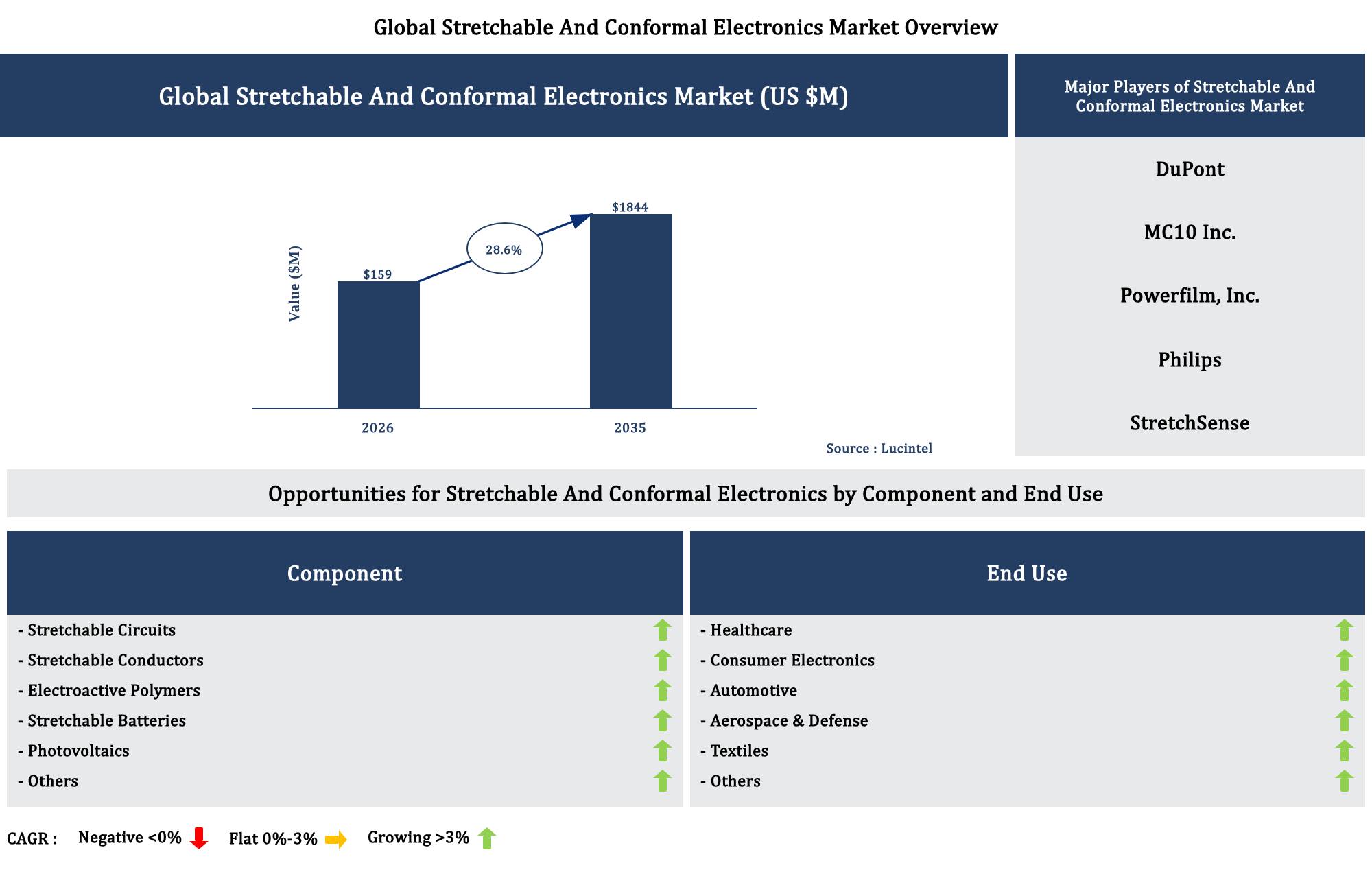
The future of the global stretchable and conformal electronics market looks promising with opportunities in the healthcare, consumer electronic, automotive, aerospace & defense, and textile markets. The global stretchable and conformal electronics market is expected to reach an estimated $1844 million by 2035 with a CAGR of 28.6% from 2026 to 2035. The major drivers for this market are the growing adoption in automotive & aerospace flexible systems, the increasing demand for wearable health & fitness monitoring devices, and the rising demand for miniaturization of electronic devices.
• Lucintel forecasts that, within the Component category, stretchable conductor is expected to witness the highest growth over the forecast period.
• Within the end use category, healthcare is expected to witness the highest growth.
• In terms of region, APAC is expected to witness the highest growth over the forecast period.
Gain valuable insights for your business decisions with our comprehensive 150+ page report. Sample figures with some insights are shown below.
Emerging Trends in the Stretchable and Conformal Electronics Market
The stretchable and conformal electronics market is evolving rapidly as innovations in flexible materials, advanced sensor technologies, and miniaturized electronic systems reshape multiple industries. These electronics are designed to bend, stretch, and conform to complex surfaces, enabling new possibilities in healthcare monitoring, consumer wearables, robotics, automotive systems, and smart textiles. Growing demand for real time data collection, personalized healthcare, and human machine interaction is accelerating adoption across global markets. Additionally, improvements in conductive polymers, nanomaterials, and manufacturing techniques are supporting scalable production. As research transitions into commercial applications, several key trends are emerging that are redefining product design, performance capabilities, and end use integration worldwide.
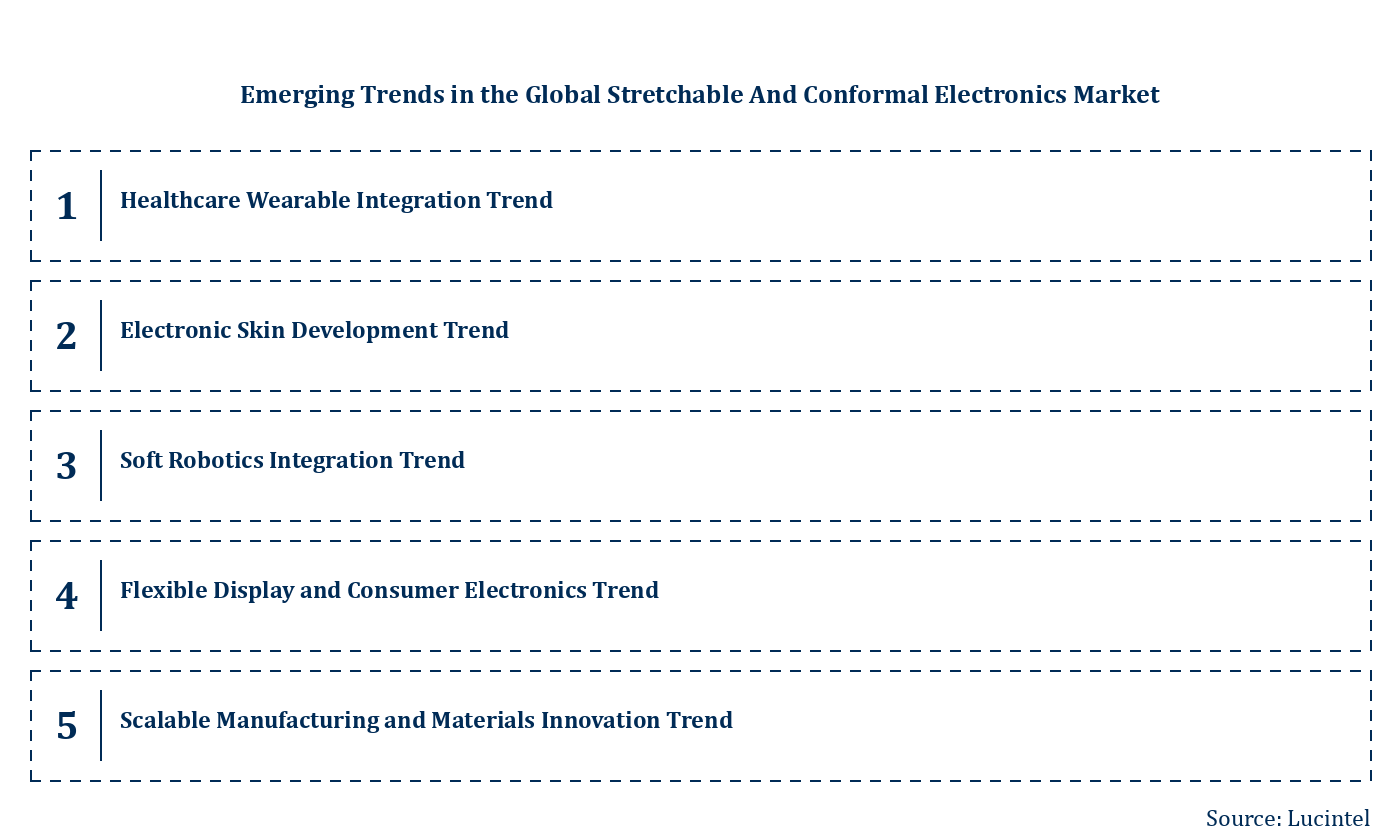
• Healthcare Wearable Integration Trend: The integration of stretchable electronics into healthcare wearables is one of the most significant trends shaping the market. These devices include skin mounted patches, flexible biosensors, and continuous health monitoring systems that track vital signs such as heart rate, temperature, glucose levels, and hydration. The growing prevalence of chronic diseases and aging populations is increasing demand for real time remote patient monitoring. Hospitals and healthcare providers are adopting these technologies to reduce clinical visits and improve preventive care. Advances in biocompatible materials and ultra thin sensors are making long term wear comfortable and reliable, enhancing patient compliance and expanding use cases across telemedicine ecosystems globally.
• Electronic Skin Development Trend: Electronic skin technology is emerging as a transformative trend, enabling devices to mimic the sensitivity and flexibility of human skin. These systems use arrays of flexible pressure, temperature, and motion sensors embedded in stretchable substrates. Applications include prosthetics with tactile feedback, robotics with enhanced sensing capabilities, and advanced human machine interfaces. Research institutions and companies are focusing on improving durability, self healing properties, and high resolution sensing accuracy. This trend is particularly important for next generation robotics and biomedical engineering, where real time sensory feedback is essential. Electronic skin is expected to bridge the gap between biological systems and artificial intelligence enabled machines.
• Soft Robotics Integration Trend: The adoption of stretchable electronics in soft robotics is gaining momentum as industries seek safer and more adaptive robotic systems. Unlike traditional rigid robots, soft robots use flexible materials and embedded electronics to achieve natural movement and interaction. Stretchable sensors and circuits allow precise motion control, pressure detection, and environmental adaptation. This trend is widely applied in medical robotics, rehabilitation devices, and industrial automation where human interaction is required. Ongoing advancements in elastomer based circuits and flexible actuators are improving performance and energy efficiency. Soft robotics is also expanding into search and rescue operations and delicate manufacturing processes requiring precision handling.
• Flexible Display and Consumer Electronics trend: Flexible and conformal displays are becoming a major driver of consumer electronics innovation. Smartphones, smartwatches, foldable devices, and wearable screens are increasingly using stretchable electronic components to improve durability and design flexibility. Manufacturers are focusing on ultra thin OLED and micro LED technologies integrated with flexible substrates. This trend is reshaping product aesthetics and functionality, enabling curved, foldable, and rollable devices. Consumer demand for lightweight and portable electronics is pushing companies to invest in advanced materials and production scaling. The trend is also extending into automotive dashboards and smart home devices, where adaptive display surfaces enhance user experience.
• Scalable Manufacturing and Materials Innovation Trend: The shift toward scalable manufacturing processes is a critical trend supporting commercialization of stretchable electronics. Techniques such as roll to roll printing, inkjet fabrication, and hybrid integration are reducing production costs and improving consistency. Material innovation, including conductive polymers, graphene, and nanowire networks, is enabling higher performance and durability. Companies are working to bridge the gap between laboratory prototypes and mass production. This trend is also supported by government funded programs and industrial partnerships aimed at standardizing flexible electronics production. As scalability improves, adoption across healthcare, automotive, and consumer sectors is expected to accelerate significantly.
The emerging trends in the stretchable and conformal electronics market are collectively driving a major transformation in how electronic systems are designed, manufactured, and applied across industries. Healthcare wearables are improving patient monitoring and preventive care, while electronic skin and soft robotics are expanding the boundaries of human machine interaction. Flexible displays are reshaping consumer electronics design, and advancements in scalable manufacturing are making mass adoption increasingly feasible. Together, these trends are accelerating commercialization and expanding application areas across healthcare, automotive, industrial, and consumer sectors. As innovation continues, the market is expected to shift from niche applications toward widespread integration in everyday technologies.
Recent Developments in the Stretchable and Conformal Electronics Market
The stretchable and conformal electronics market is witnessing rapid advancement as research shifts from experimental prototypes to scalable commercial applications across healthcare consumer electronics automotive and robotics industries. Recent developments are driven by improvements in flexible materials high performance conductive inks and advanced manufacturing techniques enabling reliable bending and stretching capabilities. Governments research institutions and private companies are increasing investments to accelerate commercialization. These developments are enhancing product durability expanding real world applications and improving integration with digital intelligent systems.
• Advanced Flexible Hybrid Electronics Manufacturing Scale-Up: Advanced flexible hybrid electronics manufacturing is scaling rapidly through roll to roll printing inkjet and hybrid integration methods that improve production efficiency and reduce costs Recent developments include pilot manufacturing lines supported by industry collaborations such as NextFlex and semiconductor partners These systems enable mass production of stretchable circuits for healthcare patches and wearables Improved yield and process stability help transition from lab prototypes to commercial products strengthening supply chains and accelerating adoption across healthcare and consumer electronics sectors globally
• Electronic Skin and Bio Integrated Sensing Advancements: Electronic skin technologies are advancing rapidly with flexible sensor arrays that replicate human tactile sensing capabilities Recent developments focus on improving sensitivity durability and self healing properties using nanomaterials and stretchable substrates Research institutions and companies are integrating these systems into prosthetics robotics and wearable health monitoring devices enabling real time feedback and improved human machine interaction These innovations are expanding applications in medical rehabilitation systems and advanced robotics while supporting next generation electronic skin commercialization efforts initiatives worldwide
• Soft Robotics Integration with Stretchable Electronics: Soft robotics systems are increasingly integrating stretchable electronics to enable adaptive movement sensing and control in complex environments Recent developments include flexible pressure sensors elastomer based circuits and embedded control systems that enhance precision and safety in human robot interaction These technologies are widely used in medical rehabilitation industrial automation and assistive robotics applications enabling more natural movement and improved responsiveness Research is also expanding into search and rescue operations and next generation manufacturing systems improving efficiency and operational flexibility
• Flexible and Conformal Display Commercialization Growth: Flexible and conformal display technologies are witnessing strong commercialization driven by consumer demand for foldable rollable and lightweight devices Recent developments include advances in OLED and micro LED integration with stretchable substrates enabling curved and adaptive screen designs Manufacturers are focusing on improving durability energy efficiency and display resolution These innovations are being applied in smartphones wearables automotive dashboards and smart home devices enhancing user experience and design flexibility while reducing device thickness and improving portability adoption rates are increasing
• Advanced Material Innovation Enabling Scalability: Advanced material innovation is playing a critical role in improving stretchable electronics performance through conductive polymers graphene based composites and nanowire networks Recent developments focus on self healing substrates high elasticity and improved electrical conductivity enabling longer device lifespans and better mechanical resilience Researchers are also developing low cost printable materials compatible with roll to roll and inkjet fabrication methods enhancing scalability These innovations are reducing production costs and supporting large scale commercialization across healthcare consumer and automotive applications globally
These recent developments in stretchable and conformal electronics are significantly transforming the global technology landscape by accelerating commercialization and expanding application areas across healthcare consumer electronics automotive and robotics sectors Improved manufacturing scalability advanced materials and integration of flexible sensors are enabling higher performance and cost effective solutions These advancements are also bridging the gap between research and market deployment driving innovation in wearable devices electronic skin and soft robotics Ultimately these developments are reshaping industry standards and creating opportunities
Strategic Growth Opportunities in the Stretchable and Conformal Electronics Market
The stretchable and conformal electronics market is expanding rapidly as demand increases across healthcare, automotive, consumer electronics, robotics, and industrial applications. Growing integration of flexible sensors, advanced materials, and miniaturized circuits is enabling new application areas and improving system performance. Industries are increasingly adopting these technologies for real time monitoring, human machine interaction, and enhanced device functionality. Continuous innovation and investment are driving commercialization and scaling opportunities globally across multiple sectors supporting long term market expansion and adoption growth globally
• Healthcare Wearable Integration Opportunities: Healthcare wearable devices are emerging as a major growth opportunity in stretchable and conformal electronics due to rising demand for continuous patient monitoring and preventive healthcare solutions. Flexible skin mounted patches and biosensors enable real time tracking of vital signs such as heart rate glucose temperature and hydration levels. Integration with telemedicine platforms and AI analytics improves diagnosis accuracy reduces hospital visits and supports remote care delivery models globally while enhancing patient compliance and healthcare efficiency worldwide significantly improving outcomes
• Smart Textiles and Textiles Expansion Opportunities: Smart textiles and electronic fabrics represent a rapidly expanding application area for stretchable and conformal electronics driven by demand for intelligent clothing and adaptive materials. These systems integrate flexible sensors conductive fibers and energy harvesting units into garments enabling functions such as health monitoring motion tracking and environmental sensing. Recent developments focus on improving washability durability and comfort while maintaining high performance signal accuracy for long term usage in consumer and industrial applications expanding adoption across global markets rapidly growing
• Automotive Interior and Safety Systems Integration Opportunities: Stretchable and conformal electronics are increasingly being integrated into automotive interiors and safety systems to enhance comfort functionality and driver assistance capabilities. Flexible sensors embedded in seats dashboards and steering systems provide real time data on pressure occupancy and driver behavior improving safety monitoring. Recent innovations include adaptive seating systems smart airbags and conformal displays that improve user experience and vehicle intelligence systems. Automotive manufacturers are collaborating with electronics companies to develop lightweight scalable solutions for next generation vehicles globally
• Robotics and Human Machine Interaction Systems Opportunities: Robotics applications are benefiting significantly from stretchable and conformal electronics which enable safer and more natural human machine interactions. Flexible pressure sensors and soft circuits allow robots to adapt to dynamic environments and perform delicate tasks with higher precision. These technologies are widely used in rehabilitation devices surgical robotics and collaborative industrial robots improving safety and efficiency. Recent advancements in elastomer based materials embedded sensors and AI enabled control systems are driving next generation soft robotics innovation across industries globally
• Consumer Electronics Foldable Devices Adoption Opportunities: Consumer electronics are witnessing rapid transformation through adoption of stretchable and conformal electronics in foldable rollable and wearable devices. Manufacturers are integrating flexible OLED and micro LED displays into smartphones smartwatches and tablets to enable new form factors. These innovations improve portability durability and user experience while enabling curved foldable and transparent display designs. Growing demand for lightweight energy efficient and highly interactive devices is encouraging companies to invest in advanced materials scalable production techniques and next generation display technologies
These strategic growth opportunities across key applications are significantly transforming the stretchable and conformal electronics market by expanding its commercial reach and technological capabilities. Advancements in healthcare wearables smart textiles automotive systems robotics and consumer electronics are driving widespread adoption and accelerating innovation cycles. Improvements in manufacturing scalability material science and system integration are enabling cost effective production and faster commercialization while supporting new use cases across global industries and strengthening competitive positioning of companies operating in this evolving sector
Stretchable and Conformal Electronics Market Driver and Challenges
The stretchable and conformal electronics market is experiencing significant growth due to the convergence of technological advancements, expanding application areas, and supportive government initiatives. Major drivers and challenges include a combination of technological innovation in flexible materials, economic factors such as rising investment in wearable technologies, and regulatory considerations related to healthcare and electronic device safety standards. Increasing demand from healthcare, consumer electronics, automotive, and robotics industries is accelerating market expansion. However, scalability limitations, high production costs, and material durability concerns continue to shape industry dynamics and influence the pace of commercialization across global markets.
The factors responsible for driving the stretchable and conformal electronics market include:-
• Rising Demand for Wearable Healthcare Technologies: The increasing adoption of wearable healthcare devices is a key driver of the market. Stretchable and conformal electronics enable continuous monitoring of vital health parameters such as heart rate, temperature, glucose levels, and hydration. Growing prevalence of chronic diseases and aging populations is fueling demand for remote patient monitoring solutions. Hospitals and healthcare providers are integrating flexible biosensors into telemedicine systems to reduce costs and improve patient outcomes. Advances in biocompatible materials and miniaturized sensors are enhancing comfort and accuracy, driving large scale adoption across healthcare systems globally and improving preventive care capabilities significantly.
• Expansion of Consumer Electronics and Flexible Devices: The rapid growth of consumer electronics is driving demand for foldable smartphones, wearable devices, and flexible displays. Stretchable electronics allow manufacturers to design lightweight, durable, and highly adaptable products that enhance user experience. Companies are investing heavily in OLED and micro LED technologies integrated with flexible substrates. Increasing consumer preference for innovative and portable devices is encouraging continuous product innovation. This trend is also expanding into smartwatches, fitness bands, and augmented reality devices, where flexibility and durability are essential. The consumer electronics boom is significantly accelerating market penetration and commercial adoption worldwide.
• Advancements in Materials and Manufacturing Technologies: Continuous advancements in materials such as conductive polymers, graphene, and nanowire networks are improving the performance and durability of stretchable electronics. In addition, manufacturing technologies like roll to roll printing, inkjet fabrication, and hybrid integration are enabling scalable production at reduced costs. These innovations are bridging the gap between laboratory research and commercial deployment. Improved elasticity, conductivity, and mechanical stability are enhancing product reliability across applications. As production efficiency increases, manufacturers are able to meet rising global demand, supporting wider adoption in healthcare, automotive, robotics, and industrial sectors.
• Growth in Automotive and Industrial Applications: The automotive and industrial sectors are increasingly integrating stretchable electronics for enhanced functionality and safety. Applications include flexible sensors in vehicle interiors, adaptive seating systems, and smart dashboards that monitor driver behavior and environmental conditions. Industrial robotics also benefit from flexible sensors that improve precision and safety in automation processes. Industry 4.0 initiatives are further supporting adoption of advanced sensing and control systems. These technologies help improve operational efficiency, reduce maintenance costs, and enhance user interaction. Growing demand for intelligent systems in transportation and manufacturing is a major driver of market expansion.
• Increasing Investment and Government Support Initiatives: Government funding and private sector investments are playing a critical role in advancing stretchable electronics research and commercialization. Programs supporting flexible hybrid electronics, such as defense and healthcare initiatives, are accelerating innovation. Countries are promoting domestic manufacturing capabilities and encouraging collaboration between academia and industry. Funding for research in smart materials, electronic skin, and wearable sensors is expanding rapidly. These initiatives are reducing development risks and encouraging startups and established companies to invest in scalable solutions. Strong policy support is significantly boosting innovation and accelerating market growth globally.
The challenges facing the stretchable and conformal electronics market include:
• High Production Costs and Scalability Limitations: One of the major challenges in the stretchable and conformal electronics market is the high cost of production and difficulty in scaling manufacturing processes. Advanced materials such as graphene and conductive polymers are expensive and require specialized fabrication techniques. Additionally, maintaining product consistency during large scale production remains a technical challenge. Although roll to roll manufacturing is improving scalability, widespread commercialization is still limited by cost barriers. These challenges restrict adoption in price sensitive markets and slow down mass production across several application areas, particularly in emerging economies and small scale industries.
• Durability and Performance Reliability Concerns: Ensuring long term durability and consistent performance of stretchable electronics remains a significant challenge. Repeated bending, stretching, and environmental exposure can degrade material performance over time. Issues such as signal instability, material fatigue, and limited lifespan affect product reliability. In critical applications such as healthcare and automotive systems, performance failures can have serious consequences. Researchers are working on self healing materials and advanced encapsulation techniques, but commercial readiness is still evolving. These reliability concerns hinder widespread adoption and limit deployment in high risk or mission critical applications globally.
• Regulatory and Standardization Challenges: The market faces regulatory challenges due to the lack of standardized frameworks for flexible and wearable electronics. Healthcare applications require strict compliance with safety, biocompatibility, and data privacy regulations, which vary across regions. Certification processes can be time consuming and expensive, delaying product commercialization. In addition, the absence of global standards for performance testing and material safety creates uncertainty for manufacturers. These regulatory barriers slow down innovation cycles and create challenges for companies seeking international market expansion, especially in medical and automotive sectors where compliance requirements are stringent.
The stretchable and conformal electronics market is being shaped by strong technological drivers and expanding application opportunities across healthcare, consumer electronics, automotive, and industrial sectors. Advancements in materials, manufacturing techniques, and government support are accelerating innovation and commercialization. However, challenges such as high production costs, durability concerns, and regulatory complexities continue to limit full scale adoption. Despite these barriers, ongoing research and investment are expected to improve scalability and performance reliability. Overall, the combined influence of drivers and challenges is pushing the market toward gradual but steady global expansion and long term technological transformation.
List of Stretchable and Conformal Electronics Companies
Companies in the market compete on the basis of product quality offered. Major players in this market focus on expanding their manufacturing facilities, R&D investments, infrastructural development, and leverage integration opportunities across the value chain. With these strategies stretchable and conformal electronics companies cater increasing demand, ensure competitive effectiveness, develop innovative products & technologies, reduce production costs, and expand their customer base. Some of the stretchable and conformal electronics companies profiled in this report include-
• DuPont
• MC10 Inc.
• Powerfilm, Inc.
• Philips
• StretchSense
Stretchable and Conformal Electronics Market by Segment
The study includes a forecast for the global stretchable and conformal electronics market by component, end use, and region.
Stretchable and Conformal Electronics Market by Component [Value from 2019 to 2035]:
• Stretchable Circuits
• Stretchable Conductors
• Electroactive Polymers
• Stretchable Batteries
• Photovoltaics
• Others
Stretchable and Conformal Electronics Market by End Use [Value from 2019 to 2035]:
• Healthcare
• Consumer Electronics
• Automotive
• Aerospace & Defense
• Textiles
• Others
Stretchable and Conformal Electronics Market by Region [Value from 2019 to 2035]:
• North America
• Europe
• Asia Pacific
• The Rest of the World
Country Wise Outlook for the Stretchable and Conformal Electronics Market
The stretchable and conformal electronics market is experiencing rapid global expansion driven by breakthroughs in flexible materials, wearable health technologies, and next generation human machine interface systems. These electronics, which can bend, stretch, and conform to irregular surfaces, are increasingly being integrated into healthcare monitoring devices, smart textiles, automotive interiors, and soft robotics. Growth is strongly supported by rising investments in research and development, government funded innovation programs, and commercialization of flexible displays and bio integrated sensors. Across major economies such as the United States, China, Germany, India, and Japan, recent developments reflect a shift from laboratory scale innovation to early stage mass manufacturing and real world deployment.
• United States: The United States is leading innovation in stretchable and conformal electronics through strong investments from defense and healthcare sectors. Agencies such as DARPA and NIH are funding advanced research in bio integrated sensors, neural interfaces, and flexible medical wearables. Institutions and startups are focusing on electronic skin, soft prosthetics, and real time health monitoring patches. Manufacturing initiatives like NextFlex are accelerating commercialization of flexible hybrid electronics. Recent developments also include rapid progress in stretchable circuits for rehabilitation devices and defense monitoring systems. The country is also seeing increased collaboration between universities and industry players to scale roll to roll manufacturing technologies for wearable and medical applications.
• China: China is rapidly expanding its stretchable electronics ecosystem driven by strong government support, industrial policy initiatives, and large scale manufacturing capabilities. The Made in China 2025 strategy has encouraged domestic production of flexible displays, sensors, and wearable devices. Companies such as BOE Technology and TCL are investing heavily in flexible OLED and conformal display technologies. China is also advancing bioelectronics for healthcare monitoring and smart city applications integrated with 5G and AI systems. Recent developments show significant growth in wearable sensors and electronic skin solutions designed for consumer electronics and medical diagnostics. Localized supply chains and R&D expansion are reducing dependence on imports while strengthening global competitiveness.
• Germany: Germany is focusing on industrial and automotive integration of stretchable and conformal electronics, supported by its strong engineering and manufacturing base. The country is actively applying flexible sensors in automotive interiors, smart textiles, and industrial automation systems aligned with Industry 4.0 initiatives. Research institutions and companies are developing advanced conductive materials and stretchable circuits for robotics and rehabilitation technologies. Collaborative European funding programs such as Horizon Europe are further supporting innovation in flexible healthcare monitoring systems. Recent developments include integration of conformal electronics into vehicle safety systems, adaptive seating, and energy efficient smart components, reinforcing Germany’s position as a leader in high precision industrial applications of flexible electronics.
• India: India is emerging as a growing market for stretchable and conformal electronics, primarily driven by rising adoption of wearable devices, healthcare digitization, and expanding consumer electronics manufacturing. Startups and research institutions are increasingly exploring low cost flexible sensors for medical diagnostics and fitness tracking applications. Government initiatives such as Make in India and Digital Health programs are indirectly supporting innovation in electronic textiles and wearable health monitoring systems. Recent developments include pilot projects in remote patient monitoring and smart wearable patches for chronic disease management. While large scale manufacturing is still developing, India is becoming an important demand center and innovation hub for affordable and scalable flexible electronics solutions.
• Japan: Japan remains a global leader in stretchable and conformal electronics, particularly in robotics, wearable healthcare, and electronic skin technologies. Companies and universities are advancing high precision flexible sensors for prosthetics, rehabilitation suits, and human machine interaction systems. Strong collaboration between industry and academia is driving innovation in conductive materials and stretchable substrates. Government backed initiatives through METI support research in flexible electronics and smart materials. Recent developments include advanced stretchable displays, self healing electronic materials, and wearable robotic systems designed for aging population care. Japan’s focus on high quality manufacturing and miniaturization continues to strengthen its leadership in next generation bio integrated electronics.
Features of the Global Stretchable and Conformal Electronics Market
Market Size Estimates: Stretchable and conformal electronics market size estimation in terms of value ($M).
Trend and Forecast Analysis: Market trends (2019 to 2025) and forecast (2026 to 2035) by various segments and regions.
Segmentation Analysis: Stretchable and conformal electronics market size by component, end use, and region in terms of value ($M).
Regional Analysis: Stretchable and conformal electronics market breakdown by North America, Europe, Asia Pacific, and Rest of the World.
Growth Opportunities: Analysis of growth opportunities in different component, end use, and regions for the stretchable and conformal electronics market.
Strategic Analysis: This includes M&A, new product development, and competitive landscape of the stretchable and conformal electronics market.
Analysis of competitive intensity of the industry based on Porter’s Five Forces model.
FAQ
Q1. What is the stretchable and conformal electronics market size?
Answer: The global stretchable and conformal electronics market is expected to reach an estimated $1844 million by 2035.
Q2. What is the growth forecast for stretchable and conformal electronics market?
Answer: The global stretchable and conformal electronics market is expected to grow with a CAGR of 28.6% from 2026 to 2035.
Q3. What are the major drivers influencing the growth of the stretchable and conformal electronics market?
Answer: The major drivers for this market are the growing adoption in automotive & aerospace flexible systems, the increasing demand for wearable health & fitness monitoring devices, and the rising demand for miniaturization of electronic devices.
Q4. What are the major segments for stretchable and conformal electronics market?
Answer: The future of the stretchable and conformal electronics market looks promising with opportunities in the healthcare, consumer electronic, automotive, aerospace & defense, and textile markets.
Q5. Who are the key stretchable and conformal electronics market companies?
Answer: Some of the key stretchable and conformal electronics companies are as follows:
• DuPont
• MC10 Inc.
• Powerfilm, Inc.
• Philips
• StretchSense
Q6. Which stretchable and conformal electronics market segment will be the largest in future?
Answer: Lucintel forecasts that, within the Component category, stretchable conductor is expected to witness the highest growth over the forecast period.
Q7. In stretchable and conformal electronics market, which region is expected to be the largest in next 8 years?
Answer: In terms of region, APAC is expected to witness the highest growth over the forecast period.
Q8. Do we receive customization in this report?
Answer: Yes, Lucintel provides 10% customization without any additional cost.
This report answers following 11 key questions:
Q.1. What are some of the most promising, high-growth opportunities for the stretchable and conformal electronics market by component (stretchable circuits, stretchable conductors, electroactive polymers, stretchable batteries, photovoltaics, and others), end use (healthcare, consumer electronics, automotive, aerospace & defense, textiles, and others), and region (North America, Europe, Asia Pacific, and the Rest of the World)?
Q.2. Which segments will grow at a faster pace and why?
Q.3. Which region will grow at a faster pace and why?
Q.4. What are the key factors affecting market dynamics? What are the key challenges and business risks in this market?
Q.5. What are the business risks and competitive threats in this market?
Q.6. What are the emerging trends in this market and the reasons behind them?
Q.7. What are some of the changing demands of customers in the market?
Q.8. What are the new developments in the market? Which companies are leading these developments?
Q.9. Who are the major players in this market? What strategic initiatives are key players pursuing for business growth?
Q.10. What are some of the competing products in this market and how big of a threat do they pose for loss of market share by material or product substitution?
Q.11. What M&A activity has occurred in the last 5 years and what has its impact been on the industry?
For any questions related to Stretchable and Conformal Electronics Market, Stretchable and Conformal Electronics Market Size, Stretchable and Conformal Electronics Market Growth, Stretchable and Conformal Electronics Market Analysis, Stretchable and Conformal Electronics Market Report, Stretchable and Conformal Electronics Market Share, Stretchable and Conformal Electronics Market Trends, Stretchable and Conformal Electronics Market Forecast, Stretchable and Conformal Electronics Companies, write Lucintel analyst at email: helpdesk@lucintel.com. We will be glad to get back to you soon.