
'
...

The Impact of COVID-19 is included in Quantum Computing Market Report. Buy it today to get an advantage.

Request the impact of COVID-19 on your product or industry


Quantum Computing Market Trends and Forecast

The future of the global quantum computing market looks promising with opportunities in the space & defense, transportation & logistic, healthcare & pharmaceutical, chemical, banking & finance, energy & power, academia, and government markets. The global quantum computing market is expected to reach an estimated $9,817 million by 2035 with a CAGR of 19.5% from 2026 to 2035. The major drivers for this market are the rising demand for advanced computing in research fields, the growing adoption in financial modeling & risk analysis, and the increasing demand for high speed data processing.

• Lucintel forecasts that, within the deployment category, cloud is expected to witness higher growth over the forecast period.
• Within the end use category, banking & finance is expected to witness the highest growth.
• In terms of region, APAC is expected to witness the highest growth over the forecast period.
Gain valuable insights for your business decisions with our comprehensive 150+ page report. Sample figures with some insights are shown below.
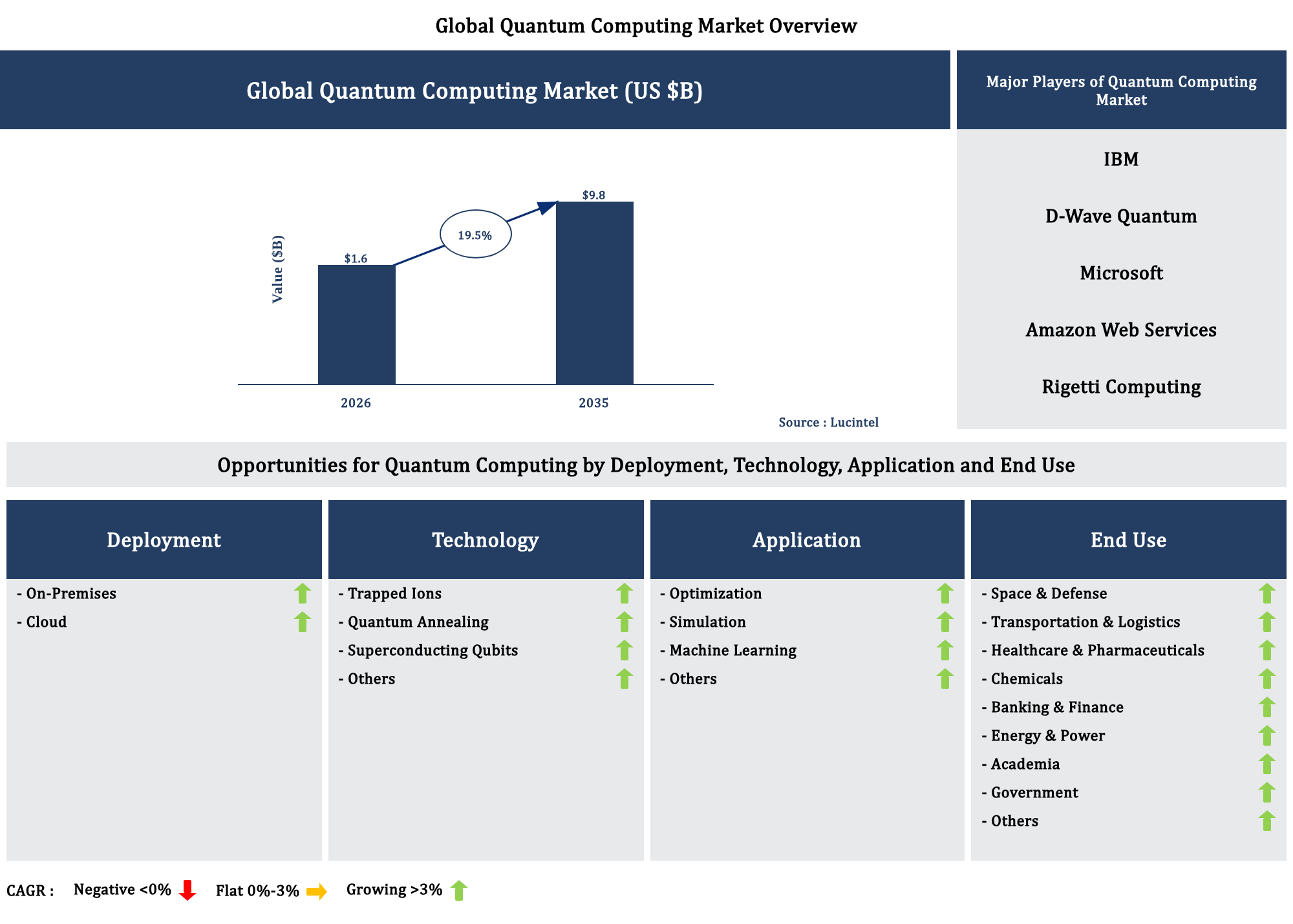
Quantum Computing Market Trends and Forecast

Emerging Trends in the Quantum Computing Market

The quantum computing market is entering a transformative phase driven by rapid technological breakthroughs, increased global investment, and expanding real-world experimentation. What was once a purely theoretical field is now evolving into a competitive industrial landscape where governments and corporations are racing to achieve quantum advantage. Key advancements in qubit stability, error correction, hybrid quantum-classical systems, and cloud-based quantum access are accelerating adoption across industries such as pharmaceuticals, finance, logistics, and materials science. At the same time, collaboration between public institutions and private enterprises is strengthening, while geopolitical competition is pushing nations to invest heavily in quantum capabilities. These dynamics are shaping a fast-evolving ecosystem where scalability, reliability, and commercialization are becoming central priorities.

• Hybrid Quantum Classical Integration Trend: Hybrid quantum-classical computing is emerging as a dominant trend as organizations recognize that fully fault-tolerant quantum systems are still years away. This approach combines classical high-performance computing with quantum processors to solve complex optimization, chemistry, and machine learning problems more efficiently. Companies like IBM and Google are advancing frameworks that allow seamless workload distribution between classical and quantum systems. This trend is significantly expanding early adoption because businesses can experiment with quantum capabilities without waiting for full-scale quantum machines. It also helps reduce computational errors and improves practicality. As a result, hybrid systems are becoming the primary entry point for enterprises exploring quantum applications.
• Quantum Cloud Computing Expansion Trend: quantum computing market is increasingly being delivered through cloud platforms, making it more accessible to researchers, enterprises, and startups without requiring expensive hardware ownership. Providers such as IBM Quantum, Amazon Braket, and Microsoft Azure Quantum are enabling remote access to quantum processors. This trend is democratizing access to advanced computing resources and accelerating innovation across industries. Cloud-based quantum computing allows users to run experiments, test algorithms, and develop applications in real time. It is also fostering a growing ecosystem of developers and third-party software providers. The expansion of quantum cloud services is expected to significantly increase adoption rates and reduce barriers to entry.
• Quantum Communication And Security Trend: Quantum communication is gaining strong momentum due to rising concerns over cybersecurity and data protection in the post-quantum era. Technologies such as quantum key distribution are being actively developed to create virtually unbreakable encryption systems. Countries like China and the United States are heavily investing in quantum-secure communication networks for defense and financial systems. This trend is also driven by fears that future quantum computers could break current encryption standards. As a result, organizations are transitioning toward quantum-safe cryptography and secure communication infrastructure. The trend is reshaping cybersecurity strategies globally and creating new opportunities in defense and secure enterprise communications.
• Quantum Hardware Diversification Trend: Quantum hardware development is moving beyond a single dominant architecture, with multiple competing technologies such as superconducting qubits, trapped ions, photonic systems, and neutral atoms. Companies like IBM and Google focus on superconducting qubits, while IonQ emphasizes trapped ion technology. This diversification is accelerating innovation by allowing parallel experimentation with different physical systems. Each approach offers unique advantages in scalability, stability, and error rates. The competition is driving rapid improvements in qubit coherence and computational reliability. This trend is critical because no single architecture has yet emerged as the definitive solution, making diversification essential for long-term progress in quantum computing development.
• Quantum Workforce And Ecosystem Growth Trend: The quantum computing ecosystem is expanding rapidly, driven by increasing demand for skilled researchers, engineers, and software developers. Universities, governments, and private companies are investing in quantum education programs and training initiatives to bridge the talent gap. Countries like India, the United States, and Germany are launching national quantum missions that include workforce development as a core pillar. Startups and tech giants are also collaborating with academic institutions to build specialized curricula. This trend is crucial because talent shortages remain one of the biggest barriers to commercialization. As a result, the global quantum workforce is becoming more structured, interdisciplinary, and industry-focused.

These trends are reshaping the quantum computing market by accelerating commercialization, expanding accessibility through cloud platforms, and strengthening security-driven applications. The convergence of hybrid systems, diversified hardware, and growing talent pipelines is pushing the industry closer to real-world adoption. At the same time, global competition and cybersecurity concerns are ensuring sustained investment and innovation. Together, these developments are transforming quantum computing from a research-driven field into a strategically important technology ecosystem with long-term industrial and geopolitical significance.
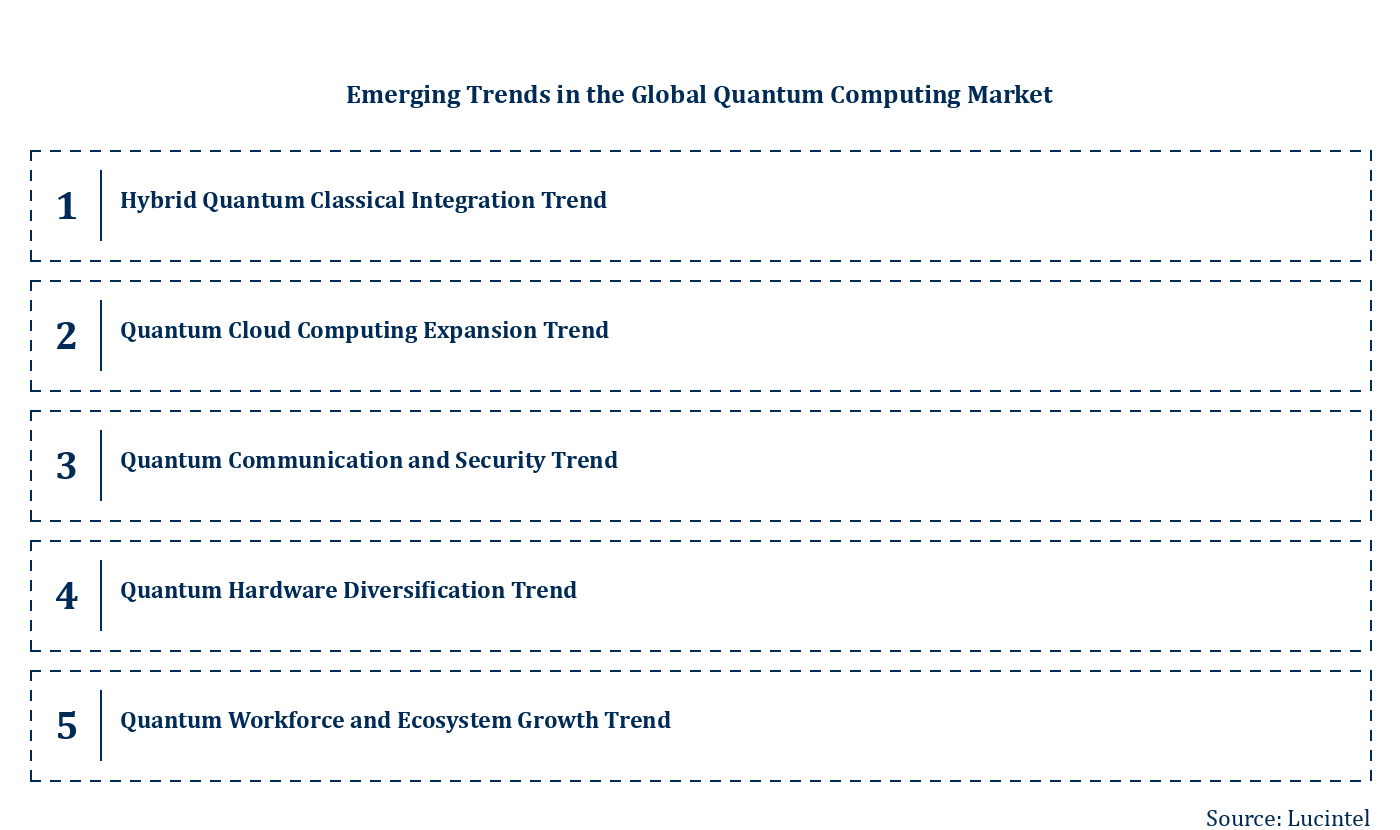
Emerging Trends in the Quantum Computing Market

Recent Developments in the Quantum Computing Market

The quantum computing market is progressing from experimental research toward early commercial deployment, driven by rapid advancements in hardware, software, and global investment initiatives. Governments and enterprises are increasingly prioritizing quantum technologies for applications in optimization, cryptography, materials science, and artificial intelligence integration. The market is witnessing strong collaboration between academia, startups, and large technology companies, which is accelerating innovation cycles. At the same time, competition among leading nations is intensifying, with strategic funding programs and infrastructure development shaping the direction of growth and long-term commercialization pathways across multiple industries.

• Quantum Hardware Scaling Breakthroughs: Recent developments in quantum hardware scaling are enabling processors with higher qubit counts and improved coherence times, significantly reducing error rates. Companies such as IBM and Google are advancing superconducting architectures, while IonQ is improving trapped ion stability. These breakthroughs are critical for moving from laboratory prototypes to commercially useful machines. Increased qubit connectivity and modular designs are also emerging, allowing systems to expand more efficiently. This progress is directly impacting computational capability, making quantum systems more practical for real-world applications in chemistry, logistics, and financial modeling across global research and industrial ecosystems.
• Expansion of Quantum Cloud Platforms: Quantum cloud computing platforms are rapidly expanding, allowing users to access quantum processors remotely without owning physical hardware. Providers like Amazon Braket, Microsoft Azure Quantum, and IBM Quantum are enabling broader participation from enterprises and academic institutions. This development is lowering entry barriers and accelerating experimentation with quantum algorithms. It also supports hybrid computing models that combine classical and quantum resources. As cloud infrastructure improves, more developers are building applications in optimization, cryptography, and simulation, increasing ecosystem maturity and driving faster adoption across industries that previously lacked direct access to quantum technology.
• Growth of Quantum Communication Networks: Quantum communication networks are emerging as a critical development focused on secure data transmission using quantum key distribution and related technologies. Countries such as China and the United States are investing heavily in building national-scale quantum communication infrastructure. These systems aim to provide ultra-secure encryption resistant to future quantum attacks. Pilot projects connecting cities and research centers are expanding, demonstrating feasibility in real-world environments. This development is reshaping cybersecurity strategies, particularly in defense, banking, and government sectors, where data protection is essential. It is also encouraging global collaboration in secure communication standards development.
• Increasing Government-Led Quantum Programs: Governments worldwide are launching structured quantum programs to accelerate research, talent development, and commercialization. Initiatives such as the United States National Quantum Initiative, China’s state-backed quantum strategy, and India’s National Quantum Mission are strengthening national capabilities. These programs provide funding for startups, research institutions, and infrastructure development. They also promote public-private partnerships to bridge the gap between theoretical research and industrial applications. This coordinated approach is enhancing innovation speed and ensuring long-term competitiveness. It is also helping countries build strategic technological independence in areas such as computing, encryption, and advanced simulation technologies.
• Diversification of Quantum Technology Approaches: The quantum computing landscape is witnessing diversification in technological approaches, including superconducting qubits, trapped ions, photonic systems, and neutral atom architectures. This diversification is driven by the absence of a single dominant solution and the need to overcome scalability and error correction challenges. Companies are experimenting with multiple designs to identify the most efficient path forward. This competition is accelerating innovation and improving system reliability. It is also fostering collaboration across hardware and software ecosystems, ensuring that different approaches contribute to overall progress. As a result, the market is becoming more resilient and technologically balanced.

These developments are collectively transforming the quantum computing market by accelerating commercialization, expanding accessibility, and strengthening global competitiveness. Advances in hardware scaling and diversified architectures are improving performance, while cloud platforms are democratizing access to quantum resources. Government initiatives are providing strong foundational support, and quantum communication networks are redefining cybersecurity standards. Together, these factors are driving the transition from experimental research to early-stage industrial adoption. As innovation continues to mature, the market is expected to experience faster integration into real-world applications across multiple high-value sectors worldwide.

Strategic Growth Opportunities in the Quantum Computing Market

quantum computing market is emerging as a transformative technology with strong strategic growth potential across multiple application areas including optimization, cryptography, materials science, artificial intelligence, and financial modeling. As enterprises and governments invest heavily in quantum research and infrastructure, practical use cases are beginning to take shape. The convergence of cloud access, hybrid computing models, and hardware advancements is accelerating experimentation. Industries are increasingly exploring quantum solutions to solve complex problems beyond the reach of classical computing, creating new commercial pathways and long-term value creation opportunities globally.

• Optimization In Supply Chain And Logistics Applications: quantum computing market is creating major opportunities in supply chain and logistics optimization by solving highly complex routing, scheduling, and resource allocation problems. Traditional systems struggle with large variable datasets, but quantum algorithms can evaluate multiple scenarios simultaneously. Companies in transportation, retail, and manufacturing are exploring quantum-enhanced optimization to reduce costs and improve efficiency. Early pilot projects demonstrate potential improvements in delivery planning, warehouse management, and inventory forecasting. As hybrid quantum systems mature, enterprises are expected to integrate quantum tools into decision-support systems, improving operational efficiency and enabling faster, data-driven strategic planning across global supply chains.

• Drug Discovery And Molecular Simulation Applications: quantum computing market is significantly advancing drug discovery and molecular simulation by enabling precise modeling of complex chemical interactions at the quantum level. Pharmaceutical companies are leveraging quantum algorithms to simulate molecules, predict protein folding, and accelerate compound testing. This reduces dependency on costly laboratory experiments and shortens development timelines. Startups and major firms are collaborating to explore quantum-assisted research platforms. As hardware improves, these systems are expected to identify new drug candidates more efficiently. This application is particularly impactful for rare diseases and personalized medicine, where traditional computational methods face significant limitations in accuracy and scalability.

• Financial Risk Modeling And Portfolio Optimization Applications: quantum computing market is opening new opportunities in financial services by improving risk modeling, portfolio optimization, and fraud detection. Financial institutions deal with massive datasets and complex variables that can benefit from quantum parallelism. Quantum algorithms are being tested for pricing derivatives, optimizing asset allocation, and simulating market behavior under uncertainty. Banks and investment firms are partnering with quantum technology providers to explore early-stage applications. Although still in experimental phases, these systems promise improved prediction accuracy and faster computation times, enabling more sophisticated financial decision-making and enhanced risk management strategies in volatile global markets.

• Artificial Intelligence And Machine Learning Enhancement Applications: quantum computing market is increasingly being integrated with artificial intelligence and machine learning to improve pattern recognition, data processing, and model training efficiency. Quantum machine learning algorithms have the potential to accelerate training cycles and enhance performance on complex datasets. Technology companies are exploring hybrid AI models that combine classical neural networks with quantum processors. This integration could significantly improve optimization tasks, natural language processing, and recommendation systems. While still in early stages, the convergence of AI and quantum computing is expected to create powerful computational frameworks that outperform traditional systems in specific high-dimensional problem-solving applications.
• Cybersecurity and Post Quantum Encryption Applications: quantum computing market is driving significant growth in cybersecurity applications, particularly in the development of post-quantum encryption methods. As quantum computers advance, existing encryption standards face potential vulnerabilities, prompting urgent development of quantum-resistant algorithms. Governments and enterprises are investing in quantum key distribution and secure communication protocols. Financial institutions, defense organizations, and cloud providers are early adopters of these technologies. This application area is critical for maintaining data security in the quantum era. It is also fostering global standardization efforts to ensure secure digital infrastructure capable of resisting future quantum-based cyber threats and data breaches.

These strategic growth opportunities highlight how quantum computing is transitioning from theoretical research to practical, high-value applications across industries. Optimization, drug discovery, finance, artificial intelligence, and cybersecurity represent key areas where quantum capabilities are beginning to demonstrate measurable impact. As hardware and software ecosystems mature, adoption is expected to accelerate, enabling broader commercialization. The integration of quantum solutions into enterprise workflows will reshape decision-making, enhance computational efficiency, and strengthen security frameworks. Collectively, these opportunities are positioning quantum computing as a foundational technology for future industrial transformation and digital innovation.

Quantum Computing Market Driver and Challenges

The Quantum Computing Market is experiencing rapid transformation driven by a combination of technological innovation, increasing private and public investment, and evolving regulatory frameworks. Major drivers include advancements in quantum hardware, expansion of cloud-based quantum services, and growing enterprise demand for high-performance computing solutions. At the same time, the market faces significant challenges related to scalability, error correction, talent shortages, and high infrastructure costs. Regulatory concerns surrounding encryption and data security further shape development pathways. Together, these factors are influencing the pace of commercialization and determining how quickly quantum computing can transition from experimental research to practical industrial applications across global markets.

The factors responsible for driving the Quantum Computing Market include:-
• Rapid Quantum Hardware Advancements: Continuous improvements in quantum hardware are a major driver of market growth, with companies such as IBM, Google, and IonQ enhancing qubit stability, coherence time, and scalability. These advancements are enabling more reliable computations and reducing error rates, which is essential for practical applications. New architectures, including superconducting qubits, trapped ions, and photonic systems, are expanding performance capabilities. Increased investment in modular and scalable designs is also accelerating progress toward fault-tolerant quantum computing. As hardware matures, industries such as pharmaceuticals, logistics, and finance are beginning to explore real-world applications, strengthening overall market adoption and long-term viability.
• Expansion Of Quantum Cloud Computing Platforms: The rise of quantum cloud computing is significantly driving market accessibility by allowing users to access quantum systems remotely without owning expensive hardware. Platforms such as IBM Quantum, Amazon Braket, and Microsoft Azure Quantum are enabling broader participation from enterprises, researchers, and startups. This democratization of access is accelerating experimentation with quantum algorithms and hybrid computing models. It also reduces entry barriers and fosters ecosystem development. As cloud infrastructure continues to improve, more industries are integrating quantum tools into research and development processes, thereby increasing adoption rates and encouraging innovation across multiple application domains globally.
• Increasing Government Funding And National Initiatives: Strong government support is a key driver of the quantum computing market, with countries such as the United States, China, Germany, and India launching large-scale national quantum programs. These initiatives provide funding for research, infrastructure development, and talent training while encouraging public-private partnerships. Strategic investments are aimed at strengthening national competitiveness in computing and cybersecurity. Governments are also prioritizing quantum communication and encryption technologies for defense and secure data transmission. This sustained financial and policy support is accelerating innovation, reducing commercialization risks, and ensuring long-term development of quantum ecosystems across both developed and emerging economies.
• Rising Demand For High Performance Computing Solutions: Increasing demand for advanced computational power across industries is driving adoption of quantum computing technologies. Sectors such as finance, healthcare, logistics, and energy require complex simulations and optimization tasks that exceed the capabilities of classical systems. quantum computing market offers the potential to process vast datasets and solve multidimensional problems more efficiently. Enterprises are particularly interested in applications like portfolio optimization, drug discovery, and supply chain management. This growing need for high-performance computing solutions is pushing organizations to invest in hybrid quantum-classical systems, thereby expanding early-stage adoption and strengthening commercial interest in quantum technologies.
• Growing Focus On Cybersecurity And Quantum Encryption: The rising importance of cybersecurity is a significant driver of the quantum computing market, particularly in the development of quantum-resistant encryption and secure communication systems. As future quantum computers could potentially break existing cryptographic standards, organizations are investing in post-quantum cryptography and quantum key distribution. Governments, financial institutions, and defense agencies are leading adoption efforts to secure sensitive data. This urgency is accelerating research and deployment of quantum-safe technologies. It is also encouraging global standardization efforts, ensuring that digital infrastructure remains secure in a future where quantum computing becomes more powerful and widely accessible.

The challenges in the Quantum Computing Market are:
• High Development Costs And Infrastructure Complexity: One of the major challenges in the quantum computing market is the extremely high cost of research, development, and infrastructure maintenance. Building quantum systems requires advanced materials, cryogenic environments, and highly specialized equipment, making scalability expensive and complex. Additionally, maintaining quantum stability and reducing environmental interference adds further operational difficulty. These factors limit participation to well-funded corporations and government-backed institutions. Startups often struggle to compete due to financial constraints. As a result, the high cost barrier slows down widespread commercialization and restricts the pace at which quantum computing can become a mainstream technology.
• Technical Limitations And Error Correction Issues: quantum computing market systems still face significant technical challenges, particularly related to error rates, qubit decoherence, and system instability. Maintaining quantum states for extended computations remains difficult, and error correction requires additional qubits, further increasing complexity. These limitations reduce the reliability of quantum outputs and restrict practical application at scale. While research is progressing in fault-tolerant architectures, current systems are still largely experimental. This slows adoption in mission-critical industries where accuracy is essential. Until these technical barriers are resolved, quantum computing will remain limited to pilot projects and research-oriented applications rather than full commercial deployment.
• Shortage Of Skilled Quantum Workforce: The lack of a sufficiently trained quantum workforce is a significant challenge affecting market growth. quantum computing market requires expertise in physics, mathematics, computer science, and engineering, making talent development complex and time-consuming. Educational institutions are still developing specialized programs, and industry demand is growing faster than supply. This shortage limits the speed of innovation and slows down commercialization efforts. Companies often compete for a small pool of experts, driving up labor costs. Without large-scale workforce development initiatives, the industry may face bottlenecks in scaling research, development, and practical deployment of quantum computing technologies globally.

The Quantum Computing Market is being shaped by strong growth drivers such as rapid hardware advancements, expanding cloud access, government initiatives, rising demand for high-performance computing, and increasing focus on cybersecurity. These factors are accelerating innovation and pushing the industry closer to real-world applications. However, significant challenges including high costs, technical limitations, and workforce shortages continue to restrict widespread adoption. The balance between these drivers and challenges is defining the pace of commercialization. As technological breakthroughs and talent development progress, the market is expected to transition gradually from experimental research toward scalable and industry-ready quantum computing solutions.

List of Quantum Computing Companies

Companies in the market compete on the basis of product quality offered. Major players in this market focus on expanding their manufacturing facilities, R&D investments, infrastructural development, and leverage integration opportunities across the value chain. With these strategies quantum computing companies cater increasing demand, ensure competitive effectiveness, develop innovative products & technologies, reduce production costs, and expand their customer base. Some of the quantum computing companies profiled in this report include-
• IBM
• D-Wave Quantum
• Microsoft
• Amazon Web Services
• Rigetti Computing
• Fujitsu
• Hitachi

Quantum Computing Market by Segment

The study includes a forecast for the global quantum computing market by deployment, technology, application, end use, and region.

Quantum Computing Market by Deployment [Value from 2019 to 2035]:


• On-Premises
• Cloud

Quantum Computing Market by Technology [Value from 2019 to 2035]:


• Trapped Ions
• Quantum Annealing
• Superconducting Qubits
• Others

Quantum Computing Market by Application [Value from 2019 to 2035]:


• Optimization
• Simulation
• Machine Learning
• Others

Quantum Computing Market by End Use [Value from 2019 to 2035]:


• Space & Defense
• Transportation & Logistics
• Healthcare & Pharmaceuticals
• Chemicals
• Banking & Finance
• Energy & Power
• Academia
• Government
• Others

Quantum Computing Market by Region [Value from 2019 to 2035]:


• North America
• Europe
• Asia Pacific
• The Rest of the World

Country Wise Outlook for the Quantum Computing Market

The quantum computing market has rapidly shifted from experimental research to strategic national competition, with 2026 marking a period of accelerated commercialization, government funding expansion, and early industrial deployments. Across major economies such as the United States, China, Germany, India, and Japan, developments are being shaped by increasing public–private partnerships, breakthroughs in qubit stability, diversification of hardware architectures, and growing interest in quantum networking and encryption. Governments are treating quantum technology as a critical pillar for economic security, defense modernization, and future AI integration. At the same time, companies are advancing toward scalable systems, early revenue generation, and cloud-based quantum access. These global movements collectively indicate that quantum computing is entering a phase of real-world testing and limited deployment across industries including finance, pharmaceuticals, and materials science.

• United States: The United States continues to lead in private-sector investment and ecosystem maturity, accounting for the largest share of global quantum entities and funding. Major companies such as IBM, Google, Microsoft, IonQ, and Rigetti are advancing hardware and software platforms, while startups are increasingly moving toward commercialization and IPO activity. Recent developments include progress in quantum networking, such as IonQ’s photon-based interconnection experiments aimed at building a future quantum internet, and Google’s diversification into neutral-atom quantum systems to improve scalability. Federal support through programs like DARPA and the National Quantum Initiative continues to strengthen R&D pipelines, while public listings and acquisitions are accelerating industry consolidation. The country remains focused on achieving fault-tolerant quantum computing while expanding cloud-based quantum computing services for enterprise use.

• China: China is advancing rapidly through a highly centralized, state-driven strategy that prioritizes large-scale funding, infrastructure development, and national integration of quantum technologies. The country is emphasizing leadership in quantum communication, encryption, and computing hardware, supported by substantial government investment reportedly reaching multi-billion-dollar levels. China leads globally in quantum-related patent filings and is aggressively scaling research institutions and pilot commercialization programs. Recent policy direction highlights ambitions to make quantum computing widely accessible by 2030, positioning it as a strategic national capability. The ecosystem is less startup-driven compared to the United States but benefits from coordinated state support and long-term planning. This approach is helping China close the gap in hardware development while strengthening its position in quantum communication networks and secure systems.

• Germany: Germany is emerging as a key European quantum hub with strong emphasis on industrial integration, engineering excellence, and public research collaboration. The country benefits from robust participation in European Union quantum initiatives and strong institutional backing from universities, Fraunhofer institutes, and industrial partners. Germany is focusing on superconducting and photonic quantum systems, alongside advancements in quantum software and error correction research. Recent developments include increasing participation in European-scale quantum infrastructure projects and expansion of startups working on scalable quantum hardware and middleware solutions. Industrial players in automotive, chemicals, and manufacturing sectors are actively exploring quantum applications for optimization and simulation. Germany’s approach is characterized by steady funding, cross-border collaboration, and a focus on near-term industrial use cases rather than purely theoretical breakthroughs.

• India: India is strengthening its position through the National Quantum Mission and growing collaboration between government, academia, and private technology providers. Recent developments include the establishment of quantum testbeds in Andhra Pradesh, marking a shift from research to early-stage infrastructure deployment. These facilities enable testing and certification of quantum hardware and are supported by leading institutions such as IITs, IISc, and DRDO. India is also attracting global technology partnerships, with companies like IBM expanding quantum and cloud infrastructure initiatives in the country. The focus is on building secure communication systems, advancing quantum sensing, and developing domestic capability in quantum hardware and software. While still in an early stage compared to global leaders, India is positioning itself as a future regional hub for quantum experimentation and applied research.

• Japan: Japan is advancing steadily with a strong emphasis on precision engineering, hardware innovation, and government-backed research programs. The country is focusing on superconducting qubits, semiconductor-based quantum systems, and quantum communication infrastructure. Japanese institutions and companies are working closely with global technology leaders to accelerate hardware scaling and error correction improvements. Government initiatives are supporting long-term development of quantum technologies for applications in materials science, healthcare, and secure communications. Japan is also actively involved in international collaborations across the United States and Europe, ensuring access to global research ecosystems. The overall strategy prioritizes reliability, miniaturization, and integration of quantum systems with existing semiconductor and computing infrastructure, positioning Japan as a strong contributor to hardware refinement and applied quantum engineering.
Lucintel Analytics Dashboard

Features of the Global Quantum Computing Market

Market Size Estimates: Quantum computing market size estimation in terms of value ($M).
Trend and Forecast Analysis: Market trends (2019 to 2025) and forecast (2026 to 2035) by various segments and regions.
Segmentation Analysis: Quantum computing market size by various segments, such as by deployment, technology, application, end use, and region in terms of value ($M).
Regional Analysis: Quantum computing market breakdown by North America, Europe, Asia Pacific, and Rest of the World.
Growth Opportunities: Analysis of growth opportunities in different deployment, technology, application, end use, and regions for the quantum computing market.
Strategic Analysis: This includes M&A, new product development, and competitive landscape of the quantum computing market.
Analysis of competitive intensity of the industry based on Porter’s Five Forces model.

Lucintel Consulting Services

FAQ

Q1. What is the quantum computing market size?
Answer: The global quantum computing market is expected to reach an estimated $9,817 million by 2035.
Q2. What is the growth forecast for quantum computing market?
Answer: The global quantum computing market is expected to grow with a CAGR of 19.5% from 2026 to 2035.
Q3. What are the major drivers influencing the growth of the quantum computing market?
Answer: The major drivers for this market are the rising demand for advanced computing in research fields, the growing adoption in financial modeling & risk analysis, and the increasing demand for high speed data processing.
Q4. What are the major segments for quantum computing market?
Answer: The future of the quantum computing market looks promising with opportunities in the space & defense, transportation & logistic, healthcare & pharmaceutical, chemical, banking & finance, energy & power, academia, and government markets.
Q5. Who are the key quantum computing market companies?
Answer: Some of the key quantum computing companies are as follows:
• IBM
• D-Wave Quantum
• Microsoft
• Amazon Web Services
• Rigetti Computing
• Fujitsu
• Hitachi
Q6. Which quantum computing market segment will be the largest in future?
Answer: Lucintel forecasts that, within the deployment category, cloud is expected to witness higher growth over the forecast period.
Q7. In quantum computing market, which region is expected to be the largest in next 8 years?
Answer: In terms of region, APAC is expected to witness the highest growth over the forecast period.
Q8. Do we receive customization in this report?
Answer: Yes, Lucintel provides 10% customization without any additional cost.

This report answers following 11 key questions:

Q.1. What are some of the most promising, high-growth opportunities for the quantum computing market by deployment (on-premises and cloud), technology (trapped ions, quantum annealing, superconducting qubits, and others), application (optimization, simulation, machine learning, and others), end use (space & defense, transportation & logistics, healthcare & pharmaceuticals, chemicals, banking & finance, energy & power, academia, government, and others), and region (North America, Europe, Asia Pacific, and the Rest of the World)?
Q.2. Which segments will grow at a faster pace and why?
Q.3. Which region will grow at a faster pace and why?
Q.4. What are the key factors affecting market dynamics? What are the key challenges and business risks in this market?
Q.5. What are the business risks and competitive threats in this market?
Q.6. What are the emerging trends in this market and the reasons behind them?
Q.7. What are some of the changing demands of customers in the market?
Q.8. What are the new developments in the market? Which companies are leading these developments?
Q.9. Who are the major players in this market? What strategic initiatives are key players pursuing for business growth?
Q.10. What are some of the competing products in this market and how big of a threat do they pose for loss of market share by material or product substitution?
Q.11. What M&A activity has occurred in the last 5 years and what has its impact been on the industry?

For any questions related to Quantum Computing Market, Quantum Computing Market Size, Quantum Computing Market Growth, Quantum Computing Market Analysis, Quantum Computing Market Report, Quantum Computing Market Share, Quantum Computing Market Trends, Quantum Computing Market Forecast, Quantum Computing Companies, write Lucintel analyst at email: helpdesk@lucintel.com. We will be glad to get back to you soon.
                                           Table of Contents

            1. Executive Summary

            2. Market Overview

                        2.1 Background and Classifications
                        2.2 Supply Chain

            3. Market Trends & Forecast Analysis

                        3.1 Macroeconomic Trends and Forecasts
                        3.2 Industry Drivers and Challenges
                        3.3 PESTLE Analysis
                        3.4 Patent Analysis
                        3.5 Regulatory Environment
                        3.6 Global Quantum Computing Market Trends and Forecast

            4. Global Quantum Computing Market by Deployment

                        4.1 Overview
                        4.2 Attractiveness Analysis by Deployment
                        4.3 On-Premises : Trends and Forecast (2019 to 2035)
                        4.4 Cloud : Trends and Forecast (2019 to 2035)

            5. Global Quantum Computing Market by Technology

                        5.1 Overview
                        5.2 Attractiveness Analysis by Technology
                        5.3 Trapped Ions : Trends and Forecast (2019 to 2035)
                        5.4 Quantum Annealing : Trends and Forecast (2019 to 2035)
                        5.5 Superconducting Qubits : Trends and Forecast (2019 to 2035)
                        5.6 Others : Trends and Forecast (2019 to 2035)

            6. Global Quantum Computing Market by Application

                        6.1 Overview
                        6.2 Attractiveness Analysis by Application
                        6.3 Optimization : Trends and Forecast (2019 to 2035)
                        6.4 Simulation : Trends and Forecast (2019 to 2035)
                        6.5 Machine Learning : Trends and Forecast (2019 to 2035)
                        6.6 Others : Trends and Forecast (2019 to 2035)

            7. Global Quantum Computing Market by End Use

                        7.1 Overview
                        7.2 Attractiveness Analysis by End Use
                        7.3 Space & Defense : Trends and Forecast (2019 to 2035)
                        7.4 Transportation & Logistics : Trends and Forecast (2019 to 2035)
                        7.5 Healthcare & Pharmaceuticals : Trends and Forecast (2019 to 2035)
                        7.6 Chemicals : Trends and Forecast (2019 to 2035)
                        7.7 Banking & Finance : Trends and Forecast (2019 to 2035)
                        7.8 Energy & Power : Trends and Forecast (2019 to 2035)
                        7.9 Academia : Trends and Forecast (2019 to 2035)
                        7.10 Government : Trends and Forecast (2019 to 2035)
                        7.11 Others : Trends and Forecast (2019 to 2035)

            8. Regional Analysis

                        8.1 Overview
                        8.2 Global Quantum Computing Market by Region

            9. North American Quantum Computing Market

                        9.1 Overview
                        9.2 North American Quantum Computing Market by Deployment
                        9.3 North American Quantum Computing Market by End Use
                        9.4 The United States Quantum Computing Market
                        9.5 Canadian Quantum Computing Market
                        9.6 Mexican Quantum Computing Market

            10. European Quantum Computing Market

                        10.1 Overview
                        10.2 European Quantum Computing Market by Deployment
                        10.3 European Quantum Computing Market by End Use
                        10.4 German Quantum Computing Market
                        10.5 French Quantum Computing Market
                        10.6 Italian Quantum Computing Market
                        10.7 Spanish Quantum Computing Market
                        10.8 The United Kingdom Quantum Computing Market

            11. APAC Quantum Computing Market

                        11.1 Overview
                        11.2 APAC Quantum Computing Market by Deployment
                        11.3 APAC Quantum Computing Market by End Use
                        11.4 Chinese Quantum Computing Market
                        11.5 Indian Quantum Computing Market
                        11.6 Japanese Quantum Computing Market
                        11.7 South Korean Quantum Computing Market
                        11.8 Indonesian Quantum Computing Market

            12. ROW Quantum Computing Market

                        12.1 Overview
                        12.2 ROW Quantum Computing Market by Deployment
                        12.3 ROW Quantum Computing Market by End Use
                        12.4 Middle Eastern Quantum Computing Market
                        12.5 South American Quantum Computing Market
                        12.6 African Quantum Computing Market

            13. Competitor Analysis

                        13.1 Product Portfolio Analysis
                        13.2 Operational Integration
                        13.3 Porter’s Five Forces Analysis
                                    • Competitive Rivalry
                                    • Bargaining Power of Buyers
                                    • Bargaining Power of Suppliers
                                    • Threat of Substitutes
                                    • Threat of New Entrants
                        13.4 Market Share Analysis

            14. Opportunities & Strategic Analysis

                        14.1 Value Chain Analysis
                        14.2 Growth Opportunity Analysis
                                    14.2.1 Growth Opportunity by Deployment
                                    14.2.2 Growth Opportunity by Technology
                                    14.2.3 Growth Opportunity by Application
                                    14.2.4 Growth Opportunity by End Use
                                    14.2.5 Growth Opportunity by Region
                        14.3 Emerging Trends in the Global Quantum Computing Market
                        14.4 Strategic Analysis
                                    14.4.1 New Product Development
                                    14.4.2 Certification and Licensing
                                    14.4.3 Mergers, Acquisitions, Agreements, Collaborations, and Joint Ventures

            15. Company Profiles of the Leading Players Across the Value Chain

                        15.1 Competitive Analysis Overview
                        15.2 IBM
                                    • Company Overview
                                    • Quantum Computing Market Business Overview
                                    • New Product Development
                                    • Merger, Acquisition, and Collaboration
                                    • Certification and Licensing
                        15.3 D-Wave Quantum
                                    • Company Overview
                                    • Quantum Computing Market Business Overview
                                    • New Product Development
                                    • Merger, Acquisition, and Collaboration
                                    • Certification and Licensing
                        15.4 Microsoft
                                    • Company Overview
                                    • Quantum Computing Market Business Overview
                                    • New Product Development
                                    • Merger, Acquisition, and Collaboration
                                    • Certification and Licensing
                        15.5 Amazon Web Services
                                    • Company Overview
                                    • Quantum Computing Market Business Overview
                                    • New Product Development
                                    • Merger, Acquisition, and Collaboration
                                    • Certification and Licensing
                        15.6 Rigetti Computing
                                    • Company Overview
                                    • Quantum Computing Market Business Overview
                                    • New Product Development
                                    • Merger, Acquisition, and Collaboration
                                    • Certification and Licensing
                        15.7 Fujitsu
                                    • Company Overview
                                    • Quantum Computing Market Business Overview
                                    • New Product Development
                                    • Merger, Acquisition, and Collaboration
                                    • Certification and Licensing
                        15.8 Hitachi
                                    • Company Overview
                                    • Quantum Computing Market Business Overview
                                    • New Product Development
                                    • Merger, Acquisition, and Collaboration
                                    • Certification and Licensing

            16. Appendix

                        16.1 List of Figures
                        16.2 List of Tables
                        16.3 Research Methodology
                        16.4 Disclaimer
                        16.5 Copyright
                        16.6 Abbreviations and Technical Units
                        16.7 About Us
                        16.8 Contact Us

                                               List of Figures


            Chapter 1

                        Figure 1.1: Trends and Forecast for the Global Quantum Computing Market

            Chapter 2

                        Figure 2.1: Usage of Quantum Computing Market
                        Figure 2.2: Classification of the Global Quantum Computing Market
                        Figure 2.3: Supply Chain of the Global Quantum Computing Market

            Chapter 3

                        Figure 3.1: Trends of the Global GDP Growth Rate
                        Figure 3.2: Trends of the Global Population Growth Rate
                        Figure 3.3: Trends of the Global Inflation Rate
                        Figure 3.4: Trends of the Global Unemployment Rate
                        Figure 3.5: Trends of the Regional GDP Growth Rate
                        Figure 3.6: Trends of the Regional Population Growth Rate
                        Figure 3.7: Trends of the Regional Inflation Rate
                        Figure 3.8: Trends of the Regional Unemployment Rate
                        Figure 3.9: Trends of Regional Per Capita Income
                        Figure 3.10: Forecast for the Global GDP Growth Rate
                        Figure 3.11: Forecast for the Global Population Growth Rate
                        Figure 3.12: Forecast for the Global Inflation Rate
                        Figure 3.13: Forecast for the Global Unemployment Rate
                        Figure 3.14: Forecast for the Regional GDP Growth Rate
                        Figure 3.15: Forecast for the Regional Population Growth Rate
                        Figure 3.16: Forecast for the Regional Inflation Rate
                        Figure 3.17: Forecast for the Regional Unemployment Rate
                        Figure 3.18: Forecast for Regional Per Capita Income
                        Figure 3.19: Driver and Challenges of the Quantum Computing Market

            Chapter 4

                        Figure 4.1: Global Quantum Computing Market by Deployment in 2019, 2025, and 2035
                        Figure 4.2: Trends of the Global Quantum Computing Market ($M) by Deployment
                        Figure 4.3: Forecast for the Global Quantum Computing Market ($M) by Deployment
                        Figure 4.4: Trends and Forecast for On-Premises in the Global Quantum Computing Market (2019-2035)
                        Figure 4.5: Trends and Forecast for Cloud in the Global Quantum Computing Market (2019-2035)

            Chapter 5

                        Figure 5.1: Global Quantum Computing Market by Technology in 2019, 2025, and 2035
                        Figure 5.2: Trends of the Global Quantum Computing Market ($M) by Technology
                        Figure 5.3: Forecast for the Global Quantum Computing Market ($M) by Technology
                        Figure 5.4: Trends and Forecast for Trapped Ions in the Global Quantum Computing Market (2019-2035)
                        Figure 5.5: Trends and Forecast for Quantum Annealing in the Global Quantum Computing Market (2019-2035)
                        Figure 5.6: Trends and Forecast for Superconducting Qubits in the Global Quantum Computing Market (2019-2035)
                        Figure 5.7: Trends and Forecast for Others in the Global Quantum Computing Market (2019-2035)

            Chapter 6

                        Figure 6.1: Global Quantum Computing Market by Application in 2019, 2025, and 2035
                        Figure 6.2: Trends of the Global Quantum Computing Market ($M) by Application
                        Figure 6.3: Forecast for the Global Quantum Computing Market ($M) by Application
                        Figure 6.4: Trends and Forecast for Optimization in the Global Quantum Computing Market (2019-2035)
                        Figure 6.5: Trends and Forecast for Simulation in the Global Quantum Computing Market (2019-2035)
                        Figure 6.6: Trends and Forecast for Machine Learning in the Global Quantum Computing Market (2019-2035)
                        Figure 6.7: Trends and Forecast for Others in the Global Quantum Computing Market (2019-2035)

            Chapter 7

                        Figure 7.1: Global Quantum Computing Market by End Use in 2019, 2025, and 2035
                        Figure 7.2: Trends of the Global Quantum Computing Market ($M) by End Use
                        Figure 7.3: Forecast for the Global Quantum Computing Market ($M) by End Use
                        Figure 7.4: Trends and Forecast for Space & Defense in the Global Quantum Computing Market (2019-2035)
                        Figure 7.5: Trends and Forecast for Transportation & Logistics in the Global Quantum Computing Market (2019-2035)
                        Figure 7.6: Trends and Forecast for Healthcare & Pharmaceuticals in the Global Quantum Computing Market (2019-2035)
                        Figure 7.7: Trends and Forecast for Chemicals in the Global Quantum Computing Market (2019-2035)
                        Figure 7.8: Trends and Forecast for Banking & Finance in the Global Quantum Computing Market (2019-2035)
                        Figure 7.9: Trends and Forecast for Energy & Power in the Global Quantum Computing Market (2019-2035)
                        Figure 7.10: Trends and Forecast for Academia in the Global Quantum Computing Market (2019-2035)
                        Figure 7.11: Trends and Forecast for Government in the Global Quantum Computing Market (2019-2035)
                        Figure 7.12: Trends and Forecast for Others in the Global Quantum Computing Market (2019-2035)

            Chapter 8

                        Figure 8.1: Trends of the Global Quantum Computing Market ($M) by Region (2019-2025)
                        Figure 8.2: Forecast for the Global Quantum Computing Market ($M) by Region (2026-2035)

            Chapter 9

                        Figure 9.1: Trends and Forecast for the North American Quantum Computing Market (2019-2035)
                        Figure 9.2: North American Quantum Computing Market by Deployment in 2019, 2025, and 2035
                        Figure 9.3: Trends of the North American Quantum Computing Market ($M) by Deployment (2019-2025)
                        Figure 9.4: Forecast for the North American Quantum Computing Market ($M) by Deployment (2026-2035)
                        Figure 9.5: North American Quantum Computing Market by Technology in 2019, 2025, and 2035
                        Figure 9.6: Trends of the North American Quantum Computing Market ($M) by Technology (2019-2025)
                        Figure 9.7: Forecast for the North American Quantum Computing Market ($M) by Technology (2026-2035)
                        Figure 9.8: Trends and Forecast for the United States Quantum Computing Market ($M) (2019-2035)
                        Figure 9.9: Trends and Forecast for the Mexican Quantum Computing Market ($M) (2019-2035)
                        Figure 9.10: Trends and Forecast for the Canadian Quantum Computing Market ($M) (2019-2035)

            Chapter 10

                        Figure 10.1: Trends and Forecast for the European Quantum Computing Market (2019-2035)
                        Figure 10.2: European Quantum Computing Market by Deployment in 2019, 2025, and 2035
                        Figure 10.3: Trends of the European Quantum Computing Market ($M) by Deployment (2019-2025)
                        Figure 10.4: Forecast for the European Quantum Computing Market ($M) by Deployment (2026-2035)
                        Figure 10.5: European Quantum Computing Market by Technology in 2019, 2025, and 2035
                        Figure 10.6: Trends of the European Quantum Computing Market ($M) by Technology (2019-2025)
                        Figure 10.7: Forecast for the European Quantum Computing Market ($M) by Technology (2026-2035)
                        Figure 10.8: Trends and Forecast for the German Quantum Computing Market ($M) (2019-2035)
                        Figure 10.9: Trends and Forecast for the French Quantum Computing Market ($M) (2019-2035)
                        Figure 10.10: Trends and Forecast for the Spanish Quantum Computing Market ($M) (2019-2035)
                        Figure 10.11: Trends and Forecast for the Italian Quantum Computing Market ($M) (2019-2035)
                        Figure 10.12: Trends and Forecast for the United Kingdom Quantum Computing Market ($M) (2019-2035)

            Chapter 11

                        Figure 11.1: Trends and Forecast for the APAC Quantum Computing Market (2019-2035)
                        Figure 11.2: APAC Quantum Computing Market by Deployment in 2019, 2025, and 2035
                        Figure 11.3: Trends of the APAC Quantum Computing Market ($M) by Deployment (2019-2025)
                        Figure 11.4: Forecast for the APAC Quantum Computing Market ($M) by Deployment (2026-2035)
                        Figure 11.5: APAC Quantum Computing Market by Technology in 2019, 2025, and 2035
                        Figure 11.6: Trends of the APAC Quantum Computing Market ($M) by Technology (2019-2025)
                        Figure 11.7: Forecast for the APAC Quantum Computing Market ($M) by Technology (2026-2035)
                        Figure 11.8: Trends and Forecast for the Japanese Quantum Computing Market ($M) (2019-2035)
                        Figure 11.9: Trends and Forecast for the Indian Quantum Computing Market ($M) (2019-2035)
                        Figure 11.10: Trends and Forecast for the Chinese Quantum Computing Market ($M) (2019-2035)
                        Figure 11.11: Trends and Forecast for the South Korean Quantum Computing Market ($M) (2019-2035)
                        Figure 11.12: Trends and Forecast for the Indonesian Quantum Computing Market ($M) (2019-2035)

            Chapter 12

                        Figure 12.1: Trends and Forecast for the ROW Quantum Computing Market (2019-2035)
                        Figure 12.2: ROW Quantum Computing Market by Deployment in 2019, 2025, and 2035
                        Figure 12.3: Trends of the ROW Quantum Computing Market ($M) by Deployment (2019-2025)
                        Figure 12.4: Forecast for the ROW Quantum Computing Market ($M) by Deployment (2026-2035)
                        Figure 12.5: ROW Quantum Computing Market by Technology in 2019, 2025, and 2035
                        Figure 12.6: Trends of the ROW Quantum Computing Market ($M) by Technology (2019-2025)
                        Figure 12.7: Forecast for the ROW Quantum Computing Market ($M) by Technology (2026-2035)
                        Figure 12.8: Trends and Forecast for the Middle Eastern Quantum Computing Market ($M) (2019-2035)
                        Figure 12.9: Trends and Forecast for the South American Quantum Computing Market ($M) (2019-2035)
                        Figure 12.10: Trends and Forecast for the African Quantum Computing Market ($M) (2019-2035)

            Chapter 13

                        Figure 13.1: Porter’s Five Forces Analysis of the Global Quantum Computing Market
                        Figure 13.2: Market Share (%) of Top Players in the Global Quantum Computing Market (2025)

            Chapter 14

                        Figure 14.1: Growth Opportunities for the Global Quantum Computing Market by Deployment
                        Figure 14.2: Growth Opportunities for the Global Quantum Computing Market by Technology
                        Figure 14.3: Growth Opportunities for the Global Quantum Computing Market by Application
                        Figure 14.4: Growth Opportunities for the Global Quantum Computing Market by End Use
                        Figure 14.5: Growth Opportunities for the Global Quantum Computing Market by Region
                        Figure 14.6: Emerging Trends in the Global Quantum Computing Market

                                               List of Tables


            Chapter 1

                        Table 1.1: Growth Rate (%, 2024-2025) and CAGR (%, 2026-2035) of the Quantum Computing Market by Deployment, Technology, Application, and End Use
                        Table 1.2: Attractiveness Analysis for the Quantum Computing Market by Region
                        Table 1.3: Global Quantum Computing Market Parameters and Attributes

            Chapter 3

                        Table 3.1: Trends of the Global Quantum Computing Market (2019-2025)
                        Table 3.2: Forecast for the Global Quantum Computing Market (2026-2035)

            Chapter 4

                        Table 4.1: Attractiveness Analysis for the Global Quantum Computing Market by Deployment
                        Table 4.2: Market Size and CAGR of Various Deployment in the Global Quantum Computing Market (2019-2025)
                        Table 4.3: Market Size and CAGR of Various Deployment in the Global Quantum Computing Market (2026-2035)
                        Table 4.4: Trends of On-Premises in the Global Quantum Computing Market (2019-2025)
                        Table 4.5: Forecast for On-Premises in the Global Quantum Computing Market (2026-2035)
                        Table 4.6: Trends of Cloud in the Global Quantum Computing Market (2019-2025)
                        Table 4.7: Forecast for Cloud in the Global Quantum Computing Market (2026-2035)

            Chapter 5

                        Table 5.1: Attractiveness Analysis for the Global Quantum Computing Market by Technology
                        Table 5.2: Market Size and CAGR of Various Technology in the Global Quantum Computing Market (2019-2025)
                        Table 5.3: Market Size and CAGR of Various Technology in the Global Quantum Computing Market (2026-2035)
                        Table 5.4: Trends of Trapped Ions in the Global Quantum Computing Market (2019-2025)
                        Table 5.5: Forecast for Trapped Ions in the Global Quantum Computing Market (2026-2035)
                        Table 5.6: Trends of Quantum Annealing in the Global Quantum Computing Market (2019-2025)
                        Table 5.7: Forecast for Quantum Annealing in the Global Quantum Computing Market (2026-2035)
                        Table 5.8: Trends of Superconducting Qubits in the Global Quantum Computing Market (2019-2025)
                        Table 5.9: Forecast for Superconducting Qubits in the Global Quantum Computing Market (2026-2035)
                        Table 5.10: Trends of Others in the Global Quantum Computing Market (2019-2025)
                        Table 5.11: Forecast for Others in the Global Quantum Computing Market (2026-2035)

            Chapter 6

                        Table 6.1: Attractiveness Analysis for the Global Quantum Computing Market by Application
                        Table 6.2: Market Size and CAGR of Various Application in the Global Quantum Computing Market (2019-2025)
                        Table 6.3: Market Size and CAGR of Various Application in the Global Quantum Computing Market (2026-2035)
                        Table 6.4: Trends of Optimization in the Global Quantum Computing Market (2019-2025)
                        Table 6.5: Forecast for Optimization in the Global Quantum Computing Market (2026-2035)
                        Table 6.6: Trends of Simulation in the Global Quantum Computing Market (2019-2025)
                        Table 6.7: Forecast for Simulation in the Global Quantum Computing Market (2026-2035)
                        Table 6.8: Trends of Machine Learning in the Global Quantum Computing Market (2019-2025)
                        Table 6.9: Forecast for Machine Learning in the Global Quantum Computing Market (2026-2035)
                        Table 6.10: Trends of Others in the Global Quantum Computing Market (2019-2025)
                        Table 6.11: Forecast for Others in the Global Quantum Computing Market (2026-2035)

            Chapter 7

                        Table 7.1: Attractiveness Analysis for the Global Quantum Computing Market by End Use
                        Table 7.2: Market Size and CAGR of Various End Use in the Global Quantum Computing Market (2019-2025)
                        Table 7.3: Market Size and CAGR of Various End Use in the Global Quantum Computing Market (2026-2035)
                        Table 7.4: Trends of Space & Defense in the Global Quantum Computing Market (2019-2025)
                        Table 7.5: Forecast for Space & Defense in the Global Quantum Computing Market (2026-2035)
                        Table 7.6: Trends of Transportation & Logistics in the Global Quantum Computing Market (2019-2025)
                        Table 7.7: Forecast for Transportation & Logistics in the Global Quantum Computing Market (2026-2035)
                        Table 7.8: Trends of Healthcare & Pharmaceuticals in the Global Quantum Computing Market (2019-2025)
                        Table 7.9: Forecast for Healthcare & Pharmaceuticals in the Global Quantum Computing Market (2026-2035)
                        Table 7.10: Trends of Chemicals in the Global Quantum Computing Market (2019-2025)
                        Table 7.11: Forecast for Chemicals in the Global Quantum Computing Market (2026-2035)
                        Table 7.12: Trends of Banking & Finance in the Global Quantum Computing Market (2019-2025)
                        Table 7.13: Forecast for Banking & Finance in the Global Quantum Computing Market (2026-2035)
                        Table 7.14: Trends of Energy & Power in the Global Quantum Computing Market (2019-2025)
                        Table 7.15: Forecast for Energy & Power in the Global Quantum Computing Market (2026-2035)
                        Table 7.16: Trends of Academia in the Global Quantum Computing Market (2019-2025)
                        Table 7.17: Forecast for Academia in the Global Quantum Computing Market (2026-2035)
                        Table 7.18: Trends of Government in the Global Quantum Computing Market (2019-2025)
                        Table 7.19: Forecast for Government in the Global Quantum Computing Market (2026-2035)
                        Table 7.20: Trends of Others in the Global Quantum Computing Market (2019-2025)
                        Table 7.21: Forecast for Others in the Global Quantum Computing Market (2026-2035)

            Chapter 8

                        Table 8.1: Market Size and CAGR of Various Regions in the Global Quantum Computing Market (2019-2025)
                        Table 8.2: Market Size and CAGR of Various Regions in the Global Quantum Computing Market (2026-2035)

            Chapter 9

                        Table 9.1: Trends of the North American Quantum Computing Market (2019-2025)
                        Table 9.2: Forecast for the North American Quantum Computing Market (2026-2035)
                        Table 9.3: Market Size and CAGR of Various Deployment in the North American Quantum Computing Market (2019-2025)
                        Table 9.4: Market Size and CAGR of Various Deployment in the North American Quantum Computing Market (2026-2035)
                        Table 9.5: Market Size and CAGR of Various Technology in the North American Quantum Computing Market (2019-2025)
                        Table 9.6: Market Size and CAGR of Various Technology in the North American Quantum Computing Market (2026-2035)
                        Table 9.7: Trends and Forecast for the United States Quantum Computing Market (2019-2035)
                        Table 9.8: Trends and Forecast for the Mexican Quantum Computing Market (2019-2035)
                        Table 9.9: Trends and Forecast for the Canadian Quantum Computing Market (2019-2035)

            Chapter 10

                        Table 10.1: Trends of the European Quantum Computing Market (2019-2025)
                        Table 10.2: Forecast for the European Quantum Computing Market (2026-2035)
                        Table 10.3: Market Size and CAGR of Various Deployment in the European Quantum Computing Market (2019-2025)
                        Table 10.4: Market Size and CAGR of Various Deployment in the European Quantum Computing Market (2026-2035)
                        Table 10.5: Market Size and CAGR of Various Technology in the European Quantum Computing Market (2019-2025)
                        Table 10.6: Market Size and CAGR of Various Technology in the European Quantum Computing Market (2026-2035)
                        Table 10.7: Trends and Forecast for the German Quantum Computing Market (2019-2035)
                        Table 10.8: Trends and Forecast for the French Quantum Computing Market (2019-2035)
                        Table 10.9: Trends and Forecast for the Spanish Quantum Computing Market (2019-2035)
                        Table 10.10: Trends and Forecast for the Italian Quantum Computing Market (2019-2035)
                        Table 10.11: Trends and Forecast for the United Kingdom Quantum Computing Market (2019-2035)

            Chapter 11

                        Table 11.1: Trends of the APAC Quantum Computing Market (2019-2025)
                        Table 11.2: Forecast for the APAC Quantum Computing Market (2026-2035)
                        Table 11.3: Market Size and CAGR of Various Deployment in the APAC Quantum Computing Market (2019-2025)
                        Table 11.4: Market Size and CAGR of Various Deployment in the APAC Quantum Computing Market (2026-2035)
                        Table 11.5: Market Size and CAGR of Various Technology in the APAC Quantum Computing Market (2019-2025)
                        Table 11.6: Market Size and CAGR of Various Technology in the APAC Quantum Computing Market (2026-2035)
                        Table 11.7: Trends and Forecast for the Japanese Quantum Computing Market (2019-2035)
                        Table 11.8: Trends and Forecast for the Indian Quantum Computing Market (2019-2035)
                        Table 11.9: Trends and Forecast for the Chinese Quantum Computing Market (2019-2035)
                        Table 11.10: Trends and Forecast for the South Korean Quantum Computing Market (2019-2035)
                        Table 11.11: Trends and Forecast for the Indonesian Quantum Computing Market (2019-2035)

            Chapter 12

                        Table 12.1: Trends of the ROW Quantum Computing Market (2019-2025)
                        Table 12.2: Forecast for the ROW Quantum Computing Market (2026-2035)
                        Table 12.3: Market Size and CAGR of Various Deployment in the ROW Quantum Computing Market (2019-2025)
                        Table 12.4: Market Size and CAGR of Various Deployment in the ROW Quantum Computing Market (2026-2035)
                        Table 12.5: Market Size and CAGR of Various Technology in the ROW Quantum Computing Market (2019-2025)
                        Table 12.6: Market Size and CAGR of Various Technology in the ROW Quantum Computing Market (2026-2035)
                        Table 12.7: Trends and Forecast for the Middle Eastern Quantum Computing Market (2019-2035)
                        Table 12.8: Trends and Forecast for the South American Quantum Computing Market (2019-2035)
                        Table 12.9: Trends and Forecast for the African Quantum Computing Market (2019-2035)

            Chapter 13

                        Table 13.1: Product Mapping of Quantum Computing Suppliers Based on Segments
                        Table 13.2: Operational Integration of Quantum Computing Manufacturers
                        Table 13.3: Rankings of Suppliers Based on Quantum Computing Revenue

            Chapter 14

                        Table 14.1: New Product Launches by Major Quantum Computing Producers (2019-2025)
                        Table 14.2: Certification Acquired by Major Competitor in the Global Quantum Computing Market
 
.

Buy full report or by chapter as follows

Price by License Type:
[-] Hide Chapter Details
[Chapter Number] [Chapter Name] [Chapter Number Of Pages] [Chapter Price]
Title/Chapter Name Pages Price
Full Report: Quantum Computing Market Report: Trends, Forecast and Competitive Analysis to 2035 Full Report $ 4,850
A 150 Page Report
Lucintel has been in the business of market research and management consulting since 2000 and has published over 1000 market intelligence reports in various markets / applications and served over 1,000 clients worldwide. This study is a culmination of four months of full-time effort performed by Lucintel's analyst team. The analysts used the following sources for the creation and completion of this valuable report:
  • In-depth interviews of the major players in this market
  • Detailed secondary research from competitors’ financial statements and published data 
  • Extensive searches of published works, market, and database information pertaining to industry news, company press releases, and customer intentions
  • A compilation of the experiences, judgments, and insights of Lucintel’s professionals, who have analyzed and tracked this market over the years.
Extensive research and interviews are conducted across the supply chain of this market to estimate market share, market size, trends, drivers, challenges, and forecasts. Below is a brief summary of the primary interviews that were conducted by job function for this report.
 
Thus, Lucintel compiles vast amounts of data from numerous sources, validates the integrity of that data, and performs a comprehensive analysis. Lucintel then organizes the data, its findings, and insights into a concise report designed to support the strategic decision-making process. The figure below is a graphical representation of Lucintel’s research process. 
 

Please sign in below to get report brochure - Quantum Computing Market Report.

At Lucintel, we respect your privacy and maintain the confidentiality of information / data provided by you
(Please enter your corporate email. * These fields are mandatory )

Follow us on