
Market Report · July 31, 2026

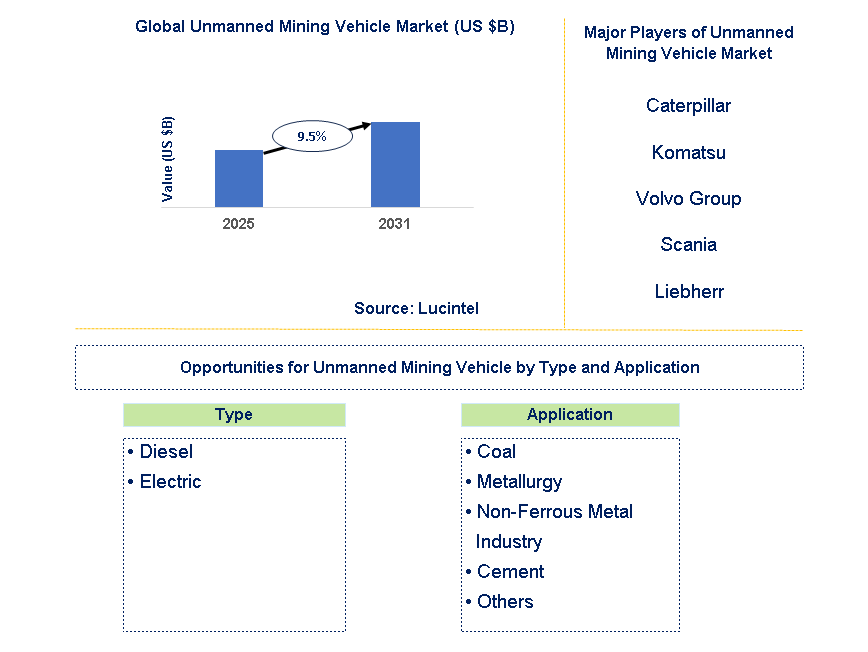
Key data points: The growth forecast = 9.5% annually for the next 7 years. Scroll below to get more insights. This market report covers Trends, opportunities and forecasts in unmanned mining vehicle market to 2031 by type (diesel and electric), application (coal, metallurgy, non-ferrous metal, cement, and others), and region (North America, Europe, Asia Pacific, and the Rest of the World)
We'll send your sample report shortly.
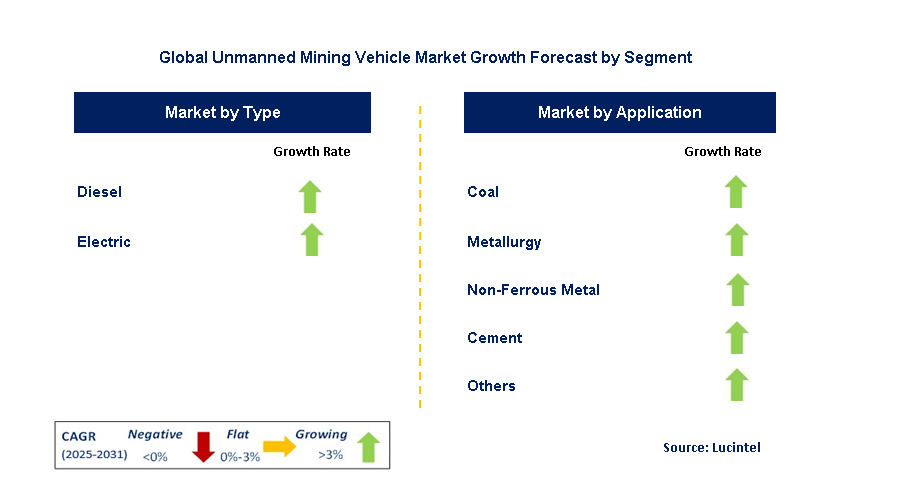
• Lucintel forecasts that, within the type category, diesel is expected to witness higher growth over the forecast period due to its high performance and durability.
• Within the application category, coal is expected to witness the highest growth due to increasing demand for efficient transportation.
• In terms of region, APAC is expected to witness the highest growth over the forecast period due to rising focus on automation in this region.
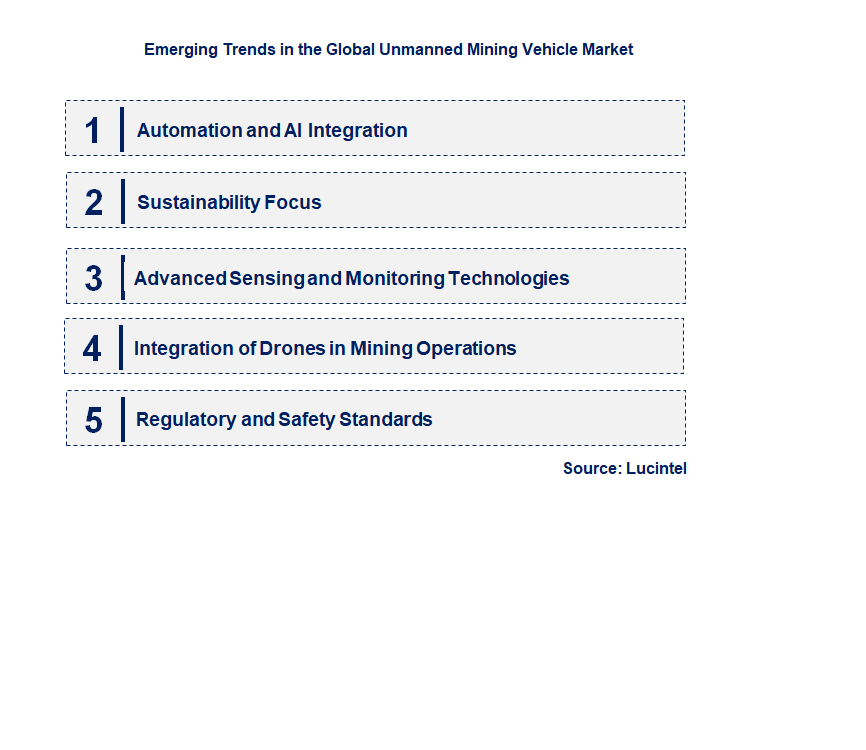
• Automation and AI Integration: Automation and AI are enhancing the functionality of UMVs, allowing for fully autonomous operations in harsh environments. AI-driven systems improve decision-making, optimize workflows, and reduce operational errors. The integration of machine learning algorithms enables unmanned vehicles to adapt to dynamic mining conditions, ensuring maximum efficiency and safety. This trend is paving the way for a fully automated mining environment, reducing the need for human labor and minimizing operational risks.
• Sustainability Focus: As mining operations come under increasing scrutiny for their environmental impact, the demand for eco-friendly unmanned vehicles is rising. Electric-powered and hybrid UMVs are gaining popularity as they reduce emissions and improve fuel efficiency. These vehicles contribute to the sustainability goals of mining companies, as they minimize carbon footprints while maintaining high performance. The push for greener technologies is accelerating the adoption of UMVs in regions with stringent environmental regulations.
• Advanced Sensing and Monitoring Technologies: Advanced sensors, cameras, and GPS systems are being developed to improve the accuracy and reliability of unmanned vehicles. Real-time data collection and analysis allow operators to monitor mining operations from a distance, detecting potential problems before they become critical. These technologies enhance the safety and effectiveness of UMVs, reducing accidents and enhancing the overall mining experience. Sensing technologies also play a key role in environmental monitoring, ensuring compliance with safety and sustainability regulations.
• Integration of Drones in Mining Operations: Drones are becoming an integral part of unmanned mining vehicle fleets. Used for surveying, inspection, and mapping, drones provide real-time data and enable quick decision-making. Drones help monitor mine conditions, assess stockpiles, and identify operational inefficiencies. The combination of drones with autonomous vehicles is enhancing the overall productivity of mining operations and streamlining logistics. This trend is making mining operations more efficient and cost-effective.
• Regulatory and Safety Standards: As unmanned mining vehicles become more common, regulatory bodies are working to establish safety standards and guidelines. Governments are introducing frameworks to ensure that these technologies are deployed safely and effectively. The development of standardized regulations will help integrate UMVs into the mining industry, providing consistency and ensuring that safety measures are in place. Regulatory clarity will also provide companies with the confidence to invest in unmanned vehicle technology. These emerging trends are reshaping the unmanned mining vehicle market by focusing on automation, sustainability, and safety. As these technologies evolve, mining companies will be able to operate more efficiently, reduce environmental impact, and improve safety in hazardous environments. The UMV market is expected to continue growing as these trends take shape, with significant investments in innovation and development. The future of mining is poised to be increasingly automated, efficient, and environmentally responsible.
• Autonomous Haul Trucks: Major mining companies are investing heavily in autonomous haul trucks, which are capable of operating without human intervention. These trucks use AI and advanced sensors to navigate mining sites, transport materials, and avoid obstacles. This development improves operational efficiency, reduces labor costs, and minimizes safety risks associated with human workers. Autonomous haul trucks are being integrated into large-scale mining operations, marking a significant shift toward automation in the mining industry.
• Survey and monitoring with adoption of unmanned drones: Drones have increasingly dominated mining operations that involve giving mining sites an overview for survey mapping, environmental conditions, and various monitoring processes in a mine site. The acquired real-time information from the mines is used and analyzed to present an assessment on site conditions; the state of stockpiles and performance. It makes mining more efficient while maintaining safety factors if drones could be combined and used with the unmanned vehicles as a decision making tool.
• Electric and Hybrid Unmanned Vehicles: With sustainability at the forefront of global mining practices, the development of electric and hybrid unmanned vehicles is becoming a significant trend. These vehicles reduce carbon emissions and offer cost savings through improved fuel efficiency. The adoption of electric and hybrid UMVs is aligning with the industry's goals to reduce its environmental footprint while maintaining operational performance. This development is driving the transition to greener mining technologies and promoting sustainability in the industry.
• Advancement in Remote Monitoring Systems: Remote monitoring systems are enhancing the capabilities of unmanned vehicles in mining operations. These systems allow operators to monitor vehicle performance, gather data, and manage operations from a centralized location. With the help of these systems, mining companies can ensure that unmanned vehicles are functioning optimally, reducing downtime and improving productivity. This technology also enables real-time response to any operational issues, improving the overall efficiency of mining operations.
• Improved Safety Features: The incorporation of advanced safety features in unmanned mining vehicles, such as collision avoidance systems, emergency shutdown protocols, and real-time communication networks, is making mining operations safer. These technologies reduce the risk of accidents, protect workers, and minimize damage to equipment. The focus on safety is driving the adoption of unmanned vehicles in more dangerous mining environments, further accelerating the growth of the UMV market. Recent trends in the unmanned mining vehicle market are revolutionizing the mining industry by increasing efficiency, safety, and sustainability. These advancements will help companies meet the growing demand for minerals while reducing operational costs and environmental impact. Autonomous trucks, drones, electric vehicles, and remote monitoring systems are all paving the way for a more automated, safer, and greener mining future. New and innovative UMV technologies are the primary drivers that will lead to significant growth in the market.
• Autonomous Haulage Systems: The implementation of autonomous haulage systems (AHS) is one of the most promising growth opportunities in the UMV market. These systems involve self-driving trucks that transport materials within mines. By improving transportation efficiency, reducing operational costs, and increasing productivity, AHS solutions are gaining traction in large mining operations. The demand for these systems is expected to grow, driven by their ability to minimize human labor and enhance safety.
• Exploration and Monitoring Drones: Mining sites are increasingly being explored, surveyed, and monitored by drones. UAVs can obtain rapid data on the mine's condition, keep track of stockpiles, and assess environmental conditions. Therefore, the use of drones is anticipated to be widespread when mining companies look for efficient ways to monitor the operations, assess safety, and optimize the use of resources. Of late, this has become pertinent in the remote and difficult locations used for mining.
• Electric and Hybrid Unmanned Vehicles: As mining companies focus on reducing their environmental footprint, electric and hybrid unmanned vehicles are gaining popularity. These vehicles offer a sustainable alternative to traditional diesel-powered machines by reducing emissions and improving fuel efficiency. The demand for electric and hybrid UMVs is expected to rise as regulatory pressure and environmental concerns increase. This offers opportunities for companies to create and promote greener technologies in line with the industry's sustainability goals.
• AI and Machine Learning in Unmanned Mining Vehicles for Optimization: A key growth area for unmanned mining vehicles is their integration with AI and machine learning. These two technologies allow for real-time vehicle decision-making by analyzing data for efficient operations, with minimal human interference. Optimization of the mining process through route planning and material handling with AI-driven UMVs is a significant growth factor in the market.
• Regulatory Compliance and Safety Standards: In the growth of the UMV market, regulatory compliance and safety standards are at their core. Governments around the world are introducing frameworks for the safe deployment of unmanned vehicles in mining operations. Companies that develop UMVs in compliance with these regulations will have a competitive advantage in global markets. The establishment of clear safety standards will also help build trust and encourage the wider adoption of unmanned vehicles in the mining sector. Strategic opportunities for the unmanned mining vehicle market focus on automation, sustainability, and safety. Businesses that invest in autonomous haulage systems, drones, electric vehicles, and AI-powered optimization will be best poised to benefit from the demand currently growing for unmanned vehicles in mining. This focus on key areas will drive growth in the UMV market by enhancing efficiency, reducing environmental impact, and improving the levels of safety.
• Caterpillar
• Komatsu
• Volvo Group
• Scania
• Liebherr
• American Strategic Insurance
• Hitachi
• Doosan
• Epiroc
• Beijing Easy Control Intelligent Driving Technology
• Diesel
• Electric
• Coal
• Metallurgy
• Non-Ferrous Metal
• Cement
• Others
• North America
• Europe
• Asia Pacific
• The Rest of the World
• United States: The United States is at the forefront of UMV adoption, driven by the country’s robust technological capabilities and strong mining sector. Key advancements include the development of autonomous haul trucks and unmanned drones for surveying and inspection. Companies like Caterpillar and Komatsu are investing heavily in automation and AI-driven systems, which are aimed at reducing costs and enhancing operational efficiency. Additionally, the regulatory environment in the U.S. is becoming more favorable for unmanned vehicles, with government agencies working to standardize rules for autonomous mining equipment. These developments are positioning the U.S. as a global leader in UMV technology.
• China: China’s UMV market is booming, supported by its large-scale mining operations and government initiatives to embrace automation. The country’s investments in smart mining technologies are driving advancements in autonomous vehicles, robotic trucks, and drones. China’s government is offering subsidies and incentives to encourage the use of unmanned vehicles in mining to improve safety and increase productivity. Companies like SANY and XCMG are leading the development of unmanned machinery for mining operations. As China continues to push for automation in industries, the UMV market is expected to grow significantly in the coming years.
• Germany: Germany is focusing on the integration of Industry 4.0 technologies in the mining sector, which includes the use of unmanned vehicles. Companies like Siemens and Liebherr are leading the development of autonomous mining trucks and robots designed to optimize extraction processes and reduce environmental impact. Germany’s strong emphasis on sustainability and energy efficiency is reflected in its UMV technologies, with a focus on electric and hybrid unmanned vehicles. The country’s regulatory environment also supports the widespread adoption of these technologies, making Germany one of the key players in the European UMV market.
• India: India is witnessing rapid growth in its UMV market, spurred by the need to address safety concerns and inefficiencies in its mining sector. The use of unmanned vehicles, such as autonomous trucks and drones, is becoming more common in large-scale mining operations. With an increasing focus on automation, companies in India are looking to improve productivity while ensuring worker safety. Government policies that encourage the adoption of advanced technologies are also playing a key role. As India’s mining sector modernizes, UMVs are expected to be a significant part of its industrial transformation.
• Japan: Japan is leading in robotics and automation, and its mining sector is adopting unmanned vehicles to enhance efficiency and reduce labor costs. Komatsu and Hitachi are some of the companies that pioneer unmanned mining trucks, drones, and remote-controlled excavation machines. Excellent precision engineering skills have permitted Japan to advance highly advanced UMVs for mining applications. With Japan’s aging population and labor shortages, the use of unmanned vehicles is increasingly seen as a solution to meet demand while reducing risks associated with human workers. These advancements are positioning Japan as a key player in the global UMV market.


• Caterpillar
• Komatsu
• Volvo Group
• Scania
• Liebherr
• American Strategic Insurance
• Hitachi
• Doosan
• Epiroc
• Beijing Easy Control Intelligent Driving Technology Q5. Which unmanned mining vehicle market segment will be the largest in future? Answer: Lucintel forecasts that, within the type category, diesel is expected to witness higher growth over the forecast period due to its high performance and durability. Q6. In unmanned mining vehicle market, which region is expected to be the largest in next 5 years? Answer: In terms of region, APAC is expected to witness the highest growth over the forecast period due to rising focus on automation in this region. Q7. Do we receive customization in this report? Answer: Yes, Lucintel provides 10% customization without any additional cost.


Choose a license that fits your team. Instant PDF delivery.
Prices exclude taxes. Instant delivery. Custom licensing available on request.
Market Report · July 31, 2026
Market Report · July 17, 2026
Market Report · May 18, 2026
Trusted partner for strategic intelligence and business growth


Receive a complimentary market analysis tailored to your industry. Our analysts will identify key growth opportunities and competitive dynamics specific to your business.

Market size, growth rate, and key trend analysis for your specific sector.

Top competitor positioning and market share analysis.

Strategic recommendations backed by data-driven insights.
Get curated market intelligence and competitive moves straight to your inbox.
By subscribing, you agree to receive our monthly insights. Unsubscribe anytime.
Receive a complimentary market analysis tailored to your industry. Our analysts will identify key growth opportunities and competitive dynamics specific to your business.
Market size, growth rate, and key trend analysis for your specific sector.
Top competitor positioning and market share analysis.
Strategic recommendations backed by data-driven insights.
Get curated market intelligence, emerging trends, and competitive moves straight to your inbox each month.
By subscribing, you agree to receive our monthly insights. Unsubscribe anytime.
We'll send your sample report shortly.