
Wireless Electric Vehicle (EV) Charging System Market
The future of the global wireless electric vehicle (EV) charging system market looks promising with opportunities in the electric passenger cars, electric commercial vehicle and electric two wheeler markets. The global wireless electric vehicle (EV) charging system market is expected to reach an estimated $1694 million by 2035 with a CAGR of 33% from 2026 to 2035. The major drivers for this market are the increasing ev adoption boosting charging demand, the rising smart mobility driving wireless charging growth and the growing infrastructure supporting ev charging expansion.
• Lucintel forecasts that, within the charging type category, none will remain the largest segment over the forecast period as the rising smart mobility trends supporting wireless charging system growth.
• Within the end use category, electric passenger cars will remain the largest segment due to the the growing charging infrastructure enhancing passenger car deployment.
• In terms of regions, APAC will remain the largest region over the forecast period due to the the increasing ev adoption boosting wireless charging demand.
Gain valuable insights for your business decisions with our comprehensive 150+ page report.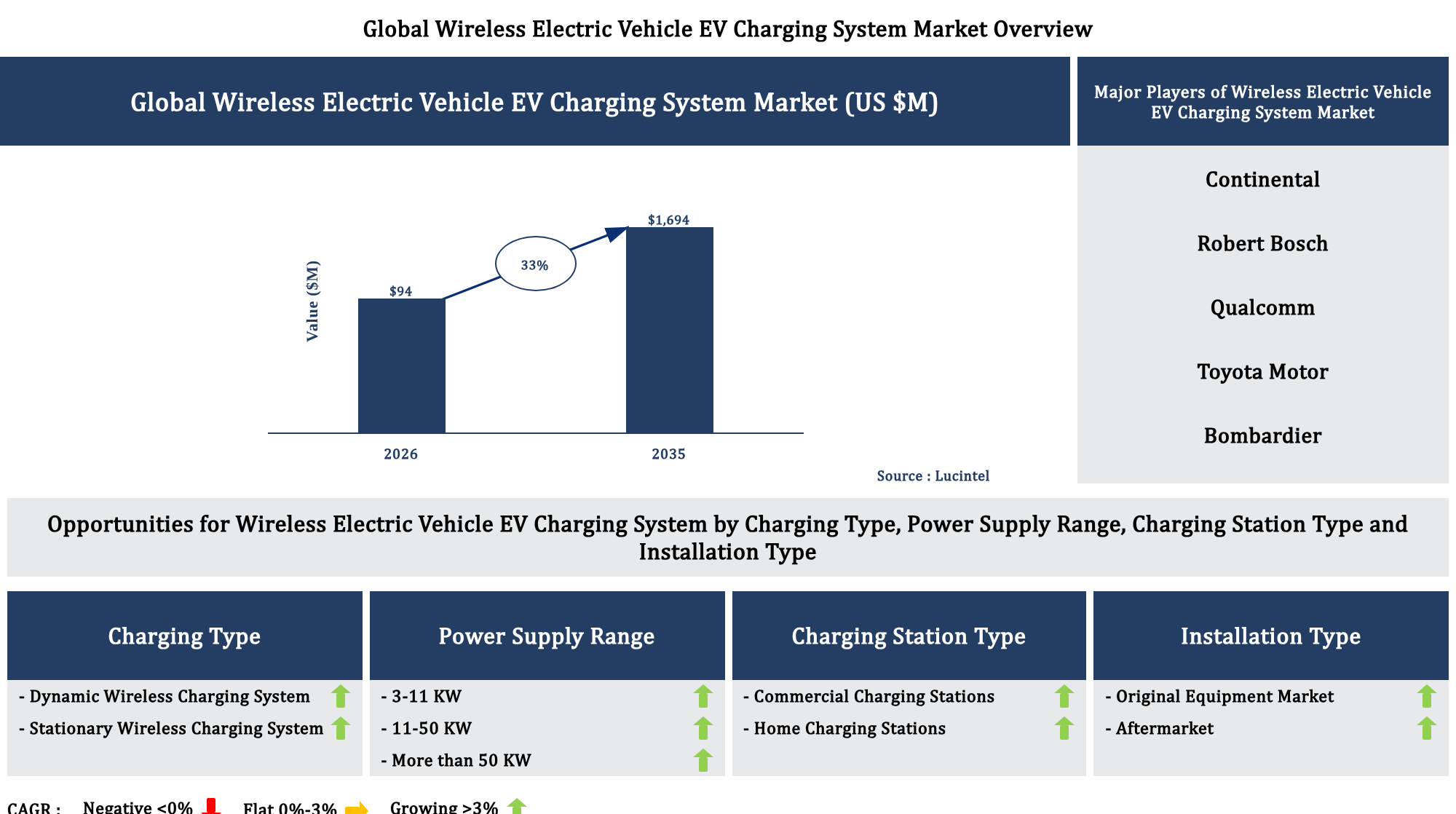
Emerging Trends in the Wireless Electric Vehicle (EV) Charging System Market
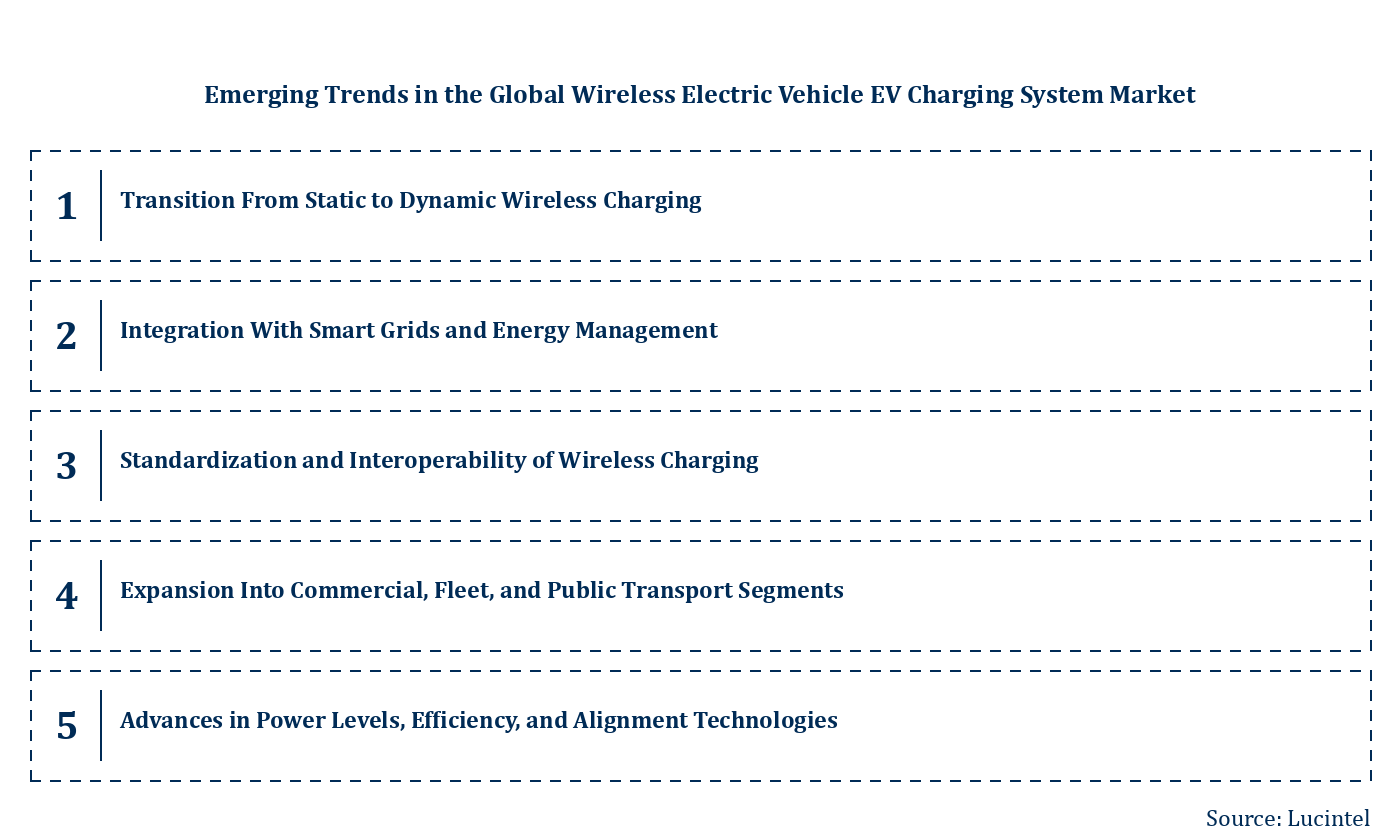
The wireless electric vehicle (EV) charging system market is evolving rapidly as automakers, utilities, and technology providers seek more convenient, automated, and efficient charging solutions. Growing EV adoption, urban congestion, and the need for seamless user experiences are accelerating investment in inductive charging pads, dynamic charging lanes, and intelligent grid integration. Standardization efforts and pilot deployments in public, residential, and commercial settings are moving the technology from proof-of-concept to scalable business models. These emerging trends are reshaping how drivers refuel, how cities manage energy flows, and how infrastructure is planned, ultimately supporting broader decarbonization and smart mobility objectives worldwide.
Recent Developments in the Wireless Electric Vehicle (EV) Charging System Market
The wireless electric vehicle (EV) charging system market is evolving rapidly as automakers, utilities, and technology providers work to remove friction from EV ownership and enable more seamless energy management. Growing EV adoption, urbanization, and fleet electrification are accelerating investment in wireless charging technologies that can operate in homes, workplaces, public spaces, and depots. Recent developments span standardization efforts, infrastructure pilots, component miniaturization, and integration with smart grids and autonomous driving. Together, these advances are improving efficiency, lowering total cost of ownership, and expanding use cases, positioning wireless charging as a critical enabler of next‑generation electric mobility worldwide.
Strategic Growth Opportunities in the Wireless Electric Vehicle (EV) Charging System Market
The wireless electric vehicle (EV) charging system market is entering a pivotal expansion phase as automakers, fleets, and infrastructure providers seek more convenient and automated charging solutions. Wireless charging unlocks new use cases, from seamless residential charging to dynamic in-motion power transfer on highways and bus lanes. Across passenger vehicles, commercial fleets, public transit, shared mobility, and smart city infrastructure, applications are converging around efficiency, user experience, and grid integration. As standards mature and costs decline, strategic opportunities are emerging for technology vendors, utilities, and mobility operators to build differentiated offerings and long-term revenue models.
Wireless Electric Vehicle (EV) Charging System Market Drivers and Challenges
The global wireless electric vehicle (EV) charging system market is shaped by a complex interplay of technological innovation, economic viability, infrastructure evolution, and regulatory direction. Growing EV adoption, the push for decarbonization, and the need for more convenient charging experiences are accelerating interest in wireless solutions. At the same time, high development costs, interoperability concerns, and safety regulations create meaningful barriers. Understanding how these drivers and challenges interact is critical for automakers, technology vendors, utilities, and policymakers aiming to scale wireless charging from pilot deployments to mass-market adoption while ensuring reliability, safety, and long-term commercial sustainability.
The factors responsible for driving the wireless electric vehicle (EV) charging system market include:
The challenges in the wireless electric vehicle (EV) charging system market are:
The global wireless electric vehicle (EV) charging system market is propelled by advances in wireless power technology, accelerating EV penetration, and the search for frictionless, automated charging experiences within smart and autonomous mobility ecosystems. At the same time, elevated costs, limited standardization, safety requirements, and infrastructure complexity restrain faster commercialization and scale. Stakeholders that effectively navigate these drivers and challenges through collaborative standards development, targeted subsidies, focused fleet applications, and integrated grid planning are best positioned to unlock sustainable growth. Over time, progress on these fronts will determine whether wireless charging becomes a mainstream option or remains a niche premium feature.
List of Wireless Electric Vehicle (EV) Charging System Market Companies
Companies in the market compete on the basis of product quality offered. Major players in this market focus on expanding their manufacturing facilities, R&D investments, infrastructural development, and leverage integration opportunities across the value chain. Through these strategies wireless electric vehicle (EV) charging system market companies cater increasing demand, ensure competitive effectiveness, develop innovative products & technologies, reduce production costs, and expand their customer base. Some of the wireless electric vehicle (EV) charging system market companies profiled in this report include-
Wireless Electric Vehicle (EV) Charging System Market by Segment
The study includes a forecast for the global wireless electric vehicle (EV) charging system market by charging type, power supply range, charging station type, installation type, component, propulsion type, end use, and region.
Country Wise Outlook for the Wireless Electric Vehicle (EV) Charging System Market
The wireless electric vehicle (EV) charging system market is progressing from pilot projects to early commercialization, driven by the need for convenient, autonomous, and high‑utilization charging infrastructure. Advances in power electronics, coil design, communication protocols, and vehicle integration are enabling higher transfer efficiencies and dynamic charging at low and moderate speeds. Automakers, utilities, and technology suppliers are increasingly collaborating to standardize interfaces and test interoperability across platforms. Regulatory interest is growing around safety, electromagnetic compatibility, and metering. Recent developments in the United States, China, Germany, India, and Japan highlight distinct strategic priorities and innovation paths in this emerging segment.
Features of the Wireless Electric Vehicle (EV) Charging System Market
Article
Wireless Electric Vehicle (EV) Charging System Market: Which Forces Are Quietly Redrawing the EV Landscape?
Dallas, July 21, 2026 – The wireless electric vehicle (EV) charging system market is moving from futuristic concept to commercial reality, reshaping how drivers think about energy access, how cities plan infrastructure, and how automakers design next-generation platforms. As EV adoption accelerates and pressure mounts to simplify charging, wireless solutions are emerging as a strategic inflection point, with resonant inductive and magnetic field technologies enabling charge pads in garages, parking lots, depots, and eventually roadways. This market is now defined by rapid experimentation, high-stakes standardization battles, and a race to prove bankable business models that extend far beyond passenger cars.
What Core Technology and Business Trends Are Defining the Wireless EV Charging System Market?
The wireless EV charging system market is being reshaped by a cluster of interlocking trends in hardware, software, and business design rather than a single breakthrough. A key trend is the shift from low-power demonstration systems to higher-power solutions targeting daily operational use for both consumer and commercial fleets. Vendors are pushing beyond 3.7 to 7 kW residential pads toward 11, 22, and even 50 kW wireless systems, with pilot projects exploring megawatt-class charging for heavy-duty applications. Another defining trend is the convergence of wireless charging with vehicle connectivity, where cloud platforms manage authentication, billing, and load balancing across distributed charging pads as part of integrated energy and mobility ecosystems. Increasingly, wireless EV charging is positioned not just as a convenience feature but as a software-defined service woven into broader smart grid and smart city architectures.
How Is Wireless EV Charging Transforming User Experience and Daily Charging Behavior?
Behavioral change sits at the heart of this market’s disruption potential. Wireless EV charging removes the visible ritual of plug-in connections and replaces it with near-invisible energy transfer, which could dramatically increase compliance with charging routines for both private drivers and fleet operators. By turning parking time into charging time with no manual intervention, these systems aim to mitigate range anxiety, reduce dwell time requirements at public chargers, and support higher vehicle utilization. Over time, vehicles could opportunistically top up in office garages, retail parking lots, taxi stands, and logistics depots, shifting the mental model of charging from episodic, high-intensity events to continuous, background replenishment. This transition demands reliable alignment, high energy transfer efficiency, and user interfaces that make charging status transparent despite the absence of visible cables and connectors.
Where Will the Strongest Market Impact and Disruption Be Felt Across Mobility Segments?
Disruption will not be uniform across all EV segments, with certain markets poised to realize outsized benefits. Commercial and municipal fleets represent one of the most attractive early markets because they operate on predictable routes and in controlled environments where charging pads can be deployed systematically. Transit buses, last-mile delivery vans, ride-hail fleets, and autonomous shuttle services can achieve high utilization by installing wireless charging pads at depots, layover stops, or key route nodes, thereby cutting idle refueling time and increasing asset productivity. Passenger vehicles in urban and suburban settings will also experience meaningful impact, particularly for drivers without dedicated home charging access, if cities and property owners retrofit parking infrastructure with embedded pads. Over time, logistics yards, ports, airports, and industrial campuses are expected to adopt wireless charging to reduce cable clutter and safety risks in high-traffic operational areas.
Why Is Dynamic (On-the-Move) Wireless Charging Seen as a Strategic Game Changer?
One of the most ambitious trajectories for the wireless EV charging system market is dynamic charging, in which vehicles receive power while moving along equipped road segments. Although still largely in pilot and early demonstration phases, dynamic wireless charging carries the potential to structurally change EV design constraints by enabling smaller onboard batteries, longer effective range, and reduced charging stops. Strategic corridors for freight transport, bus rapid transit lanes, and high-density commuter routes are under evaluation for such deployments. If cost and standardization challenges can be resolved, dynamic charging could tilt the economics of long-distance electrified logistics and intercity travel, with knock-on effects for battery supply chains, energy storage business models, and highway infrastructure planning.
How Are Interoperability, Standards, and Ecosystems Shaping Competitive Advantage?
Interoperability has become a central strategic battleground. Industry alliances, standards bodies, and consortia are working toward common specifications for power transfer levels, frequency bands, alignment tolerance, and communication protocols between vehicle receivers and ground transmitters. Automakers, charger manufacturers, semiconductor firms, and utilities are all seeking influence over these emerging standards to ensure compatibility and protect future option value. Companies that deliver robust, standards-compliant systems which work seamlessly across multiple vehicle brands and charging operators will be best positioned to scale, while proprietary, closed approaches risk isolation. The ability to integrate wireless charging data into mobility platforms, fleet management systems, and utility demand response programs is evolving into a competitive differentiator that extends beyond the hardware into software and services.
Which Key Challenges Could Slow Adoption of Wireless EV Charging Systems?
Where Do the Most Attractive Opportunities Emerge for Innovators and Investors?
What Use Cases in the Technology Industry Are Accelerating Market Validation?
The technology industry is playing a pivotal role in validating and scaling wireless EV charging by embedding it into broader digital and automation solutions. One prominent use case is autonomous vehicle operations, where self-driving cars and shuttles require fully automated, human-free charging that wireless systems can uniquely provide. Cloud-connected fleet management platforms integrate wireless charging data to optimize routing, charging schedules, and energy procurement. In smart city projects, technology vendors are integrating wireless charging pads with sensors, computer vision, and edge computing devices to manage traffic, parking, and charging availability dynamically. Within large technology campuses and industrial sites, autonomous mobile robots and electric utility vehicles use wireless pads to maintain uptime without manual plug-in, providing a test bed for robust, high-cycle charging systems that can later extend to public roads and urban deployments.
How Are Recent Developments and Strategic Moves Signaling Market Maturity?
Recent developments indicate that the wireless EV charging system market is shifting from experimental pilots to commercially oriented rollouts. Automakers are announcing factory-fit wireless charging options for select premium models and are working with tier-one suppliers to integrate receivers into vehicle platforms at scale. Charging solution providers have begun to secure multi-year agreements with logistics companies, transit agencies, and property owners to deploy pads in depots, bus stops, and parking structures, often bundled with software and maintenance contracts. Alliances between technology companies and utilities are emerging to test time-of-use tariffs, grid-responsive charging algorithms, and integration with distributed energy resources such as rooftop solar and stationary storage. Regulators and standards bodies are also stepping up activity, with test protocols, safety guidelines, and interoperability frameworks progressing, which will reduce risk and support broader investment.
What Strategic Questions Should Stakeholders Be Asking Now?
As the wireless EV charging system market advances toward broader commercialization, stakeholders across the value chain face critical timing and positioning decisions. Automakers must determine how aggressively to embed wireless receivers into new platforms and whether to treat wireless charging as a premium feature or a foundational capability. Fleet operators need to quantify lifetime cost and productivity gains from automated charging and weigh them against upfront capital and infrastructure disruption. Utilities must assess the grid implications of highly distributed, often invisible charging loads, while equipment vendors decide where to place bets between static pad systems and more ambitious dynamic roadway deployments. Those who align technology roadmaps, partnerships, and capital allocation with the most promising use cases in fleets, property infrastructure, and autonomous mobility stand to benefit as wireless EV charging moves from niche innovation to mainstream element of the electrified transport ecosystem.
Top 5 Companies
1. Continental
Continental is a Germany-based technology company with a strong position in automotive systems, including emerging solutions for wireless electric vehicle (EV) charging systems. Headquartered in Hanover and established in 1871, the company employs more than 200,000 people across Europe, North America, Asia-Pacific, and other regions, supporting a broad geographic presence in major automotive manufacturing hubs. Continental’s portfolio in and around the wireless EV charging system market spans power electronics, intelligent charging control units, sensors, connectivity modules, and software platforms that enable automated alignment, communication, and billing for inductive charging. The company collaborates with automakers and infrastructure providers to integrate wireless charging coils and vehicle-side receivers into next-generation EV platforms, focusing on safety, efficiency, and interoperability with smart grids. Continental has been involved in pilot projects and testbeds in Europe and North America to validate automatic wireless charging in urban parking, fleets, and residential environments. Its broader electrification strategy includes high-voltage components, battery management systems, and thermal management that complement wireless charging deployments. While Continental has not publicly announced large-scale mergers or acquisitions dedicated solely to wireless EV charging, it has pursued technology partnerships and selective investments in e-mobility and software firms to enhance its competencies in power transfer, positioning systems, and over-the-air update capabilities. These moves strengthen the company’s role as a system integrator for advanced charging technologies, including static and potential dynamic wireless charging segments.
2. Robert Bosch
Robert Bosch GmbH is a diversified engineering and technology company headquartered in Gerlingen, Germany, with more than 400,000 employees and operations in over 60 countries. Bosch is a key supplier to global automakers and has been expanding its electrification and charging solutions portfolio, including technologies relevant to the wireless electric vehicle (EV) charging system market. The company develops power electronics, on-board chargers, control units, and software platforms that can be integrated with inductive charging pads and vehicle receiver units. Bosch’s expertise in sensors, radar, cameras, and automated parking systems allows it to offer integrated solutions that assist vehicles in precisely positioning over wireless charging pads, enabling efficient energy transfer and user-friendly experiences for both private and fleet customers. The company is active in collaborations and pilot programs in Europe, North America, and Asia involving wireless charging for passenger cars, commercial vehicles, and autonomous shuttles. Bosch’s global manufacturing and R&D footprint, including centers in Germany, the United States, China, India, and Japan, supports development and localization of wireless charging components and control software. Bosch has engaged in multiple partnerships and minority investments in e-mobility startups and software companies, some of which involve intelligent charging and energy management capabilities that are complementary to wireless charging. While there have been no headline-grabbing acquisitions focused purely on wireless EV charging, Bosch’s strategic moves in electrification, connectivity, and mobility services reinforce its positioning as a solutions provider capable of bundling wired and wireless charging offerings for automotive OEMs and infrastructure operators worldwide.
3. Qualcomm
Qualcomm, headquartered in San Diego, California, is a global leader in wireless communications and semiconductor technologies with more than 50,000 employees and operations spanning North America, Europe, and Asia. The company has played an important pioneering role in wireless electric vehicle (EV) charging through its Qualcomm Halo technology, which focused on inductive power transfer for passenger cars and high-performance vehicles. Qualcomm’s wireless EV charging activities combined power electronics, resonant inductive coils, communication protocols, and position detection to enable convenient charging without physical cables. Its technology demonstrations and pilot projects in Europe and the United States showcased both static and limited dynamic wireless charging, supporting charging while parked and, in some trials, while vehicles moved along specially equipped road segments. To scale commercialization, Qualcomm licensed its Halo wireless charging technology and related intellectual property to industry players, most notably through an agreement where the IP and commercialization rights were transferred to WiTricity, allowing an ecosystem around standard-based wireless charging to emerge. This transaction, while not an acquisition of Qualcomm itself, represented a major strategic move that shaped the structure of the wireless EV charging market, consolidating key patents under a focused charging specialist while Qualcomm continued to benefit from licensing. Qualcomm’s broader automotive portfolio, including telematics, connectivity, and in-vehicle computing platforms, positions the company as an enabler of integrated charging, connectivity, and data services. Its geographic presence in key automotive markets such as the United States, Germany, China, Japan, and South Korea supports ongoing collaboration with automakers and Tier 1 suppliers working on advanced wireless charging solutions aligned with global standards.
4. WiTricity
WiTricity, headquartered in Watertown, Massachusetts, is a specialized technology company focused on wireless power transfer and is one of the most prominent pure-play participants in the wireless electric vehicle (EV) charging system market. Established in 2007 as a spin-out from research at the Massachusetts Institute of Technology, the company has a relatively small but highly technical workforce and collaborates extensively with global automotive manufacturers and Tier 1 suppliers rather than relying on large in-house manufacturing. WiTricity’s core portfolio includes resonant inductive wireless charging platforms for passenger vehicles, fleets, and micro-mobility solutions, covering both vehicle-side receiver systems and ground-side transmit pads. The company offers reference designs, licensing programs, and engineering support to enable automakers to integrate interoperable wireless charging capabilities that align with emerging standards. WiTricity has established partnerships and pilot deployments across North America, Europe, and Asia, working with OEMs and city authorities to deploy residential, commercial, and public wireless charging infrastructure. A pivotal step in the company’s growth was its acquisition of Qualcomm Halo-related patents and technology rights for wireless EV charging, which significantly expanded its intellectual property portfolio and consolidated key foundational IP under WiTricity’s control. This transaction strengthened WiTricity’s position as a licensing and technology hub for the market. The company continues to explore geographic expansion through agreements in China, Europe, and the Middle East, targeting passenger vehicles, taxis, and autonomous shuttles. WiTricity’s business model centers on technology development, standardization, and licensing rather than mass production, positioning it as a critical enabler for multiple automotive brands seeking to commercialize wireless EV charging solutions globally.
5. Evatran Group
Evatran Group, based in Richmond, Virginia, is a company dedicated to wireless electric vehicle (EV) charging solutions, best known under its Plugless Power brand. Founded in 2009, Evatran focuses on aftermarket and retrofit wireless charging systems for existing EV models, serving individual consumers, fleets, and commercial operators. The company’s product portfolio includes vehicle adapter kits and ground-based charging pads that enable inductive charging without cables, typically offering power levels suitable for overnight home charging and workplace or fleet applications. Evatran has developed systems compatible with multiple EV models from major automakers and has worked with dealers and installation partners across North America to expand adoption. Its technology integrates coil assemblies, alignment aids, and safety interlocks, as well as communication interfaces that coordinate with vehicle charging systems and user interfaces. The company maintains a regional presence in the United States and has explored partnerships to reach customers in Canada and selected international markets. Evatran has engaged in collaboration agreements and strategic investments, including partnerships with automotive and industrial groups that provided capital and manufacturing support to refine its Plugless platform and scale production. While there have not been widely publicized large-scale mergers or acquisitions centered solely on Evatran, the company’s capital infusions and technology alliances with automotive ecosystem participants have been important to its evolution. Evatran continues to position itself as a practical, user-focused provider of wireless charging upgrades, complementing OEM-integrated wireless solutions and contributing to the broader growth and visibility of wireless EV charging technologies.
Table of Contents
List of Figures
List of Tables
Methodology
Lucintel has been in the business of market research and management consulting since 2000 and has published over 1000 market intelligence reports in various markets / applications and served over 1,000 clients worldwide. This study is a culmination of four months of full-time effort performed by Lucintel's analyst team. The analysts used the following sources for the creation and completion of this valuable report:
- In-depth interviews of the major players in this market
- Detailed secondary research from competitors' financial statements and published data
- Extensive searches of published works, market, and database information pertaining to industry news, company press releases, and customer intentions
- A compilation of the experiences, judgments, and insights of Lucintel's professionals, who have analyzed and tracked this market over the years.
Extensive research and interviews are conducted across the supply chain of this market to estimate market share, market size, trends, drivers, challenges, and forecasts. Below is a brief summary of the primary interviews that were conducted by job function for this report.

Thus, Lucintel compiles vast amounts of data from numerous sources, validates the integrity of that data, and performs a comprehensive analysis. Lucintel then organizes the data, its findings, and insights into a concise report designed to support the strategic decision-making process. The figure below is a graphical representation of Lucintel's research process.

Buy Now
Choose a license that fits your team. Instant PDF delivery.
Prices exclude taxes. Instant delivery. Custom licensing available on request.
Frequently Asked Questions
What is the Wireless Electric Vehicle (EV) Charging System Market size?
What is the growth forecast for Wireless Electric Vehicle (EV) Charging System Market?
What are the major drivers influencing the growth of the Wireless Electric Vehicle (EV) Charging System Market?
What are the major segments for Wireless Electric Vehicle (EV) Charging System Market?
Who are the key Wireless Electric Vehicle (EV) Charging System Market companies?
Which Wireless Electric Vehicle (EV) Charging System Market segment will be the largest in future?
In Wireless Electric Vehicle (EV) Charging System Market, which region is expected to be the largest in next 9 years?
Do we receive customization in this report?
Key Questions
- • What are some of the most promising, high-growth opportunities for the Wireless Electric Vehicle (EV) Charging System Market by Charging Type (Dynamic Wireless Charging System and Stationary Wireless Charging System), Power Supply Range (3-11 KW, 11-50 KW, and More than 50 KW), Charging Station Type (Commercial Charging Stations and Home Charging Stations), Installation Type (Original Equipment Market and Aftermarket), Component (Base Charging Pad, Power Control Unit, and Vehicle Charging Pad), Propulsion Type (Battery Electric Vehicle (BEV) and Plug-In Hybrid Electric Vehicle (PHEV)), End Use (Electric Passenger Cars, Electric Commercial Vehicle, and Electric Two Wheeler), and region (North America, Europe, Asia Pacific, and the Rest of the World)?
- • Which segments will grow at a faster pace and why?
- • Which region will grow at a faster pace and why?
- • What are the key factors affecting market dynamics? What are the key challenges and business risks in this market?
- • What are the business risks and competitive threats in this market?
- • What are the emerging trends in this market and the reasons behind them?
- • What are some of the changing demands of customers in the market?
- • What are the new developments in the market? Which companies are leading these developments?
- • Who are the major players in this market? What strategic initiatives are key players pursuing for business growth?
- • What are some of the competing products in this market and how big of a threat do they pose for loss of market share by material or product substitution?
- • What M&A activity has occurred in the last 9 years, and what has its impact been on the industry?


