
Intelligent Vending Machine Market Trends and Forecast
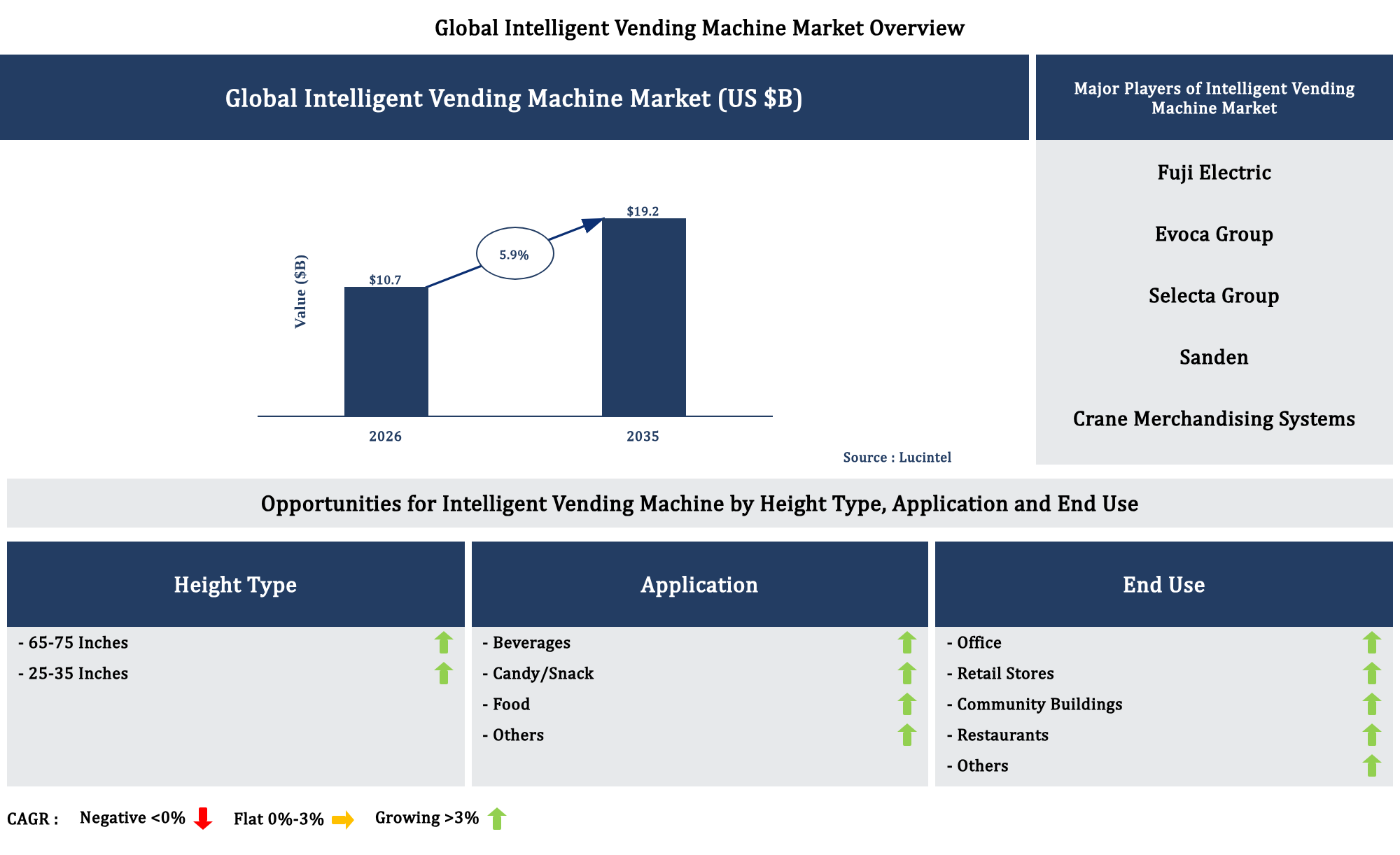
The future of the global intelligent vending machine market looks promising with opportunities in the office, retail store, community building, and restaurant markets. The global intelligent vending machine market is expected to reach an estimated $19233 million by 2035 with a CAGR of 5.9% from 2026 to 2035. The major drivers for this market are the rising adoption of cashless & digital payment systems, the increasing demand for energy-efficient & connected machines, and the growing demand for integration of ai & iot in vending machines.
• Lucintel forecasts that, within the height type category, 65–75 inch is expected to witness higher growth over the forecast period.
• Within the application category, is expected to witness the highest growth.
• In terms of region, APAC is expected to witness the highest growth over the forecast period.
Gain valuable insights for your business decisions with our comprehensive 150+ page report. Sample figures with some insights are shown below.
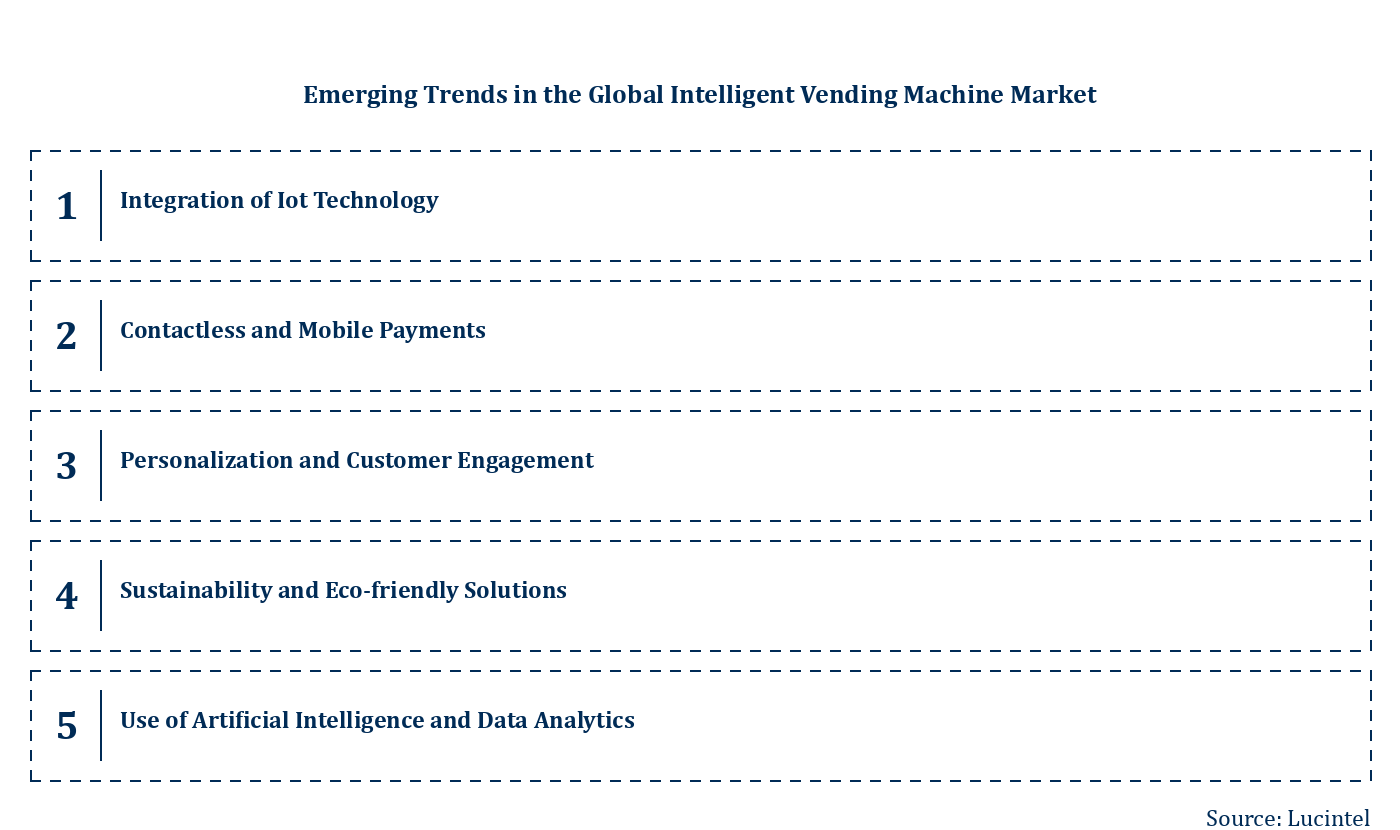
Emerging Trends in the Intelligent Vending Machine Market
The intelligent vending machine market is experiencing rapid growth driven by technological advancements, changing consumer preferences, and the need for enhanced convenience. As automation and digitalization become integral to retail environments, vendors are adopting innovative solutions to attract customers and improve operational efficiency. These developments are transforming traditional vending machines into smart, interactive, and personalized shopping experiences. The market‘s evolution is also influenced by the increasing demand for contactless payments, sustainability initiatives, and data-driven insights. These trends collectively are reshaping the landscape, creating new opportunities and challenges for industry stakeholders.
• Integration of IoT Technology: The adoption of Internet of Things (IoT) enables vending machines to connect with other devices and systems, providing real-time data on inventory, sales, and machine health. This connectivity allows for predictive maintenance, reducing downtime and operational costs. IoT integration also facilitates personalized customer experiences through targeted promotions and tailored product recommendations. As a result, vending machines become more efficient, responsive, and customer-centric, driving increased sales and customer satisfaction.
• Contactless and Mobile Payments: The shift towards contactless payment options, including mobile wallets and NFC technology, enhances convenience and safety for consumers. This trend is particularly significant in a post-pandemic world where hygiene concerns are paramount. Contactless payments reduce transaction times, minimize physical contact, and support a seamless shopping experience. Vendors adopting these payment methods can attract a broader customer base, improve transaction security, and streamline operations, ultimately boosting sales and customer loyalty.
• Personalization and Customer Engagement: Advanced data analytics and AI enable vending machines to offer personalized product suggestions based on customer preferences and purchase history. Interactive screens and digital interfaces foster engagement, allowing consumers to customize their orders and access promotional content. This trend enhances the overall customer experience, encourages repeat business, and provides valuable insights for vendors to optimize inventory and marketing strategies.
• Sustainability and Eco-Friendly Solutions: Growing environmental awareness is prompting vendors to incorporate sustainable practices, such as energy-efficient machines, recyclable packaging, and eco-friendly materials. Solar-powered vending machines and waste reduction initiatives are gaining popularity. These efforts not only reduce the environmental footprint but also appeal to eco-conscious consumers, strengthening brand reputation. Sustainability trends are influencing product offerings and operational practices, aligning the market with global environmental goals.
• Use of Artificial Intelligence and Data Analytics: AI-driven algorithms analyze sales data, customer behavior, and inventory levels to optimize stock management and pricing strategies. Machine learning models predict demand patterns, enabling better supply chain planning and reducing waste. AI also enhances customer service through chatbots and virtual assistants integrated into vending machines. These technologies empower vendors to make data-informed decisions, improve operational efficiency, and deliver a more personalized and responsive customer experience.
These emerging trends are fundamentally transforming the intelligent vending machine market by making machines smarter, more efficient, and customer-focused. The integration of IoT, contactless payments, personalization, sustainability, and AI is creating a more dynamic, sustainable, and engaging retail environment. As these trends continue to evolve, they will drive innovation, improve profitability, and redefine the future landscape of vending solutions.
Recent Developments in the Intelligent Vending Machine Market
The intelligent vending machine market is experiencing rapid growth driven by technological advancements and changing consumer preferences. Innovations in AI, IoT, and cashless payment systems are transforming traditional vending machines into smart, interactive, and highly efficient solutions. These developments are expanding market reach across various sectors, including retail, hospitality, and healthcare. As consumer demand for convenience and personalized experiences increases, companies are investing heavily in intelligent vending solutions to stay competitive and meet evolving expectations.
• Growth in AI-Powered Personalization: The integration of AI enables vending machines to offer tailored product recommendations, enhancing customer satisfaction and increasing sales. This personalization attracts more users, especially in retail and hospitality sectors, driving market expansion. The ability to analyze consumer data in real-time allows for dynamic inventory management and targeted marketing, making vending machines more efficient and user-friendly. Consequently, this fosters higher engagement and loyalty among consumers.
• Expansion of Cashless and Contactless Payments: The adoption of cashless and contactless payment options has revolutionized vending transactions, providing convenience and safety. This shift reduces transaction times and minimizes cash handling, lowering operational costs. It also appeals to tech-savvy consumers who prefer digital payments, broadening the customer base. As contactless payments become standard, vending machines equipped with NFC, QR code, and mobile wallet options are gaining popularity, boosting overall market growth.
• Integration of IoT for Real-Time Monitoring: IoT connectivity allows vending machines to transmit data on inventory levels, machine health, and sales performance in real-time. This capability enables proactive maintenance, reduces downtime, and optimizes stock management. Businesses benefit from improved operational efficiency and reduced costs, while consumers enjoy uninterrupted service. IoT integration also facilitates remote diagnostics and updates, making vending machines smarter and more reliable, thus expanding their deployment across diverse locations.
• Adoption of AI and Robotics for Automation: AI and robotics are automating various functions within vending machines, such as restocking, cleaning, and customer interaction. These technologies improve efficiency, reduce labor costs, and enhance user experience through interactive interfaces. Automated systems can handle complex tasks, ensuring consistent service quality. This innovation attracts businesses seeking cost-effective solutions and consumers valuing seamless, high-tech interactions, thereby accelerating market penetration and technological advancement.
• Focus on Sustainability and Eco-Friendly Solutions: The market is witnessing a shift towards sustainable vending solutions, including energy-efficient machines and eco-friendly packaging. Companies are adopting green technologies to reduce carbon footprints and appeal to environmentally conscious consumers. Solar-powered vending machines and recyclable materials are gaining traction, aligning with global sustainability goals. This focus not only enhances brand reputation but also opens new market segments, encouraging investment in eco-friendly innovations and expanding the overall market landscape.
These developments are significantly transforming the intelligent vending machine market by enhancing operational efficiency, customer experience, and sustainability. The integration of AI, IoT, and contactless payments is driving growth and expanding market reach across various sectors. As companies continue to innovate and prioritize eco-friendly solutions, the market is poised for sustained expansion, meeting evolving consumer demands and setting new standards for convenience, personalization, and sustainability in vending solutions.
Strategic Growth Opportunities in the Intelligent Vending Machine Market
The intelligent vending machine market is experiencing rapid expansion driven by technological advancements, changing consumer preferences, and the need for enhanced convenience. Integration of AI, IoT, and cashless payment systems is transforming traditional vending solutions into smart, interactive experiences. Market players are focusing on innovative features, customization, and sustainability to capture new customer segments. This growth presents significant opportunities for manufacturers, technology providers, and service providers to capitalize on evolving demand and redefine the vending landscape globally.
• Integration of AI and IoT for Personalized Customer Experiences: The adoption of artificial intelligence and Internet of Things technologies enables vending machines to offer tailored product recommendations, real-time inventory management, and predictive maintenance. These innovations improve customer satisfaction, reduce operational costs, and enhance efficiency. As consumers seek convenience and customization, intelligent vending machines with smart features are becoming essential in retail, workplaces, and public spaces, driving market growth and competitive differentiation.
• Expansion into Emerging Markets with Urbanization and Digital Payment Adoption: Rapid urbanization and increasing smartphone penetration in emerging economies create new opportunities for intelligent vending machines. The shift towards digital payments, contactless transactions, and cashless systems facilitates seamless purchasing experiences. Companies are targeting these markets to establish a presence early, leveraging local partnerships and adapting to regional preferences. This expansion accelerates market penetration, diversifies revenue streams, and supports the global growth trajectory of intelligent vending solutions.
• Development of Eco-Friendly and Sustainable Vending Solutions: Sustainability is a key driver in the market, prompting the development of energy-efficient, recyclable, and environmentally friendly vending machines. Incorporating solar power, eco-friendly materials, and waste reduction features appeals to environmentally conscious consumers and regulatory bodies. These sustainable solutions not only reduce operational costs but also enhance brand reputation. As environmental concerns grow, the demand for green vending options is expected to significantly boost market adoption and innovation.
• Adoption of Cashless and Contactless Payment Systems for Enhanced Convenience: The shift towards cashless payments, including mobile wallets, contactless cards, and QR codes, is transforming the vending experience. These systems enable faster transactions, reduce cash handling, and improve hygiene, especially post-pandemic. Vendors integrating secure, user-friendly payment options attract more customers and streamline operations. The increasing preference for contactless payments is a major growth driver, expanding the customer base and increasing sales volume across various locations.
• Integration of advanced security and anti-theft features to protect assets: As vending machines become more connected and high-tech, security concerns rise. Implementing advanced anti-theft measures, remote monitoring, and cybersecurity protocols safeguards inventory and financial data. These features reduce losses, prevent vandalism, and ensure operational continuity. Enhanced security measures are critical for gaining customer trust and complying with regulations. The focus on robust security solutions is expected to be a significant factor in market expansion and customer confidence.
The overall impact of these growth opportunities is set to revolutionize the intelligent vending machine market, fostering innovation, expanding reach, and improving customer engagement. Companies that leverage these trends will be well-positioned to capture market share, enhance profitability, and meet evolving consumer demands in a competitive landscape.
Intelligent Vending Machine Market Driver and Challenges
The intelligent vending machine market is influenced by a variety of technological, economic, and regulatory factors that shape its growth and development. Advances in AI, IoT, and payment technologies are transforming traditional vending solutions into smart, connected systems. Economic factors such as rising consumer demand for convenience and personalized experiences drive market expansion. Regulatory considerations, including health and safety standards, impact product offerings and operational practices. Additionally, challenges like cybersecurity risks and high initial investments pose hurdles. Understanding these drivers and challenges is essential for stakeholders to navigate the evolving landscape and capitalize on emerging opportunities within this dynamic market.
The factors responsible for driving the intelligent vending machine market include:
• Technological Innovation: The rapid development of AI, IoT, and machine learning enables vending machines to offer personalized, efficient, and interactive experiences. These technologies facilitate real-time inventory management, cashless payments, and remote monitoring, significantly enhancing customer satisfaction and operational efficiency. As technology becomes more affordable and sophisticated, vendors can differentiate their offerings, attract more consumers, and expand into new markets. The integration of advanced sensors and data analytics also allows for predictive maintenance, reducing downtime and operational costs, thus fueling market growth.
• Consumer Demand for Convenience: Modern consumers prioritize quick, seamless, and contactless transactions, especially in the wake of the COVID-19 pandemic. Intelligent vending machines meet this demand by providing 24/7 access, multiple payment options, and personalized product recommendations. The convenience factor encourages higher usage rates and broadens customer base, including busy professionals, students, and travelers. As urbanization continues and lifestyles become busier, the demand for such smart vending solutions is expected to grow, driving market expansion across various sectors including retail, healthcare, and transportation.
• Expansion of Digital Payment Systems: The proliferation of digital payment methods such as mobile wallets, contactless cards, and QR codes has revolutionized vending machine transactions. These secure, fast, and hygienic payment options eliminate the need for cash handling, reducing operational risks and enhancing user experience. The integration of digital payments with IoT-enabled machines allows for real-time transaction tracking and data collection, enabling targeted marketing and inventory management. As digital payent adoption accelerates globally, vending machines equipped with these technologies are becoming more prevalent, significantly contributing to market growth.
• Growing Adoption of AI and Data Analytics: AI-driven analytics enable vending machines to analyze consumer preferences, purchasing patterns, and inventory levels. This data-driven approach allows operators to optimize stock, personalize offerings, and improve overall service quality. AI also facilitates dynamic pricing and targeted promotions, increasing sales and customer engagement. The ability to gather and analyze large volumes of data provides valuable insights for strategic decision-making, fostering innovation and competitive advantage. As businesses seek smarter solutions, the adoption of AI and analytics in vending machines is expected to accelerate, propelling market development.
• Strategic Partnerships and Market Expansion: Collaborations between vending machine manufacturers, technology providers, and retail chains are expanding the reach and capabilities of intelligent vending solutions. These partnerships enable the integration of advanced features, customization, and scalability, catering to diverse customer needs. Market expansion into emerging economies is driven by increasing urbanization, rising disposable incomes, and infrastructure development. Such strategic alliances facilitate technology transfer, local adaptation, and increased distribution channels, thereby accelerating market penetration and growth across different regions.
The challenges facing the intelligent vending machine market include:
• Cybersecurity Risks and Data Privacy Concerns: The integration of IoT and digital payment systems exposes vending machines to cyber threats such as hacking, data breaches, and malware attacks. These risks threaten customer data security and operational integrity, potentially leading to financial losses and reputational damage. Ensuring robust cybersecurity measures and compliance with data privacy regulations is complex and costly. As cyber threats evolve, vendors must continuously update security protocols, which can hinder rapid deployment and increase operational expenses, posing a significant challenge to market growth.
• High Initial Investment and Maintenance Costs: Implementing intelligent vending solutions requires substantial capital expenditure on hardware, software, and integration services. Additionally, ongoing costs for maintenance, software updates, and cybersecurity measures can be significant. Small and medium-sized operators may find these costs prohibitive, limiting market penetration. The need for specialized technical expertise further complicates deployment and management. These financial barriers can slow down adoption, especially in price-sensitive markets, constraining overall market expansion.
• Regulatory and Compliance Challenges: The vending industry faces complex regulatory frameworks related to health and safety standards, product labeling, and payment security. Navigating diverse regional regulations can be time-consuming and costly, delaying product launches and operational scaling. Compliance with evolving data privacy laws, such as GDPR, adds additional layers of complexity. Non-compliance risks legal penalties and reputational damage, discouraging investment and innovation. These regulatory hurdles require continuous monitoring and adaptation, which can impede the rapid growth of the intelligent vending machine market.
The intelligent vending machine market is driven by technological advancements, consumer preferences for convenience, digital payment proliferation, AI and data analytics adoption, and strategic partnerships. However, cybersecurity concerns, high costs, and regulatory complexities pose significant challenges. These factors collectively influence the pace and scope of market growth. While opportunities for innovation and expansion are substantial, addressing these challenges is crucial for sustainable development. Overall, the market is poised for growth, provided stakeholders effectively navigate technological, financial, and regulatory landscapes.
List of Intelligent Vending Machine Companies
Companies in the market compete on the basis of product quality offered. Major players in this market focus on expanding their manufacturing facilities, R&D investments, infrastructural development, and leverage integration opportunities across the value chain. With these strategies intelligent vending machine companies cater increasing demand, ensure competitive effectiveness, develop innovative products & technologies, reduce production costs, and expand their customer base. Some of the intelligent vending machine companies profiled in this report include-
• Fuji Electric
• Evoca Group
• Selecta Group
• Sanden
• Crane Merchandising Systems
• Royal Vendors
• Azkoyen Group
• Seaga
• Bianchi Vending Group S.p.A
• Godrej Vending
Intelligent Vending Machine Market by Segment
The study includes a forecast for the global intelligent vending machine market by height type, application, end use, and region.
Intelligent Vending Machine Market by Height Type [Value from 2019 to 2035]:
• 65-75 Inches
• 25-35 Inches
Intelligent Vending Machine Market by Application [Value from 2019 to 2035]:
• Beverages
• Candy/Snack
• Food
• Others
Intelligent Vending Machine Market by End Use [Value from 2019 to 2035]:
• Office
• Retail Stores
• Community Buildings
• Restaurants
• Others
Intelligent Vending Machine Market by Region [Value from 2019 to 2035]:
• North America
• Europe
• Asia Pacific
• The Rest of the World
Country Wise Outlook for the Intelligent Vending Machine Market
The intelligent vending machine market has experienced significant growth driven by technological advancements, changing consumer preferences, and increased demand for convenience. Innovations in AI, IoT, and cashless payment systems have transformed traditional vending machines into smart, interactive, and highly efficient solutions. Countries are adopting these technologies at varying paces, influenced by economic factors, infrastructure, and consumer behavior. Recent developments reflect a global shift towards automation and personalized experiences, with key markets expanding their offerings and integrating new features to enhance user engagement and operational efficiency.
• United States: The US market has seen rapid adoption of AI-powered vending machines with advanced payment options, including mobile wallets and contactless cards. Major companies are integrating facial recognition and personalized advertising, boosting consumer engagement. There is also a focus on health-conscious options, with machines offering fresh and organic products. Deployment in workplaces, airports, and universities is increasing, supported by strong infrastructure and consumer demand for convenience.
• China: China leads in the deployment of intelligent vending machines, driven by urbanization and a tech-savvy population. Innovations include facial recognition for payment and targeted advertising. The market is expanding rapidly with the integration of AI to optimize inventory and personalize offerings. Smart vending machines are prevalent in public spaces, shopping malls, and transportation hubs. The government’s support for digital payments and smart city initiatives further accelerates growth.
• Germany: The German market emphasizes quality, sustainability, and technological integration. Recent developments include energy-efficient machines and eco-friendly materials. There is a growing trend toward contactless and cashless payments, with some machines offering multilingual interfaces. Companies are focusing on health and wellness products, catering to health-conscious consumers. The adoption of IoT for remote monitoring and maintenance is also increasing, improving operational efficiency.
• India: The Indian market is witnessing rapid growth due to urbanization and increasing disposable incomes. Innovations include mobile-based payments and multilingual interfaces to cater to diverse populations. The focus is on affordability and accessibility, with machines installed in rural and semi-urban areas. Recent developments include integration with local payment apps and the introduction of machines offering fresh and regional products. The market is also seeing increased investment from startups and global players.
• Japan: Japan’s market is characterized by high technological sophistication and consumer preference for quality. Recent advancements include AI-driven personalization and advanced payment systems, such as QR code payments. Vending machines are increasingly offering a wide range of products, including hot meals and beverages. There is a focus on hygiene and safety, especially post-pandemic, with touchless interfaces and self-cleaning features. The integration of IoT for inventory management and maintenance is also prominent, supporting efficient operations.
Features of the Global Intelligent Vending Machine Market
Market Size Estimates: Intelligent vending machine market size estimation in terms of value ($M).
Trend and Forecast Analysis: Market trends (2019 to 2025) and forecast (2026 to 2035) by various segments and regions.
Segmentation Analysis: Intelligent vending machine market size by height type, application, end use, and region in terms of value ($M).
Regional Analysis: Intelligent vending machine market breakdown by North America, Europe, Asia Pacific, and Rest of the World.
Growth Opportunities: Analysis of growth opportunities in different height type, application, end use, and regions for the intelligent vending machine market.
Strategic Analysis: This includes M&A, new product development, and competitive landscape of the intelligent vending machine market.
Analysis of competitive intensity of the industry based on Porter’s Five Forces model.
FAQ
Q1. What is the intelligent vending machine market size?
Answer: The global intelligent vending machine market is expected to reach an estimated $19233 million by 2035.
Q2. What is the growth forecast for intelligent vending machine market?
Answer: The global intelligent vending machine market is expected to grow with a CAGR of 5.9% from 2026 to 2035.
Q3. What are the major drivers influencing the growth of the intelligent vending machine market?
Answer: The major drivers for this market are the rising adoption of cashless & digital payment systems, the increasing demand for energy-efficient & connected machines, and the growing demand for integration of ai & iot in vending machines.
Q4. What are the major segments for intelligent vending machine market?
Answer: The future of the intelligent vending machine market looks promising with opportunities in the office, retail store, community building, and restaurant markets.
Q5. Who are the key intelligent vending machine market companies?
Answer: Some of the key intelligent vending machine companies are as follows:
• Fuji Electric
• Evoca Group
• Selecta Group
• Sanden
• Crane Merchandising Systems
• Royal Vendors
• Azkoyen Group
• Seaga
• Bianchi Vending Group S.p.A
• Godrej Vending
Q6. Which intelligent vending machine market segment will be the largest in future?
Answer: Lucintel forecasts that, within the height type category, 65–75 inch is expected to witness higher growth over the forecast period.
Q7. In intelligent vending machine market, which region is expected to be the largest in next 8 years?
Answer: In terms of region, APAC is expected to witness the highest growth over the forecast period.
Q8. Do we receive customization in this report?
Answer: Yes, Lucintel provides 10% customization without any additional cost.
This report answers following 11 key questions:
Q.1. What are some of the most promising, high-growth opportunities for the intelligent vending machine market by height type (65-75 inches and 25-35 inches), application (beverages , candy/snack, food, and others), end use (office, retail stores, community buildings, restaurants, and others), and region (North America, Europe, Asia Pacific, and the Rest of the World)?
Q.2. Which segments will grow at a faster pace and why?
Q.3. Which region will grow at a faster pace and why?
Q.4. What are the key factors affecting market dynamics? What are the key challenges and business risks in this market?
Q.5. What are the business risks and competitive threats in this market?
Q.6. What are the emerging trends in this market and the reasons behind them?
Q.7. What are some of the changing demands of customers in the market?
Q.8. What are the new developments in the market? Which companies are leading these developments?
Q.9. Who are the major players in this market? What strategic initiatives are key players pursuing for business growth?
Q.10. What are some of the competing products in this market and how big of a threat do they pose for loss of market share by material or product substitution?
Q.11. What M&A activity has occurred in the last 5 years and what has its impact been on the industry?
For any questions related to Intelligent Vending Machine Market, Intelligent Vending Machine Market Size, Intelligent Vending Machine Market Growth, Intelligent Vending Machine Market Analysis, Intelligent Vending Machine Market Report, Intelligent Vending Machine Market Share, Intelligent Vending Machine Market Trends, Intelligent Vending Machine Market Forecast, Intelligent Vending Machine Companies, write Lucintel analyst at email: helpdesk@lucintel.com. We will be glad to get back to you soon.
