
Market Report · July 15, 2026

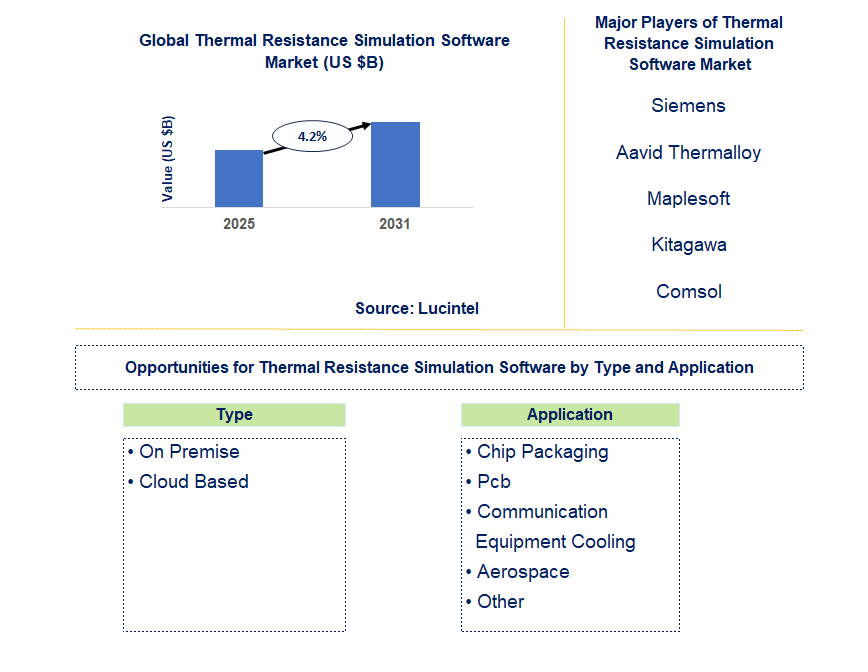
Key data points: The growth forecast = 4.2% annually for the next 7 years. Scroll below to get more insights. This market report covers Trends, opportunities and forecasts in thermal resistance simulation software market to 2031 by type (on premise and cloud based), application (chip packaging, PCB, communication equipment cooling, aerospace, and other), and region (North America, Europe, Asia Pacific, and the Rest of the World)
We'll send your sample report shortly.
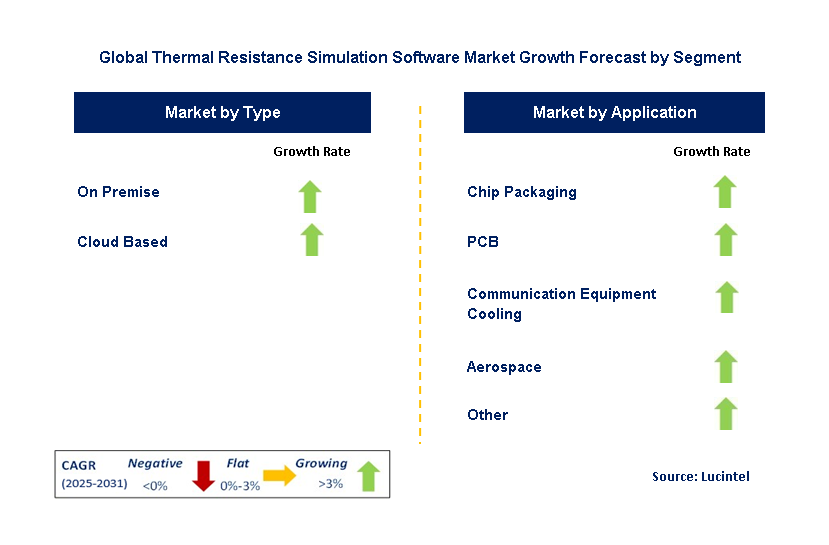
• Lucintel forecasts that, within the type category, cloud based is expected to witness higher growth over the forecast period due to its scalability, cost-efficiency, and remote accessibility.
• Within the application category, chip packaging is expected to witness the highest growth due to the increasing demand for advanced semiconductor technologies.
• In terms of region, APAC is expected to witness the highest growth over the forecast period.
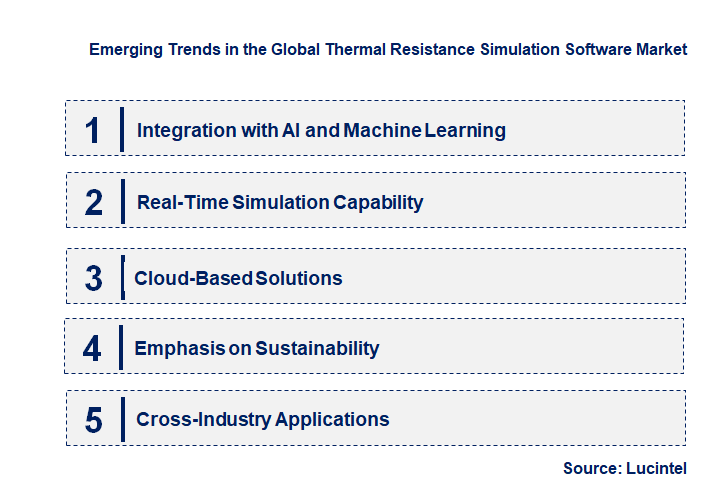
• Integration with AI and Machine Learning: Thermal resistance simulation software is being integrated with AI to further the predictive capability. This allows for designers to simulate more precise predictions and maximize heat management designs, drastically enhancing design and product reliability.
• Real-Time Simulation Capability: The increased need for real-time simulations has resulted in the creation of software that can simulate dynamic conditions. This is especially important in industries such as automotive and electronics, where real-time thermal analysis can significantly enhance product testing and iteration rates.
• Cloud-Based Solutions: Cloud-based thermal resistance simulation software is gaining traction since it facilitates smoother collaboration between teams and locations. The platforms also provide scalability, allowing users to manage complex simulations without the necessity of expensive in-house computing facilities.
• Emphasis on Sustainability: With sustainability at the top of the agenda, businesses are employing thermal resistance simulation software to minimize energy use and waste. Thermal behavior simulation during the design stage optimizes product performance while reducing environmental footprints, particularly in sectors such as automotive and electronics.
• Cross-Industry Applications: Thermal resistance simulation software usage is broadening beyond conventional sectors such as electronics and automotive. New markets are opening up in industries such as renewable energy, aerospace, and consumer products due to the necessity of effective heat management in complex systems. These forthcoming trends suggest that the thermal resistance simulation software industry is transforming due to the embrace of AI, real-time performance, and cloud-based systems. The focus on sustainability and wider applications across different industries implies that these technologies are likely to be further developed in order to match the increasing needs for effective thermal management
• AI-Augmented Simulation Software: The incorporation of artificial intelligence in thermal resistance simulation software has transformed the design process. Utilizing machine learning, the software is now capable of forecasting thermal behavior with greater accuracy, minimizing design time and improving performance predictions.
• Cloud-Based Collaboration Platforms: Cloud-based collaboration platforms are enabling real-time collaboration across worldwide teams. The solutions offer improved accessibility and scalability, allowing users to execute intricate simulations without the requirement of vast computing resources.
• Real-Time Thermal Management Simulations: Software is being developed to offer real-time thermal simulations with instant feedback during design. This new development helps to accelerate iterations, which is important for sectors such as automotive and electronics, where rapid prototyping is vital.
• Enhanced CAD System Integration: The integrated use of thermal resistance simulation software with computer-aided design (CAD) systems has streamlined operations. This integration enables designers to execute thermal simulations within their CAD environments, minimizing the use of external tools and maximizing efficiency.
• Emphasis on Energy Efficiency and Sustainability: With the growing importance of sustainability, latest simulation software is developed to improve energy efficiency within products. With these, simulation is made possible that can be used to lower thermal energy losses and enhance the overall efficiency of the system to support environmentally friendly practices across many industries. These new developments show the growing complexity and adaptability of thermal resistance simulation software. The convergence of AI, cloud computing, and real-time technology is revolutionizing the way industries tackle thermal management, allowing for quicker, more efficient design processes while also emphasizing sustainability.
• Automotive: Automotive companies are the main target when it comes to creating electric cars (EVs) and more sophisticated powertrains, wherein thermal resistance software plays an instrumental role. Improved thermal performance saves EV battery lifespan, improves the efficiency of an engine, and increases the overall safety of vehicles, offering substantial growth in the automotive market.
• Consumer Electronics: The consumer electronics industry is more and more dependent on thermal resistance simulation software to deal with heat dissipation in smaller devices such as smartphones and laptops. As there is a growing demand for ever-smaller yet powerful devices, this usage is a big opportunity for software companies to fulfill these demands.
• Aerospace Market: Aerospace industry players are growingly using thermal resistance simulation tools to maximize the thermal performance of engines and components of spacecraft. Effective heat control is crucial in guaranteeing safety and durability for high-performance aerospace systems, fostering strong demand for this use case.
• Renewable Energy Systems: Thermal resistance simulation software is being used in renewable energy systems like solar panels and wind turbines. With these industries competing for efficiency and longevity, the demand for precise thermal simulations is growing, offering growth opportunities in the renewable energy industry.
• Industrial Machinery: In the industrial machinery industry, thermal resistance simulation software is applied to control heat in high-performance machines. Its application is vital because industries want to maximize machinery efficiency, life, and reliability, presenting a promising growth opportunity for the software market. The rising use of thermal resistance simulation software across various industries, such as automotive, consumer electronics, aerospace, renewable energy, and industrial machinery, shows strong growth potential. These applications are consistent with the overall market trend towards optimizing thermal management for enhanced performance and energy efficiency.
• Siemens
• Aavid Thermalloy
• Maplesoft
• Kitagawa
• Comsol
• Tenfong
• MoorEDA Technology
• On Premise
• Cloud Based
• Chip Packaging
• PCB
• Communication Equipment Cooling
• Aerospace
• Other
• North America
• Europe
• Asia Pacific
• The Rest of the World
• United States: The United States has experienced considerable growth in the usage of thermal resistance simulation software due to the need for high-performance computing and power-saving technologies. Prominent companies within this region are using AI and machine learning to enhance simulation accuracy, which has resulted in better heat dissipation solutions.
• China: In China, efforts have been made to merge thermal resistance simulation software with advanced manufacturing processes. China's surging electronics and semiconductor industries are principal drivers, where such software facilitates the optimization of component designs for energy efficiency and performance, minimizing the probability of heat-induced device failures.
• Germany: Germany's automotive and engineering sectors are using thermal resistance simulation software to improve the design and production of energy-efficient systems. Focused on electric vehicle manufacturing and industrial equipment, this software enables German manufacturers to simulate and analyze thermal behavior at all stages of product development.
• India: India is witnessing increasing demand for energy-efficient consumer electronics and power generation systems, which is driving the usage of thermal resistance simulation software. This software helps Indian producers reduce thermal complications in electronic products, making their products more competitive in foreign markets.
• Japan: Japan is a leader in adopting cutting-edge simulation technologies in its automotive and robotics industries. Thermal resistance simulation software is an essential tool in designing high-performance parts for automotive engines and robotics, where heat management is the primary factor in ensuring system longevity and efficiency.


• Siemens
• Aavid Thermalloy
• Maplesoft
• Kitagawa
• Comsol
• Tenfong
• MoorEDA Technology Q5. Which thermal resistance simulation software market segment will be the largest in future? Answer: Lucintel forecasts that, within the type category, cloud based is expected to witness higher growth over the forecast period due to its scalability, cost-efficiency, and remote accessibility. Q6. In thermal resistance simulation software market, which region is expected to be the largest in next 5 years? Answer: In terms of region, APAC is expected to witness the highest growth over the forecast period. Q7. Do we receive customization in this report? Answer: Yes, Lucintel provides 10% customization without any additional cost.


Choose a license that fits your team. Instant PDF delivery.
Prices exclude taxes. Instant delivery. Custom licensing available on request.
Market Report · July 15, 2026
Market Report · June 26, 2026
Market Report · June 24, 2026
Trusted partner for strategic intelligence and business growth


Receive a complimentary market analysis tailored to your industry. Our analysts will identify key growth opportunities and competitive dynamics specific to your business.

Market size, growth rate, and key trend analysis for your specific sector.

Top competitor positioning and market share analysis.

Strategic recommendations backed by data-driven insights.
Get curated market intelligence and competitive moves straight to your inbox.
By subscribing, you agree to receive our monthly insights. Unsubscribe anytime.
Receive a complimentary market analysis tailored to your industry. Our analysts will identify key growth opportunities and competitive dynamics specific to your business.
Market size, growth rate, and key trend analysis for your specific sector.
Top competitor positioning and market share analysis.
Strategic recommendations backed by data-driven insights.
Get curated market intelligence, emerging trends, and competitive moves straight to your inbox each month.
By subscribing, you agree to receive our monthly insights. Unsubscribe anytime.
We'll send your sample report shortly.