
Market Report · July 22, 2026

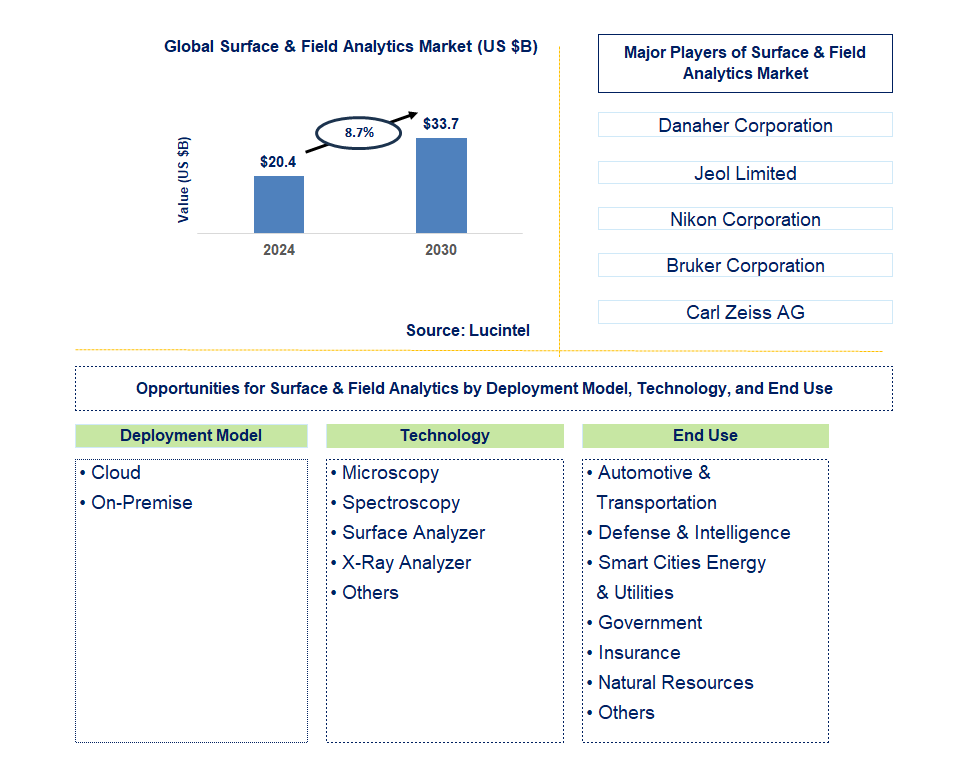
Key data points: The market size in 2030 = $33.7 billion, growth forecast = 8.7% annually for the next 6 years. Scroll below to get more insights. This market report covers trends, opportunities, and forecasts in the global surface & field analytics market to 2030 by deployment model (cloud and on-premise), technology (microscopy, spectroscopy, surface analyzer, x-ray analyzer, and others), end use (automotive & transportation, defense & intelligence, smart cities energy & utilities, government, insurance, natural resources, and others), and region (North America, Europe, Asia Pacific, and the Rest of the World)
We'll send your sample report shortly.
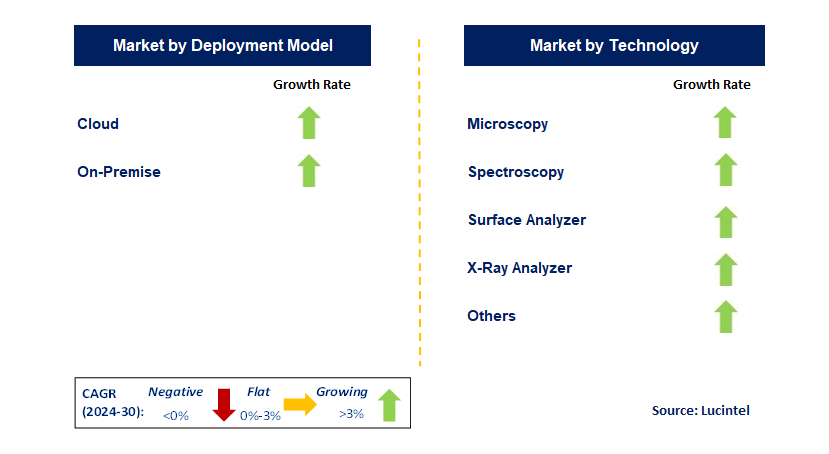
• Lucintel forecasts that, within the technology categore, microscopy is expected to witness the highest growth over the forecast period.
• Within the ensd use category, automotive & transportation is expected to witness the highest growth.
• In terms of region, APAC is expected to witness the highest growth over the forecast period. Gain valuable insights for your business decisions with our comprehensive 150+ page report.
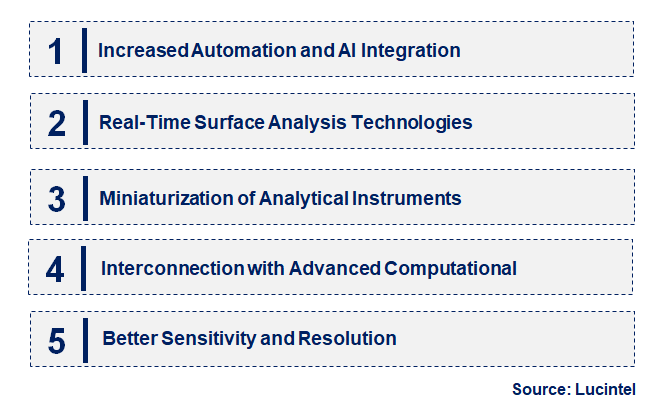
• Increased Automation and AI Integration: Automation and artificial intelligence are changing the approach to surface and field analysis, accelerating improvements in data processing and enhancing comparison through the efficiency of machine learning algorithms and automated systems. These innovations reduce the likelihood of human error when interpreting complex datasets, optimizing the process to provide faster and more reliable results for industries in pharmaceuticals and materials science.
• Real-Time Surface Analysis Technologies: The shift toward real-time analysis technologies, including in situ spectroscopy and imaging, provides more dynamic and immediate insights into surface properties. Techniques such as real-time atomic force microscopy (AFM) and optical imaging allow scientists to monitor changes as they occur, which is critical for applications in material science and manufacturing processes.
• Miniaturization of Analytical Instruments: The miniaturization of analytical instruments improves portability and simplifies preparatory techniques. Compact, portable devices enable surface and field analysis in various settings, supporting applications in environmental monitoring and on-site inspections where large instruments are impractical.
• Interconnection with Advanced Computational Techniques: The incorporation of surface analysis into advanced computational techniques, including molecular modeling and simulations, provides deeper insights into material properties and behaviors. This interconnectivity enables better predictions and understanding of complex systems, particularly in research related to nanotechnology and material design.
• Better Sensitivity and Resolution: Advances in technology are increasing the need for enhanced sensitivity and resolution in analytical tools. The development of high-resolution microscopy and spectroscopy allows for higher surface characterization with greater resolution and accuracy. This is essential for high-tech industries such as semiconductors and nanomaterials, where performance depends heavily on minute surface details. These trends are transforming the surface and field analysis market. The improved capabilities and applications of analytical tools are reshaping the market in unprecedented ways. Automation, miniaturization, real-time analysis, computational integration, and improved sensitivity will drive advancements and potential increases across industries.
• Advances in Spectroscopy Techniques: Advanced spectroscopy techniques, such as high-resolution X-ray photoelectron spectroscopy and time-of-flight secondary ion mass spectrometry, provide much finer characterization of materials. Such technologies improve sensitivity and resolution, thereby enabling more profound analysis of surface composition and chemical states.
• Growth of In-Situ and Real-Time Analysis: Surface analysis has been witnessing transformational growth with the advent of in-situ and real-time analysis technologies, as they allow changes to surface properties to be observed immediately. Techniques such as real-time atomic force microscopy and in-situ spectroscopy provide dynamic insights that are crucial for understanding material behavior under various conditions.
• Development of Portable Analytical Instruments: The development of portable and miniaturized analytical instruments increases accessibility to surface analysis and field surveys in remote locations. Miniaturized advancements in spectroscopy and microscopy will promote on-site analysis for applications in environmental monitoring, quality control, and field research.
• Integration with Advanced Data Analytics: The integration of surface and field analysis with advanced data analytics, including AI and machine learning, provides improved interpretation and accuracy of data. Modern technologies can handle complex datasets more effectively, thus enhancing decision-making and research outcomes.
• Exploration of Sustainable and Green Technologies: Further surface and field analysis technologies are being explored in sustainable and environmentally friendly ways. Advances aimed at reducing chemical usage, energy consumption, and waste generation align with broader environmental goals and regulations that promote more sustainable industry practices. These developments are changing the landscape for surface and field analysis by producing accurate, accessible, and sustainable tools for analysis. The future of surface and field analysis is shaped by advancements in spectroscopy, real-time analysis, portable instruments, data analytics, and sustainable technologies.
• Expansion in Semiconductor Manufacturing Growth Opportunities: The semiconductor industry promises expansion in surface and field analysis technologies. Advances in wafer analysis and contamination detection are critical for meeting higher standards in the fabrication of semiconductors. Atomic force microscopy (AFM) and X-ray photoelectron spectroscopy (XPS) technologies are fundamental in achieving quality and performance levels.
• Development of Advanced Materials: With the growing demand for nanomaterials, composites, and similar materials, the development of advanced materials requires much more precise tools for surface analysis. Understanding material properties at the nanoscale level becomes essential through innovative characterization techniques in further research and development in industries such as aerospace, automotive, and electronics.
• Environmental Monitoring Growth in Surface and Field Analysis Applications: This area reflects the needs for effective environmental monitoring, which is necessary for growth in surface and field analysis applications. Precise detection of pollutants, contaminants, and environmental changes involves technologies for regulatory compliance and sustainability efforts. High value for on-site environmental assessments is derived from portable and real-time analysis tools.
• Improvements in Drug Development: Surface and field analysis technologies play an important role in the drug development process and pharmaceutical industries. Techniques that provide detailed information about formulations, interactions, and stability of drugs promote progress in pharmaceutical research and manufacturing, leading to more effective and safer products.
• Integration with Industrial Manufacturing: The integration of surface and field analysis into industrial manufacturing processes enables opportunities to evaluate process and product quality. Technologies such as real-time analysis and monitoring enhance both efficiency in manufacturing and the quality of products produced in industries like automotive, consumer goods, and machinery. Strategic growth prospects for surface and field analysis are supported by developments in semiconductor fabrication, advanced materials development, environmental monitoring, drug development, and industrial manufacturing. These market opportunities lead to high market growth and technological innovation.
• Technological Advancements: Advances in technology remain an important factor behind the surface and field analysis market. New spectroscopy, microscopy, and automation techniques enhance the capabilities of analytical equipment, improving resolution, accuracy, and the range of applications. These advancements also allow for more precise and efficient characterization of surfaces for research and industrial processes.
• Increased Demand for Precision: The increased demand for precision in material analysis is propelling the need for sophisticated technologies in surface and field analysis. The semiconductor, pharmaceuticals, and materials science industries require high-resolution and precise analyses, making market growth more probable where these features are emphasized.
• Expansion of Research and Development: The advancement of sectors in research and development creates an increasing need for surface and field analysis technologies. Increased research and development in nanotechnology, biotechnology, and materials science require detailed characterization tools for analytical instruments, contributing to market expansion.
• Regulatory Requirements: Heightened regulatory requirements for quality control and environmental monitoring are driving the adoption of surface and field analysis technologies. For the pharmaceutical, chemical, and environmental protection industries, regulatory compliance necessitates a strong demand for accurate and reliable analytical solutions.
• Growing Focus on Sustainability: With an increasing emphasis on environmental sustainability in the surface and field analysis market, innovations that reduce environmental impacts and use resources efficiently align well with broader sustainability goals, creating demand for green technologies in analytical applications. Challenges in the surface and field analytics market include:
• High Cost of Advanced Equipment: Advanced surface and field analysis equipment is very expensive, posing a significant barrier to adoption, particularly among smaller organizations and research institutes. Such high investment levels may deter accessibility and slow down market growth.
• Complexity of Data Interpretation: The complexity of data implies challenges in interpretation and analysis, especially with data generated by advanced analytical tools. Managing and accurately interpreting vast amounts of data requires specialized expertise and sophisticated software, limiting access for some users.
• Regulatory and Compliance Issues: Companies operating in highly regulated industries often face difficulties related to regulatory and compliance issues. Continuous efforts to adhere to strict standards for analytical tools and processes can affect the speed and effectiveness with which a product can be developed and introduced to the marketplace. In conclusion, the market for surface and field analysis is influenced by drivers such as technological advancement, increased demand for surface and field analysis, expansion in research and development processes, and the need for compliance with regulatory requirements. However, challenges such as high equipment costs, data complexity, and regulatory hurdles must be addressed before the market can fully realize its potential for growth.
• Danaher Corporation
• Jeol Limited
• Nikon Corporation
• Bruker Corporation
• Carl Zeiss AG
• ULVAN-PHI
• Olympus Corporation
• Cloud
• On-Premise
• Microscopy
• Spectroscopy
• Surface Analyzer
• X-Ray Analyzer
• Others
• Automotive & Transportation
• Defense & Intelligence
• Smart Cities Energy & Utilities
• Government
• Insurance
• Natural Resources
• North America
• Europe
• Asia Pacific
• The Rest of the World
• United States: In the United States, there is a growing interest in surface and field analysis through advances in spectroscopy and imaging technologies being integrated into new developments. The adoption of higher-resolution techniques such as TOF-SIMS and XPS has improved the characterization of materials and the detection of contaminants. Along with the rise of automation and AI in data analysis, accuracy and efficiency have been enhanced, supporting industries such as semiconductors and pharmaceuticals.
• China: The surface and field analysis market in China has been experiencing impressive developments in efforts to scale up research and development capabilities. China is acquiring electron microscopy and AFM technologies to advance its manufacturing and materials science sectors. Government programs and funding are aimed at promoting the advancement of analytical tools that will be key to supporting China's growth in high-tech industries and innovation.
• Germany: Germany is a leader in surface and field analysis, with significant progress in high-precision instrumentation and software integration. Advances in SPM and nano-analysis are commendable. Other German companies are also contributing, with a focus on sustainable and environmentally friendly technology, in accordance with EU regulations. The ultra-high vacuum (UHV) systems, along with in-situ analysis techniques, enhance the ability to study materials under conditions close to realistic ones.
• India: In India, the surface and field analysis market is experiencing an upswing with a focus on affordable and accessible solutions for analytics. Recent developments include cost-effective tools in spectroscopy targeted at education and research institutions, as well as microscopy. Local manufacturing capabilities are also supporting advancements in surface characterization technologies, contributing to the nationwide expansion of research infrastructure and industrial applications.
• Japan: Recent innovations in Japan are derived from ongoing research in surface and field analysis, focusing on high-resolution and ultra-sensitive analytical techniques. Recent developments are related to synchrotron radiation techniques and improvements in scanning electron microscopy (SEM). Precision and miniaturization led by Japan, as a country with a strong electronics and materials science sector, make these research applications increasingly relevant for industrial use.


• Danaher Corporation
• Jeol Limited
• Nikon Corporation
• Bruker Corporation
• Carl Zeiss AG
• ULVAN-PHI
• Olympus Corporation Q6. Which surface & field analytics market segment will be the largest in future? Answer: Lucintel forecasts that microscopy is expected to witness the highest growth over the forecast period. Q7. In surface & field analytics market, which region is expected to be the largest in next 6 years? Answer: APAC is expected to witness the highest growth over the forecast period. Q.8 Do we receive customization in this report? Answer: Yes, Lucintel provides 10% customization without any additional cost.


Choose a license that fits your team. Instant PDF delivery.
Prices exclude taxes. Instant delivery. Custom licensing available on request.
Market Report · July 22, 2026
Market Report · July 17, 2026
Market Report · July 17, 2026
Trusted partner for strategic intelligence and business growth


Receive a complimentary market analysis tailored to your industry. Our analysts will identify key growth opportunities and competitive dynamics specific to your business.

Market size, growth rate, and key trend analysis for your specific sector.

Top competitor positioning and market share analysis.

Strategic recommendations backed by data-driven insights.
Get curated market intelligence and competitive moves straight to your inbox.
By subscribing, you agree to receive our monthly insights. Unsubscribe anytime.
Receive a complimentary market analysis tailored to your industry. Our analysts will identify key growth opportunities and competitive dynamics specific to your business.
Market size, growth rate, and key trend analysis for your specific sector.
Top competitor positioning and market share analysis.
Strategic recommendations backed by data-driven insights.
Get curated market intelligence, emerging trends, and competitive moves straight to your inbox each month.
By subscribing, you agree to receive our monthly insights. Unsubscribe anytime.
We'll send your sample report shortly.