
Market Report · July 15, 2026

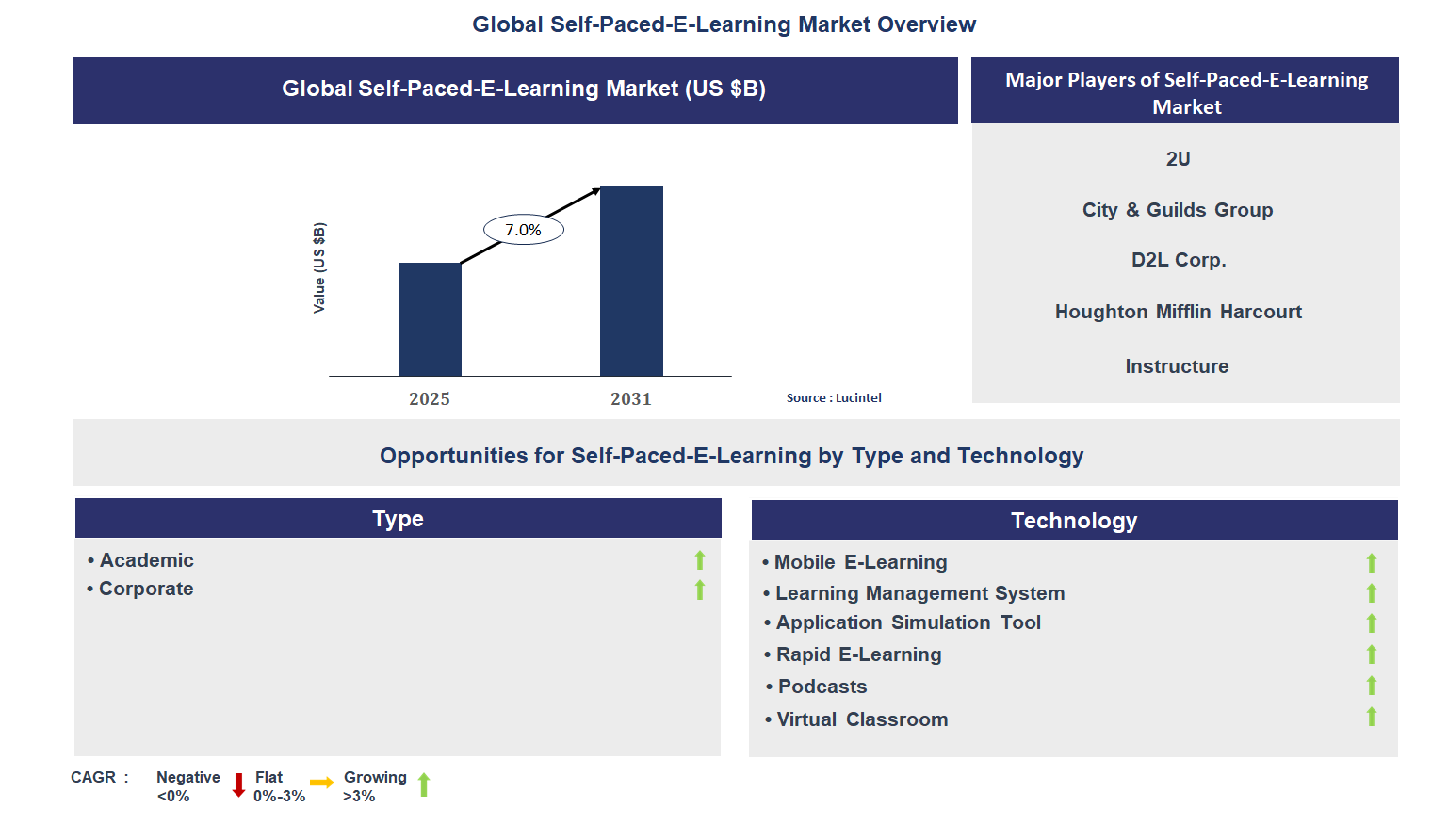
Key data points: The growth forecast = 7% annually for the next 7 years. Scroll below to get more insights. This market report covers trends, opportunities and forecasts in self-paced-E-learning market to 2031 by type (academic and corporate), technology (mobile E-learning, learning management system, application simulation tool, rapid E-learning, podcasts, and virtual classroom), and region (North America, Europe, Asia Pacific, and the Rest of the World)
We'll send your sample report shortly.
• Lucintel forecasts that, within the type category, corporate is expected to witness higher growth over the forecast period.
• Within the technology category, rapid E-learning is expected to witness the highest growth.
• In terms of region, APAC is expected to witness the highest growth over the forecast period. Gain valuable insights for your business decisions with our comprehensive 150+ page report. Sample figures with some insights are shown below.
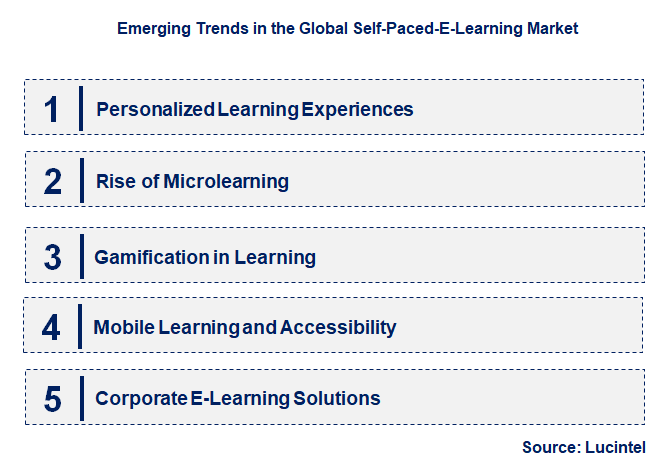
• Personalized Learning Experiences: Self-paced e-learning platforms are increasingly incorporating AI and machine learning to offer tailored learning experiences. These platforms analyze user behavior and learning progress to suggest courses, content, and resources that fit individual learning styles, boosting engagement and retention. Personalization has become a critical feature in improving the learning process and helping learners achieve their goals faster.
• Rise of Microlearning: Microlearning refers to short, focused learning sessions designed for quick comprehension. This trend is gaining popularity as learners seek bite-sized content that fits into their busy schedules. Self-paced platforms are increasingly offering microlearning modules, allowing learners to acquire skills in small chunks that can be accessed anytime, enhancing convenience and efficiency.
• Gamification in Learning: Gamification is becoming a key element in self-paced e-learning. Platforms are incorporating game-like features, such as points, leaderboards, and challenges, to increase learner engagement. These features make learning more interactive and enjoyable, especially in areas like coding, language learning, and soft skills training, driving motivation and improving long-term retention.
• Mobile Learning and Accessibility: Mobile learning is on the rise, as learners prefer to access courses on their smartphones or tablets for greater flexibility. Self-paced e-learning platforms are optimizing their content for mobile devices, ensuring that users can learn from anywhere, at any time. This trend is particularly popular in developing countries where mobile devices are the primary means of internet access.
• Corporate E-Learning Solutions: Corporations are increasingly adopting self-paced e-learning for employee development and training. Companies are leveraging platforms like LinkedIn Learning and Coursera for Business to provide continuous learning opportunities in a variety of professional domains, from leadership skills to technical certifications. This trend reflects a shift toward lifelong learning and skill development in the corporate sector. The self-paced-E-learning market is being shaped by trends such as personalized learning, microlearning, gamification, mobile accessibility, and corporate e-learning solutions. These trends are driving greater engagement, flexibility, and skill development across different demographics and industries, making self-paced learning more effective and adaptable to individual needs.
• Growth of Online Platforms: The expansion of online learning platforms such as Coursera, Udemy, BYJUs, and edX has been a key development in the self-paced-E-learning market. These platforms are offering a wide range of courses in diverse fields such as business, technology, and creative arts. They enable learners to access high-quality content from anywhere in the world, contributing to the global growth of self-paced learning.
• AI-Driven Learning Personalization: Many self-paced e-learning platforms are integrating AI to personalize learning experiences. This technology helps analyze a learner’s progress and adjust the content accordingly, ensuring that the learner stays engaged and challenged. Personalized learning paths are becoming increasingly popular, allowing users to learn at their own pace while receiving recommendations that match their skills and interests.
• Corporate Adoption of E-Learning: Corporate adoption of self-paced e-learning has surged, with companies using platforms like LinkedIn Learning and Coursera for Business to provide skill development and continuous education opportunities for employees. Companies are increasingly focused on upskilling and reskilling their workforce, particularly in tech-heavy areas like data science, programming, and digital marketing.
• Focus on Mobile Learning: Mobile learning is rapidly becoming a primary mode of access for self-paced courses. Many e-learning platforms are optimizing their courses for mobile devices, enabling learners to access content on-the-go. This flexibility has contributed to the popularity of self-paced e-learning, especially in regions where mobile devices are the primary means of accessing the internet.
• Increased Government and Institutional Support: Governments and educational institutions are increasingly supporting self-paced e-learning initiatives. For example, the Chinese government has made significant investments in education technology, while in India, programs like the National Digital Library of India (NDLI) aim to provide free access to online learning resources. These initiatives are helping to make education more accessible to a wider audience. Recent developments such as the rise of online platforms, AI-driven personalization, corporate adoption, mobile learning, and increased governmental support are significantly impacting the self-paced-E-learning market. These advancements are enhancing accessibility, improving learning outcomes, and opening up new opportunities for learners globally.
• Expansion in Emerging Markets: There is a significant growth opportunity in emerging markets like India, Africa, and Southeast Asia. With increasing internet access and the demand for affordable education, self-paced e-learning platforms can expand by offering localized content and mobile-optimized courses. This will make education accessible to a broader demographic, particularly in regions where traditional learning infrastructure is limited.
• Corporate Skill Development Programs: Self-paced e-learning platforms can partner with corporations to offer tailored skill development programs. Companies are increasingly investing in employee upskilling and reskilling, particularly in areas like technology, management, and leadership. By offering specialized corporate learning solutions, e-learning platforms can cater to the growing demand for flexible, on-demand training options.
• Mobile and App-Based Learning: With mobile usage on the rise, offering mobile-friendly learning solutions presents a key opportunity. Self-paced e-learning platforms that focus on optimizing content for mobile devices and creating apps for easy access can capture a larger user base. This model caters to users who prefer learning on-the-go, especially in developing regions with limited access to desktop computers.
• Increased Focus on Professional Certifications: Offering accredited certifications in high-demand fields such as data science, project management, and digital marketing presents a significant opportunity for growth. Many learners are seeking credentials that will help them advance in their careers, and platforms offering industry-recognized certifications can attract a large, motivated user base looking for career advancement.
• Partnerships with Educational Institutions: Collaborating with universities and educational institutions to offer self-paced, online degree programs can enhance the growth prospects of e-learning platforms. By offering flexible, accredited programs that allow students to learn at their own pace, these platforms can tap into the growing demand for higher education that accommodates personal schedules. Strategic growth opportunities in the self-paced-E-learning market lie in expanding to emerging markets, offering corporate training programs, enhancing mobile learning, providing professional certifications, and forming partnerships with educational institutions. These opportunities will drive further innovation and growth, making self-paced learning more accessible and effective for a global audience.
• 2U
• City & Guilds Group
• D2L Corp.
• Houghton Mifflin Harcourt
• Instructure
• John Wiley & Sons
• NIIT
• Pearson
• Providence Equity Partners
• Think & Learn
• Academic
• Corporate
• Mobile E-Learning
• Learning Management System
• Application Simulation Tool
• Rapid E-Learning
• Podcasts
• Virtual Classroom
• North America
• Europe
• Asia Pacific
• The Rest of the World
• United States: In the U.S., self-paced e-learning has seen significant growth due to the shift toward remote learning, accelerated by the COVID-19 pandemic. Major platforms like Coursera, Udemy, and LinkedIn Learning have expanded their offerings, providing learners with flexibility. The emphasis on skill development in tech fields such as data science and AI is driving adoption.
• China: Chinas self-paced-E-learning market is growing rapidly, supported by its vast digital infrastructure and government investments in education technology. Platforms like Mooc, XuetangX, and iCourse are making online courses accessible, with a strong focus on English language learning, coding, and exam preparation. Increased internet access in rural areas is also contributing to growth.
• Germany: Germanys self-paced-E-learning market is evolving with a focus on professional development and vocational training. Platforms like LinkedIn Learning and edX are gaining traction, especially for corporate skill development. Additionally, Germany’s strong emphasis on digital education and industry partnerships is driving the growth of specialized training courses, particularly in fields like engineering and IT.
• India: India’s self-paced-E-learning market is expanding rapidly, particularly in tech-related fields, language learning, and competitive exam preparation. Platforms such as BYJU’s, Unacademy, and Coursera are leading the charge. The increasing internet penetration and the demand for affordable learning solutions for a young population are key factors driving this growth in the country.
• Japan: Japans self-paced-E-learning market is focused on improving business skills, language learning, and IT education. Online platforms like Gs Academy and Udemy are becoming more popular among Japanese learners, particularly for tech certifications and upskilling. The growing adoption of e-learning in corporate training and government initiatives to promote digital education are major factors in this markets expansion.


• 2U
• City & Guilds Group
• D2L Corp.
• Houghton Mifflin Harcourt
• Instructure
• John Wiley & Sons
• NIIT
• Pearson
• Providence Equity Partners
• Think & Learn Q5. Which self-paced-E-learning market segment will be the largest in future? Answer: Lucintel forecasts that, within the type category, corporate is expected to witness higher growth over the forecast period. Q6. In self-paced-E-learning market, which region is expected to be the largest in next 5 years? Answer: In terms of region, APAC is expected to witness the highest growth over the forecast period. Q7. Do we receive customization in this report? Answer: Yes, Lucintel provides 10% customization without any additional cost.


Choose a license that fits your team. Instant PDF delivery.
Prices exclude taxes. Instant delivery. Custom licensing available on request.
Market Report · July 15, 2026
Market Report · June 26, 2026
Market Report · June 24, 2026
Trusted partner for strategic intelligence and business growth


Receive a complimentary market analysis tailored to your industry. Our analysts will identify key growth opportunities and competitive dynamics specific to your business.

Market size, growth rate, and key trend analysis for your specific sector.

Top competitor positioning and market share analysis.

Strategic recommendations backed by data-driven insights.
Get curated market intelligence and competitive moves straight to your inbox.
By subscribing, you agree to receive our monthly insights. Unsubscribe anytime.
Receive a complimentary market analysis tailored to your industry. Our analysts will identify key growth opportunities and competitive dynamics specific to your business.
Market size, growth rate, and key trend analysis for your specific sector.
Top competitor positioning and market share analysis.
Strategic recommendations backed by data-driven insights.
Get curated market intelligence, emerging trends, and competitive moves straight to your inbox each month.
By subscribing, you agree to receive our monthly insights. Unsubscribe anytime.
We'll send your sample report shortly.