
Market Report · July 15, 2026

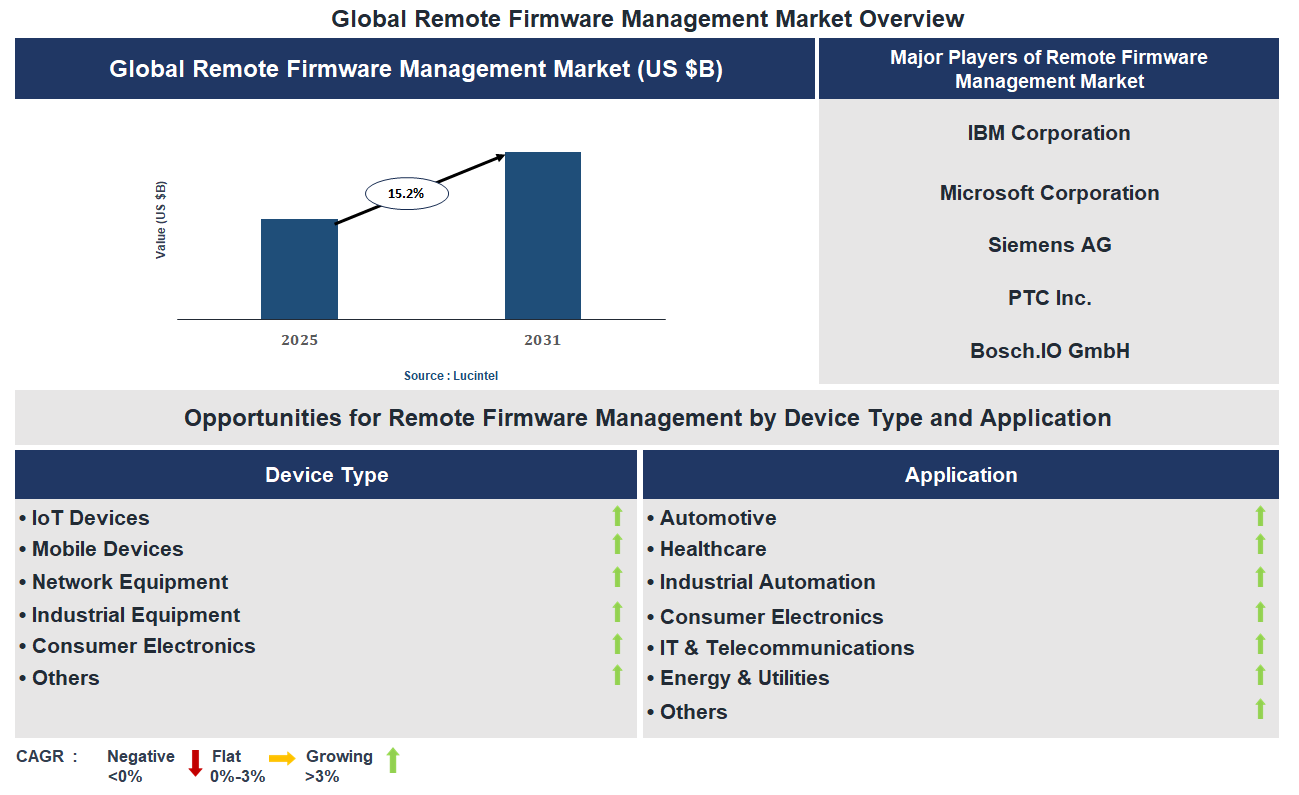
Key data points: The growth forecast = 15.2% annually for the next 7 years. Scroll below to get more insights. This market report covers trends, opportunities and forecasts in remote firmware management market to 2031 by device type (IoT devices, mobile devices, network equipment, industrial equipment, consumer electronics, and others), application (automotive, healthcare, industrial automation, consumer electronics, IT & telecommunications, energy & utilities, and others), and region (North America, Europe, Asia Pacific, and the Rest of the World)
We'll send your sample report shortly.
• Lucintel forecasts that, within the device type category, IoT device is expected to witness the highest growth over the forecast period.
• Within the application category, automotive is expected to witness the highest growth.
• In terms of region, North America is expected to witness the highest growth over the forecast period. Gain valuable insights for your business decisions with our comprehensive 150+ page report. Sample figures with some insights are shown below.
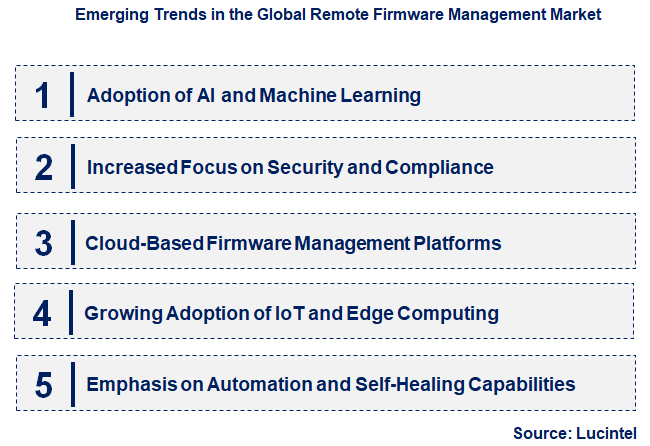
• Adoption of AI and Machine Learning: The integration of AI and ML into remote firmware management systems enhances automation and predictive maintenance. These technologies enable real-time analysis of device performance, early detection of potential failures, and automated firmware updates, reducing manual intervention. This results in improved efficiency, minimized downtime, and proactive security measures. As AI-driven solutions become more sophisticated, they are expected to further optimize firmware management processes, making them more intelligent and responsive to evolving device needs.
• Increased Focus on Security and Compliance: With rising cybersecurity threats, the market is prioritizing secure firmware management solutions. Advanced encryption protocols, secure boot processes, and regular vulnerability assessments are now standard features. Additionally, compliance with industry standards such as GDPR, HIPAA, and ISO is becoming critical, prompting vendors to incorporate robust security measures. This focus ensures that firmware updates do not introduce vulnerabilities, safeguarding sensitive data and maintaining regulatory adherence, which is vital for industries like healthcare and finance.
• Cloud-Based Firmware Management Platforms: The shift towards cloud computing is significantly impacting firmware management by offering scalable, flexible, and centralized control over devices. Cloud platforms facilitate remote updates, monitoring, and diagnostics across geographically dispersed assets, reducing the need for on-site interventions. They also enable seamless integration with other enterprise systems, providing comprehensive device lifecycle management. As cloud technology matures, it is expected to drive widespread adoption of remote firmware management solutions, especially for large-scale IoT deployments.
• Growing Adoption of IoT and Edge Computing: The proliferation of IoT devices and the rise of edge computing are expanding the scope of remote firmware management. Managing firmware across numerous connected devices requires scalable, real-time solutions capable of operating at the network edge. This trend enhances device autonomy, reduces latency, and improves overall system resilience. As IoT ecosystems grow, firmware management solutions are evolving to support complex, distributed networks, ensuring devices remain secure, updated, and functional without centralized intervention.
• Emphasis on Automation and Self-Healing Capabilities: Automation in firmware management is increasingly sophisticated, with self-healing features that automatically detect, diagnose, and resolve issues without human intervention. These capabilities minimize operational disruptions and improve system reliability. Automated rollback, patching, and recovery processes are becoming standard, enabling organizations to maintain continuous device operation. This trend not only reduces operational costs but also enhances security by ensuring timely updates and vulnerability patches, making firmware management more resilient and efficient. In summary, these emerging trends are fundamentally transforming the remote firmware management market by making solutions more intelligent, secure, scalable, and autonomous. They are enabling organizations to better manage their device ecosystems, improve operational efficiency, and strengthen security postures, thereby reshaping the future landscape of remote device management.
• Expansion of Cloud-Based Solutions: The shift towards cloud-based firmware management platforms has accelerated, offering scalable, flexible, and cost-effective options for organizations. These solutions enable remote updates, real-time monitoring, and centralized control, reducing the need for on-site maintenance. This development enhances operational efficiency and supports the deployment of large-scale IoT networks, thereby expanding market reach and adoption.
• Integration of AI and Machine Learning: Vendors are incorporating AI and machine learning algorithms into firmware management tools to improve predictive maintenance, anomaly detection, and security threat identification. This integration enhances the reliability and security of devices, reduces downtime, and minimizes manual intervention. Consequently, it boosts customer confidence and accelerates market growth by providing smarter, more autonomous management solutions.
• Increased Focus on Security and Compliance: With rising cybersecurity threats, companies are prioritizing secure firmware updates and compliance with industry standards such as GDPR and ISO. Enhanced security protocols, encryption, and authentication mechanisms are being integrated into firmware management platforms. This focus helps organizations mitigate risks, ensure regulatory compliance, and foster trust, thereby driving market expansion.
• Strategic Partnerships and Collaborations: Major players are forming alliances with technology providers, device manufacturers, and service integrators to expand their offerings and reach new markets. These collaborations facilitate the development of comprehensive solutions, improve interoperability, and accelerate innovation. Such strategic moves are crucial for gaining a competitive advantage and capturing emerging opportunities in the market.
• Adoption of Edge Computing: The rise of edge computing is influencing firmware management strategies by enabling localized processing and updates directly at the device level. This reduces latency, bandwidth usage, and dependency on centralized servers. Edge computing integration allows for faster response times and improved device performance, making firmware management more efficient and responsive to real-time needs. In summary, these developments are collectively transforming the remote firmware management market by enhancing scalability, security, intelligence, and operational efficiency. The adoption of cloud solutions, AI integration, security enhancements, strategic partnerships, and edge computing is driving market growth, expanding application areas, and fostering innovation. As a result, the market is becoming more competitive and better equipped to meet the evolving demands of IoT and connected device ecosystems.
• Enhanced Network Security: The deployment of remote firmware management solutions in telecommunications enables real-time security updates, reducing vulnerabilities in 5G infrastructure and network equipment, thereby ensuring reliable and secure connectivity.
• Improved Device Compliance and Safety: In healthcare, remote firmware management ensures medical devices are consistently updated with the latest security patches and functionalities, enhancing patient safety and regulatory compliance.
• Increased Automation and Efficiency: Manufacturing industries leverage remote firmware management to automate device updates and maintenance, minimizing downtime, reducing operational costs, and improving overall productivity.
• Over-the-Air Updates for Vehicles: The automotive sector benefits from remote firmware management through OTA updates, allowing manufacturers to enhance vehicle features, fix bugs, and improve safety remotely, thus accelerating innovation cycles.
• Enhanced User Experience and Security: In consumer electronics, remote firmware management facilitates seamless updates, improving device performance, security, and user satisfaction, which drives brand loyalty and market competitiveness. These growth opportunities are significantly impacting the remote firmware management market by fostering innovation, enhancing security, and improving operational efficiencies across key industries. As organizations increasingly prioritize digital transformation and cybersecurity, the market is expected to witness sustained growth and technological advancements.
• Technological Advancements: The continuous evolution of IoT and connected devices necessitates efficient firmware management solutions. As devices become more complex, the need for remote updates, security patches, and troubleshooting increases, driving demand for sophisticated firmware management platforms. These advancements enable real-time monitoring, automation, and improved security, which are critical for industries like healthcare, manufacturing, and automotive. The integration of AI and machine learning further enhances the capabilities of firmware management systems, making them more proactive and predictive. This technological progression ensures that organizations can maintain device performance, security, and compliance efficiently, fueling market growth.
• Growing Cybersecurity Concerns: As connected devices proliferate, vulnerabilities in firmware become prime targets for cyberattacks. The increasing frequency and sophistication of cyber threats compel organizations to adopt robust remote firmware management solutions to ensure device security. Regular updates and patches are essential to mitigate risks associated with malware, ransomware, and unauthorized access. The rising awareness of cybersecurity risks across industries has accelerated investments in firmware management tools that provide real-time threat detection and automated security updates. This focus on security not only protects sensitive data but also ensures regulatory compliance, thereby propelling market expansion.
• Increasing Adoption of IoT Devices: The exponential growth of IoT devices across sectors such as healthcare, manufacturing, and smart cities is a major driver. These devices require regular firmware updates to enhance functionality, security, and interoperability. Remote firmware management simplifies the process of maintaining large-scale IoT deployments, reducing operational costs and minimizing downtime. As organizations seek to leverage IoT for improved efficiency and data insights, the demand for scalable, reliable firmware management solutions continues to rise. This trend is expected to sustain market growth as IoT adoption accelerates globally.
• Regulatory and Compliance Requirements: Governments and industry bodies are implementing stringent standards related to device security, data privacy, and firmware integrity. Compliance with these regulations necessitates regular firmware updates and secure management practices. Organizations are compelled to adopt remote firmware management solutions that facilitate compliance, audit trails, and secure deployment of updates. The evolving regulatory landscape acts as a catalyst for market growth, encouraging vendors to develop compliant solutions that address diverse regional standards. This regulatory push ensures that firmware management becomes an integral part of device lifecycle management strategies.
• Cost Optimization and Operational Efficiency: Remote firmware management offers significant cost savings by reducing the need for on-site maintenance and manual interventions. Automated updates and remote troubleshooting streamline operations, minimize downtime, and enhance device lifespan. Organizations are increasingly adopting these solutions to optimize operational efficiency, especially in large-scale deployments. The ability to remotely monitor and manage firmware reduces labor costs and accelerates response times to issues, providing a competitive advantage. As cost pressures mount across industries, the market for remote firmware management solutions is expected to expand rapidly. The challenges in the remote firmware management market are:
• Security and Privacy Concerns: Despite the benefits, remote firmware management introduces risks related to data breaches and unauthorized access. Ensuring secure communication channels, authentication, and encryption is complex and critical. Any vulnerabilities in the management system can be exploited by cybercriminals, leading to potential device compromise or data loss. Organizations must invest heavily in cybersecurity measures, which can increase costs and complexity. Additionally, maintaining compliance with data privacy regulations adds another layer of challenge. These security concerns can hinder adoption and slow market growth if not adequately addressed.
• Compatibility and Integration Issues: The diverse range of devices, operating systems, and firmware versions complicates the implementation of remote management solutions. Compatibility issues can lead to system failures, increased downtime, and higher maintenance costs. Integrating new firmware management tools with existing infrastructure requires significant customization and testing, which can be resource-intensive. This fragmentation hampers seamless deployment and scalability, posing a barrier for organizations seeking uniform management across heterogeneous environments. Overcoming these technical challenges is essential for broader market adoption.
• Regulatory and Standardization Challenges: The lack of universal standards for firmware management creates uncertainty and complexity. Different regions and industries have varying compliance requirements, making it difficult for vendors to develop one-size-fits-all solutions. Navigating this regulatory landscape requires substantial effort and adaptation, which can delay deployment and increase costs. Moreover, evolving standards may necessitate frequent updates to management systems, adding to operational burdens. Addressing these regulatory and standardization issues is crucial for fostering trust and widespread adoption in the market. In summary, the remote firmware management market is driven by technological innovations, increasing IoT adoption, and regulatory pressures, which collectively foster growth opportunities. However, security risks, compatibility issues, and regulatory complexities pose significant challenges that could impede progress. The market’s future depends on how effectively stakeholders can leverage technological advancements while mitigating associated risks. Overall, the market is poised for substantial expansion, provided these drivers are harnessed and challenges addressed through strategic innovation and collaboration.
• IBM Corporation
• Microsoft Corporation
• Siemens AG
• PTC Inc.
• Bosch.IO GmbH
• Oracle Corporation
• Hewlett Packard Enterprise
• Advantech Co., Ltd.
• Wind River Systems, Inc.
• Arm Holdings plc
• IoT Devices
• Mobile Devices
• Network Equipment
• Industrial Equipment
• Consumer Electronics
• Others
• Automotive
• Healthcare
• Industrial Automation
• Consumer Electronics
• IT & Telecommunications
• Energy & Utilities
• Others
• North America
• Europe
• Asia Pacific
• The Rest of the World
• United States: The US market for remote firmware management is expanding rapidly, driven by the proliferation of IoT devices and smart infrastructure. Major tech companies are investing in advanced automation tools and AI-driven security features to improve firmware update efficiency and security. Regulatory frameworks are also encouraging the adoption of secure firmware management practices, especially in critical sectors like healthcare and manufacturing. Cloud-based solutions are gaining popularity, offering scalable and flexible management options for enterprises. The US remains a leader in innovation, with startups and established firms collaborating to develop next-generation firmware management platforms.
• China: China is witnessing substantial growth in remote firmware management, fueled by the rapid expansion of IoT and smart city projects. The government’s focus on digital infrastructure and smart manufacturing has led to increased adoption of firmware management solutions. Local companies are investing in AI and machine learning to enhance automation and security features. The market is also characterized by a strong emphasis on cost-effective solutions tailored for large-scale deployment across industries such as automotive, retail, and telecommunications. Regulatory policies are evolving to address cybersecurity concerns, promoting the development of more secure firmware management systems.
• Germany: The German market is characterized by a focus on industrial automation and manufacturing sectors, where remote firmware management is crucial for maintaining operational efficiency. Companies are adopting advanced cybersecurity measures to protect critical infrastructure from cyber threats. There is a growing trend toward integrating firmware management with existing enterprise resource planning (ERP) and industrial control systems. Germany’s emphasis on Industry 4.0 initiatives is driving innovation in firmware update processes, with a focus on interoperability and security. Local firms are also investing in research and development to create more robust and secure firmware management solutions tailored to industrial needs.
• India: India’s remote firmware management market is experiencing rapid growth, driven by the increasing adoption of IoT devices in agriculture, healthcare, and smart cities. The government’s push for digital transformation and smart infrastructure projects is boosting demand for efficient firmware management solutions. Local companies are focusing on affordable, scalable, and easy-to-deploy systems to cater to small and medium-sized enterprises. The market is also seeing a rise in partnerships between technology providers and government agencies to develop secure firmware update protocols. As cybersecurity awareness increases, there is a growing emphasis on secure firmware management practices across various sectors.
• Japan: Japan’s market for remote firmware management is expanding, with a strong focus on industrial automation, robotics, and smart manufacturing. Companies are investing in AI and IoT integration to enhance firmware update processes and security. The country’s emphasis on quality and reliability is driving the development of highly secure and efficient firmware management solutions. Regulatory standards for cybersecurity are becoming more stringent, prompting firms to adopt advanced security measures. Japan is also exploring the integration of firmware management with predictive maintenance systems, aiming to reduce downtime and improve operational efficiency in manufacturing and infrastructure sectors.


• IBM Corporation
• Microsoft Corporation
• Siemens AG
• PTC Inc.
• Bosch.IO GmbH
• Oracle Corporation
• Hewlett Packard Enterprise
• Advantech Co., Ltd.
• Wind River Systems, Inc.
• Arm Holdings plc Q5. Which remote firmware management market segment will be the largest in future? Answer: Lucintel forecasts that, within the device type category, IoT device is expected to witness the highest growth over the forecast period. Q6. In remote firmware management market, which region is expected to be the largest in next 5 years? Answer: In terms of region, North America is expected to witness the highest growth over the forecast period. Q7. Do we receive customization in this report? Answer: Yes, Lucintel provides 10% customization without any additional cost.


Choose a license that fits your team. Instant PDF delivery.
Prices exclude taxes. Instant delivery. Custom licensing available on request.
Market Report · July 15, 2026
Market Report · June 26, 2026
Market Report · June 24, 2026
Trusted partner for strategic intelligence and business growth


Receive a complimentary market analysis tailored to your industry. Our analysts will identify key growth opportunities and competitive dynamics specific to your business.

Market size, growth rate, and key trend analysis for your specific sector.

Top competitor positioning and market share analysis.

Strategic recommendations backed by data-driven insights.
Get curated market intelligence and competitive moves straight to your inbox.
By subscribing, you agree to receive our monthly insights. Unsubscribe anytime.
Receive a complimentary market analysis tailored to your industry. Our analysts will identify key growth opportunities and competitive dynamics specific to your business.
Market size, growth rate, and key trend analysis for your specific sector.
Top competitor positioning and market share analysis.
Strategic recommendations backed by data-driven insights.
Get curated market intelligence, emerging trends, and competitive moves straight to your inbox each month.
By subscribing, you agree to receive our monthly insights. Unsubscribe anytime.
We'll send your sample report shortly.