
Market Report · July 22, 2026

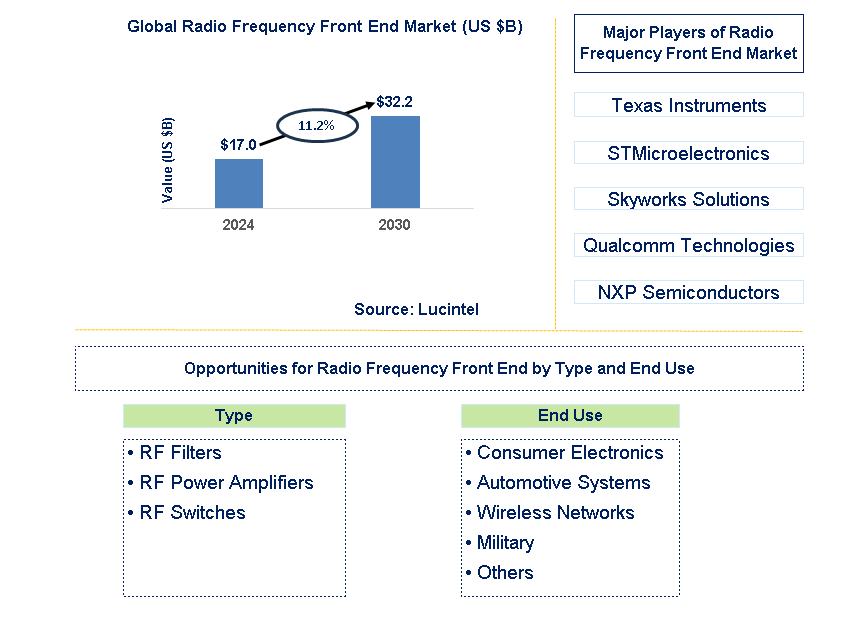
Key data points: The market size in 2030 = $32.2 billion, growth forecast = 11.2% annually next 6 years. Scroll below to get more insights. This market report covers trends, opportunities, and forecast in the global radio frequency front end market to 2030 by type (RF filters, RF power amplifiers, and RF switches), end use (consumer electronics, automotive systems, wireless networks, military, and others), and region (North America, Europe, Asia Pacific, and the Rest of the World)
We'll send your sample report shortly.
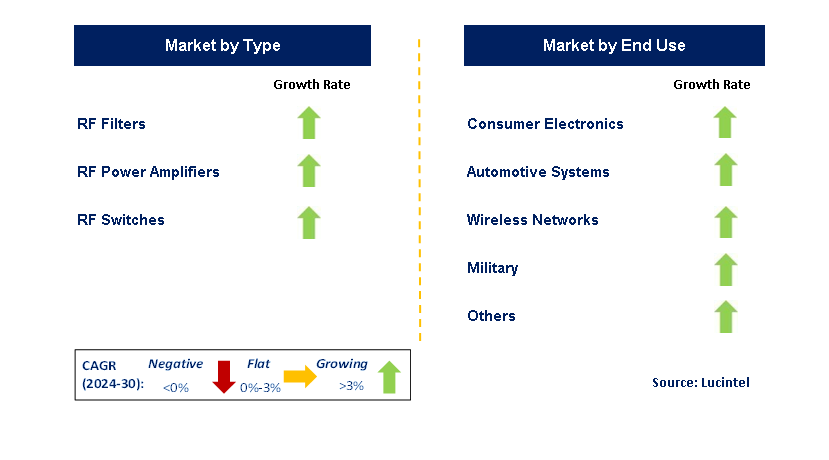
• Lucintel forecasts that RF filter will remain the largest segment over the forecast period because the filters are electrical components that enable or restrict certain signals or frequencies from passing through to reduce noise or allow undesirable signals to flow through.
• APAC will remain the largest region over the forecast period because of the development of consumer electronics and growing need for defense equipment, together with the notable growth of major emerging countries such as China, India, and South Korea, will result in a greater need for radiofrequency components. A more than 150-page report is developed to help in your business decisions.
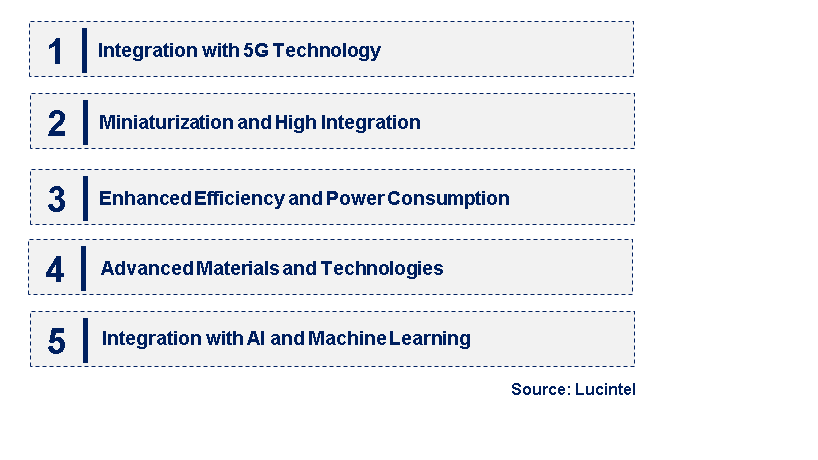
• Integration with 5G Technology: The integration of RF Front End components with 5G technology is a significant trend driving the market. The rollout of 5G networks requires advanced RF Front End modules capable of handling higher frequencies and increased data rates. This trend is pushing manufacturers to develop innovative solutions that offer improved performance, efficiency, and reliability for 5G applications. The focus is on creating components that can support higher bandwidths and low latency, crucial for the success of 5G networks.
• Miniaturization and High Integration: Miniaturization and high integration of RF Front End components are becoming increasingly important. There is a growing demand for compact and efficient RF modules that can be integrated into smaller devices without compromising performance. This trend is driven by the need for advanced features in consumer electronics, wearables, and IoT devices. Manufacturers are focusing on developing smaller, more powerful RF Front End solutions that offer high performance while minimizing space and power consumption.
• Enhanced Efficiency and Power Consumption: Enhanced efficiency and reduced power consumption are key trends in the RF front end market. As wireless devices become more advanced, there is a need for RF Front End components that offer improved energy efficiency. This trend is driven by the growing emphasis on sustainability and the desire to extend battery life in portable devices. Manufacturers are developing RF solutions that optimize power usage and reduce heat generation, contributing to overall system efficiency and performance.
• Advanced Materials and Technologies: The use of advanced materials and technologies is shaping the RF front end market. Innovations in semiconductor materials, such as gallium nitride (GaN) and silicon germanium , are enhancing the performance of RF components. These materials offer superior thermal and electrical properties, enabling higher frequencies and better efficiency. Additionally, advancements in packaging and integration technologies are improving the reliability and functionality of RF Front End solutions, supporting the development of next-generation wireless systems.
• Integration with AI and Machine Learning: Integration with artificial intelligence (AI) and machine learning is emerging as a significant trend in the RF front end market. AI and machine learning technologies are being used to optimize RF system performance, manage network traffic, and enhance signal processing. This trend is driving the development of intelligent RF Front End modules that can adapt to changing conditions and improve overall system efficiency. The application of AI in RF technology is expected to lead to more dynamic and responsive wireless communication solutions. These trends are reshaping the RF front end market by driving innovation and improving performance across various applications. The integration with 5G technology, miniaturization, enhanced efficiency, advanced materials, and AI capabilities are contributing to the development of more advanced and efficient RF solutions. As these trends continue to evolve, they will significantly impact the direction and growth of the RF front end market, influencing both technological advancements and market dynamics.
• Advancements in 5G RF Front End Technology: Advancements in 5G RF Front End technology are a major development in the market. Companies are focusing on developing RF components that can handle the high frequencies and broad bandwidths required for 5G networks. These advancements include improvements in signal processing, power efficiency, and thermal management. The introduction of new materials and design techniques is enabling RF Front End solutions to meet the demanding requirements of 5G applications.
• Integration of Advanced Materials: The integration of advanced materials, such as gallium nitride (GaN) and silicon germanium, is transforming the RF front end market. These materials offer superior performance characteristics, including higher power efficiency and better thermal management. The adoption of these materials is enhancing the capabilities of RF Front End components, allowing for higher frequency operation and improved reliability. This development is crucial for supporting the next generation of wireless communication systems.
• Miniaturization of RF Front End Components: Miniaturization of RF Front End components is a key development driven by the demand for smaller and more efficient devices. Innovations in packaging and integration technologies are enabling the production of compact RF modules that do not compromise on performance. This trend is particularly important for consumer electronics, wearables, and IoT devices, where space and power efficiency are critical. Miniaturized RF components are facilitating the development of more advanced and feature-rich devices.
• Improved Manufacturing Processes: Improvements in manufacturing processes are impacting the RF front end market by increasing production efficiency and reducing costs. Advances in semiconductor fabrication technologies and automated assembly techniques are enabling the mass production of high-quality RF components. These improvements are leading to more consistent product performance and lower manufacturing costs, benefiting both manufacturers and consumers. Enhanced manufacturing processes are supporting the scalability of RF Front End solutions for various applications.
• Strategic Industry Partnerships: Strategic industry partnerships are driving innovation and market growth in the RF Front End sector. Collaborations between technology companies, semiconductor manufacturers, and research institutions are facilitating the development of advanced RF solutions. These partnerships are enabling the sharing of expertise and resources, leading to faster innovation and improved product offerings. Strategic alliances are also supporting the expansion of RF Front End technologies into new markets and applications. Recent developments in the RF front end market are shaping the industry by driving technological advancements and strategic changes. Key developments such as advancements in 5G technology, integration of advanced materials, miniaturization, improved manufacturing processes, and strategic partnerships are contributing to the growth and evolution of the RF front end market. These developments are enhancing the performance, efficiency, and capabilities of RF Front End solutions, supporting the ongoing evolution of wireless communication systems.
• Expansion of 5G Networks: The expansion of 5G networks represents a significant growth opportunity for the RF front end market. As 5G technology continues to roll out globally, there is an increasing demand for advanced RF components that can support higher frequencies and greater bandwidths. This opportunity includes the development of RF Front End modules optimized for 5G applications, such as base stations, mobile devices, and IoT solutions. Companies that can deliver high-performance, reliable RF solutions will benefit from the growing 5G infrastructure investments.
• Growth in IoT Applications: The growth of Internet of Things (IoT) applications is driving demand for RF Front End solutions that support connectivity and communication in a wide range of devices. IoT applications require RF components that offer compact size, low power consumption, and reliable performance. This opportunity includes the development of RF Front End modules tailored for smart home devices, industrial sensors, and wearable technology. As the IoT market expands, there is potential for significant growth in RF Front End solutions designed for these applications.
• Advancements in Automotive Technology: Advancements in automotive technology, particularly with the rise of autonomous vehicles and advanced driver-assistance systems (ADAS), are creating growth opportunities in the RF front end market. Automotive applications require RF components that support high-frequency communication, radar, and connectivity. This opportunity involves developing RF Front End solutions that enhance vehicle-to-everything (V2X) communication, radar systems, and in-car connectivity. Companies that can deliver high-performance RF modules for these advanced automotive systems will be well-positioned for growth.
• Increased Demand for Consumer Electronics: The increased demand for consumer electronics, including smartphones, tablets, and wearable devices, presents a growth opportunity for RF Front End solutions. These devices require advanced RF components to support high-speed connectivity, enhanced signal processing, and miniaturization. This opportunity involves developing RF Front End modules that meet the performance and space requirements of modern consumer electronics. As the consumer electronics market continues to grow, there will be a need for innovative RF solutions that cater to these demands.
• Emerging Applications in Smart Cities: Emerging applications in smart cities are driving demand for RF Front End solutions that support connectivity and communication infrastructure. Smart city applications, such as intelligent transportation systems, smart grids, and public safety networks, require reliable and high-performance RF components. This opportunity includes developing RF Front End modules that facilitate communication and data exchange in smart city environments. Companies that can provide RF solutions for these applications will benefit from the expanding smart city initiatives worldwide. Strategic growth opportunities in the RF front end market are emerging across various applications, including 5G networks, IoT devices, automotive technology, consumer electronics, and smart cities. By focusing on these growth areas, companies can leverage technological advancements and market trends to drive innovation and capture new business opportunities. These opportunities are shaping the future of the RF front end market and influencing the development of advanced RF solutions for diverse applications.
• Texas Instruments
• STMicroelectronics
• Skyworks Solutions
• Qualcomm Technologies
• NXP Semiconductors
• Qorvo
• Murata Manufacturing
• Infineon Technologies
• Broadcom
• Teradyne
• RF Filters
• RF Power Amplifiers
• RF Switches
• Consumer Electronics
• Automotive Systems
• Wireless Networks
• Military
• Others
• North America
• Europe
• Asia Pacific
• The Rest of the World
• United States: In the U.S., recent developments in the RF front end market are marked by the rapid rollout of 5G infrastructure. Major technology companies are investing heavily in developing advanced RF components that support higher frequencies and broader bandwidths. Additionally, there is a growing emphasis on integrating RF Front End modules with AI and machine learning technologies to optimize network performance. Increased regulatory support and incentives for 5G deployment are also accelerating market growth, positioning the U.S. as a leader in RF technology innovation.
• China: China is advancing its RF front end market with a strong focus on 5G and its application in smart devices. The country is investing in developing domestic RF Front End solutions to reduce reliance on foreign technology. Significant efforts are being made to improve the efficiency and performance of RF components for telecommunications and consumer electronics. Additionally, China is emphasizing research and development in high-frequency RF technologies to support its expanding 5G network and future technological advancements.
• Germany: Germany’s RF front end market is driven by advancements in automotive applications and industrial automation. The country is investing in RF solutions to support the development of autonomous vehicles and Industry 4.0 initiatives. German companies are focusing on integrating RF Front End modules with advanced sensors and communication systems to enhance vehicle connectivity and industrial processes. Additionally, Germany’s emphasis on precision engineering is leading to innovations in RF component design and performance.
• India: In India, the RF front end market is experiencing growth due to the expansion of 4G and the upcoming 5G rollout. The country is focusing on enhancing its telecommunications infrastructure to support increasing data consumption and connectivity demands. There is a growing interest in developing cost-effective RF solutions to cater to the large consumer electronics market. Indian companies are also exploring partnerships and collaborations to boost local manufacturing and technological capabilities in RF Front End solutions.
• Japan: Japan’s RF front end market is characterized by advancements in consumer electronics and telecommunications. The country is leading in the development of high-frequency RF components that support next-generation wireless technologies. Japanese companies are investing in research to improve RF component efficiency and integration with emerging technologies like IoT and smart devices. Additionally, Japan’s focus on miniaturization and high performance is driving innovation in RF Front End designs, making them suitable for a wide range of applications.


• Texas Instruments
• STMicroelectronics
• Skyworks Solutions
• Qualcomm Technologies
• NXP Semiconductors
• Qorvo
• Murata Manufacturing
• Infineon Technologies
• Broadcom
• Teradyne Q6. Which radio frequency front end market segment will be the largest in future? Answer: Lucintel forecasts that RF filter will remain the largest segment over the forecast period because the filters are electrical components that enable or restrict certain signals or frequencies from passing through to reduce noise or allow undesirable signals to flow through. Q7. In radio frequency front end market, which region is expected to be the largest in next 5 years? Answer: APAC will remain the largest region over the forecast period because of the development of consumer electronics and growing need for defense equipment, together with the notable growth of major emerging countries such as China, India, and South Korea, will result in a greater need for radiofrequency components. Q.8 Do we receive customization in this report? Answer: Yes, Lucintel provides 10% customization without any additional cost.


Choose a license that fits your team. Instant PDF delivery.
Prices exclude taxes. Instant delivery. Custom licensing available on request.
Market Report · July 22, 2026
Market Report · July 17, 2026
Market Report · July 17, 2026
Trusted partner for strategic intelligence and business growth


Receive a complimentary market analysis tailored to your industry. Our analysts will identify key growth opportunities and competitive dynamics specific to your business.

Market size, growth rate, and key trend analysis for your specific sector.

Top competitor positioning and market share analysis.

Strategic recommendations backed by data-driven insights.
Get curated market intelligence and competitive moves straight to your inbox.
By subscribing, you agree to receive our monthly insights. Unsubscribe anytime.
Receive a complimentary market analysis tailored to your industry. Our analysts will identify key growth opportunities and competitive dynamics specific to your business.
Market size, growth rate, and key trend analysis for your specific sector.
Top competitor positioning and market share analysis.
Strategic recommendations backed by data-driven insights.
Get curated market intelligence, emerging trends, and competitive moves straight to your inbox each month.
By subscribing, you agree to receive our monthly insights. Unsubscribe anytime.
We'll send your sample report shortly.