
Market Report · July 15, 2026

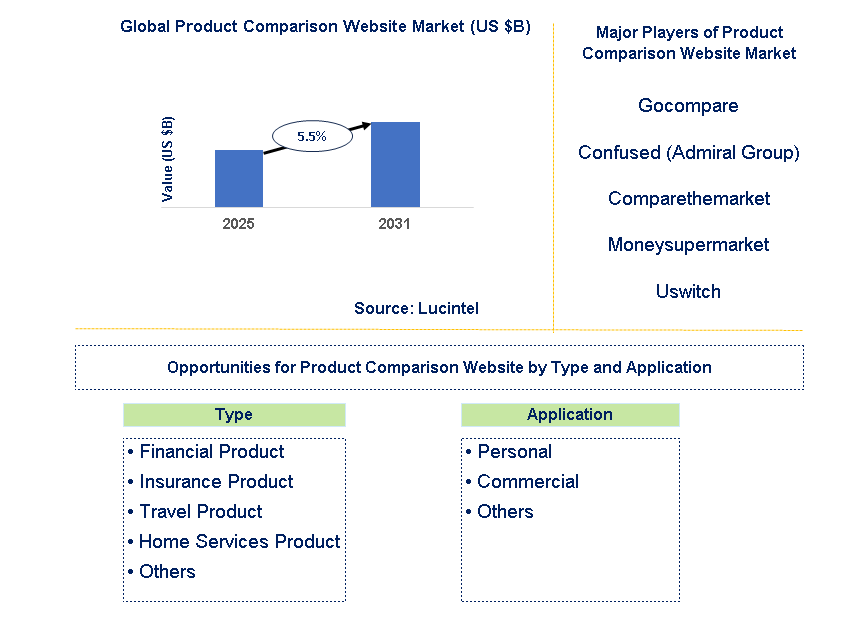
Key data points: The growth forecast = 5.5% annually for the next 7 years. Scroll below to get more insights. This market report covers Trends, opportunity and forecast in product comparison website market to 2031 by type (financial product, insurance product, travel product, home services product, and others), application (personal, commercial, and others), and region (North America, Europe, Asia Pacific, and the Rest of the World)
We'll send your sample report shortly.
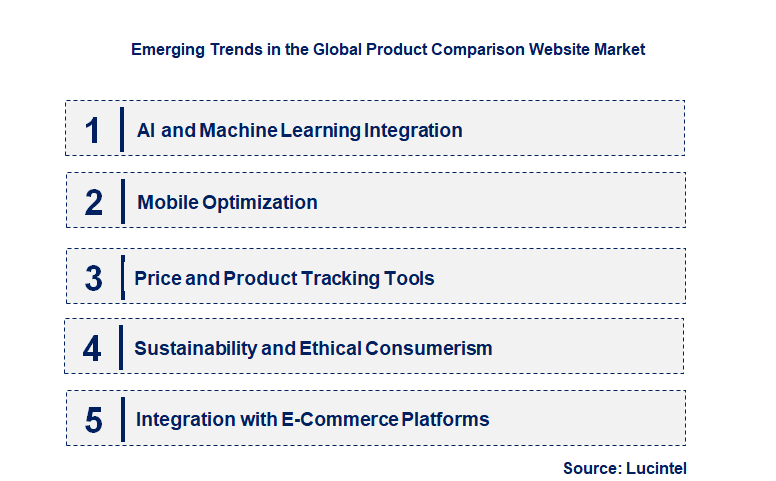
• AI and Machine Learning Integration: AI and machine learning are playing a major role in enhancing the user experience on product comparison websites. By analyzing consumer behavior, these technologies allow websites to provide more personalized product recommendations and price tracking tools, improving user engagement and increasing conversion rates. AI also helps in predicting trends, offering consumers timely deals based on historical data. This trend is expected to continue growing, as businesses strive to create a more intuitive and customized shopping experience.
• Mobile Optimization: With mobile commerce on the rise, mobile-optimized comparison websites have become essential. As more consumers shop via their smartphones, comparison platforms are focusing on delivering seamless experiences through apps and responsive websites. This trend is particularly strong in emerging markets like India and China, where mobile-first consumers are increasingly turning to comparison sites for shopping assistance. Mobile optimization allows businesses to engage users on the go, improving accessibility and overall user experience.
• Price and Product Tracking Tools: Price tracking and product monitoring tools have become integral to the product comparison website experience. These features allow users to receive alerts when prices drop or when new products are launched. This trend is helping consumers save money while giving businesses valuable data on price fluctuations and demand patterns. As e-commerce competition intensifies, offering comprehensive price and product tracking will be crucial to attracting and retaining users on these platforms.
• Sustainability and Ethical Consumerism: As consumers become more environmentally conscious, product comparison websites are incorporating sustainability filters and ethical purchasing options. Websites now offer comparisons based on energy efficiency, carbon footprints, and certifications for fair labor practices. This trend is growing particularly in regions like Europe, where consumers are demanding transparency in product sourcing and manufacturing processes. By catering to this demand, websites can tap into a more socially responsible consumer base.
• Integration with E-Commerce Platforms: E-commerce integration is becoming increasingly popular as product comparison websites partner with major online retailers like Amazon, eBay, and Alibaba. These integrations allow users to compare products directly on e-commerce platforms and make purchases with a single click. By streamlining the purchasing process, businesses enhance convenience for consumers and increase revenue opportunities for both comparison websites and e-commerce platforms. These emerging trends are reshaping the product comparison website market by enhancing user experiences, improving accessibility, and driving more informed purchasing decisions. As AI, mobile optimization, and sustainability become more integral to the market, businesses will need to adapt to meet the evolving needs of tech-savvy and conscious consumers.
• AI-Powered Comparison Engines: AI-driven comparison engines are transforming the way consumers interact with product comparison websites. These platforms now leverage machine learning algorithms to offer personalized recommendations, predict future trends, and even forecast price changes. The use of AI allows websites to deliver a more tailored shopping experience, leading to increased user engagement and conversion rates.
• Expansion of Mobile Apps: Mobile applications for product comparison have gained significant traction, particularly in emerging markets. As smartphone usage continues to rise globally, especially in countries like India and China, comparison websites are prioritizing mobile-first strategies. This includes developing dedicated apps and mobile-optimized websites, ensuring that consumers can compare products on the go, enhancing convenience and user engagement.
• Sustainability Filters: In response to growing consumer demand for ethical and sustainable products, many product comparison websites have added sustainability filters. These filters allow users to compare products based on factors like energy efficiency, carbon footprint, and certifications such as Fair Trade or Organic. This shift is particularly strong in European markets, where consumers are increasingly prioritizing environmental and ethical considerations when making purchasing decisions.
• Integration with Voice Assistants: Integration with voice assistants like Amazon Alexa and Google Assistant is emerging as a key development for product comparison websites. By enabling voice-enabled search and product comparisons, these platforms are catering to consumers who prefer hands-free, fast shopping experiences. This integration allows users to easily compare products using voice commands, improving the overall accessibility and user experience.
• Price Alert Features: Price alert tools have been increasingly integrated into comparison websites, enabling users to track price drops and get notified when a product reaches their desired price point. This feature helps consumers save money and enhances the value of comparison websites. As e-commerce competition intensifies, offering real-time price tracking will be a critical differentiator for these platforms. These recent developments are driving growth in the product comparison website market by enhancing the consumer experience and expanding the capabilities of comparison platforms. As AI, mobile-first strategies, and sustainability trends continue to dominate, businesses will need to innovate to stay ahead in this competitive space.
• Mobile-First Experiences: Mobile-first experiences present a significant growth opportunity for product comparison websites, especially in regions where mobile commerce is on the rise. By optimizing platforms for mobile devices and creating dedicated apps, businesses can tap into the growing number of consumers shopping via smartphones. This will enable companies to increase engagement and reach new, mobile-centric customer segments.
• AI-Driven Personalization: Leveraging AI-driven personalization is a key opportunity for businesses in the product comparison market. By using AI algorithms to analyze user behavior and preferences, websites can offer personalized product recommendations, tailor advertising, and even predict future purchases. This customization enhances user experience and increases the likelihood of conversions, driving revenue for businesses.
• Sustainability and Ethical Consumerism: As consumers become more socially conscious, integrating sustainability filters into comparison websites offers a unique growth opportunity. Websites that allow consumers to compare products based on environmental impact, ethical sourcing, and fair trade certifications can attract a growing segment of eco-conscious buyers, particularly in markets like Europe and North America.
• Voice Search Integration: With the rise of voice assistants, integrating voice search into comparison websites can open up new growth opportunities. Voice-enabled comparison tools allow consumers to compare products hands-free, creating a more seamless and convenient shopping experience. This feature is especially attractive to busy consumers who prefer to make purchases quickly and efficiently.
• E-Commerce Partnerships: Partnering with e-commerce giants like Amazon, Alibaba, and eBay is another key growth opportunity for product comparison websites. These partnerships allow comparison platforms to drive more traffic to e-commerce sites, earning commissions on sales. By integrating comparison tools directly into these platforms, businesses can capitalize on the growing e-commerce market. These strategic growth opportunities reflect the changing landscape of the product comparison website market, driven by mobile optimization, AI, sustainability, and partnerships with e-commerce platforms. Businesses that capitalize on these trends will be better positioned to meet the evolving needs of consumers and maximize their growth potential in the competitive digital space.
• Gocompare
• Confused (Admiral Group)
• Comparethemarket
• Moneysupermarket
• Uswitch
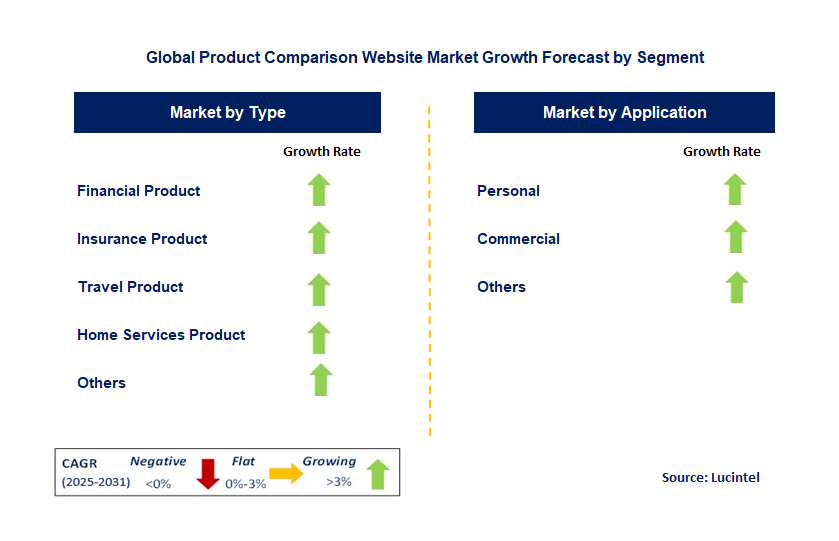
• Financial Product
• Insurance Product
• Travel Product
• Home Services Product
• Others
• Personal
• Commercial
• Others
• North America
• Europe
• Asia Pacific
• The Rest of the World
• United States: In the U.S., product comparison websites are becoming more AI-driven, offering personalized product recommendations and tailored suggestions based on user behavior. The integration of user reviews, expert opinions, and price tracking tools is enhancing the value of these platforms, enabling users to make well-informed purchasing decisions. Additionally, partnerships with e-commerce giants like Amazon have helped boost traffic and credibility.
• China: In China, the rise of mobile commerce has had a significant impact on the product comparison website market. The widespread use of mobile apps for shopping has led to the development of mobile-optimized comparison platforms. Chinese consumers are increasingly using these websites to compare electronics, appliances, and fashion products, driven by the rapid expansion of digital infrastructure and e-commerce platforms like Alibaba and JD.com.
• Germany: Germany has seen a shift toward sustainability-focused product comparison websites, where consumers are looking to compare not only prices but also the environmental impact of products. Websites now offer filters for eco-friendly products, energy efficiency ratings, and certifications such as Fair Trade or Organic. This trend aligns with growing environmental awareness among German consumers, who are becoming more conscious of their purchasing decisions.
• India: In India, the product comparison market is growing rapidly as internet penetration increases. With the rise of online shopping, particularly in tier-two and tier-three cities, comparison websites have become essential for consumers looking to get the best deals. These platforms are becoming mobile-first, with a focus on offering deals across various categories, from electronics to groceries. The demand for localized language options is also growing, as India has a diverse population.
• Japan: Japan is embracing product comparison websites that emphasize product quality and durability. With a strong preference for long-lasting and high-quality products, Japanese consumers often turn to comparison websites to assess the durability and performance of various items before making purchases. Platforms are focusing on integrating user reviews, expert opinions, and detailed product specifications to cater to this discerning market.


• Gocompare
• Confused (Admiral Group)
• Comparethemarket
• Moneysupermarket
• Uswitch Q5. Which product comparison website market segment will be the largest in future? Answer: Lucintel forecasts that the financial product is expected to witness the highest growth over the forecast period. Q6. In product comparison website market, which region is expected to be the largest in next 5 years? Answer: APAC is expected to witness the highest growth over the forecast period. Q7. Do we receive customization in this report? Answer: Yes, Lucintel provides 10% customization without any additional cost.


Choose a license that fits your team. Instant PDF delivery.
Prices exclude taxes. Instant delivery. Custom licensing available on request.
Market Report · July 15, 2026
Market Report · June 26, 2026
Market Report · June 24, 2026
Trusted partner for strategic intelligence and business growth


Receive a complimentary market analysis tailored to your industry. Our analysts will identify key growth opportunities and competitive dynamics specific to your business.

Market size, growth rate, and key trend analysis for your specific sector.

Top competitor positioning and market share analysis.

Strategic recommendations backed by data-driven insights.
Get curated market intelligence and competitive moves straight to your inbox.
By subscribing, you agree to receive our monthly insights. Unsubscribe anytime.
Receive a complimentary market analysis tailored to your industry. Our analysts will identify key growth opportunities and competitive dynamics specific to your business.
Market size, growth rate, and key trend analysis for your specific sector.
Top competitor positioning and market share analysis.
Strategic recommendations backed by data-driven insights.
Get curated market intelligence, emerging trends, and competitive moves straight to your inbox each month.
By subscribing, you agree to receive our monthly insights. Unsubscribe anytime.
We'll send your sample report shortly.