
Market Report · July 31, 2026

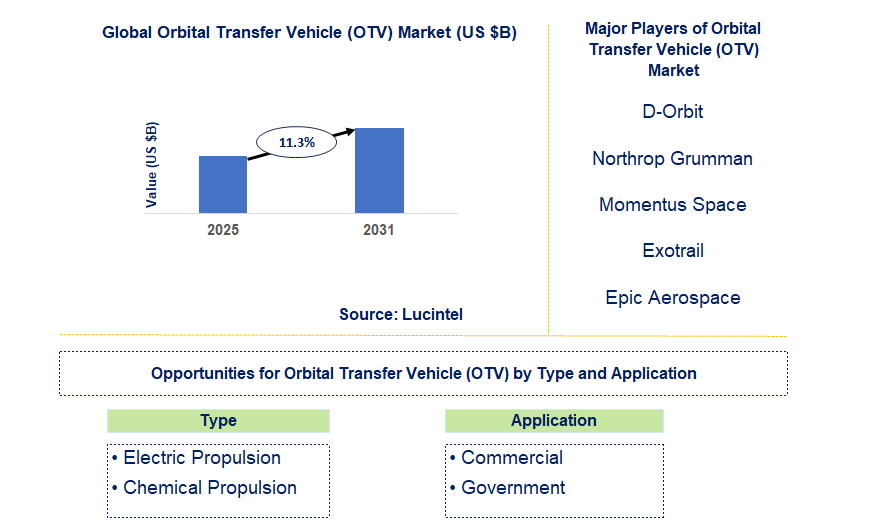
Key data points: The growth forecast = 11.3% annually for the next 7 years. Scroll below to get more insights. This market report covers Trends, opportunities and forecasts in orbital transfer vehicle market to 2031 by type (electric propulsion and chemical propulsion), application (commercial and government), and region (North America, Europe, Asia Pacific, and the Rest of the World)
We'll send your sample report shortly.
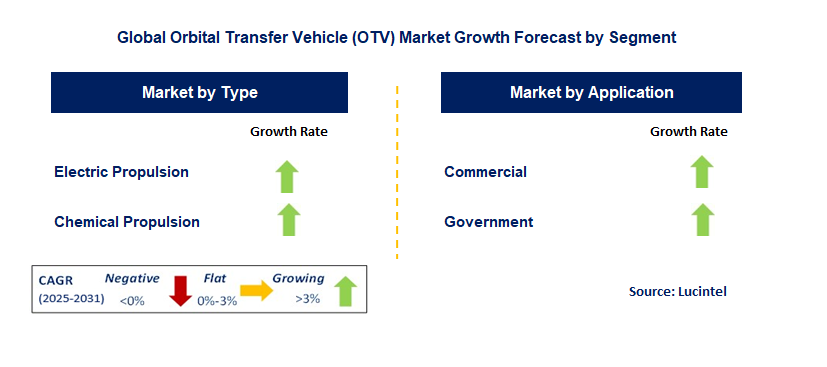
• Lucintel forecasts that, within the type category, electric propulsion is expected to witness higher growth over the forecast period due to increased efficiency and sustainability in space missions.
• Within the application category, commercial is expected to witness the higher growth due to increased private space exploration investments.
• In terms of region, North America is expected to witness the highest growth over the forecast period.
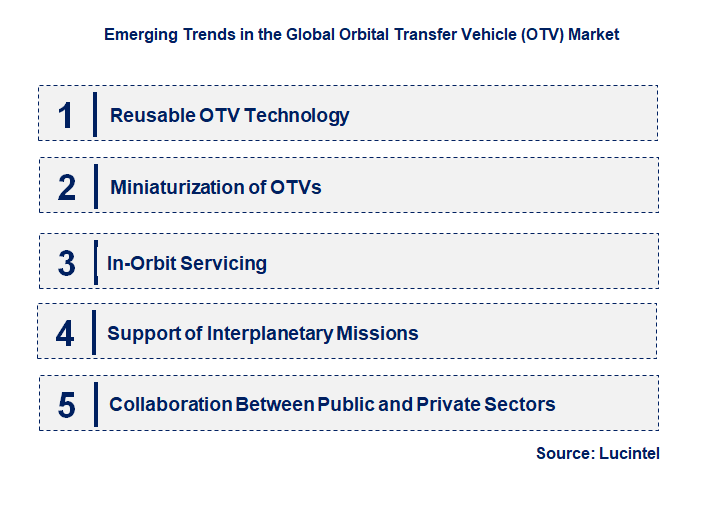
• Reusable OTV Technology: Reusability OTVs are gaining popularity as they save a lot of money for satellite deployment and space logistics. The key players are working to make these vehicles reusable, which will eventually decrease the launch cost, making space access cheaper and sustainable.
• Miniaturization of OTVs: Miniaturization of OTVs is becoming the new trend that allows for lighter, more efficient designs that can handle smaller payloads. These compact vehicles are ideal for micro-satellites and space-based services, opening new business avenues for space exploration and satellite deployment.
• In-Orbit Servicing: OTVs are driving the in-orbit servicing market, which is gaining momentum. They are going to change space operations by refueling, repairing, or upgrading satellites. The longevity of spacecraft will be ensured, and efficiency in satellite management, critical for commercial satellite operators, will also be enhanced.
• Support of Interplanetary Missions: The OTVs are designed increasingly to carry out missions on the planets and their satellites, particularly to Mars and the Moon. It will support national space agencies' ambitious plans and private companies for cargo transport to deep space with astronauts and equipment.
• Collaboration Between Public and Private Sectors: Strategic partnerships between government agencies and private companies are fostering innovation in OTV technology. Collaborations help to combine public funding and expertise with private sector agility and technological advancements, accelerating the development of next-generation OTVs. These new trends are transforming the OTV market, which is opening new avenues for innovation and expansion. Reusability, miniaturization, in-orbit services, interplanetary support, and public-private collaborations are going to drive the next wave of growth, which will make space missions more affordable and efficient. These trends will eventually make space operations more sustainable and accessible.
• US Developments: NASA in partnership with SpaceX is working toward more efficient reusable OTVs that can be developed for satellite launch and in-orbit refueling to support Moon, Mars missions, and much more. Additionally, the US is also considering autonomous OTV technology to bring more efficiency into space operations.
• China’s Investments: China has been developing its OTV capabilities, focusing on both military and commercial applications. China’s space agency is working on OTV technology for long-duration space missions, satellite servicing, and reusability, strengthening its position as a key player in global space exploration.
• The Role of Germany: Germany is expanding its foothold in space exploration through the development of OTVs. The country's contribution to the European Space Agency has helped bring forth advanced designs related to the delivery of cargo and servicing of satellites. Germany is also contributing to international OTV projects, which will further boost global space infrastructure.
• India's Rising Capabilities: India is stepping up OTV efforts while keeping an eye on cost-effective technologies. ISRO is now working on the reusable vehicles to be used in the deployment of satellites and for space logistics. International collaboration of the country will enhance its competitive position in the market through strengthened OTV technology. Recent innovations in the OTV market underscore the rising space logistics, satellite servicing, and space exploration industries. Countries that include the United States, China, Germany, India, and Japan are now leaders in enhancing OTV technology. The market is likely to see changes in the future by way of opening up new fields of innovation with regards to new space missions.
• Satellite Servicing: OTVs are increasingly being used for satellite servicing, including refueling, repairs, and upgrades. This market is growing due to the demand for satellite longevity and efficiency. Companies providing OTV-based servicing solutions are experiencing significant growth as they offer cost-effective alternatives to satellite replacement.
• Cargo Transportation: With space exploration missions becoming more complex, there is a growing demand for OTVs to transport cargo to low-Earth orbit (LEO) and beyond. This opportunity is particularly relevant for deep-space missions, as OTVs offer a reliable means of transporting supplies to space stations and exploration sites.
• Micro-Satellite Deployment: The OTVs are now being designed to deploy micro-satellites, which will be an integral part of the commercial space services. The vehicles are small, efficient, and meet the demand for constellations of micro-satellites, used in communications, Earth observation, and scientific research.
• Interplanetary Exploration: With the expansion of space exploration goals by nations, OTVs are becoming crucial for interplanetary missions. These vehicles will be used to transport humans and cargo to destinations like the Moon, Mars, and beyond. They will play a crucial role in supporting space exploration initiatives and building infrastructure on other planets. The strategic growth opportunities of the OTV market are mostly focused on satellite servicing, cargo transportation, micro-satellite deployment, in-orbit manufacturing, and interplanetary exploration. These opportunities create a dynamic and expansive market where OTV technology becomes a fore front in future space operations and exploration.
• D-Orbit
• Northrop Grumman
• Momentus Space
• Exotrail
• Epic Aerospace
• Impulse Space
• Space Machines
• Firefly Aerospace
• Exolaunch
• Atomos Space
• Electric Propulsion
• Chemical Propulsion
• Commercial
• Government
• North America
• Europe
• Asia Pacific
• The Rest of the World
• United States: The United States has significantly advanced in the OTV market, with initiatives from both the government and private sectors. NASA is improving OTV technology through partnerships with private companies such as SpaceX and Blue Origin. The U.S. is developing reusable and more efficient OTVs, expanding its capabilities in satellite servicing, and aiming for interplanetary missions in the long run.
• China: China has invested heavily in OTV technology, with a focus on military as well as commercial space applications. CNSA, the country's space agency, has been partnering with private enterprise to design OTVs to be used for satellite transfer and reusability. China's technological developments are significantly making it become the world's most essential player in space missions and space exploration for long-duration.
• Germany: Germany, with its strong space infrastructure, has emerged as a contender on the OTV market. DLR has conducted studies concerning the design of reusable OTVs for commercial satellite delivery and orbital cargo missions. International cooperation through participation in the ESA is also supporting the development of OTV technology, which could be employed for global applications, thanks to Germany.
• India: ISRO, India's space agency, is slowly entering the OTV market, focusing on cost-effective and sustainable technologies. The development of reusable vehicles will enable India to cut the cost of satellite deployment and provide efficient in-orbit services. ISRO's collaborations with international partners are strengthening its OTV capabilities and positioning the country as a competitive player in space logistics.
• Japan: Japan is developing its OTV capabilities through JAXA-led initiatives. Japan's space programs focus on the development of lightweight, high-efficiency OTVs for satellite servicing and interplanetary missions. Japan is looking for partnerships with other spacefaring nations to leverage its technological expertise and expand its influence in the global OTV market.


• D-Orbit
• Northrop Grumman
• Momentus Space
• Exotrail
• Epic Aerospace
• Impulse Space
• Space Machines
• Firefly Aerospace
• Exolaunch
• Atomos Space Q5. Which orbital transfer vehicle market segment will be the largest in future? Answer: Lucintel forecasts that, within the type category, electric propulsion is expected to witness higher growth over the forecast period due to increased efficiency and sustainability in space missions. Q6. In orbital transfer vehicle market, which region is expected to be the largest in next 5 years? Answer: In terms of region, North America is expected to witness the highest growth over the forecast period. Q7. Do we receive customization in this report? Answer: Yes, Lucintel provides 10% customization without any additional cost.


Choose a license that fits your team. Instant PDF delivery.
Prices exclude taxes. Instant delivery. Custom licensing available on request.
Market Report · July 31, 2026
Market Report · July 17, 2026
Market Report · May 18, 2026
Trusted partner for strategic intelligence and business growth


Receive a complimentary market analysis tailored to your industry. Our analysts will identify key growth opportunities and competitive dynamics specific to your business.

Market size, growth rate, and key trend analysis for your specific sector.

Top competitor positioning and market share analysis.

Strategic recommendations backed by data-driven insights.
Get curated market intelligence and competitive moves straight to your inbox.
By subscribing, you agree to receive our monthly insights. Unsubscribe anytime.
Receive a complimentary market analysis tailored to your industry. Our analysts will identify key growth opportunities and competitive dynamics specific to your business.
Market size, growth rate, and key trend analysis for your specific sector.
Top competitor positioning and market share analysis.
Strategic recommendations backed by data-driven insights.
Get curated market intelligence, emerging trends, and competitive moves straight to your inbox each month.
By subscribing, you agree to receive our monthly insights. Unsubscribe anytime.
We'll send your sample report shortly.