
Market Report · July 31, 2026

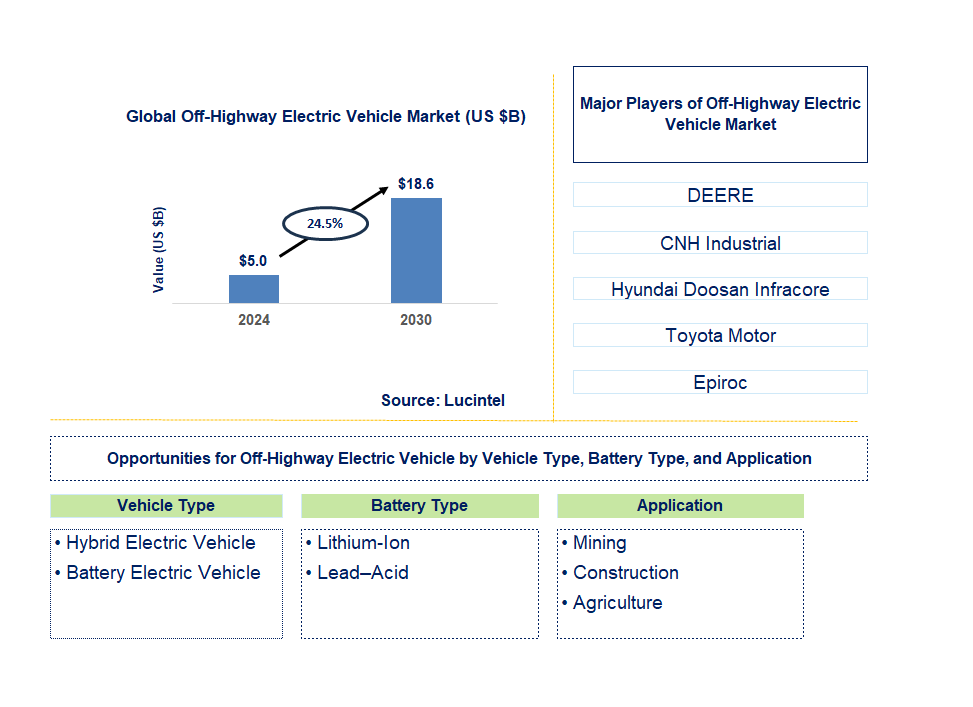
Key data points: The market size in 2031 = $23.2 billion, growth forecast = 24.5% annually for the next 7 years. Scroll below to get more insights. This market report covers trends, opportunities, and forecasts in the global off-highway electric vehicle market to 2031 by vehicle type (hybrid electric vehicle and battery electric vehicle), battery type (lithium-ion and lead–acid), application (mining, construction, agriculture, and others), and region (North America, Europe, Asia Pacific, and the Rest of the World)
We'll send your sample report shortly.
• Lucintel forecasts that, within the vehicle type category, the hybrid electric vehicle will remain the larger segment over the forecast period.
• Within the application category, agriculture will remain the largest segment over the forecast period.
• In terms of region, North America will remain the largest region over the forecast period. Gain valuable insights for your business decisions with our comprehensive 150+ page report.
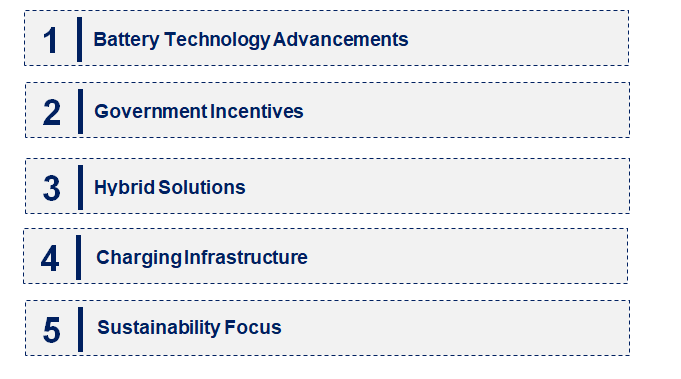
• Battery Technology Advancements: Better batteries with longer life, faster charge times, and more energy packed into less space make electric vehicles, commonly known as EVs, viable alternatives to internal combustion engines (ICE) in many off-road applications.
• Government Incentives: Governments are increasing support and subsidies for this type of vehicle, which has led to a decrease in their prices, making them attractive to consumers.
• Hybrid Solutions: The development of hybrid electric-off-highway vehicles that combine an electric drive system with a conventional engine represents a transition solution that extends the market possibilities.
• Charging Infrastructure: This is supported by the expansion of charging infrastructure, including fast charging solutions and stations.
• Sustainability Focus: As industries strive to reduce their carbon footprint through lower emissions, there has been an increased emphasis on sustainability, causing them to shift towards using electric off-highway vehicles. Key trends emerging from the off-highway EV market include improvements made to battery technology, increased government incentives, hybrid developments, wider charging options, and an enhanced focus on sustainability. These trends help revamp the marketplace by boosting vehicle efficiency levels and raising their acceptance while adhering to environmentally conscious operations.
• Better Battery Technology: The range and efficiency of off-road electric vehicles are being increased by advances in battery technology, including solid-state batteries and rapid recharging capabilities.
• More Investment: There has been considerable funding from major manufacturers as well as start-ups, which is accelerating the development of electric equipment for off-road use and leading to the introduction of new models and technologies.
• Government Policies: Subsidies, tax breaks, and stricter emission regulations have been put in place globally to encourage the adoption of electric off-highway vehicles by various governments.
• Expansion of Charging Infrastructure: This includes fast charging stations and on-site charging for the widespread use of electric off-highway vehicles.
• Market Penetration: Increased market presence in regions such as North America, Europe, and Asia is causing growth and adoption, with different models appearing across various sectors of the off-highway spectrum. Off-road EVs have recently witnessed advancements in battery technologies, more investments, favorable government policies, wider charging infrastructures, and further penetration into markets. These changes have a significant impact on the industry. Consequently, there has been an increase in demand for electric-powered off-highway machinery due to its improved accessibility and performance levels.
• Construction Equipment: Introduce more electric construction machinery like excavators and bulldozers to reduce emissions at job sites while lowering operational costs at the same time.
• Agricultural Machinery: Develop electric tractors and harvesters among other agricultural machinery to address environmental concerns and improve efficiency.
• Mining Equipment: Mining trucks and loaders should be developed into electric versions to make mining operations more sustainable and reduce their environmental impact.
• Material Handling: Investing in electric forklifts and other material handling equipment will enhance performance and cut down on emissions within industrial environments.
• Urban Logistics: Urban logistics and last-mile solutions could benefit from the incorporation of electric off-road vehicles to make transportation more sustainable and efficient in cities. These include expanding electric construction equipment, agricultural machinery, mining equipment, material handling solutions, and urban logistics. Market growth is driven by these opportunities, which are targeted at meeting various industry needs by improving sustainability and increasing operational efficiency.
• Technological Advancements: There have been innovations in battery technology as well as electric drivetrains that have improved the effectiveness of off-highway electric vehicles.
• Environmental Regulations: Stricter emission regulations are driving the shift toward electric vehicles to meet compliance and reduce environmental impact.
• Government Incentives: Financial incentives and subsidies are making electric off-highway vehicles more affordable and attractive to consumers and businesses.
• Rising Fuel Costs: Increasing fuel prices encourage people to adopt electric vehicles as a cheaper alternative to petrol-powered vehicles.
• Sustainability Goals: A greater emphasis on sustainability and corporate social responsibility has compelled industries to transition toward electric off-highway machinery that reduces carbon footprints. Challenges in the off-highway electric vehicle market include:
• High Initial Costs: Compared to traditional machinery, the initial cost of electric vehicles can be a barrier that inhibits the adoption of electric vehicles designed for off-road use due to their high upfront costs.
• Charging Infrastructure: A lack of charging infrastructure, especially in remote areas, may limit the practicality and acceptance of electric off-road vehicles.
• Battery Life and Performance: Issues related to power demands and limited functionality, such as longer recharging times or shorter range, can affect the viability of electric off-highway vehicles.
• Technological Integration: Linking electric equipment with existing off-highway technology and machinery is a challenging process that may also be expensive.
• Market Education: Limited knowledge about the benefits and potential of electric vehicles without road access can hinder market growth. There are several factors driving the electric vehicle market for off-highway vehicles, including technological advancements, environmental regulations, government incentives, rising fuel costs, and sustainability goals. Challenges include high initial costs, insufficient charging infrastructure, battery performance issues, technological integration, and market education. Addressing these drivers and challenges is essential for advancing the market and achieving widespread adoption of electric off-highway vehicles.
• DEERE
• CNH Industrial
• Hyundai Doosan Infracore
• Toyota Motor
• Epiroc
• Cargotec
• Caterpillar
• SANY
• Liebherr-International Deutschland
• JCB
• Hybrid Electric Vehicle
• Battery Electric Vehicle
• Lithium-Ion
• Lead–Acid
• Mining
• Construction
• Agriculture
• Others
• North America
• Europe
• Asia Pacific
• The Rest of the World
• USA: In the United States, there is a notable increase in investment in off-highway electric vehicles, especially for construction and agricultural machinery. Companies are investing in battery-electric and hybrid-electric models to reduce emissions while improving efficiency. Federal and state incentives are promoting the transition to electric off-highway equipment, with some major manufacturers introducing new electric models.
• China: China’s adoption of off-highway electric vehicles is driven by strong government support and environmental regulations. The Chinese market now includes electric-powered excavators, loaders, and farming machinery. Government subsidies and incentives have accelerated adaptation, while local manufacturers have developed cost-effective solutions that last longer on a single charge.
• Germany: Germany focuses on integrating electric technology into heavy-duty machinery and construction equipment to develop its off-highway electric vehicle market. German companies concentrate on developing green, high-performance electric machines that meet strict European emission standards. Additionally, there is an increased focus on developing charging infrastructure to enhance access to electric off-highway vehicles across Germany.
• India: India recently began transforming its off-highway electric vehicle market due to increased public environmental awareness and government support. This transformation has led to the introduction of electric versions of farm machinery and construction equipment, addressing pollution concerns in India amid rising fuel costs. The Indian market emphasizes low-cost local options through indigenous production of customized electric vehicles.
• Japan: Japan stands out as an innovator and early adopter within its off-highway electric vehicle market segment. Japanese manufacturers are incorporating advanced electric technologies into construction and mining machinery. Enhancing battery technology is a major priority, alongside improving the overall performance of off-highway electric vehicles. Moreover, Japan is exploring hybrid models that combine electric propulsion with traditional power sources.
• DEERE
• CNH Industrial
• Hyundai Doosan Infracore
• Toyota Motor
• Epiroc
• Cargotec
• Caterpillar
• SANY
• Liebherr-International Deutschland
• JCB Q6. Which off-highway electric vehicle market segment will be the largest in future? Answer: Lucintel forecasts that hybrid electric vehicle will remain the larger segment over the forecast period. Q7. In off-highway electric vehicle market, which region is expected to be the largest in next 5 years? Answer: North America will remain the largest region over the forecast period. Q.8 Do we receive customization in this report? Answer: Yes, Lucintel provides 10% customization without any additional cost.


Choose a license that fits your team. Instant PDF delivery.
Prices exclude taxes. Instant delivery. Custom licensing available on request.
Market Report · July 31, 2026
Market Report · July 17, 2026
Market Report · May 18, 2026
Trusted partner for strategic intelligence and business growth


Receive a complimentary market analysis tailored to your industry. Our analysts will identify key growth opportunities and competitive dynamics specific to your business.

Market size, growth rate, and key trend analysis for your specific sector.

Top competitor positioning and market share analysis.

Strategic recommendations backed by data-driven insights.
Get curated market intelligence and competitive moves straight to your inbox.
By subscribing, you agree to receive our monthly insights. Unsubscribe anytime.
Receive a complimentary market analysis tailored to your industry. Our analysts will identify key growth opportunities and competitive dynamics specific to your business.
Market size, growth rate, and key trend analysis for your specific sector.
Top competitor positioning and market share analysis.
Strategic recommendations backed by data-driven insights.
Get curated market intelligence, emerging trends, and competitive moves straight to your inbox each month.
By subscribing, you agree to receive our monthly insights. Unsubscribe anytime.
We'll send your sample report shortly.