
Market Report · July 15, 2026

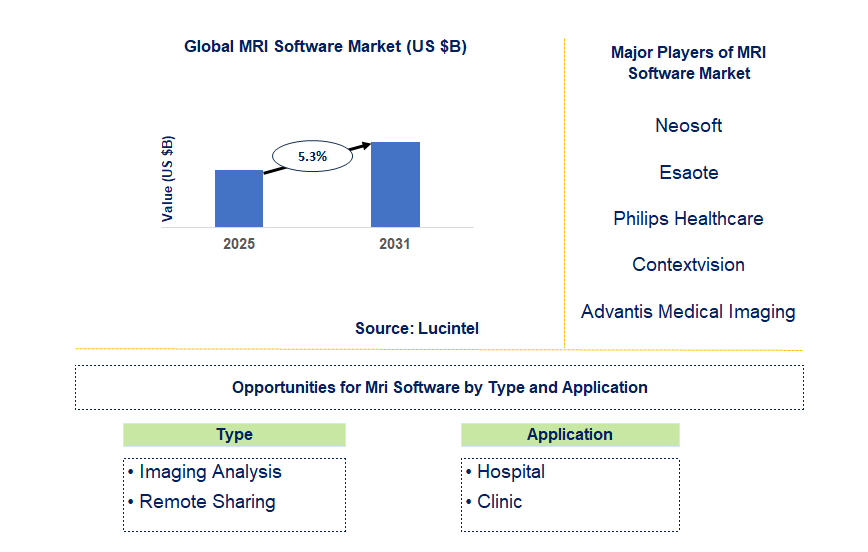
Key data points: The growth forecast = 5.3% annually for the next 7 years. Scroll below to get more insights. This market report covers Trends, opportunities and forecasts in MRI software market to 2031 by type (imaging analysis and remote sharing), application (hospital and clinic), and region (North America, Europe, Asia Pacific, and the Rest of the World)
We'll send your sample report shortly.
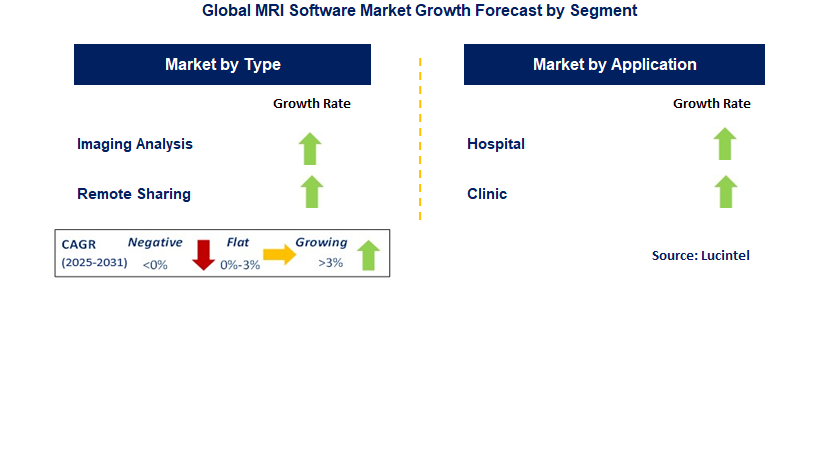
• Lucintel forecasts that, within the type category, imaging analysis is expected to witness higher growth over the forecast period.
• Within the application category, hospital is expected to witness higher growth.
• In terms of region, APAC is expected to witness the highest growth over the forecast period.
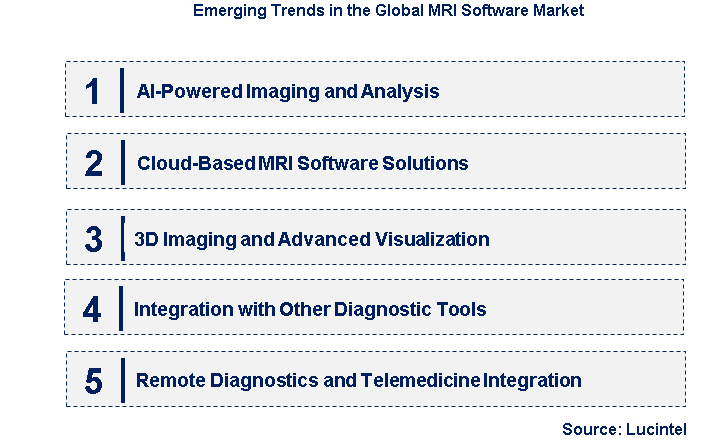
• AI-Powered Imaging and Analysis: AI-driven MRI software is becoming increasingly popular as it significantly enhances image quality and diagnostic accuracy. Machine learning algorithms can help radiologists identify patterns, anomalies, and diseases more efficiently. AI can also automate image processing, reducing diagnostic time and increasing throughput. This trend enhances the overall efficiency of medical imaging practices, particularly in high-volume healthcare settings. AI integration in MRI software is expected to continue to evolve, contributing to better patient outcomes and more personalized treatments.
• Cloud-Based MRI Software Solutions: Cloud technology is becoming a key trend in the MRI software market. By shifting data storage and processing to the cloud, healthcare providers can access MRI software remotely, improving flexibility and scalability. Cloud-based MRI software allows for easier collaboration among medical professionals across different locations and enhances data sharing. It also helps reduce costs by eliminating the need for extensive on-premise infrastructure. As data security and cloud technology improve, this trend is likely to continue reshaping the MRI software landscape.
• 3D Imaging and Advanced Visualization: 3D imaging and advanced visualization in MRI software are changing the way clinicians interpret and analyze images. 3D imaging has enabled more precise and accurate images of anatomical structures, and the ability to diagnose complex conditions is enhanced. Enhanced visualization of MRI software enhances the understanding of the nuances of patients' conditions by radiologists, thus more accurate and timely diagnoses. This is prominently significant in neurology, oncology, and musculoskeletal medicine where accuracy is of paramount importance for the imaging.
• Integration with Other Diagnostic Tools: MRI software is integrated with other diagnostic tools, including CT scans, PET scans, and ultrasound systems. The entire view regarding a patient's condition can, thus, be clearly accessed and further used to draw appropriate decisions. Clinicians can gain a broader and more complete understanding of complex medical issues by combining MRI with other imaging modalities. Integration of MRI software with hospital information systems and electronic health records further streamlines workflows and enhances the quality of care.
• Remote Diagnostics and Telemedicine Integration: With the increasing use of telemedicine, MRI software is increasingly being integrated into remote diagnostic solutions. This allows radiologists and clinicians to remotely view MRI scans and counsel their distant patients. Remote diagnosis is crucial where, for instance, rural populations have limited access to medical experts. This factor continues to propel cloud-based MRI application and telemedicine solutions, thus increasing access to timely and appropriate healthcare regardless of place. Emerging trends such as AI-powered imaging, cloud-based solutions, 3D imaging, integration with other diagnostic tools, and telemedicine integration are transforming the MRI software market. These innovations are improving diagnostic accuracy, reducing operational costs, and making healthcare more accessible and efficient. As these trends continue to develop, MRI software will play an increasingly pivotal role in the future of healthcare diagnostics.
• Artificial Intelligence and Machine Learning: The greatest advancement in MRI software is the inclusion of AI and machine learning technologies. These innovations have dramatically improved the speed and accuracy of MRI image analysis, allowing radiologists to better detect anomalies. AI algorithms can process large datasets, identify patterns, and help automate routine tasks, freeing up radiologists to focus on more complex diagnoses. This development not only makes the diagnostic skills more accurate but also helps patients by lessening waiting times.
• Better Image Quality and Resolution: The latest software for MRI has enhanced the image quality and resolution, which allows healthcare professionals to detect even the smallest abnormalities. Enhanced image resolution allows for more accurate diagnoses in fields such as oncology, neurology, and cardiology. This development is particularly important as the demand for higher-resolution imaging grows, especially in critical areas where precision is essential for treatment planning and outcomes.
• Seamless Integration with Other Healthcare Systems: MRI software is increasingly integrated with electronic health records (EHR) and other healthcare systems, which presents a more unifying approach towards patient care. This integration makes it possible for healthcare professionals to access MRI results along with the patient's histories, lab results, and other diagnostic data in order to better make decisions about treatment. This integration of MRI software with the healthcare system makes workflows more efficient, reduces the administrative burden on healthcare providers, and improves the operational efficiency in medical settings.
• Real-Time Image Processing and Diagnostics: Real-time MRI image processing is becoming one of the emerging developments in the MRI software market. With quicker processing capabilities, radiologists are able to interpret images almost immediately, thus reducing the time needed for diagnosis and patient care. This development has been particularly relevant in emergency and critical care departments, where early intervention can result in a more favorable outcome. Real-time image processing also facilitates easier collaboration of medical teams because results can be shared and discussed in real time.
• Portable and Low-Cost MRI Software Solutions: Advances in developing portable, low-cost MRI software solutions are making MRI technology accessible to resource-constrained settings. The idea is to develop it for use with smaller, cheaper MRI machines so that hospitals and clinics, which lack sufficient budgets for MRI technology, can employ it. Portable MRI software also allows imaging in rural or underserved areas where traditional MRI systems may not be available, thus improving access to diagnostic services for a wider population. The latest developments in the MRI software market, such as AI integration, improved image quality, seamless integration with the healthcare system, real-time processing, and portable solutions, are greatly changing the usage of MRI technology. These innovations are making MRI diagnostics faster, more accurate, and more accessible, which in turn is leading to better healthcare outcomes worldwide.
• Integration of AI and Machine Learning in Diagnostic Imaging: AI integration offers the most significant growth opportunity in the MRI software market, especially in the area of diagnostic imaging. The use of AI in MRI software increases the accuracy of image interpretation, minimizes human error, and accelerates diagnostic processes. Healthcare providers can utilize AI-based MRI software to improve workflow, increase the success rate of diagnosis, and reduce operational costs. As AI technology advances, its role in MRI diagnostics will continue to grow, presenting significant opportunities for software developers and healthcare providers alike.
• Telemedicine and Remote Diagnostics: The increasing adoption of telemedicine presents a significant growth opportunity for MRI software developers. Remote diagnostics enabled by cloud-based MRI software allow radiologists to review scans and provide consultation services from anywhere, expanding access to healthcare in remote and underserved areas. As telemedicine becomes more mainstream, integrating MRI software into these platforms will be crucial for improving patient access to timely and accurate diagnoses, driving market growth.
• Integration with Healthcare Information Systems: The integration of MRI software with other healthcare information systems, such as electronic health records (EHR), represents a key growth opportunity. Seamless integration ensures that MRI results are easily accessible alongside other medical records, improving decision-making and patient care. This trend is particularly important as hospitals and clinics continue to digitize their operations and streamline workflows. MRI software that can be well integrated with other broader healthcare systems will be highly sought after.
• Portable MRI Software Solutions for Rural and Remote Areas: Portable MRI software solutions offer an important growth opportunity, especially in low-resource and rural areas. The portable MRI system combined with cheap and efficient software can bring diagnostic imaging to remote regions where traditional MRI equipment might not be accessible. This may have significant scope for further development of MRI software, and more importantly it has the possibility to increase accessibility and reduce inequality in diagnostic skills for healthcare facilities.
• Precision Medicine and Personalized Treatment: Growing interest in precision medicine and individualized treatment represents an expansion potential for MRI software that could perform advanced imaging analysis. With this, more precise diagnosis could be possible to further create appropriate, personalized treatments. The future trend is likely to move toward the incorporation of personalizing medicine with increasing demands in terms of the implementation of highly specific and detailed MRI software solutions across various specializations, particularly oncology, neurology, among others. In terms of MRI software, AI integration, telemedicine, health care system integration, portable solutions, and precision medicine are leading growth opportunities, all of which reshape the landscape. The higher the demand for faster, more precise, and easily accessible diagnostic devices, the higher the driving factors for innovation and expansion in MRI software market growth.
• Neosoft
• Esaote
• Philips Healthcare
• ContextVision
• Advantis Medical Imaging
• Medecom
• ADinstruments
• ASG Superconductors
• OR Technology
• PaxeraHealth Corp
• Imaging Analysis
• Remote Sharing
• Hospital
• Clinic
• North America
• Europe
• Asia Pacific
• The Rest of the World
• United States: The growth in the United States is fast-paced due to the advancements in machine learning and artificial intelligence. Healthcare providers are increasingly adopting AI-driven software for enhanced image processing, better diagnostic accuracy, and more efficient workflows. The integration of MRI software with electronic health records (EHR) and other hospital systems is also driving growth, improving patient care and operational efficiency. Moreover, increasing investment in healthcare, combined with the government push for digital healthcare, is facilitating broader adoptions of MRI software in both clinical and research fields.
• China: China's MRI software market is witnessing such healthy growth, driven by the government's commitment to enhancing healthcare infrastructure. That has led to expansion in healthcare, coupled with the requirement for improved diagnostic tools that are propelling hospitals and research institutions into the more advanced MRI software. China: AI-enabled image analysis software is becoming very popular in the country as this software reduces the time taken in diagnosing any problem and raises the accuracy percentage. Moreover, increasing healthcare improvement, especially in rural areas of China, requires the adoption of MRI technology with its software applications for timely diagnosis with accuracy.
• Germany: With the strong health system and its technological expertise, Germany is booming in the growth of MRI software market. The innovative MRI software solutions developed by German companies are highly leading in the field of advanced image analysis, visualization, and processing. Integration of MRI software with other imaging modalities and hospital management systems is streamlining healthcare workflows. Additionally, precision medicine and personalized healthcare are key focus areas in Germany, thus demanding MRI software with high-resolution imaging and advanced data processing capabilities for more tailored and effective patient care.
• India: In India, the MRI software market is on the rise because of the rising number of hospitals and diagnostic centers that are implementing advanced imaging technology. The Indian healthcare system has become more concerned with improving the capabilities of diagnosis, which makes MRI software grow more in use. Indian companies are developing cost-effective, AI-driven MRI software solutions to address the growing need for efficient and accurate diagnostics. With improvement in healthcare access throughout the country, especially in cities, MRI software is being considered as one of the basic requirements for rapid and accurate diagnoses of an increasingly large patient population.
• Japan: Japan, known for its highly developed technological foundation, is incorporating innovations in MRI software, mainly in artificial intelligence and image processing. Japanese health care providers are embracing advanced MRI software to ensure greater diagnostic accuracy and better care for patients. The boom in the elderly population in Japan is creating an ever-growing demand for diagnostic tools that are efficient and accurate, especially with regard to neurological and musculoskeletal diseases, where MRI will have a key role. Software for MRI is also being integrated into robotics and AI to improve the imaging quality, shorten operation time, and ultimately lead to better outcomes for patients.


• Neosoft
• Esaote
• Philips Healthcare
• ContextVision
• Advantis Medical Imaging
• Medecom
• ADinstruments
• ASG Superconductors
• OR Technology
• PaxeraHealth Corp Q5. Which MRI software market segment will be the largest in future? Answer: Lucintel forecasts that, within the type category, imaging analysis is expected to witness higher growth over the forecast period. Q6. In MRI software market, which region is expected to be the largest in next 5 years? Answer: In terms of region, APAC is expected to witness the highest growth over the forecast period. Q7. Do we receive customization in this report? Answer: Yes, Lucintel provides 10% customization without any additional cost.


Choose a license that fits your team. Instant PDF delivery.
Prices exclude taxes. Instant delivery. Custom licensing available on request.
Market Report · July 15, 2026
Market Report · June 26, 2026
Market Report · June 24, 2026
Trusted partner for strategic intelligence and business growth


Receive a complimentary market analysis tailored to your industry. Our analysts will identify key growth opportunities and competitive dynamics specific to your business.

Market size, growth rate, and key trend analysis for your specific sector.

Top competitor positioning and market share analysis.

Strategic recommendations backed by data-driven insights.
Get curated market intelligence and competitive moves straight to your inbox.
By subscribing, you agree to receive our monthly insights. Unsubscribe anytime.
Receive a complimentary market analysis tailored to your industry. Our analysts will identify key growth opportunities and competitive dynamics specific to your business.
Market size, growth rate, and key trend analysis for your specific sector.
Top competitor positioning and market share analysis.
Strategic recommendations backed by data-driven insights.
Get curated market intelligence, emerging trends, and competitive moves straight to your inbox each month.
By subscribing, you agree to receive our monthly insights. Unsubscribe anytime.
We'll send your sample report shortly.