
Metal Pipe Market Trends and Forecast
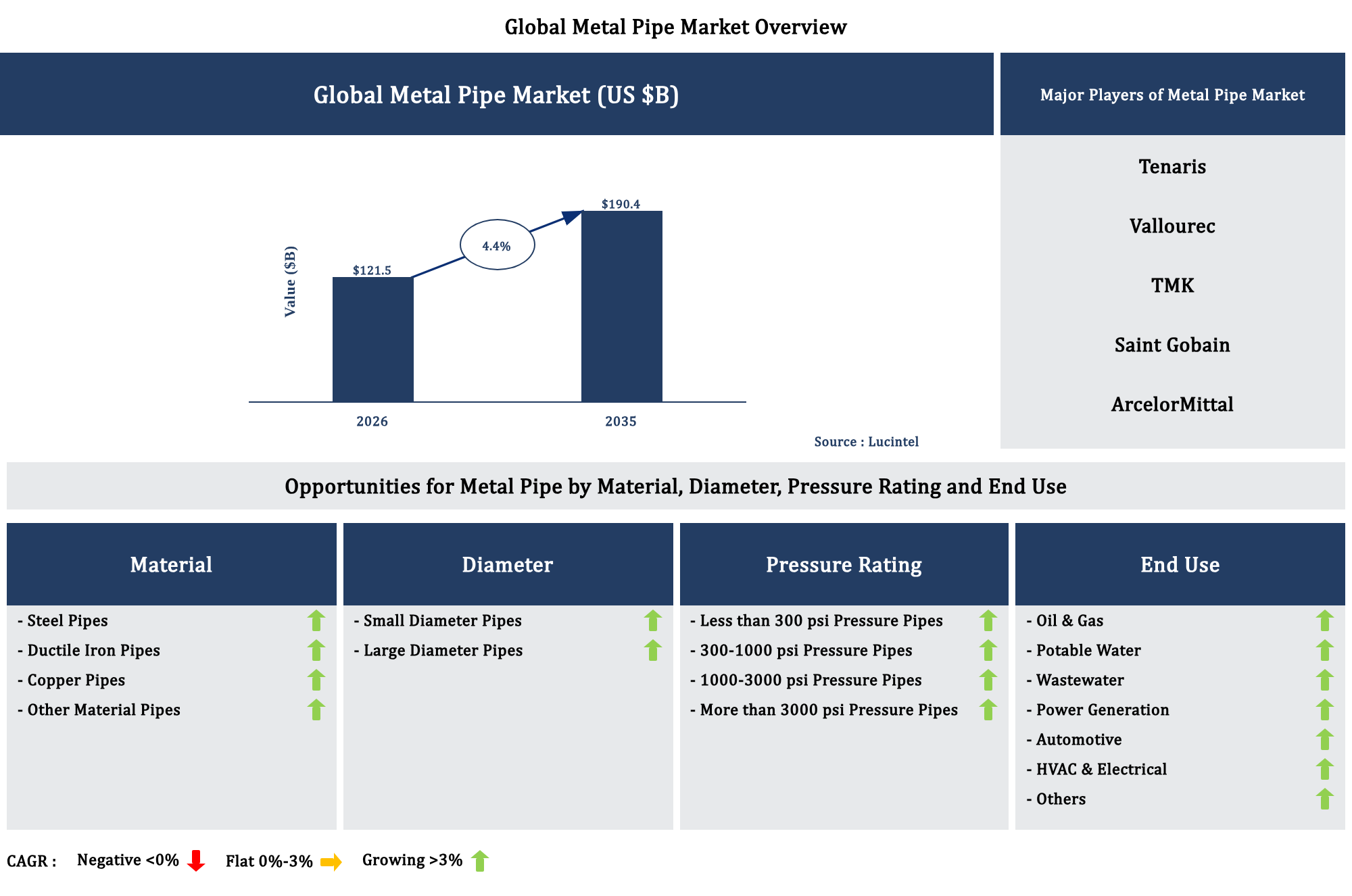
The future of the global metal pipe market looks promising with opportunities in the oil & gas, potable water, wastewater, power generation, automotive, and HVAC & electrical markets. The global metal pipe market is expected to reach an estimated $190,466 million by 2035 with a CAGR of 4.4% from 2026 to 2035. The major drivers for this market are the growing demand in construction & real estate sector, the increasing demand for durable & high-strength piping systems, and the rising demand for replacement of old and corroded pipelines.
• Lucintel forecasts that, within the material category, steel pipe is expected to witness the highest growth over the forecast period.
• Within the end use category, oil & gas is expected to witness the highest growth.
• In terms of region, APAC is expected to witness the highest growth over the forecast period.
Gain valuable insights for your business decisions with our comprehensive 150+ page report. Sample figures with some insights are shown below.
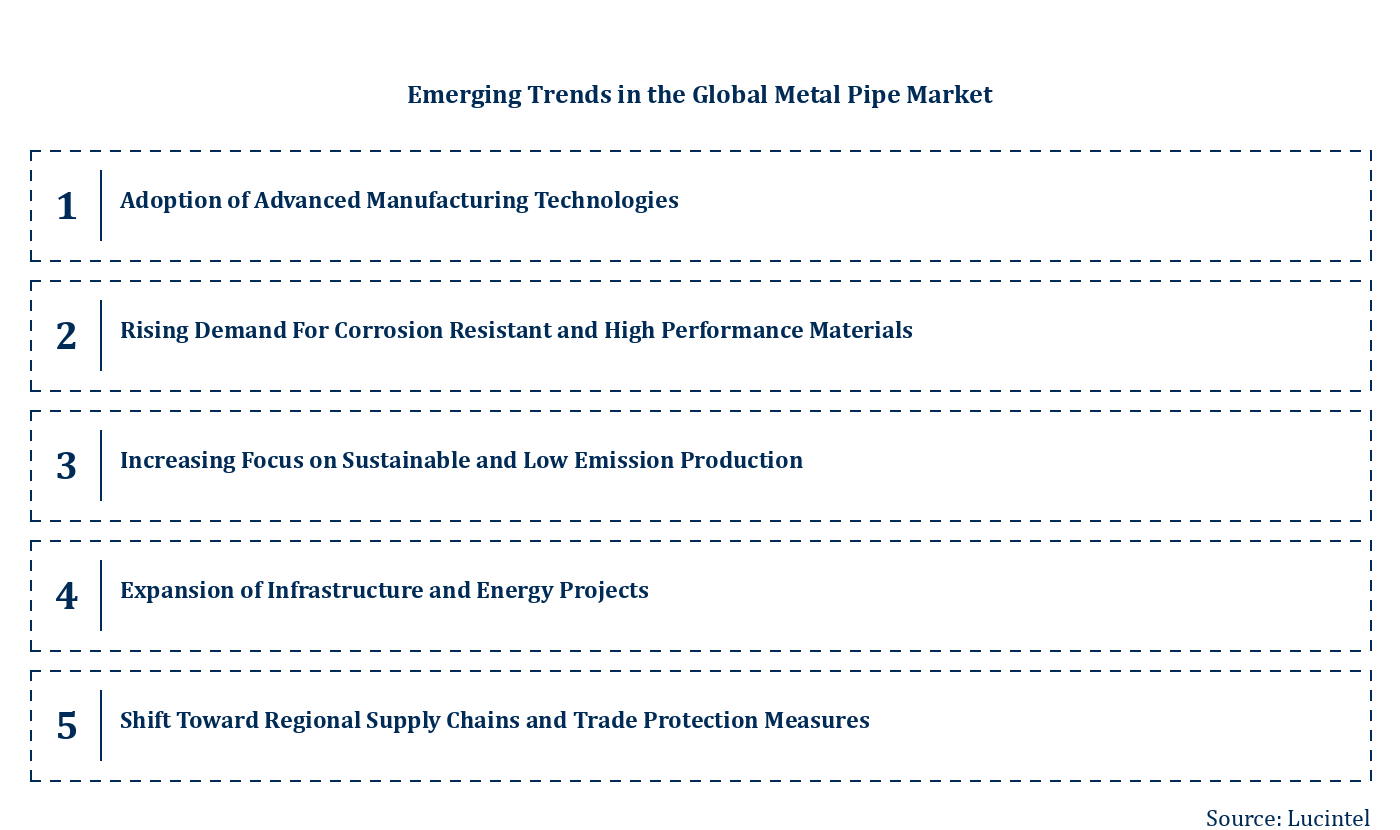
Emerging Trends in the Metal Pipe Market
The metal pipe market is undergoing a period of transformation driven by evolving industrial requirements, sustainability pressures, and rapid technological advancements. Increasing demand from construction, energy, and water infrastructure sectors is reshaping production priorities and material innovation. At the same time, global supply chain shifts and regulatory frameworks are encouraging localized manufacturing and greener processes. Digitalization, advanced materials, and automation are further enhancing efficiency and product performance. These developments are not only improving operational capabilities but also redefining competitive dynamics, pushing manufacturers to adopt innovative strategies to remain relevant in a highly competitive and increasingly sustainability-focused global market.
• Adoption of Advanced Manufacturing Technologies: The integration of advanced manufacturing technologies such as automation, artificial intelligence, and smart factory systems is becoming a major trend in the metal pipe market. Manufacturers are increasingly deploying robotics and digital monitoring tools to improve production accuracy, reduce waste, and enhance operational efficiency. These technologies enable real-time quality control and predictive maintenance, minimizing downtime and lowering operational costs. As competition intensifies, companies are investing in digital transformation to gain a competitive edge. This trend is significantly improving productivity and product consistency, while also enabling faster response to changing market demands and customized production requirements.
• Rising Demand for Corrosion Resistant and High Performance Materials: There is a growing shift toward corrosion resistant and high performance metal pipes, particularly in industries such as oil and gas, chemicals, and water treatment. Materials such as stainless steel, alloys, and coated pipes are gaining traction due to their durability and longer service life. This trend is driven by the need to reduce maintenance costs and improve safety in harsh operating environments. As infrastructure projects become more complex, the demand for high quality materials is increasing. This shift is encouraging manufacturers to innovate and develop advanced material solutions that offer superior strength, resistance, and long term reliability.
• Increasing Focus on Sustainable and Low Emission Production: Sustainability is becoming a central focus in the metal pipe market, with manufacturers adopting low emission production processes and energy efficient technologies. Governments and regulatory bodies are imposing stricter environmental standards, pushing companies to reduce carbon footprints and adopt cleaner production methods. The use of recycled materials and green energy sources is also gaining importance. This trend is not only helping companies comply with regulations but also improving brand image and attracting environmentally conscious customers. As sustainability becomes a key differentiator, companies are investing heavily in eco friendly innovations and circular economy practices.
• Expansion of Infrastructure and Energy Projects: The rapid expansion of infrastructure and energy projects across both developed and emerging economies is significantly driving demand for metal pipes. Investments in water supply systems, urban development, oil and gas pipelines, and renewable energy projects are creating substantial growth opportunities. Governments are prioritizing infrastructure modernization to support economic development, which in turn is boosting the consumption of metal pipes. This trend is particularly strong in emerging markets, where urbanization and industrialization are accelerating. As a result, manufacturers are expanding production capacities and strengthening distribution networks to meet the growing demand.
• Shift Toward Regional Supply Chains and Trade Protection Measures: The metal pipe market is witnessing a shift toward regional supply chains, influenced by trade tensions, tariffs, and geopolitical uncertainties. Countries are increasingly focusing on strengthening domestic manufacturing capabilities to reduce dependency on imports. Trade protection measures such as tariffs and quotas are encouraging local production and investment. This trend is reshaping global trade flows and prompting companies to establish regional manufacturing hubs. While it enhances supply chain resilience, it also increases operational complexity. Companies must adapt to changing trade policies and develop flexible strategies to maintain competitiveness in different regional markets.
These emerging trends are collectively reshaping the metal pipe market by driving innovation, sustainability, and regionalization. Advanced manufacturing is improving efficiency and quality, while the shift toward high performance materials is enhancing product durability and application scope. Sustainability initiatives are redefining production processes, and infrastructure expansion is fueling demand across sectors. Meanwhile, the move toward regional supply chains is altering global trade dynamics. Together, these trends are creating a more resilient, technologically advanced, and environmentally responsible market, encouraging companies to continuously evolve and invest in future ready solutions to sustain long term growth.
Recent Developments in the Metal Pipe Market
The metal pipe market is witnessing notable developments driven by industrial expansion, technological innovation, and evolving regulatory frameworks. Increasing investments in infrastructure, energy transition projects, and advanced manufacturing capabilities are shaping recent advancements. At the same time, sustainability goals and supply chain restructuring are influencing production and distribution strategies. These developments are strengthening competitiveness and encouraging modernization across key regions. As demand patterns shift globally, manufacturers are adapting to new requirements, focusing on efficiency, quality, and environmental compliance to maintain growth and resilience.
• Expansion of Domestic Manufacturing Capabilities: Governments and industry players are increasingly investing in domestic manufacturing to reduce reliance on imports and enhance supply chain resilience. This development is driven by geopolitical uncertainties and trade restrictions, encouraging localized production. New facilities, capacity expansions, and modernization of existing plants are improving output quality and efficiency. This shift supports job creation and strengthens national industrial bases. As a result, companies are better positioned to respond to local demand fluctuations while reducing logistical costs and risks associated with global supply chain disruptions.
• Integration of Digital and Smart Manufacturing Systems: The adoption of digital technologies such as automation, artificial intelligence, and real time monitoring systems is transforming metal pipe production. Smart manufacturing enables improved precision, reduced waste, and enhanced operational efficiency. Companies are implementing predictive maintenance and data driven decision making to minimize downtime and optimize resource utilization. This development is increasing competitiveness by lowering production costs and improving product consistency. It also allows manufacturers to quickly adapt to changing customer requirements, supporting customized solutions and faster delivery timelines across various industries.
• Development of Advanced and High Strength Materials: There is a growing focus on producing advanced metal pipes using high strength alloys and corrosion resistant materials. These innovations are essential for demanding applications in sectors such as energy, chemicals, and infrastructure. Enhanced material properties improve durability, safety, and performance under extreme conditions. This development reduces maintenance costs and extends product lifespan, making it highly attractive for long term projects. Manufacturers are investing in research and development to create innovative material solutions that meet evolving industry standards and regulatory requirements.
• Increasing Investments in Sustainable Production Processes: Sustainability has become a key development in the metal pipe market, with companies adopting energy efficient technologies and low emission production methods. The use of recycled materials and renewable energy sources is gaining momentum to reduce environmental impact. Regulatory pressure and customer awareness are driving this shift toward greener operations. Companies that invest in sustainable practices are improving compliance and brand reputation. This development is also opening opportunities for innovation, enabling manufacturers to align with global environmental goals while maintaining operational efficiency and cost effectiveness.
• Growth in Infrastructure and Energy Sector Projects: Rising investments in infrastructure development and energy projects are significantly influencing the metal pipe market. Governments are prioritizing water management systems, urban expansion, and pipeline networks to support economic growth. Additionally, the transition toward renewable energy is creating new demand for specialized piping solutions. This development is increasing the need for high quality and durable metal pipes across multiple applications. Manufacturers are expanding production capacity and enhancing distribution networks to meet this growing demand, ensuring timely delivery and improved service capabilities.
These developments are collectively transforming the metal pipe market by enhancing production efficiency, material quality, and sustainability. The focus on domestic manufacturing and digital integration is strengthening operational resilience, while advanced materials are improving product performance. Sustainable practices are aligning the market with environmental goals, and infrastructure growth is driving consistent demand. Together, these factors are creating a more competitive and future ready market, encouraging continuous innovation and strategic investments to support long term growth and adaptability in an evolving global landscape.
Strategic Growth Opportunities in the Metal Pipe Market
The metal pipe market is expanding steadily due to rising demand across construction, energy, water management, and industrial sectors. Rapid urbanization, infrastructure modernization, and the global transition toward sustainable energy systems are creating new avenues for growth. Technological advancements and material innovations are further enhancing application potential. As industries evolve, the need for durable, efficient, and high performance piping solutions is increasing. These factors are opening strategic growth opportunities across key applications, encouraging manufacturers to diversify offerings and strengthen their presence in high demand segments.
• Increasing Demand in Water and Wastewater Infrastructure Applications: The growing need for efficient water supply and wastewater management systems is creating significant opportunities for metal pipes. Governments are investing heavily in modernizing aging infrastructure and expanding access to clean water. Metal pipes offer durability, pressure resistance, and long service life, making them ideal for these applications. Increasing urban population and stricter environmental regulations are further driving demand. This opportunity encourages manufacturers to develop corrosion resistant and cost effective solutions to meet large scale infrastructure requirements across both developed and emerging markets.
• Expanding Use in Oil and Gas Transportation Networks: Metal pipes continue to play a critical role in oil and gas transportation, offering high strength and reliability under extreme conditions. Increasing exploration and production activities, along with pipeline expansion projects, are driving demand in this segment. The need for safe and efficient transportation of hydrocarbons is encouraging the use of advanced pipe materials. Additionally, maintenance and replacement of existing pipelines are contributing to market growth. This opportunity is prompting manufacturers to innovate and supply high performance pipes that meet stringent safety and operational standards.
• Rising Adoption in Renewable Energy and Hydrogen Projects: The transition toward renewable energy and hydrogen infrastructure is creating new growth opportunities for metal pipe applications. These projects require specialized piping systems capable of handling high pressure and corrosive environments. Governments and private investors are funding large scale renewable energy initiatives, including hydrogen production and distribution networks. Metal pipes are essential for ensuring safe and efficient energy transfer. This opportunity is driving innovation in material technology and design, enabling manufacturers to cater to emerging energy sectors with advanced and sustainable piping solutions.
• Growth In Construction and Urban Development Activities: Rapid urbanization and increasing construction activities are significantly boosting demand for metal pipes in residential, commercial, and industrial projects. These pipes are widely used for structural, plumbing, and heating applications due to their strength and durability. Infrastructure development in emerging economies is further accelerating this demand. The need for high quality construction materials is encouraging the adoption of advanced piping solutions. This opportunity is leading manufacturers to expand production capacity and enhance product offerings to support large scale urban development initiatives.
• Increasing Application in Industrial and Chemical Processing Sectors: Industrial and chemical processing industries require high performance metal pipes that can withstand harsh operating conditions, including high temperatures and corrosive substances. The expansion of manufacturing activities and process industries is driving demand for specialized piping systems. Metal pipes ensure safety, efficiency, and long term reliability in these environments. This opportunity is encouraging manufacturers to focus on developing advanced alloys and coatings. As industrial output continues to grow globally, the demand for durable and efficient piping solutions is expected to rise steadily.
These strategic growth opportunities are significantly shaping the future of the metal pipe market by expanding its application scope across critical industries. Water infrastructure, energy transportation, renewable projects, construction, and industrial processing are driving consistent demand. Advancements in material technology and increasing investments are further strengthening market potential. Together, these opportunities are encouraging innovation, capacity expansion, and diversification, enabling manufacturers to capitalize on evolving industry needs while ensuring long term growth, resilience, and competitiveness in a dynamic global market.
Metal Pipe Market Driver and Challenges
The metal pipe market is influenced by a combination of technological advancements, economic conditions, and regulatory frameworks that collectively shape its growth trajectory. Increasing demand from infrastructure, energy, and industrial sectors is driving innovation and capacity expansion. At the same time, evolving environmental regulations and global trade dynamics are creating both opportunities and constraints. Manufacturers are focusing on efficiency, sustainability, and product quality to remain competitive. However, challenges such as fluctuating raw material costs and supply chain disruptions continue to impact operations, requiring strategic adaptation to maintain long term growth and stability.
The Factors Responsible for Driving the metal pipe market Include:-
• Increasing Infrastructure Development and Urbanization: Rapid urbanization and large scale infrastructure development projects across both developed and emerging economies are significantly driving demand for metal pipes. Governments are investing heavily in transportation networks, water supply systems, and urban housing projects, all of which require durable piping solutions. Metal pipes are preferred due to their strength, longevity, and ability to withstand high pressure. This driver is particularly strong in emerging economies where urban expansion is accelerating. As infrastructure modernization continues globally, manufacturers are expanding production capacities and enhancing product offerings to meet growing demand, ensuring consistent market growth.
• Rising Demand From Energy And Oil and Gas Sectors: The energy sector, particularly oil and gas, remains a major driver for the metal pipe market. Pipelines are essential for the transportation of crude oil, natural gas, and refined products, requiring high performance and corrosion resistant materials. Increasing exploration activities and expansion of pipeline networks are boosting demand. Additionally, maintenance and replacement of aging infrastructure in developed regions are contributing to growth. The transition toward cleaner energy sources is also creating demand for specialized piping systems. This driver encourages continuous innovation in material technology to meet stringent safety and operational requirements.
• Technological Advancements in Manufacturing Processes: Advancements in manufacturing technologies, including automation, artificial intelligence, and precision engineering, are enhancing production efficiency and product quality in the metal pipe market. These technologies enable real time monitoring, predictive maintenance, and reduced material wastage. As a result, manufacturers can achieve higher productivity and cost efficiency. The adoption of smart manufacturing systems also allows for customization and faster response to market demands. This driver is strengthening competitiveness and enabling companies to meet evolving industry standards, while also reducing operational risks and improving overall supply chain performance.
• Growing Focus on Sustainable and High Performance Materials: Increasing environmental awareness and regulatory pressure are driving the adoption of sustainable production practices and high performance materials in the metal pipe market. Manufacturers are investing in energy efficient processes, recycled materials, and low emission technologies to reduce environmental impact. At the same time, there is rising demand for corrosion resistant and durable pipes that offer longer service life. This driver is encouraging innovation and research in advanced materials, helping companies meet regulatory requirements while improving product reliability and reducing lifecycle costs for end users.
The Challenges in the metal pipe market Are:
• Volatility in Raw Material Prices and Supply Constraints: Fluctuations in the prices of key raw materials such as steel and alloys pose a significant challenge for the metal pipe market. These price variations are often influenced by global supply demand imbalances, trade policies, and geopolitical tensions. Rising input costs can impact profit margins and pricing strategies for manufacturers. Additionally, supply chain disruptions can lead to delays in production and delivery. Companies must adopt effective procurement strategies and explore alternative sourcing options to mitigate these risks and maintain stable operations in a highly competitive environment.
• Stringent Environmental Regulations and Compliance Requirements: Increasingly strict environmental regulations related to emissions, waste management, and energy consumption are creating challenges for metal pipe manufacturers. Compliance with these regulations often requires significant investment in advanced technologies and process upgrades. Smaller players may find it difficult to meet these requirements due to limited financial resources. While these regulations promote sustainability, they also increase operational complexity and costs. Companies must balance regulatory compliance with profitability, making strategic investments in cleaner technologies and sustainable practices to remain competitive in the evolving market landscape.
• Intense Market Competition and Pricing Pressure: The metal pipe market is highly competitive, with numerous global and regional players competing on price, quality, and innovation. This intense competition often leads to pricing pressure, reducing profit margins for manufacturers. Additionally, the presence of low cost producers in certain regions increases the challenge for companies operating in higher cost environments. To stay competitive, manufacturers must focus on differentiation through quality, innovation, and customer service. Strategic partnerships, mergers, and acquisitions are also being used to strengthen market position and achieve economies of scale.
The metal pipe market is shaped by a dynamic interplay of strong growth drivers and persistent challenges. Infrastructure development, energy sector demand, technological advancements, and sustainability initiatives are driving expansion and innovation. At the same time, challenges such as raw material price volatility, regulatory pressures, and intense competition require careful management. Companies that successfully adapt to these conditions by investing in advanced technologies, sustainable practices, and efficient supply chains will be better positioned to achieve long term growth and maintain competitiveness in an increasingly complex global market.
List of Metal Pipe Companies
Companies in the market compete on the basis of product quality offered. Major players in this market focus on expanding their manufacturing facilities, R&D investments, infrastructural development, and leverage integration opportunities across the value chain. With these strategies metal pipe companies cater increasing demand, ensure competitive effectiveness, develop innovative products & technologies, reduce production costs, and expand their customer base. Some of the metal pipe companies profiled in this report include-
• Tenaris
• Vallourec
• TMK
• Saint Gobain
• ArcelorMittal
• Nippon Steel and Sumitomo Metals
• United States Steel Corporation
• Mueller Industries
• Kaiser Aluminum
• Amiantit
Metal Pipe Market by Segment
The study includes a forecast for the global metal pipe market by material, diameter, pressure rating, end use, and region.
Metal Pipe Market by Material [Value from 2019 to 2035]:
• Steel Pipes
• Ductile Iron Pipes
• Copper Pipes
• Other Material Pipes
Metal Pipe Market by Diameter [Value from 2019 to 2035]:
• Small Diameter Pipes
• Large Diameter Pipes
Metal Pipe Market by Pressure Rating [Value from 2019 to 2035]:
• Less than 300 psi Pressure Pipes
• 300-1000 psi Pressure Pipes
• 1000-3000 psi Pressure Pipes
• More than 3000 psi Pressure Pipes
Metal Pipe Market by End Use [Value from 2019 to 2035]:
• Oil & Gas
• Potable Water
• Wastewater
• Power Generation
• Automotive
• HVAC & Electrical
• Others
Metal Pipe Market by Region [Value from 2019 to 2035]:
• North America
• Europe
• Asia Pacific
• The Rest of the World
Country Wise Outlook for the Metal Pipe Market
The metal pipe market is experiencing significant transformation driven by infrastructure expansion, energy transition, and evolving trade policies. Across major economies such as the United States, China, Germany, India, and Japan, recent developments reflect a mix of technological innovation, sustainability initiatives, and geopolitical influences. Governments and industry players are investing in advanced manufacturing, corrosion-resistant materials, and low-emission production processes. At the same time, trade regulations, tariffs, and shifting demand patterns are reshaping supply chains. These developments are collectively strengthening domestic production capabilities while encouraging modernization and diversification across end-use sectors such as construction, oil and gas, and water management.
• United States: The United States metal pipe market is witnessing growth supported by rising domestic steel production and strong infrastructure investments. In 2025, steel output increased, reflecting improved industrial activity and demand from construction and energy sectors. Trade policies, including expanded tariffs on steel and copper-based products, are encouraging local manufacturing and reducing reliance on imports. Additionally, industry consolidation and vertical integration strategies by major producers are strengthening supply chains and improving efficiency. Investments in smart manufacturing and digital supply chain systems are also enhancing productivity, positioning the United States as a fast-growing and technologically advanced market for metal pipes.
• China: China continues to dominate themetal pipe market, driven by its large-scale manufacturing base and infrastructure capabilities. However, recent developments indicate a gradual shift, with slower growth in exports and increasing domestic focus. Rising global trade restrictions and reduced export demand are prompting Chinese manufacturers to upgrade technology and improve product quality. At the same time, the country remains a major supplier of steel pipes globally, supported by extensive production capacity. The transition toward sustainable and high-performance materials, including alloy and corrosion-resistant pipes, is gaining traction, reflecting China’s effort to align with global environmental and industrial standards.
• Germany: Germany metal pipe market is evolving through technological innovation and strategic global expansion. German manufacturers are focusing on high-quality stainless steel and engineered pipe solutions for industrial applications such as chemicals, energy, and automotive sectors. Companies are also expanding internationally, including investments in production facilities abroad to strengthen global presence. Sustainability remains a key priority, with increasing emphasis on energy-efficient production and recyclable materials. Additionally, Germany’s role within the European industrial ecosystem ensures steady demand for advanced piping systems, particularly in renewable energy and precision engineering applications, reinforcing its position as a technology-driven market.
• India: India metal pipe market is experiencing rapid growth driven by infrastructure expansion, urbanization, and government-led industrial policies. The country is targeting significant increases in steel production capacity while simultaneously focusing on reducing carbon emissions through greener manufacturing processes. Rising domestic demand for pipelines in water supply, construction, and energy sectors is further boosting the market. However, challenges such as rising imports of cheaper steel products have led to policy responses, including potential safeguard duties to protect local manufacturers. Overall, India is emerging as a high-growth market with strong investment potential and increasing global competitiveness.
• Japan: Japan metal pipe market is undergoing restructuring amid global competition and shifting demand dynamics. While the country remains a key producer of high-quality steel pipes, its production levels have faced pressure from rising competition and changing global trade patterns. Japanese companies are increasingly focusing on expanding into high-growth markets such as the United States and India to offset domestic stagnation. Innovation in advanced materials and precision manufacturing continues to be a core strength, particularly in automotive and high-performance industrial applications. Japan’s strategy emphasizes international expansion and technological leadership to sustain its position in the global metal pipe industry.
Features of the Global Metal Pipe Market
Market Size Estimates: Metal pipe market size estimation in terms of value ($M).
Trend and Forecast Analysis: Market trends (2019 to 2025) and forecast (2026 to 2035) by various segments and regions.
Segmentation Analysis: Metal pipe market size by various segments, such as by material, diameter, pressure rating, end use, and region in terms of value ($M).
Regional Analysis: Metal pipe market breakdown by North America, Europe, Asia Pacific, and Rest of the World.
Growth Opportunities: Analysis of growth opportunities in different material, diameter, pressure rating, end use, and regions for the metal pipe market.
Strategic Analysis: This includes M&A, new product development, and competitive landscape of the metal pipe market.
Analysis of competitive intensity of the industry based on Porter’s Five Forces model.
FAQ
Q1. What is the metal pipe market size?
Answer: The global metal pipe market is expected to reach an estimated $190,466 million by 2035.
Q2. What is the growth forecast for metal pipe market?
Answer: The global metal pipe market is expected to grow with a CAGR of 4.4% from 2026 to 2035.
Q3. What are the major drivers influencing the growth of the metal pipe market?
Answer: The major drivers for this market are the growing demand in construction & real estate sector, the increasing demand for durable & high-strength piping systems, and the rising demand for replacement of old and corroded pipelines.
Q4. What are the major segments for metal pipe market?
Answer: The future of the metal pipe market looks promising with opportunities in the oil & gas, potable water, wastewater, power generation, automotive, and HVAC & electrical markets.
Q5. Who are the key metal pipe market companies?
Answer: Some of the key metal pipe companies are as follows:
• Tenaris
• Vallourec
• TMK
• Saint Gobain
• ArcelorMittal
• Nippon Steel and Sumitomo Metals
• United States Steel Corporation
• Mueller Industries
• Kaiser Aluminum
• Amiantit
Q6. Which metal pipe market segment will be the largest in future?
Answer: Lucintel forecasts that, within the material category, steel pipe is expected to witness the highest growth over the forecast period.
Q7. In metal pipe market, which region is expected to be the largest in next 8 years?
Answer: In terms of region, APAC is expected to witness the highest growth over the forecast period.
Q8. Do we receive customization in this report?
Answer: Yes, Lucintel provides 10% customization without any additional cost.
This report answers following 11 key questions:
Q.1. What are some of the most promising, high-growth opportunities for the metal pipe market by material (steel pipes, ductile iron pipes, copper pipes, and other material pipes), diameter (small diameter pipes and large diameter pipes), pressure rating (less than 300 psi pressure pipes, 300-1000 psi pressure pipes, 1000-3000 psi pressure pipes, and more than 3000 psi pressure pipes), end use (oil & gas, potable water, wastewater, power generation, automotive, HVAC & electrical, and others), and region (North America, Europe, Asia Pacific, and the Rest of the World)?
Q.2. Which segments will grow at a faster pace and why?
Q.3. Which region will grow at a faster pace and why?
Q.4. What are the key factors affecting market dynamics? What are the key challenges and business risks in this market?
Q.5. What are the business risks and competitive threats in this market?
Q.6. What are the emerging trends in this market and the reasons behind them?
Q.7. What are some of the changing demands of customers in the market?
Q.8. What are the new developments in the market? Which companies are leading these developments?
Q.9. Who are the major players in this market? What strategic initiatives are key players pursuing for business growth?
Q.10. What are some of the competing products in this market and how big of a threat do they pose for loss of market share by material or product substitution?
Q.11. What M&A activity has occurred in the last 5 years and what has its impact been on the industry?
For any questions related to Metal Pipe Market, Metal Pipe Market Size, Metal Pipe Market Growth, Metal Pipe Market Analysis, Metal Pipe Market Report, Metal Pipe Market Share, Metal Pipe Market Trends, Metal Pipe Market Forecast, Metal Pipe Companies, write Lucintel analyst at email: helpdesk@lucintel.com. We will be glad to get back to you soon.