
Market Report · July 17, 2026

Key data points: The growth forecast = 13.1% annually for the next 7 years. Scroll below to get more insights. This market report covers trends, opportunities and forecasts in copper pipe & tube market to 2031 by type (copper pipes and copper tubes), application (plumbing, HVAC, refrigeration, and industrial), and region (North America, Europe, Asia Pacific, and the Rest of the World)
We'll send your sample report shortly.
• Lucintel forecasts that, within the type category, copper tube is expected to witness higher growth over the forecast period.
• Within the application category, HVAC is expected to witness the highest growth.
• In terms of region, APAC is expected to witness the highest growth over the forecast period. Gain valuable insights for your business decisions with our comprehensive 150+ page report. Sample figures with some insights are shown below.

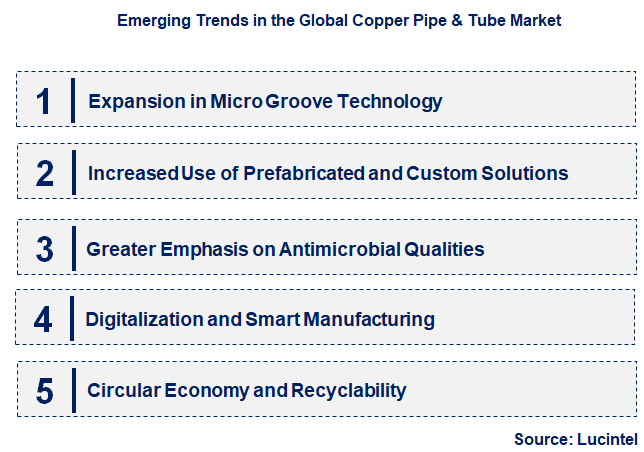
• Expansion in Micro Groove Technology: This is a trend where smaller-diameter copper tubes with internal grooves are used. The technology improves heat transfer effectiveness, enabling the reduction of overall copper usage in heat exchangers and HVAC-R equipment. The effect is dramatic: it enables manufacturers to comply with energy efficiency regulations, lowers material costs, and minimizes equipment size and weight. The technology is especially timely as the industry prepares to switch over to new, low-GWP refrigerants that require higher pressures.
• Increased Use of Prefabricated and Custom Solutions: To enhance on-site installation efficiency and save on labor costs, more and more people are opting for prefabricated copper pipe assemblies. This consists of pre-bent, pre-cut, and often pre-insulated lengths of tubing fabricated off-site. The effect of this trend is three-pronged: it simplifies construction timetables, provides consistent quality due to controlled production environments, and reduces material waste.
• Greater Emphasis on Antimicrobial Qualities: As global concern over public health increases, the intrinsic antimicrobial qualities of copper are once again attracting greater notice. Copper piping is being used with increased frequency for water supply and medical gas systems in hospitals and commercial facilities in order to suppress bacterial and viral growth. This trend is influencing the market by establishing a high-end segment for health-oriented applications.
• Digitalization and Smart Manufacturing: The copper pipe & tube industry is adopting digitalization with the implementation of smart manufacturing technologies like real-time quality monitoring, automated production lines, and predictive maintenance. This trend is also revolutionizing production processes through enhanced efficiency, waste minimization, and product consistency. The result is a supply chain that is stronger and more responsive and can rapidly change to suit market requirements.
• Circular Economy and Recyclability: Being a highly recyclable metal, copper is a central player in the circular economy. This movement entails growing the utilization of recycled copper during production and encouraging closed-loop recycling systems. The outcome is a considerable decline in the environmental impact of copper pipe & tube production, positioning the industry at par with worldwide sustainability targets. These are all coming together to collectively redefine the market as it is nudged towards increased efficiency, sustainability, and tech novation. Its emphasis on energy efficiency in innovations such as Micro Groove technology, installation simplification using prefabricated systems, and public health focus through the antimicrobial nature of copper are all fueling growth. At the same time, the use of smart manufacturing and circular economy strategies is also rendering the industry more resilient, competitive, and environmentally friendly.
• Innovation in Manufacturing Processes: Advances in recent manufacturing have resulted in the creation of high-performance, thin-gauge copper pipes. These copper pipes can handle more pressure and temperature and require less material. This technology has a profound effect, enabling companies to minimize the cost of raw materials and produce lighter, more efficient products.
• Transition to Low-GWP Refrigerants: Global phasing down of high GWP refrigerants like R-410A is a significant development. This is propelling a shift to new, lower-GWP substitutes that run at higher pressures. Copper tube and pipe producers are meeting this challenge by creating products specifically engineered to accommodate these higher pressures. This innovation is shaping the market by making copper the material of choice for the HVAC-R market, cementing its vital position in climate control systems and presenting a growth possibility in a shifting regulatory climate.
• Growth in the Medical Industry: Copper pipe and tube demand in the medical industry has increased, fueled by requirements for dependable and sterile systems for gas distribution in medical facilities. Copper inherently possesses antimicrobial properties that qualify it for conveying medical gases such as oxygen. This is leading to a niche and high-value market segment. It promotes copper’s special health-related advantages and is a straightforward outcome of rising investments in healthcare facilities as well as stricter hygiene standards.
• Increased Prefabricated Construction Solutions: The construction sector is fast embracing prefabricated copper pipe solutions. These are pre-cut, pre-assembled pipe sections that are produced off-site and subsequently installed at the construction site. This innovation is a reaction to the demand for quicker installation times, lower labor expenses, and better quality control. Its effect is that it simplifies construction procedures, reduces on-site material waste, and positions copper as a more attractive alternative to other materials.
• Increasing Demand from Electric Vehicles: The increasing growth of electric vehicles is a recent trend that is generating tremendous opportunities for the copper pipe & tube market. Copper finds application in EV battery cooling systems owing to its high thermal conductivity. This is a new and emerging growth factor. Its effect is a market diversification into a growth segment, generating new revenue sources and diminishing dependency on conventional applications such as building and HVAC-R. These five advancements are all contributing to the copper pipe & tube market by propelling innovation and increasing its applications. They are making the industry more competitive and flexible by concentrating on efficiency, sustainability, and new market opportunities. The market is not just reacting to outside pressures such as environmental laws but also actively developing new solutions that meet the demands of contemporary industries, from sophisticated manufacturing to healthcare and electric vehicles.
• HVAC-R and Energy Efficiency: Increased global demand for energy-saving heating and cooling applications is a major opportunity. Copper tubes and pipes play vital roles in such systems because of their high thermal conductivity, which enhances efficiency. This potential is fueled by customer demand for lower energy costs and by government policies encouraging green building regulations. The strategic emphasis in this regard is to formulate advanced grooved copper tubing and customized alloys that will improve heat transfer further, hence resulting in a high-end product that is critical to high-efficiency HVAC-R units.
• Plumbing and Water Infrastructure: In light of a global focus on modernizing ageing water infrastructure and securing clean water supply, the plumbing industry provides a critical opportunity for growth. Copper’s high corrosion resistance, longevity, and antimicrobial characteristics make it a perfect product for water systems. The strategic opportunity for growth comes from marketing copper as a long-term, safe, and enduring option for residential and commercial plumbing.
• Medical Gas and Healthcare Systems: The medical industry is one of the high-growth sectors, fueled by growing infrastructure and high safety standards. Copper is the preferred material for medical gas distribution in hospitals and clinics. The business opportunity is to provide high-purity, sterilized copper tubes for such critical use. The process involves emphasis on quality control and adherence to strict industry standards. This growth segment takes advantage of copper’s antimicrobial characteristics and trustworthiness, and places the market at the forefront of enabling modern healthcare infrastructure.
• Electric Vehicles and E-Mobility: The fast-growing EV market opens up new and promising opportunity. Copper is a critical element in EV battery cooling systems, and its high thermal conductivity is critical to controlling heat from batteries. The strategic initiative is to establish itself as a principal supplier to the auto industry, offering specialized copper tubing for these innovative cooling systems.
• Renewable Energy Systems: The shift towards renewable energy sources worldwide, i.e., solar and geothermal, is generating a novel use for copper tubes and pipes. Copper finds application in solar thermal systems to absorb and transfer heat, and in geothermal heat pumps for ground-source heat exchange. The strategic possibility is to align with renewable energy companies and create special products for these markets. These growth prospects are transforming the market for copper pipes & tubes by spreading its base and positioning it with broader, leading international trends. The industry is moving away from conventional markets and towards high-growth, high-value markets such as renewable energy, electric vehicles, and medical infrastructure. Through the use of copper’s inherent characteristics and investment in innovation, businesses are not merely reacting to the changes happening around them; they are driving them actively.
• Mueller Industries
• Cerro Flow
• MetTube
• Luvata
• MetTube
• Luvata
• Lawton Copper Tubes
• Copper Pipes
• Copper Tubes
• Plumbing
• HVAC
• Refrigeration
• Industrial
• North America
• Europe
• Asia Pacific
• The Rest of the World
• United States: The US market is growing substantially due to the Bipartisan Infrastructure Law, which invests heavily in initiatives like the replacement of lead-service-lines and grid modernization. All these projects increase demand for copper tubing substantially. The nation also possesses a well-developed construction industry, with residential and commercial construction demanding copper for plumbing and HVAC applications. Manufacturers are emphasizing the production of sustainable and cutting-edge products to keep up with market needs and adhere to new regulations.
• China: China is the leader of the world copper pipe & tube market both in consumption and production. The market is driven by fast urbanization, huge infrastructure development projects, and growth of its manufacturing base. Consumption declined slightly recently but is predicted to pick up with healthy growth. The nation is a world-leading exporter of copper products, and the performance of its market is directly associated with its industrialization and electrification drive.
• Germany: In Germany, the copper pipe and tube industry is dominated by a strong emphasis on high-quality and precision-engineered products. The country’s manufacturing industry, especially in industrial heat exchangers and machinery, is a driving force. There is growing demand for energy-efficient and sustainable solutions, with manufacturers investing in cutting-edge manufacturing technology to support product performance. The industry is also driven by stringent environmental regulations, which support the application of long-lasting and recyclable materials such as copper.
• India: India ranks among the most rapidly growing copper pipes and tubes markets, with consumption boosted by high urbanization and infrastructure growth rates. State initiatives such as the "Smart Cities" mission are generating significant opportunities. The plumbing and HVAC-R industries are the biggest end-users, with increasing use of copper on the back of its longevity and antimicrobial resistance. The market is, however, challenged by fluctuating copper prices and the presence of substitutes.
• Japan: Per capita consumption of copper pipes and fittings is high in Japan. The market is stable but mature, with demand from an emphasis on reliable and high-performance products for plumbing and HVAC-R applications. Although the level of consumption has been fairly stagnant, the nation is a dominant force in Asia. Japanese companies, including Kobe Steel, lead the way in terms of technology and are major players in the world market.


• Mueller Industries
• Cerro Flow
• MetTube
• Luvata
• MetTube
• Luvata
• Lawton Copper Tubes Q5. Which copper pipe & tube market segment will be the largest in future? Answer: Lucintel forecasts that, within the type category, copper tube is expected to witness higher growth over the forecast period. Q6. In copper pipe & tube market, which region is expected to be the largest in next 5 years? Answer: In terms of region, APAC is expected to witness the highest growth over the forecast period. Q7. Do we receive customization in this report? Answer: Yes, Lucintel provides 10% customization without any additional cost.


Choose a license that fits your team. Instant PDF delivery.
Prices exclude taxes. Instant delivery. Custom licensing available on request.
Market Report · July 17, 2026
Market Report · July 17, 2026
Market Report · July 16, 2026
Trusted partner for strategic intelligence and business growth


Receive a complimentary market analysis tailored to your industry. Our analysts will identify key growth opportunities and competitive dynamics specific to your business.

Market size, growth rate, and key trend analysis for your specific sector.

Top competitor positioning and market share analysis.

Strategic recommendations backed by data-driven insights.
Get curated market intelligence and competitive moves straight to your inbox.
By subscribing, you agree to receive our monthly insights. Unsubscribe anytime.
Receive a complimentary market analysis tailored to your industry. Our analysts will identify key growth opportunities and competitive dynamics specific to your business.
Market size, growth rate, and key trend analysis for your specific sector.
Top competitor positioning and market share analysis.
Strategic recommendations backed by data-driven insights.
Get curated market intelligence, emerging trends, and competitive moves straight to your inbox each month.
By subscribing, you agree to receive our monthly insights. Unsubscribe anytime.
We'll send your sample report shortly.