
Market Report · July 17, 2026

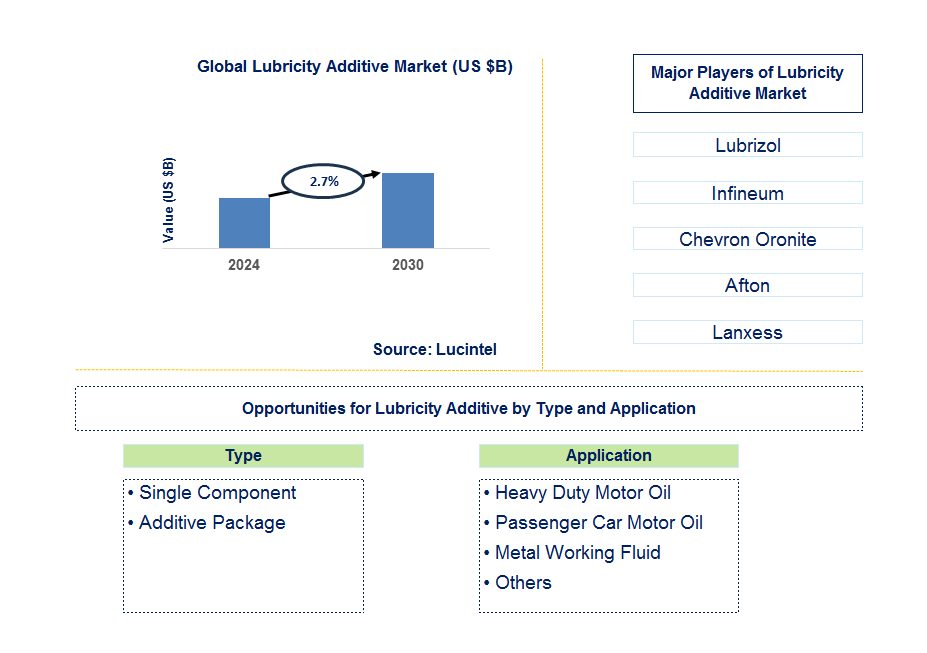
Key data points: The growth forecast = 2.7% annually for the next 6 years. Scroll below to get more insights. This market report covers trends, opportunities, and forecasts in the global lubricity additive market to 2030 by type (single component and additive package), application (heavy duty motor oil, passenger car motor oil, metal working fluid, and others), and region (North America, Europe, Asia Pacific, and the Rest of the World)
We'll send your sample report shortly.
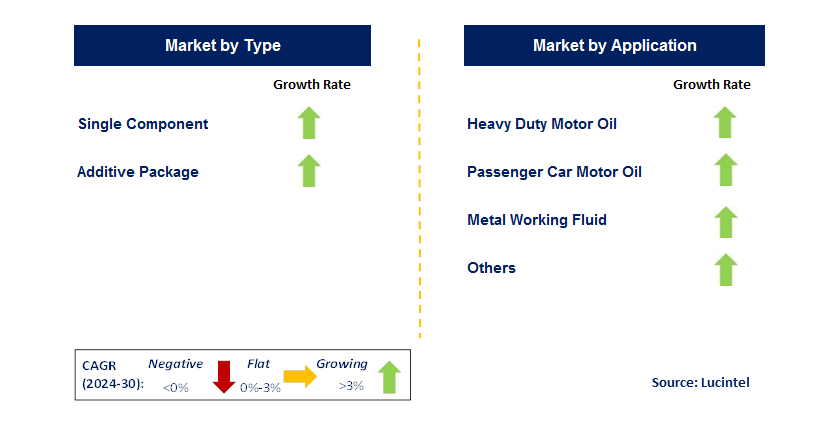
• Lucintel forecasts that, within the type category, single component is expected to witness a higher growth over the forecast period.
• Within the application category, heavy duty motor oil is expected to witness the highest growth.
• In terms of regions, APAC is expected to witness the highest growth over the forecast period. A more than 150-page report is developed to help in your business decisions.
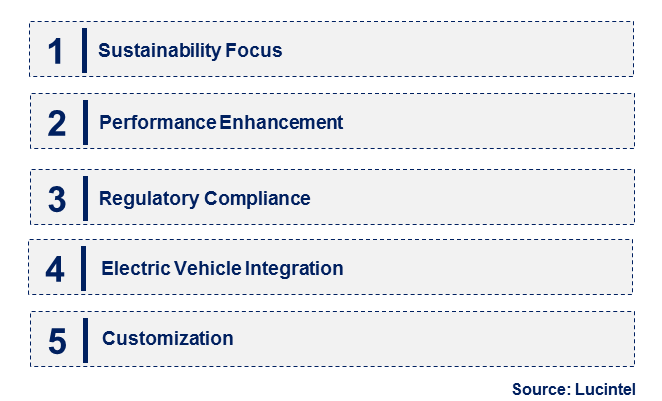
• Sustainability Focus: There is a growing emphasis on bio-based lubricity additives that are environmentally friendly.
• Performance Enhancement: Innovations are aimed at improving the performance and efficiency of lubricants in extreme conditions.
• Regulatory Compliance: Stricter regulations on emissions are driving the development of low-sulfur and high-lubricity solutions.
• Electric Vehicle Integration: The rise of electric vehicles is creating a need for specialized lubricity additives to improve efficiency.
• Customization: Manufacturers are increasingly offering tailored additives to meet specific industry needs.
• Smart Technology: The incorporation of smart technology in lubricants is emerging, allowing for adaptive performance based on conditions. These trends illustrate the dynamic nature of the lubricity additive market, emphasizing sustainability, performance, and innovation.
• Product Launches: New formulations are being introduced that enhance lubricity and meet regulatory standards.
• Research Investments: Companies are committing significant resources to R&D to develop high-performance lubricity additives.
• Market Expansion: The demand for lubricity additives in emerging markets is increasing due to industrial growth.
• Quality Enhancements: Stricter quality control measures are being adopted to ensure product effectiveness and compliance.
• Collaborative Innovation: Partnerships between manufacturers and research institutions are fostering innovation in additive formulations.
• Focus on Bio-based Solutions: There is an increasing trend toward the development of eco-friendly lubricity additives. Recent developments in the lubricity additive market reflect a strong alignment with sustainability and performance demands, ensuring future growth.
• Automotive Sector: The ongoing evolution of the automotive industry presents opportunities for high-performance lubricity additives.
• Industrial Applications: Expanding industrial sectors, such as manufacturing and construction, are driving demand for effective lubricants.
• Electric Vehicle Market: The rise of electric vehicles is creating a need for specialized lubricity additives tailored for new technologies.
• Bio-based Product Demand: The shift toward sustainable products opens opportunities for bio-based lubricity additives.
• Global Market Expansion: Emerging markets are becoming increasingly important, providing new avenues for growth.
• Technological Advancements: Innovations in additive formulations and smart lubricants present opportunities for competitive differentiation. By leveraging these strategic growth opportunities, stakeholders in the lubricity additive market can position themselves for long-term success.
• Regulatory Pressures: Increasing regulations focused on emissions and performance are driving demand for effective lubricity additives.
• Industrial Growth: Expansion in the automotive and industrial sectors is fueling market growth.
• Technological Innovation: Continuous advancements in product formulations are enhancing the appeal of lubricity additives.
• Sustainability Initiatives: Growing consumer preference for eco-friendly products is driving the development of bio-based additives. Challenges in the lubricity additive market are:
• Cost of Raw Materials: Fluctuating prices of raw materials can impact production costs and pricing strategies.
• Intense Competition: The presence of numerous manufacturers leads to competitive pricing and market fragmentation.
• Quality Control: Ensuring consistent product quality can be challenging amid varying production processes.
• Market Awareness: Educating consumers about the benefits and importance of lubricity additives remains a hurdle. While the lubricity additive market is driven by significant growth factors, addressing challenges related to costs and quality is crucial for sustained development.
• Lubrizol
• Infineum
• Chevron Oronite
• Afton
• Lanxess
• BASF
• Adeka
• Additiv-Chemie Luers
• Akzo Nobel
• Dow Chemical
• Single Component
• Additive Package
• Heavy Duty Motor Oil
• Passenger Car Motor Oil
• Metal Working Fluid
• Others
• North America
• Europe
• Asia Pacific
• The Rest of the World
• USA: The lubricity additive market in the USA is experiencing significant growth, driven by the rising demand for high-performance lubricants in automotive and industrial applications. Recent developments include innovations in bio-based lubricity additives that offer environmentally friendly alternatives to traditional petroleum-based products. Companies are investing in R&D to enhance the effectiveness of these additives, particularly in extreme conditions. Moreover, regulatory pressures to reduce emissions are prompting manufacturers to develop low-sulfur, high-lubricity solutions. The trend toward sustainable products is also leading to collaborations between chemical manufacturers and lubricant producers to create more efficient formulations.
• China: China’s lubricity additive market is booming due to the rapid industrialization and growth of the automotive sector. Recent developments include the introduction of novel lubricity additives aimed at enhancing the performance of fuels and lubricants under varying conditions. Local manufacturers are focusing on producing high-quality additives that comply with international standards, promoting exports. The government’s commitment to reducing environmental impact is driving demand for eco-friendly lubricants, leading to increased investment in bio-based lubricity additives. Furthermore, the market is witnessing a trend toward more stringent quality control measures, pushing manufacturers to innovate and improve their product lines.
• India: In India, the lubricity additive market is evolving, spurred by increasing automotive production and industrial growth. Recent developments highlight the shift toward synthetic lubricity additives that provide superior performance compared to traditional options. Companies are launching new products tailored for specific applications, such as high-temperature and heavy-load environments. Additionally, the rising awareness of the benefits of lubricity additives in reducing friction and wear is driving market growth. As the automotive sector expands, manufacturers are also focusing on developing additives that comply with global sustainability standards, which is becoming a critical competitive advantage.
• Japan: Japan’s lubricity additive market is characterized by innovation and high-quality standards. Recent developments include the launch of advanced synthetic lubricity additives designed for the automotive and industrial sectors, emphasizing fuel efficiency and reduced emissions. Companies are increasingly focusing on developing additives that enhance the performance of electric vehicles, as the market shifts toward more sustainable transportation solutions. Furthermore, collaboration between manufacturers and academic institutions is fostering research into new formulations that offer improved performance. The trend toward smart lubricants that adapt to varying conditions is also gaining momentum, reflecting the industry’s focus on advanced technology.


• Lubrizol
• Infineum
• Chevron Oronite
• Afton
• Lanxess
• BASF
• Adeka
• Additiv-Chemie Luers
• Akzo Nobel
• Dow Chemical Q5. Which lubricity additive market segment will be the largest in future? Answer: Lucintel forecasts that single component is expected to witness a higher growth over the forecast period. Q6. In lubricity additive market, which region is expected to be the largest in next 5 years? Answer: APAC is expected to witness the highest growth over the forecast period. Q.7 Do we receive customization in this report? Answer: Yes, Lucintel provides 10% customization without any additional cost.


Choose a license that fits your team. Instant PDF delivery.
Prices exclude taxes. Instant delivery. Custom licensing available on request.
Market Report · July 17, 2026
Market Report · July 16, 2026
Market Report · July 15, 2026
Trusted partner for strategic intelligence and business growth


Receive a complimentary market analysis tailored to your industry. Our analysts will identify key growth opportunities and competitive dynamics specific to your business.

Market size, growth rate, and key trend analysis for your specific sector.

Top competitor positioning and market share analysis.

Strategic recommendations backed by data-driven insights.
Get curated market intelligence and competitive moves straight to your inbox.
By subscribing, you agree to receive our monthly insights. Unsubscribe anytime.
Receive a complimentary market analysis tailored to your industry. Our analysts will identify key growth opportunities and competitive dynamics specific to your business.
Market size, growth rate, and key trend analysis for your specific sector.
Top competitor positioning and market share analysis.
Strategic recommendations backed by data-driven insights.
Get curated market intelligence, emerging trends, and competitive moves straight to your inbox each month.
By subscribing, you agree to receive our monthly insights. Unsubscribe anytime.
We'll send your sample report shortly.