
Pharmaceutical Filler Market Trends and Forecast
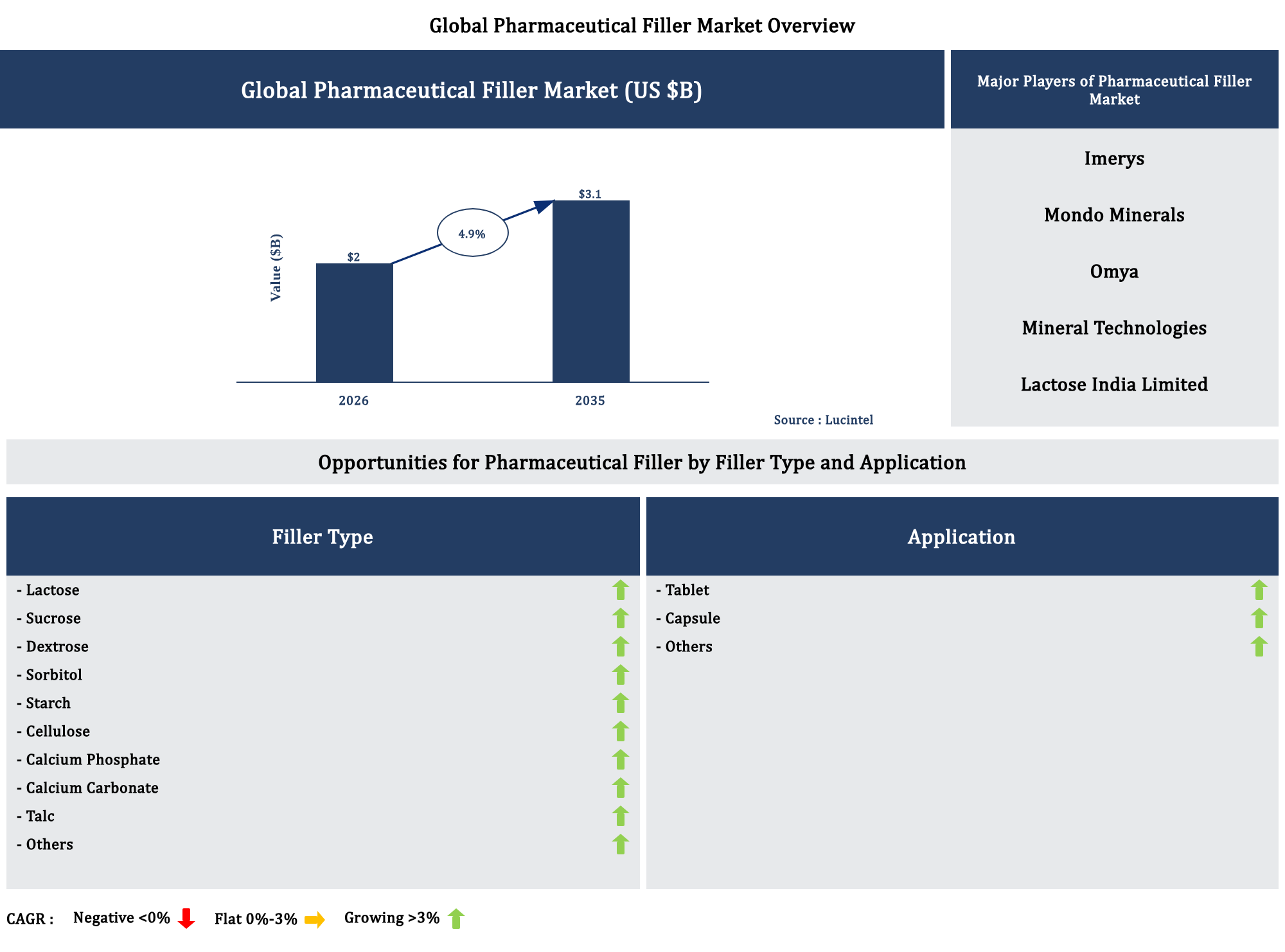
The future of the global pharmaceutical filler market looks promising with opportunities in the tablet and capsule markets. The global pharmaceutical filler market is expected to reach an estimated $3,199 million by 2035 with a CAGR of 4.9% from 2026 to 2035. The major drivers for this market are the rising demand for cost effective drug formulations, the increasing demand for tablets & capsules, and the growing demaand for generic drug manufacturing activities.
• Lucintel forecasts that, within the filler type category, cellulose is expected to witness the highest growth over the forecast period.
• Within the application category, tablet is expected to witness the highest growth.
• In terms of region, APAC is expected to witness the highest growth over the forecast period.
Gain valuable insights for your business decisions with our comprehensive 150+ page report. Sample figures with some insights are shown below.
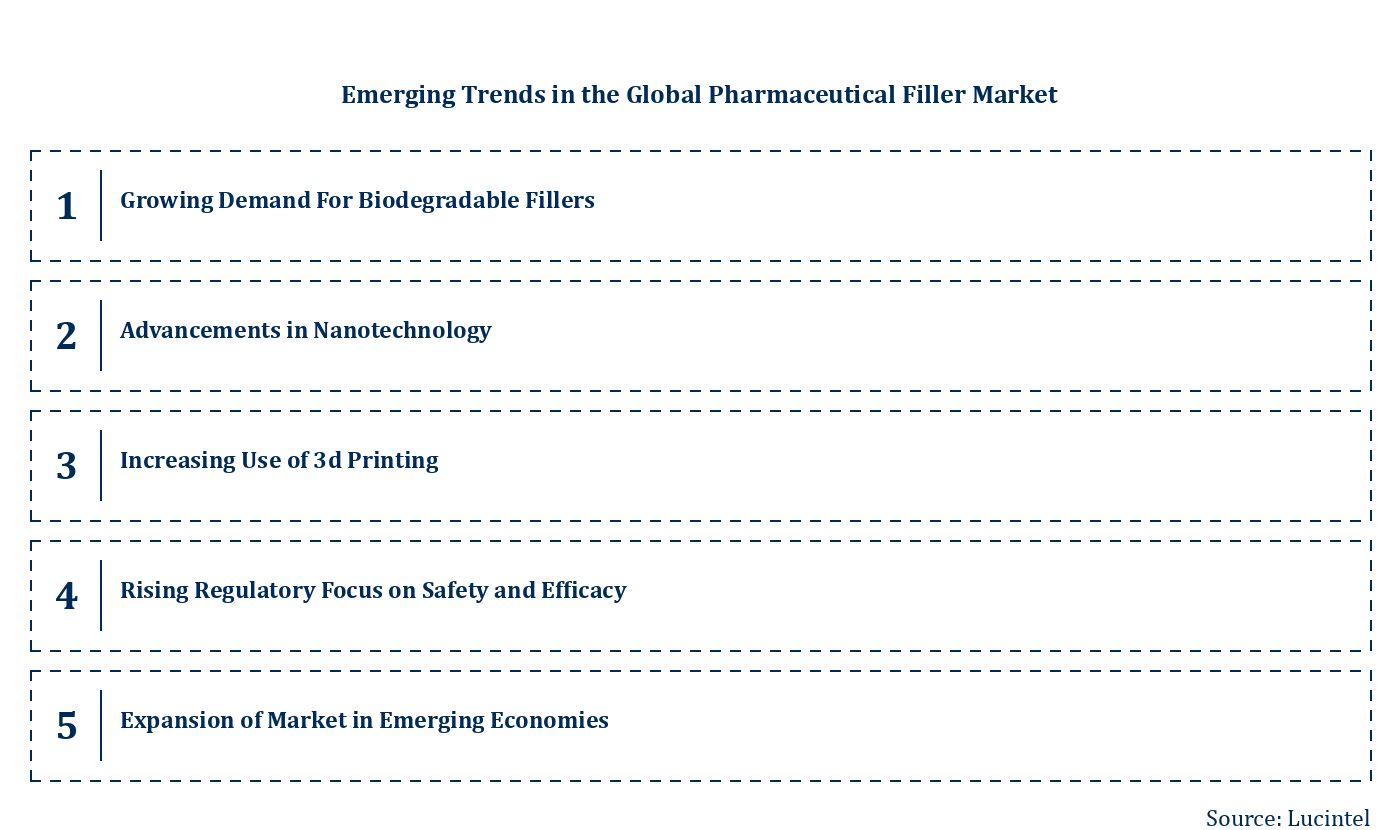
Emerging Trends in the Pharmaceutical Filler Market
The pharmaceutical filler market is experiencing rapid evolution driven by technological advancements, regulatory changes, and shifting consumer preferences. As the healthcare landscape becomes more complex, companies are innovating to meet increasing demand for efficiency, safety, and personalized treatments. Emerging trends are shaping the future of pharmaceutical fillers, influencing product development, manufacturing processes, and market strategies. These developments are not only expanding the market size but also enhancing the quality and accessibility of pharmaceutical fillers worldwide. Understanding these key trends is essential for stakeholders aiming to stay competitive and capitalize on new opportunities in this dynamic industry.
• Growing Demand for Biodegradable Fillers: Increasing awareness of environmental sustainability is driving demand for biodegradable pharmaceutical fillers. These eco-friendly options reduce environmental impact and align with regulatory pressures for sustainable practices. Manufacturers are investing in research to develop biodegradable polymers that maintain efficacy while being environmentally safe. This trend is expanding the market by attracting environmentally conscious consumers and healthcare providers seeking sustainable solutions, ultimately fostering innovation and responsible manufacturing practices.
• Advancements in Nanotechnology: The integration of nanotechnology in pharmaceutical fillers is revolutionizing drug delivery and tissue regeneration. Nanoparticles enable targeted delivery, improved bioavailability, and controlled release of active ingredients. This trend enhances treatment efficacy and reduces side effects, making fillers more effective for personalized medicine. The adoption of nanotech is also opening new avenues for research and development, leading to innovative products that cater to complex medical needs and expanding market potential.
• Increasing Use of 3D Printing: 3D printing technology is transforming the production of pharmaceutical fillers by enabling customized, precise, and rapid manufacturing. This approach allows for tailored dosages and complex geometries that traditional methods cannot achieve. The trend supports personalized medicine and reduces production costs, making treatments more accessible. As 3D printing becomes more sophisticated, it is expected to significantly impact the market by offering innovative solutions for complex medical conditions and improving patient outcomes.
• Rising Regulatory Focus on Safety and Efficacy: Regulatory agencies are tightening standards for pharmaceutical fillers to ensure safety, efficacy, and quality. This trend prompts companies to enhance their research, testing, and manufacturing processes. Stricter regulations also encourage transparency and traceability throughout the supply chain. While this may increase compliance costs, it ultimately boosts consumer confidence and market credibility. Companies that proactively adapt to these regulatory changes are better positioned to succeed in a competitive landscape.
• Expansion of Market in Emerging Economies: Emerging economies are witnessing rapid growth in healthcare infrastructure and increasing healthcare expenditure, fueling demand for pharmaceutical fillers. Market players are expanding their presence through local partnerships and tailored product offerings. This trend is driven by rising awareness, improved healthcare access, and government initiatives promoting medical innovation. The expansion into these markets offers significant growth opportunities, diversifies revenue streams, and helps meet the global demand for advanced pharmaceutical solutions.
These trends are collectively reshaping the pharmaceutical filler market by fostering innovation, enhancing safety standards, and expanding global reach. They are driving the development of more sustainable, personalized, and technologically advanced products, ultimately transforming how healthcare providers and patients access and benefit from pharmaceutical fillers.
Recent Developments in the Pharmaceutical Filler Market
The pharmaceutical filler market is experiencing rapid growth driven by technological advancements, increasing demand for minimally invasive procedures, and expanding applications across various medical fields. Innovations in filler formulations and delivery methods are enhancing safety and efficacy, attracting more healthcare providers and patients. Regulatory approvals and rising awareness about aesthetic and therapeutic benefits are further fueling market expansion. This dynamic environment presents significant opportunities for industry players to innovate, diversify, and capture new market segments, ultimately transforming healthcare delivery and patient outcomes worldwide.
• Growth in Aesthetic Medicine: Increasing popularity of cosmetic procedures is boosting demand for dermal fillers, driven by societal beauty standards and aging populations seeking non-surgical solutions. This trend expands market size and encourages product innovation to meet diverse patient needs, fostering competitive growth and technological advancements in filler formulations.
• Technological Innovations in Filler Formulations: Development of longer-lasting, biocompatible, and biodegradable fillers enhances safety and effectiveness. These innovations reduce adverse effects and improve patient satisfaction, leading to broader clinical applications and increased adoption in both aesthetic and therapeutic contexts.
• Rising Use in Therapeutic Applications: Beyond aesthetics, fillers are increasingly used for medical treatments such as tissue regeneration, scar correction, and joint pain relief. This diversification opens new revenue streams, encourages research, and broadens the market scope, making fillers integral to various medical specialties.
• Regulatory Approvals and Market Expansion: Stringent regulatory standards and approvals in key regions facilitate safer product development and market entry. These regulations build consumer trust, enable international expansion, and stimulate innovation, ultimately driving global market growth.
• Increasing Investment and Strategic Collaborations: Industry players are investing heavily in R&D and forming strategic partnerships to develop advanced filler products. These collaborations accelerate innovation, improve manufacturing capabilities, and expand distribution channels, strengthening market competitiveness and growth potential.
The overall impact of these developments is a robust, innovative, and expanding pharmaceutical filler market. Enhanced product safety, diversified applications, and regulatory support are attracting new entrants and increasing consumer confidence. This growth is fostering technological progress, improving patient outcomes, and creating lucrative opportunities for stakeholders, positioning the market for sustained expansion and transformation in healthcare practices worldwide.
Strategic Growth Opportunities in the Pharmaceutical Filler Market
The pharmaceutical filler market is experiencing rapid expansion driven by increasing demand for injectable medications, advancements in biocompatible materials, and growing healthcare needs worldwide. Innovations in formulation techniques and regulatory approvals are further fueling growth. Market players are focusing on product development, strategic collaborations, and geographic expansion to capitalize on emerging opportunities. This dynamic environment offers significant potential for companies to enhance their market share and meet the evolving needs of the pharmaceutical industry.
• Growing Demand for Injectable Medications Drives need for Advanced Fillers: The rising prevalence of chronic diseases and the shift towards minimally invasive treatments increase the demand for pharmaceutical fillers used in drug delivery systems. Innovations in filler formulations improve stability, bioavailability, and patient compliance. As healthcare providers seek more effective and safer options, the market for specialized fillers expands, creating opportunities for manufacturers to develop tailored solutions that meet regulatory standards and address specific therapeutic needs.
• Advancements in Biocompatible and Biodegradable Filler Materials: The development of biocompatible and biodegradable fillers enhances safety profiles and reduces adverse reactions. These materials are increasingly preferred for long-term and implantable applications, especially in regenerative medicine and tissue engineering. Continuous research into novel polymers and natural sources is expanding the range of options available, enabling companies to offer more sustainable and patient-friendly products, thereby opening new avenues for growth in the pharmaceutical filler market.
• Increasing Adoption of Fillers in Regenerative Medicine and Tissue Engineering: The rising focus on tissue regeneration and repair is boosting the use of fillers in regenerative therapies. These applications require specialized, bioactive fillers that support cell growth and tissue integration. The integration of fillers with stem cell therapies and biomaterials is creating new treatment modalities. This trend offers significant growth potential for companies investing in innovative, functional fillers that can meet the complex demands of regenerative medicine.
• Strategic Collaborations and Acquisitions to Expand Product Portfolios: Market players are engaging in partnerships, joint ventures, and acquisitions to diversify their product offerings and access new technologies. Collaborations with biotech firms and research institutions accelerate innovation and facilitate regulatory approvals. These strategic moves enable companies to strengthen their market position, enter new geographic regions, and develop advanced filler solutions tailored to specific applications, thereby fueling overall market growth.
• Expansion into Emerging Markets with Increasing Healthcare Infrastructure: Rapid economic growth and healthcare investments in emerging regions are creating substantial opportunities for pharmaceutical filler companies. Improving healthcare infrastructure, rising disposable incomes, and increasing awareness about advanced treatments drive demand. Companies expanding their presence in these markets can capitalize on unmet needs, establish local manufacturing, and adapt products to regional preferences, significantly contributing to the global growth trajectory of the pharmaceutical filler market.
The overall impact of these opportunities is set to significantly accelerate market growth, foster innovation, and enable companies to meet diverse healthcare needs globally. By leveraging technological advancements and strategic initiatives, the pharmaceutical filler market is poised for sustained expansion and increased competitiveness in the coming years.
Pharmaceutical Filler Market Driver and Challenges
The pharmaceutical filler market is influenced by a complex interplay of technological advancements, economic shifts, and regulatory changes. Innovations in filling technologies, increasing demand for biopharmaceuticals, and stringent quality standards are shaping its growth trajectory. Economic factors such as rising healthcare expenditure and global pharmaceutical investments further propel the market. Conversely, regulatory hurdles, high R&D costs, and supply chain disruptions pose significant challenges. Understanding these drivers and challenges is essential for stakeholders to navigate the evolving landscape effectively and capitalize on emerging opportunities while mitigating risks.
The factors responsible for driving the pharmaceutical filler market include:-
• Technological Innovation: The development of advanced filling equipment and automation technologies enhances efficiency, precision, and compliance with regulatory standards. These innovations reduce contamination risks and improve throughput, making manufacturing more cost-effective and scalable. As pharmaceutical companies seek to meet increasing demand for sterile and high-quality products, technological progress becomes a key driver of market growth.
• Rising Demand for Biopharmaceuticals: The global surge in biopharmaceutical production, driven by the prevalence of chronic diseases and personalized medicine, significantly boosts the need for specialized filling solutions. Biologics require sensitive handling and precise filling techniques, which fuels demand for advanced pharmaceutical fillers capable of maintaining product integrity and sterility.
• Regulatory Compliance and Quality Standards: Stringent regulations by agencies such as the FDA and EMA necessitate high-quality filling solutions that ensure safety, efficacy, and traceability. Companies investing in compliant filling technologies gain a competitive edge, fostering market expansion. The focus on quality assurance and validation processes further propels the adoption of sophisticated filling systems.
• Increasing Healthcare Expenditure: Growing healthcare budgets worldwide, especially in emerging economies, lead to higher pharmaceutical production volumes. This economic trend encourages pharmaceutical companies to invest in efficient filling solutions to meet rising demand, thereby expanding the market. The emphasis on improving patient outcomes and access to medicines also supports market growth.
The challenges in the pharmaceutical filler market are:
• High R&D and Capital Investment Costs: Developing new filling technologies and maintaining compliance with evolving regulations require substantial financial investment. These costs can be prohibitive for smaller players and may slow down innovation and market entry, limiting competition and slowing overall growth.
• Supply Chain Disruptions: The global supply chain for raw materials, components, and equipment faces disruptions due to geopolitical tensions, pandemics, and logistical issues. Such disruptions can delay production timelines, increase costs, and hinder timely delivery of filling solutions, impacting market stability.
• Stringent Regulatory Environment: While regulations drive quality, they also pose barriers to market entry and innovation. Navigating complex approval processes and maintaining compliance can be resource-intensive, deterring new entrants and slowing the adoption of novel filling technologies.
The pharmaceutical filler market is shaped by rapid technological advancements, increasing demand for biopharmaceuticals, and strict regulatory standards, all of which foster growth. However, high costs, supply chain issues, and regulatory complexities present significant hurdles. These drivers and challenges collectively influence market dynamics, requiring stakeholders to adapt strategically. Embracing innovation while managing regulatory and financial risks will be crucial for sustained growth and competitiveness in this evolving landscape.
List of Pharmaceutical Filler Companies
Companies in the market compete on the basis of product quality offered. Major players in this market focus on expanding their manufacturing facilities, R&D investments, infrastructural development, and leverage integration opportunities across the value chain. With these strategies pharmaceutical filler companies cater increasing demand, ensure competitive effectiveness, develop innovative products & technologies, reduce production costs, and expand their customer base. Some of the pharmaceutical filler companies profiled in this report include-
• Imerys
• Mondo Minerals
• Omya
• Mineral Technologies
• Lactose India Limited
• Nippon Talc Co. Ltd.
• Huber Engineered Materials
• DFE Pharma
• Meggle Group
• Merck Group
Pharmaceutical Filler Market by Segment
The study includes a forecast for the global pharmaceutical filler market by filler type, application, and region.
Pharmaceutical Filler Market by Filler Type [Value from 2019 to 2035]:
• Lactose
• Sucrose
• Dextrose
• Sorbitol
• Starch
• Cellulose
• Calcium Phosphate
• Calcium Carbonate
• Talc
• Others
Pharmaceutical Filler Market by Application [Value from 2019 to 2035]:
• Tablet
• Capsule
• Others
Pharmaceutical Filler Market by Region [Value from 2019 to 2035]:
• North America
• Europe
• Asia Pacific
• The Rest of the World
Country Wise Outlook for the Pharmaceutical Filler Market
The pharmaceutical filler market has experienced significant growth and innovation driven by technological advancements, increasing demand for personalized medicine, and expanding healthcare infrastructure worldwide. Countries are investing heavily in research and development to improve filler formulations, enhance safety profiles, and meet regulatory standards. The market‘s evolution is also influenced by rising awareness of minimally invasive procedures and aesthetic treatments. As a result, key players are focusing on product diversification, strategic collaborations, and expanding manufacturing capacities to capture emerging opportunities. These developments reflect a dynamic landscape shaped by technological progress, regulatory changes, and shifting consumer preferences across major economies.
• United States: The US pharmaceutical filler market has seen rapid growth due to high demand for aesthetic procedures and advancements in biocompatible materials. Innovations in biodegradable fillers and longer-lasting formulations are gaining popularity. Regulatory agencies like the FDA are tightening safety standards, prompting companies to invest in rigorous testing and quality control. The rise of minimally invasive procedures and increasing awareness among consumers are driving market expansion. Additionally, strategic collaborations between biotech firms and cosmetic companies are fostering product innovation. The US remains a leader in research and development, with a focus on personalized and targeted filler solutions.
• China: China‘s pharmaceutical filler market is expanding swiftly, fueled by a large population and rising disposable incomes. The country is witnessing increased adoption of aesthetic treatments, supported by government initiatives to modernize healthcare infrastructure. Local manufacturers are investing in R&D to develop cost-effective, high-quality fillers that meet international standards. The market is also benefiting from technological advancements such as 3D imaging and minimally invasive techniques. Regulatory reforms are streamlining approval processes, encouraging foreign investment. Moreover, the growing middle class and urbanization are boosting demand for aesthetic and reconstructive procedures, positioning China as a key growth hub in this sector.
• Germany: Germany‘s pharmaceutical filler market is characterized by high-quality standards and innovation. The country is a leader in developing advanced, biocompatible fillers with improved safety profiles. Strong regulatory frameworks ensure product efficacy and safety, fostering consumer confidence. Germany‘s focus on research and development, coupled with collaborations between academia and industry, drives technological progress. The aging population is increasing demand for anti-aging and reconstructive treatments. Additionally, Germany‘s emphasis on sustainable and eco-friendly products is influencing market offerings. The country also exports many innovative fillers to other European nations, reinforcing its position as a market leader in Europe.
• India: The Indian pharmaceutical filler market is experiencing rapid growth due to increasing awareness of aesthetic procedures and expanding healthcare infrastructure. Cost-effective solutions and local manufacturing are making fillers more accessible to a broader population. The market is witnessing a surge in demand for minimally invasive and non-surgical treatments, driven by urbanization and changing beauty standards. Regulatory agencies are working to streamline approval processes, encouraging innovation. The rise of medical tourism also contributes to market growth, with India becoming a preferred destination for cosmetic procedures. Investments in R&D and collaborations with international firms are further boosting the development of advanced filler products.
• Japan: Japan‘s pharmaceutical filler market is marked by technological innovation and a focus on safety. The aging population is a significant driver, increasing demand for anti-aging and reconstructive fillers. Japanese companies are pioneering in developing long-lasting, natural-looking fillers with minimal side effects. Strict regulatory standards ensure high product quality and safety, fostering consumer trust. The market is also influenced by cultural preferences for subtle, natural enhancements. Advances in minimally invasive procedures and the integration of digital imaging technologies are enhancing treatment precision. Japan continues to emphasize research and development, maintaining its position as a key player in the global pharmaceutical filler market.
Features of the Global Pharmaceutical Filler Market
Market Size Estimates: Pharmaceutical filler market size estimation in terms of value ($M).
Trend and Forecast Analysis: Market trends (2019 to 2025) and forecast (2026 to 2035) by various segments and regions.
Segmentation Analysis: Pharmaceutical filler market size by filler type, application, and region in terms of value ($M).
Regional Analysis: Pharmaceutical filler market breakdown by North America, Europe, Asia Pacific, and Rest of the World.
Growth Opportunities: Analysis of growth opportunities in different filler type, application, and regions for the pharmaceutical filler market.
Strategic Analysis: This includes M&A, new product development, and competitive landscape of the pharmaceutical filler market.
Analysis of competitive intensity of the industry based on Porter’s Five Forces model.
FAQ
Q1. What is the pharmaceutical filler market size?
Answer: The global pharmaceutical filler market is expected to reach an estimated $3,199 million by 2035.
Q2. What is the growth forecast for pharmaceutical filler market?
Answer: The global pharmaceutical filler market is expected to grow with a CAGR of 4.9% from 2026 to 2035.
Q3. What are the major drivers influencing the growth of the pharmaceutical filler market?
Answer: The major drivers for this market are the rising demand for cost effective drug formulations, the increasing demand for tablets & capsules, and the growing demaand for generic drug manufacturing activities.
Q4. What are the major segments for pharmaceutical filler market?
Answer: The future of the pharmaceutical filler market looks promising with opportunities in the tablet and capsule markets.
Q5. Who are the key pharmaceutical filler market companies?
Answer: Some of the key pharmaceutical filler companies are as follows:
• Imerys
• Mondo Minerals
• Omya
• Mineral Technologies
• Lactose India Limited
• Nippon Talc Co. Ltd.
• Huber Engineered Materials
• DFE Pharma
• Meggle Group
• Merck Group
Q6. Which pharmaceutical filler market segment will be the largest in future?
Answer: Lucintel forecasts that, within the filler type category, cellulose is expected to witness the highest growth over the forecast period.
Q7. In pharmaceutical filler market, which region is expected to be the largest in next 8 years?
Answer: In terms of region, APAC is expected to witness the highest growth over the forecast period.
Q8. Do we receive customization in this report?
Answer: Yes, Lucintel provides 10% customization without any additional cost.
This report answers following 11 key questions:
Q.1. What are some of the most promising, high-growth opportunities for the pharmaceutical filler market by filler type (lactose, sucrose, dextrose, sorbitol, starch, cellulose, calcium phosphate, calcium carbonate, talc, and others), application (tablet, capsule, and others), and region (North America, Europe, Asia Pacific, and the Rest of the World)?
Q.2. Which segments will grow at a faster pace and why?
Q.3. Which region will grow at a faster pace and why?
Q.4. What are the key factors affecting market dynamics? What are the key challenges and business risks in this market?
Q.5. What are the business risks and competitive threats in this market?
Q.6. What are the emerging trends in this market and the reasons behind them?
Q.7. What are some of the changing demands of customers in the market?
Q.8. What are the new developments in the market? Which companies are leading these developments?
Q.9. Who are the major players in this market? What strategic initiatives are key players pursuing for business growth?
Q.10. What are some of the competing products in this market and how big of a threat do they pose for loss of market share by material or product substitution?
Q.11. What M&A activity has occurred in the last 5 years and what has its impact been on the industry?
For any questions related to Pharmaceutical Filler Market, Pharmaceutical Filler Market Size, Pharmaceutical Filler Market Growth, Pharmaceutical Filler Market Analysis, Pharmaceutical Filler Market Report, Pharmaceutical Filler Market Share, Pharmaceutical Filler Market Trends, Pharmaceutical Filler Market Forecast, Pharmaceutical Filler Companies, write Lucintel analyst at email: helpdesk@lucintel.com. We will be glad to get back to you soon.
