
Automotive Adhesive Market Trends and Forecast
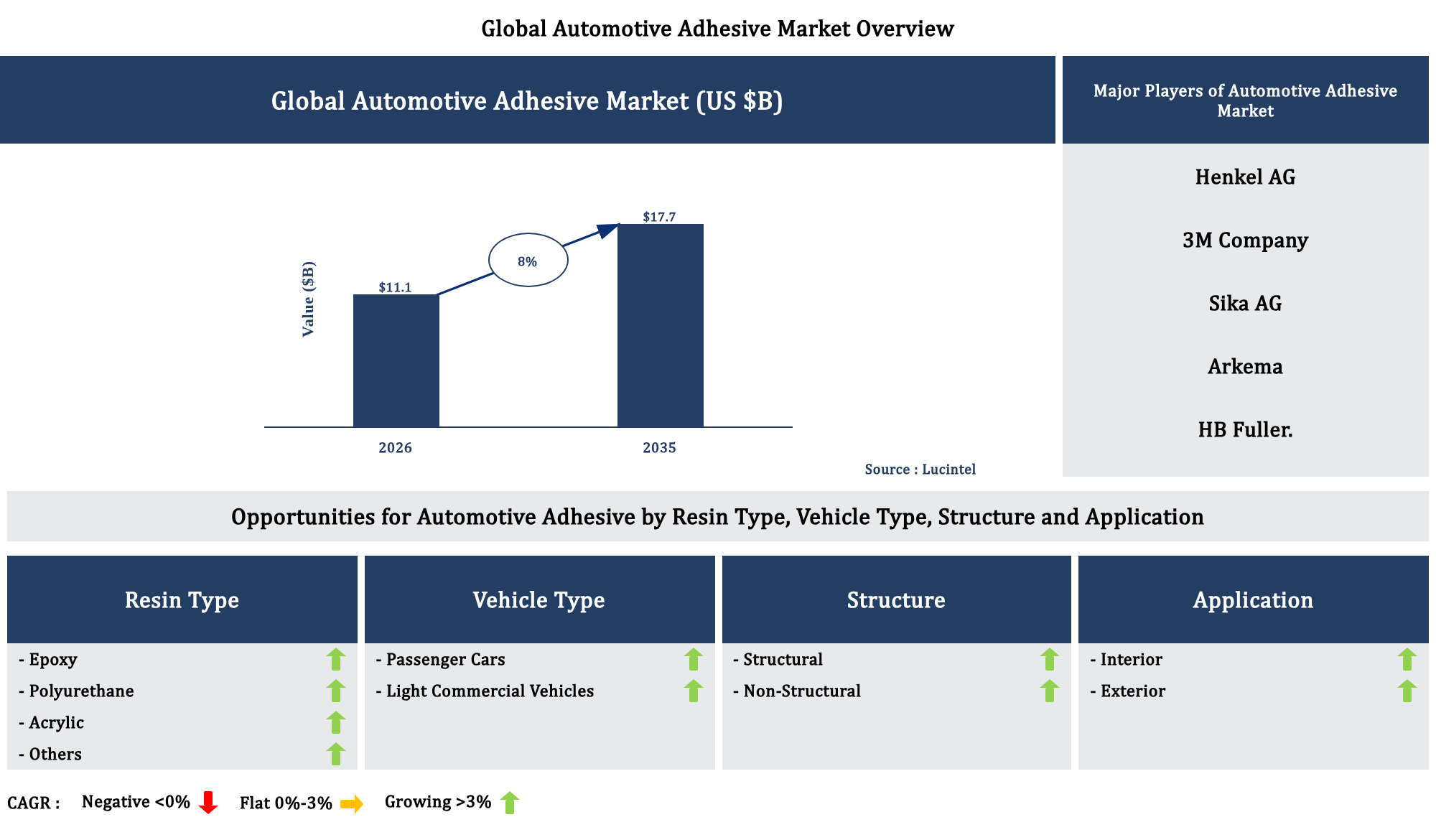
The future of the global automotive adhesive market looks promising with opportunities in the interior and exterior markets. The global automotive adhesive market is expected to reach an estimated $17,733 million by 2035 with a CAGR of 4.8% from 2026 to 2035. The major drivers for this market are the increasing demand for lightweight vehicles improving fuel efficiency, the rising demand for noise vibration & harshness reduction, and the growing demand for innovation in high-performance adhesive technologies.
• Lucintel forecasts that, within the resin type category, epoxy is expected to witness the highest growth over the forecast period.
• Within the application category, interior is expected to witness the highest growth.
• In terms of region, APAC is expected to witness the highest growth over the forecast period.
Gain valuable insights for your business decisions with our comprehensive 150+ page report. Sample figures with some insights are shown below.
Emerging Trends in the Automotive Adhesive Market
The automotive adhesive market is experiencing rapid evolution driven by technological advancements, changing consumer preferences, and stricter regulatory standards. As automakers seek lighter, more durable, and environmentally friendly solutions, the market is witnessing innovative product developments and strategic collaborations. These trends are not only enhancing vehicle performance and safety but also contributing to sustainability goals. The increasing adoption of electric vehicles and the need for efficient manufacturing processes further accelerate these changes. Understanding these emerging trends is crucial for stakeholders aiming to capitalize on new opportunities and stay competitive in this dynamic industry landscape.
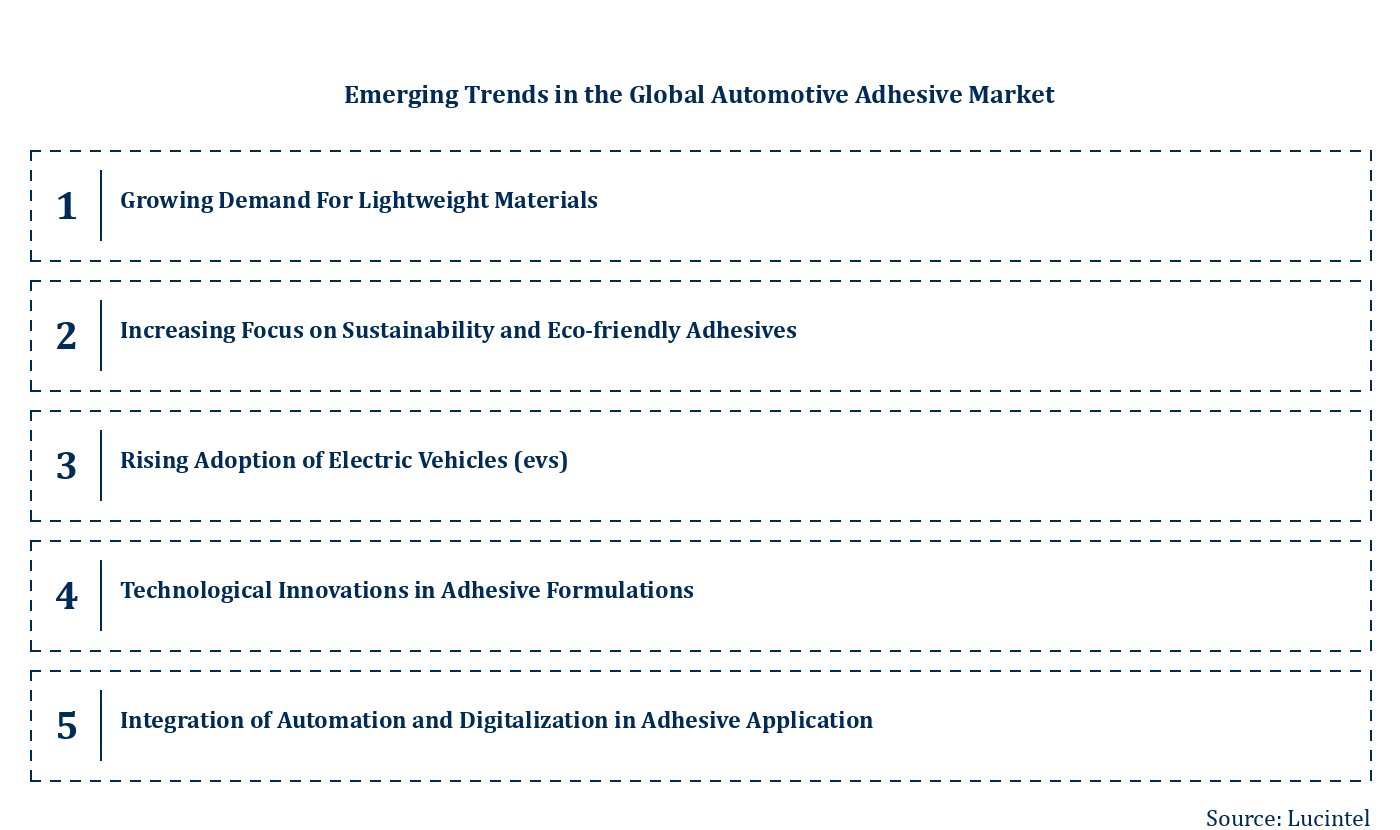
• Growing Demand for Lightweight Materials: The shift towards lightweight vehicles to improve fuel efficiency and reduce emissions is driving the adoption of advanced adhesives. These adhesives enable the use of lighter materials like composites and aluminum, which traditional mechanical fasteners cannot easily join. This trend enhances vehicle performance, safety, and fuel economy, making it a key focus for automakers. As environmental regulations tighten, the demand for lightweight adhesives is expected to surge, prompting manufacturers to innovate and develop high-performance, eco-friendly adhesive solutions.
• Increasing Focus on Sustainability and Eco-Friendly Adhesives: Environmental concerns and stricter regulations are pushing the automotive industry toward sustainable solutions. Manufacturers are developing bio-based and water-based adhesives that reduce volatile organic compounds (VOCs) and hazardous emissions. These eco-friendly adhesives not only meet regulatory standards but also appeal to environmentally conscious consumers. The shift towards sustainable adhesives is fostering innovation in formulation and application techniques, ultimately leading to greener manufacturing processes and a reduced carbon footprint across the automotive supply chain.
• Rising Adoption of Electric Vehicles (EVs): The growth of EVs is significantly impacting the automotive adhesive market. EVs require specialized adhesives for battery assembly, thermal management, and lightweight construction. These adhesives must withstand high temperatures, vibrations, and chemical exposure, demanding advanced formulations. As EV sales increase globally, the demand for high-performance adhesives tailored for electric powertrains and battery modules is expanding. This trend is encouraging adhesive manufacturers to develop innovative products that meet the unique requirements of electric vehicles, thereby opening new market segments and growth opportunities.
• Technological Innovations in Adhesive Formulations: Advances in chemistry and materials science are leading to the development of high-performance adhesives with enhanced properties such as faster curing times, improved durability, and better resistance to environmental factors. These innovations enable automakers to streamline manufacturing processes, reduce assembly time, and improve vehicle longevity. The integration of nanotechnology and smart adhesives with self-healing or sensor capabilities is also emerging, offering new functionalities. These technological breakthroughs are transforming the automotive adhesive landscape, making products more efficient, reliable, and adaptable to complex vehicle designs.
• Integration of Automation and Digitalization in Adhesive Application: The adoption of automation and digital tools in manufacturing processes is revolutionizing how adhesives are applied in vehicle assembly. Robotics and precision dispensing systems ensure consistent quality, reduce waste, and increase efficiency. Digitalization allows real-time monitoring and control of adhesive application, leading to improved process optimization and traceability. This trend supports the shift towards Industry 4.0, enabling manufacturers to meet high standards of quality and productivity. As automation becomes more prevalent, the automotive adhesive market is poised for increased precision, reduced costs, and enhanced overall manufacturing performance.
These emerging trends are fundamentally reshaping the automotive adhesive market by promoting sustainability, innovation, and efficiency. They are enabling automakers to produce safer, lighter, and more environmentally friendly vehicles while optimizing manufacturing processes. As these developments continue, the market is expected to see increased competition, new product offerings, and expanded opportunities across various vehicle segments, ultimately driving industry growth and transformation.
Recent Development in the Automotive Adhesive Market
The automotive adhesive market is experiencing rapid growth driven by technological advancements, increasing demand for lightweight vehicles, and stringent environmental regulations. Innovations in adhesive formulations are enhancing vehicle safety, durability, and fuel efficiency. Manufacturers are focusing on sustainable solutions to meet eco-friendly standards. The market‘s expansion is also fueled by rising electric vehicle production and the need for efficient assembly processes. These developments are transforming the industry landscape, creating new opportunities for stakeholders and reshaping automotive manufacturing practices globally.
• Growth in Lightweight Vehicle Production: The shift towards lightweight vehicles is boosting demand for advanced adhesives that reduce weight without compromising strength. These adhesives enable manufacturers to meet fuel efficiency and emission standards while maintaining vehicle safety. As automakers prioritize sustainability, lightweight adhesives are becoming essential in vehicle design, leading to increased adoption across various vehicle segments. This trend is expected to continue, significantly expanding the market and encouraging innovation in adhesive technology.
• Advancements in Eco-Friendly Adhesives: The push for environmentally sustainable solutions is driving innovation in eco-friendly automotive adhesives. Water-based, solvent-free, and bio-based adhesives are gaining popularity due to their lower VOC emissions and reduced environmental impact. These developments help automakers comply with strict regulations and appeal to eco-conscious consumers. The adoption of green adhesives is expected to grow, fostering a more sustainable industry and opening new market segments focused on environmental responsibility.
• Rising Demand from Electric Vehicles: The surge in electric vehicle (EV) production is a key driver for the automotive adhesive market. EVs require specialized adhesives for battery assembly, thermal management, and lightweight construction. These adhesives must withstand high temperatures and provide excellent bonding strength. As EV sales increase globally, the demand for high-performance adhesives tailored for electric vehicles will expand, creating significant growth opportunities and encouraging innovation in adhesive formulations specific to EV applications.
• Technological Innovations in Adhesive Formulations: Continuous research and development are leading to advanced adhesive technologies that offer superior bonding, flexibility, and durability. Innovations include fast-curing adhesives, high-temperature resistant formulations, and multi-functional adhesives that combine bonding with sealing or damping properties. These technological advancements improve manufacturing efficiency and vehicle performance. The market benefits from increased product versatility, enabling automakers to meet diverse design requirements and improve overall vehicle quality, thus driving market growth.
• Integration of Smart Adhesives: The development of smart adhesives with sensing capabilities is revolutionizing automotive manufacturing. These adhesives can monitor structural health, detect stress or damage, and provide real-time data for predictive maintenance. Such innovations enhance vehicle safety, reliability, and longevity. The integration of smart adhesives aligns with the industry’s move towards connected and autonomous vehicles. This emerging technology is expected to open new avenues for market expansion, offering automakers innovative solutions for advanced vehicle systems.
The automotive adhesive market is being reshaped by these developments, leading to increased innovation, sustainability, and efficiency. These opportunities are driving market growth, attracting investments, and fostering technological progress, ultimately transforming the automotive manufacturing landscape and meeting evolving industry demands.
Strategic Growth Opportunities in the Automotive Adhesive Market
The automotive adhesive market is experiencing rapid expansion driven by technological advancements, stringent safety standards, and increasing demand for lightweight vehicles. Innovations in adhesive formulations and application techniques are enabling automakers to improve vehicle performance, safety, and fuel efficiency. Growing environmental concerns are also prompting a shift toward eco-friendly adhesives. This evolving landscape presents numerous strategic growth opportunities for industry players to capitalize on emerging trends and meet the rising global demand for durable, high-performance automotive adhesives.
• Expansion into Electric Vehicle Manufacturing: Automotive adhesives are crucial in EV assembly for lightweighting and battery safety. As EV adoption accelerates globally, demand for specialized adhesives that enhance battery performance, thermal management, and structural integrity is increasing. Companies investing in R&D to develop high-performance, eco-friendly adhesives tailored for EV components can capture significant market share. This growth is driven by government incentives, consumer preferences for sustainable vehicles, and automakers’ focus on reducing vehicle weight to improve range and efficiency.
• Development of Eco-Friendly and Sustainable Adhesives: Rising environmental regulations and consumer awareness are pushing the industry toward greener solutions. Manufacturers are focusing on bio-based, solvent-free, and recyclable adhesives that reduce volatile organic compounds (VOCs) and carbon footprint. Innovations in sustainable adhesive formulations can meet stringent standards while maintaining performance. This opportunity allows companies to differentiate themselves, access new markets, and align with global sustainability goals, ultimately driving market growth and customer loyalty.
• Adoption of Advanced Adhesive Technologies for Lightweighting: Automakers are increasingly adopting advanced adhesives, such as structural and hybrid adhesives, to replace traditional mechanical fasteners. These adhesives enable the production of lighter, more aerodynamic vehicles, improving fuel efficiency and reducing emissions. Investment in high-strength, durable adhesives that can withstand harsh conditions is essential. This trend offers growth prospects for companies developing innovative adhesive solutions that support vehicle weight reduction without compromising safety or durability.
• Integration of Smart Adhesives for Enhanced Vehicle Safety: The development of smart adhesives embedded with sensors or self-healing properties presents new opportunities for vehicle safety and maintenance. These adhesives can monitor structural integrity, detect damage, and facilitate repairs, reducing downtime and repair costs. Automakers seeking to enhance vehicle safety features are increasingly interested in such innovative solutions. This technological advancement opens avenues for collaboration, licensing, and new product lines, fostering growth in the automotive adhesive sector.
• Expansion into Emerging Markets with Localized Solutions: Rapid automotive industry growth in regions like Asia-Pacific and Latin America offers significant opportunities. Localized adhesive formulations tailored to regional manufacturing standards, climate conditions, and vehicle types can provide competitive advantages. Establishing regional production facilities and partnerships can reduce costs and lead times. This expansion enables companies to tap into growing vehicle production volumes, diversify their customer base, and strengthen their global presence, ultimately fueling overall market growth.
These strategic growth opportunities—spanning technological innovation, sustainability, and regional expansion—are poised to significantly influence the automotive adhesive market. Embracing these trends will enable industry players to meet evolving customer demands, comply with regulations, and maintain competitive advantage. As the automotive industry shifts toward smarter, lighter, and more sustainable vehicles, the market’s growth prospects remain robust and dynamic.
Automotive Adhesive Market Driver and Challenges
The automotive adhesive market is influenced by a complex interplay of technological advancements, economic conditions, and regulatory frameworks. Innovations in adhesive formulations, such as high-performance and eco-friendly options, are driving demand for lighter, more durable vehicle components. Economic factors like rising vehicle production and increasing consumer preference for safety and comfort further propel market growth. Simultaneously, regulatory standards aimed at reducing vehicle emissions and enhancing safety are shaping product development and application practices. Navigating these dynamic drivers and challenges is essential for stakeholders to capitalize on opportunities and address potential risks in this evolving industry.
The factors responsible for driving the automotive adhesive market include:-
• Technological Innovation: The development of advanced adhesives, such as structural and hybrid adhesives, enhances vehicle safety, weight reduction, and durability. These innovations enable manufacturers to meet stringent safety standards while improving fuel efficiency. The integration of nanotechnology and eco-friendly formulations further accelerates adoption, making adhesives more versatile and sustainable. As automakers focus on lightweighting and safety, the demand for high-performance adhesives continues to grow, fostering market expansion.
• Increasing Vehicle Production: The global surge in vehicle manufacturing, driven by rising urbanization and disposable incomes, directly boosts demand for automotive adhesives. The expansion of automotive markets in Asia-Pacific and other emerging regions contributes significantly to this growth. As vehicle complexity increases with features like electric powertrains and advanced safety systems, the need for specialized adhesives becomes more critical, supporting market growth.
• Growing Adoption of Electric Vehicles (EVs): The shift toward electric mobility necessitates new adhesive solutions for battery assembly, lightweighting, and thermal management. EVs require adhesives that can withstand high temperatures and provide strong bonding for battery packs, which are crucial for safety and performance. This trend opens new avenues for adhesive manufacturers to develop specialized products, thereby expanding the market.
• Regulatory and Environmental Standards: Stringent regulations aimed at reducing vehicle emissions and promoting sustainability influence adhesive formulation and application. Governments are encouraging the use of eco-friendly, low-VOC, and solvent-free adhesives to minimize environmental impact. Compliance with these standards drives innovation and adoption of greener adhesive solutions, shaping the market landscape.
• Rising Demand for Lightweight Vehicles: To improve fuel efficiency and reduce emissions, automakers are increasingly focusing on lightweight vehicle designs. Adhesives play a vital role in replacing traditional mechanical fasteners, enabling seamless bonding of lightweight materials like composites and aluminum. This trend enhances vehicle performance and safety, further fueling the demand for advanced adhesives.
The challenges facing this Market include:-
• Stringent Regulatory Compliance: The automotive industry faces strict regulations concerning environmental impact, safety, and material recyclability. Developing adhesives that meet these diverse standards can be complex and costly. Manufacturers must invest heavily in research and development to create compliant products, which may slow innovation and increase overall costs, potentially limiting market growth.
• High Development and Certification Costs: Introducing new adhesive formulations requires extensive testing, certification, and quality assurance processes. These high costs can act as barriers for small and medium-sized enterprises, restricting market entry and innovation. Lengthy approval timelines may also delay product launches, impacting competitiveness.
• Fluctuating Raw Material Prices: The automotive adhesive industry relies heavily on raw materials like resins, polymers, and chemicals, whose prices are subject to volatility due to geopolitical tensions, supply chain disruptions, and environmental factors. Price fluctuations can increase manufacturing costs, reduce profit margins, and create uncertainty, challenging manufacturers to maintain competitive pricing and supply stability.
The automotive adhesive market is shaped by rapid technological advancements, increasing vehicle production, and evolving regulatory standards, all of which present significant growth opportunities. However, challenges such as regulatory compliance, high R&D costs, and raw material price volatility pose risks that could hinder market expansion. Overall, the market‘s future depends on how effectively stakeholders innovate and adapt to these drivers and challenges, balancing growth with sustainability and cost management.
List of Automotive Adhesive Companies
Companies in the market compete on the basis of product quality offered. Major players in this market focus on expanding their manufacturing facilities, R&D investments, infrastructural development, and leverage integration opportunities across the value chain. With these strategies automotive adhesive companies cater increasing demand, ensure competitive effectiveness, develop innovative products & technologies, reduce production costs, and expand their customer base. Some of the automotive adhesive companies profiled in this report include-
• Henkel AG
• 3M Company
• Sika AG
• Arkema
• HB Fuller.
Automotive Adhesive Market by Segment
The study includes a forecast for the global automotive adhesive market by resin type, vehicle type, structure, application, and region.
Automotive Adhesive Market by Resin Type [Value from 2019 to 2035]:
• Epoxy
• Polyurethane
• Acrylic
• Others
Automotive Adhesive Market by Vehicle Type [Value from 2019 to 2035]:
• Passenger Cars
• Light Commercial Vehicles
Automotive Adhesive Market by Structure [Value from 2019 to 2035]:
• Structural
• Non-Structural
Automotive Adhesive Market by Application [Value from 2019 to 2035]:
• Interior
• Exterior
Automotive Adhesive Market by Region [Value from 2019 to 2035]:
• North America
• Europe
• Asia Pacific
• The Rest of the World
Country Wise Outlook for the Automotive Adhesive Market
The automotive adhesive market has experienced significant growth driven by technological advancements, increasing demand for lightweight vehicles, and stricter environmental regulations worldwide. Innovations in adhesive formulations and application techniques have enhanced vehicle safety, durability, and fuel efficiency. Countries are adopting new standards and investing in research to develop eco-friendly and high-performance adhesives. The market dynamics are also influenced by the rise of electric vehicles and the need for advanced bonding solutions. As automotive manufacturers focus on sustainability and innovation, the market continues to evolve rapidly across key regions, reflecting broader trends in automotive manufacturing and environmental consciousness.
• United States: The U.S. automotive adhesive market has seen increased adoption of eco-friendly adhesives, driven by stringent environmental regulations and consumer demand for sustainable vehicles. Major automakers are investing in lightweight adhesive solutions to improve fuel efficiency and safety. Innovations in structural adhesives for electric vehicles are gaining traction, with a focus on durability and performance. The market is also benefiting from advancements in manufacturing processes, such as automation and robotics, which enhance adhesive application precision.
• China: China remains the largest market for automotive adhesives, fueled by rapid growth in vehicle production and exports. The country is focusing on developing high-performance, cost-effective adhesives to meet domestic and international standards. Government policies promoting new energy vehicles (NEVs) are encouraging the use of specialized adhesives for battery assembly and lightweighting. Local manufacturers are investing heavily in R&D to develop innovative adhesive formulations that cater to electric and hybrid vehicles.
• Germany: Germany‘s automotive adhesive market is characterized by a focus on high-quality, durable adhesives for luxury and premium vehicles. The country emphasizes sustainable and environmentally friendly solutions, aligning with EU regulations. German automakers are adopting advanced structural adhesives to enhance vehicle safety and reduce weight. The market also benefits from Germany‘s strong automotive R&D sector, which is developing cutting-edge adhesive technologies for autonomous and electric vehicles.
• India: The Indian automotive adhesive market is witnessing rapid growth due to expanding vehicle production and increasing demand for affordable, durable adhesives. The focus is on developing cost-effective solutions that meet quality standards for both passenger and commercial vehicles. The rise of electric vehicles in India is prompting manufacturers to explore specialized adhesives for battery and electronic component assembly. Local companies are also investing in innovation to compete with international players.
• Japan: Japan‘s market is driven by technological innovation and a focus on high-performance adhesives for advanced automotive applications. Japanese automakers are adopting lightweight, high-strength adhesives to improve vehicle safety and fuel efficiency. The country emphasizes environmentally friendly formulations, aligning with global sustainability goals. Japan is also a leader in developing adhesives for electric and hybrid vehicles, with ongoing research into new materials that enhance vehicle performance and longevity.
Features of the Global Automotive Adhesive Market
Market Size Estimates: Automotive adhesive market size estimation in terms of value ($M).
Trend and Forecast Analysis: Market trends (2019 to 2025) and forecast (2026 to 2035) by various segments and regions.
Segmentation Analysis: Automotive adhesive market size by various segments, such as by resin type, vehicle type, structure, application, and region in terms of value ($M).
Regional Analysis: Automotive adhesive market breakdown by North America, Europe, Asia Pacific, and Rest of the World.
Growth Opportunities: Analysis of growth opportunities in different resin type, vehicle type, structure, application, and regions for the automotive adhesive market.
Strategic Analysis: This includes M&A, new product development, and competitive landscape of the automotive adhesive market.
Analysis of competitive intensity of the industry based on Porter’s Five Forces model.
FAQ
Q1. What is the automotive adhesive market size?
Answer: The global automotive adhesive market is expected to reach an estimated $17,733 million by 2035.
Q2. What is the growth forecast for automotive adhesive market?
Answer: The global automotive adhesive market is expected to grow with a CAGR of 4.8% from 2026 to 2035.
Q3. What are the major drivers influencing the growth of the automotive adhesive market?
Answer: The major drivers for this market are the increasing demand for lightweight vehicles improving fuel efficiency, the rising demand for noise vibration & harshness reduction, and the growing demand for innovation in high-performance adhesive technologies.
Q4. What are the major segments for automotive adhesive market?
Answer: The future of the automotive adhesive market looks promising with opportunities in the interior and exterior markets.
Q5. Who are the key automotive adhesive market companies?
Answer: Some of the key automotive adhesive companies are as follows:
• Henkel AG
• 3M Company
• Sika AG
• Arkema
• HB Fuller.
Q6. Which automotive adhesive market segment will be the largest in future?
Answer: Lucintel forecasts that, within the resin type category, epoxy is expected to witness the highest growth over the forecast period.
Q7. In automotive adhesive market, which region is expected to be the largest in next 8 years?
Answer: In terms of region, APAC is expected to witness the highest growth over the forecast period.
Q8. Do we receive customization in this report?
Answer: Yes, Lucintel provides 10% customization without any additional cost.
This report answers following 11 key questions:
Q.1. What are some of the most promising, high-growth opportunities for the automotive adhesive market by resin type (epoxy, polyurethane, acrylic, and others), vehicle type (passenger cars and light commercial vehicles), structure (structural and non-structural), application (interior and exterior), and region (North America, Europe, Asia Pacific, and the Rest of the World)?
Q.2. Which segments will grow at a faster pace and why?
Q.3. Which region will grow at a faster pace and why?
Q.4. What are the key factors affecting market dynamics? What are the key challenges and business risks in this market?
Q.5. What are the business risks and competitive threats in this market?
Q.6. What are the emerging trends in this market and the reasons behind them?
Q.7. What are some of the changing demands of customers in the market?
Q.8. What are the new developments in the market? Which companies are leading these developments?
Q.9. Who are the major players in this market? What strategic initiatives are key players pursuing for business growth?
Q.10. What are some of the competing products in this market and how big of a threat do they pose for loss of market share by material or product substitution?
Q.11. What M&A activity has occurred in the last 7 years and what has its impact been on the industry?
For any questions related to Automotive Adhesive Market, Automotive Adhesive Market Size, Automotive Adhesive Market Growth, Automotive Adhesive Market Analysis, Automotive Adhesive Market Report, Automotive Adhesive Market Share, Automotive Adhesive Market Trends, Automotive Adhesive Market Forecast, Automotive Adhesive Companies, write Lucintel analyst at email: helpdesk@lucintel.com. We will be glad to get back to you soon.
