
Market Report · July 15, 2026

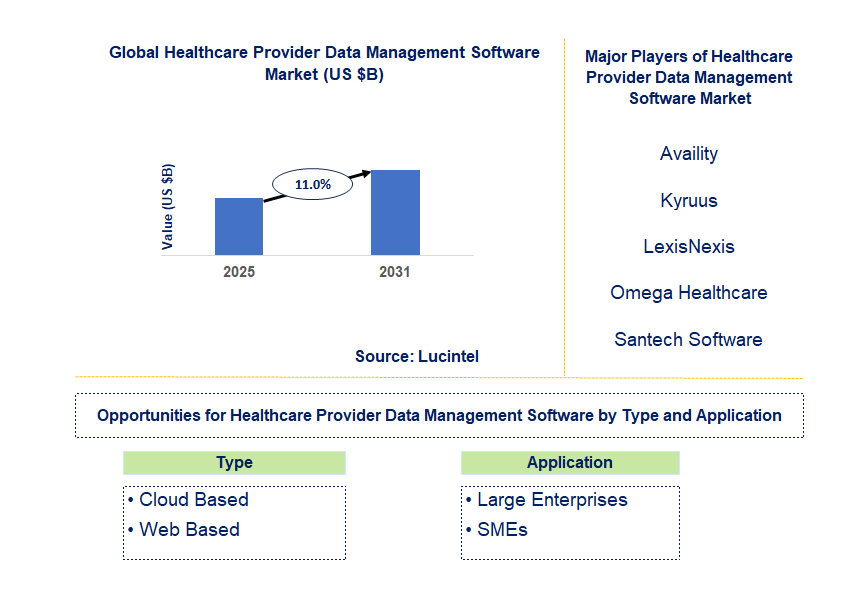
Key data points: The growth forecast = 11% annually for the next 7 years. Scroll below to get more insights. This market report covers Trends, opportunities and forecasts in healthcare provider data management software market to 2031 by type (cloud based and web based), application (large enterprises and SMEs), and region (North America, Europe, Asia Pacific, and the Rest of the World)
We'll send your sample report shortly.
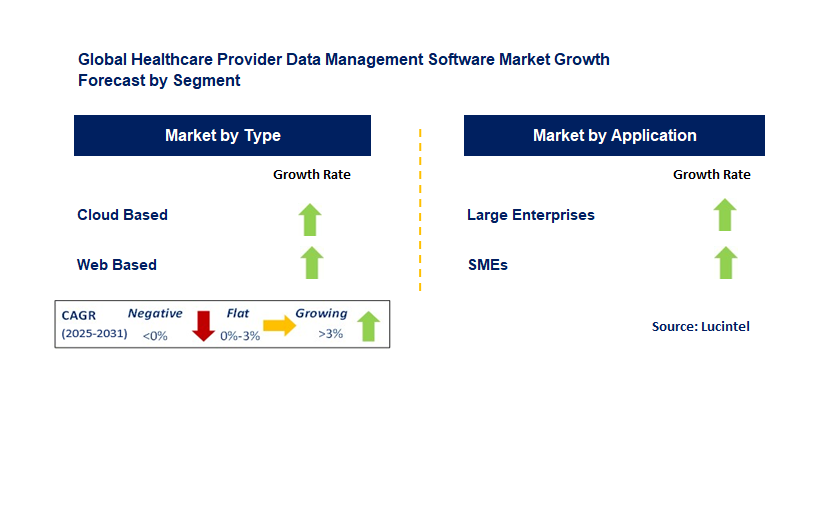
• Lucintel forecasts that, within the type category, cloud based is expected to witness higher growth over the forecast period.
• Within the application category, large enterprise is expected to witness higher growth.
• In terms of region, North America is expected to witness the highest growth over the forecast period.
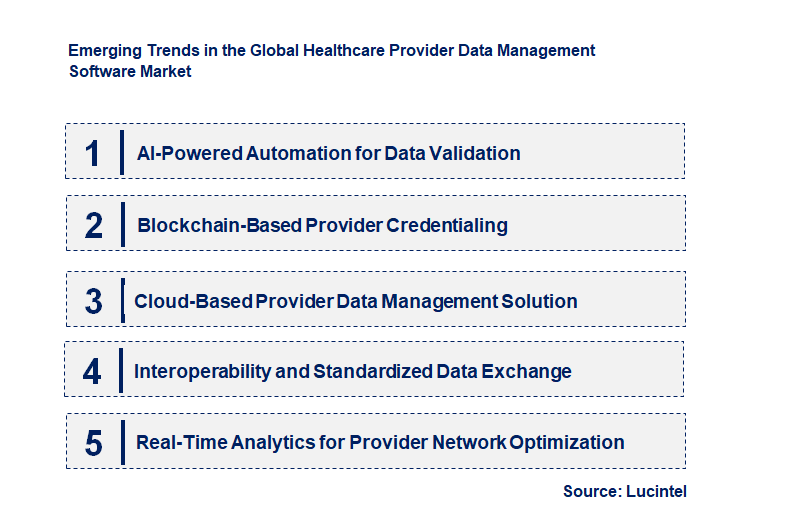
• AI-Powered Automation for Data Validation: Artificial Intelligence (AI) is playing a critical role in automating provider data validation, reducing errors, and improving efficiency. AI-driven solutions streamline credential verification, license renewals, and provider directory updates, ensuring real-time accuracy. Machine learning algorithms detect inconsistencies in provider databases, flagging potential discrepancies before they cause administrative challenges. Healthcare organizations leveraging AI-powered automation are seeing significant reductions in administrative costs, increased regulatory compliance, and improved provider data accuracy. This trend is driving greater adoption of intelligent data management platforms, allowing healthcare networks to maintain up-to-date provider registries with minimal manual intervention.
• Blockchain-Based Provider Credentialing: Blockchain technology is emerging as a key solution for secure provider data management and credential verification. Decentralized provider credentialing systems ensure tamper-proof data storage, reducing fraud and improving transparency. Blockchain enhances interoperability by allowing hospitals, insurers, and regulatory bodies to access real-time, verifiable provider credentials without compromising data security. Leading healthcare organizations are adopting blockchain-powered solutions to streamline provider onboarding and eliminate redundant verification processes. This trend is particularly significant in regions with stringent data privacy laws, as blockchain ensures compliance with regulatory requirements while enhancing operational efficiency.
• Cloud-Based Provider Data Management Solution: Cloud computing is revolutionizing provider data management by enabling secure, scalable, and remote access to healthcare provider databases. Cloud-based solutions facilitate real-time data updates, ensuring that provider information is always accurate and accessible across healthcare networks. Many organizations are migrating to HIPAA-compliant cloud platforms, reducing the burden of maintaining on-premise databases. This trend is accelerating the adoption of Software-as-a-Service (SaaS) solutions, allowing healthcare providers to centralize data management while ensuring compliance with evolving regulations. Cloud integration is particularly beneficial for large healthcare systems, enabling seamless provider credentialing and data sharing across multiple facilities.
• Interoperability and Standardized Data Exchange: The push for interoperability is driving the development of standardized data exchange protocols, such as FHIR (Fast Healthcare Interoperability Resources). Regulatory initiatives worldwide are mandating healthcare organizations to adopt standardized frameworks for provider data sharing. Interoperable systems improve data accuracy, reduce duplication, and streamline provider credentialing processes. This trend is particularly crucial for insurance firms, hospitals, and telehealth providers, ensuring seamless provider data exchange across diverse healthcare ecosystems. Increased interoperability is enhancing patient care coordination, reducing administrative inefficiencies, and ensuring compliance with data-sharing regulations.
• Real-Time Analytics for Provider Network Optimization: Healthcare organizations are leveraging real-time analytics to optimize provider networks, ensuring efficient resource allocation and improved service delivery. Advanced data analytics platforms enable predictive modeling, helping insurers and healthcare providers identify trends in provider availability, workload distribution, and credentialing issues. Real-time insights facilitate proactive decision-making, improving provider-patient matching and enhancing operational efficiency. The integration of big data analytics and AI-driven dashboards is enabling healthcare administrators to make data-driven improvements in provider network management, leading to better patient outcomes and streamlined healthcare services. The healthcare provider data management software market is evolving rapidly, driven by technological innovations and regulatory requirements. Emerging trends such as AI-powered automation, blockchain credentialing, cloud-based solutions, interoperability, and real-time analytics are reshaping how healthcare organizations manage provider data. These advancements are improving efficiency, security, and compliance, ensuring that healthcare providers can deliver seamless and reliable patient care. As these trends continue to develop, the healthcare industry will witness increased adoption of intelligent, automated, and scalable provider data management solutions, leading to enhanced healthcare delivery and operational excellence.
• Enhanced Data Interoperability: The push for seamless data exchange has led to enhanced interoperability features in healthcare provider data management solutions. New standards like Fast Healthcare Interoperability Resources (FHIR) are being widely adopted, facilitating smooth integration across electronic health records (EHR) and other digital platforms. This advancement enables healthcare providers to access and share data more efficiently, improving patient outcomes and operational efficiency. Additionally, enhanced interoperability helps organizations meet compliance requirements, reducing errors and administrative burdens. The ability to integrate multiple data sources effectively is a significant step toward a more connected and efficient healthcare ecosystem.
• AI-Driven Data Validation and Automation: Artificial intelligence (AI) is playing a crucial role in improving data accuracy and operational efficiency. AI-driven data validation tools are being integrated into healthcare provider data management software to detect inconsistencies, reduce manual errors, and automate data cleansing processes. This reduces the administrative workload on healthcare organizations while ensuring that provider databases remain up to date. AI-powered automation also enhances decision-making capabilities by providing predictive insights and identifying potential compliance risks before they become critical issues. This development is increasing efficiency and reducing costs for healthcare providers.
• Strengthened Regulatory Compliance Capabilities: With evolving regulations like the 21st Century Cures Act and the GDPR, healthcare provider data management software is incorporating advanced compliance features. Automated tracking of regulatory changes, real-time auditing tools, and built-in compliance frameworks are helping organizations adhere to complex legal requirements. These features ensure that healthcare providers remain compliant with data privacy laws and avoid penalties. By offering streamlined compliance solutions, software providers are enabling healthcare organizations to focus more on patient care and operational efficiency rather than regulatory complexities.
• Expansion of Cloud-Based Solutions: Cloud-based healthcare provider data management solutions are gaining traction due to their scalability, cost-effectiveness, and accessibility. Leading software providers are offering cloud-based platforms with real-time data synchronization, ensuring healthcare providers can access up-to-date information from anywhere. Cloud adoption enhances collaboration between different healthcare entities, reducing duplication of records and improving overall efficiency. Additionally, the flexibility of cloud-based solutions allows healthcare organizations to integrate additional functionalities, such as AI analytics and interoperability tools, without significant infrastructure investment.
• Improved Cybersecurity Measures: As cyber threats continue to rise, healthcare provider data management software developers are strengthening security measures to protect sensitive provider and patient data. Advanced encryption protocols, multi-factor authentication, and AI-driven threat detection are being integrated into these platforms. Additionally, software providers are adopting zero-trust security models to prevent unauthorized access and mitigate the risk of data breaches. These improvements are essential in building trust among healthcare organizations and ensuring compliance with stringent data protection regulations. These advancements are significantly enhancing the efficiency, security, and compliance capabilities of healthcare provider data management software. Enhanced interoperability and cloud adoption are facilitating seamless data exchange and operational flexibility, while AI-driven automation is improving accuracy and reducing costs. Strengthened compliance measures ensure adherence to evolving regulations, reducing legal risks. Improved cybersecurity frameworks are addressing growing concerns about data security. Collectively, these developments are driving innovation and accelerating the adoption of healthcare provider data management solutions.
• Expanding Electronic Health Record (EHR) Integration: With the growing adoption of EHR systems, healthcare provider data management software must integrate seamlessly with these platforms. By enhancing interoperability with EHR solutions, software providers can improve data accuracy, reduce administrative burdens, and support comprehensive patient care coordination. This integration enables real-time updates and reduces errors associated with duplicate or outdated provider data. Companies that invest in seamless EHR connectivity can capitalize on the increasing demand for integrated digital health solutions.
• Leveraging AI for Predictive Analytics: AI-driven predictive analytics is emerging as a key application in healthcare provider data management. By analyzing provider performance, patient trends, and operational data, AI solutions can identify potential inefficiencies and suggest improvements. Predictive analytics can also help healthcare organizations anticipate staffing needs and optimize resource allocation. Software providers incorporating AI capabilities into their solutions can offer value-added services that improve decision-making and drive efficiency.
• Enhancing Telehealth Support: Telehealth adoption has surged, necessitating robust provider data management solutions to ensure accurate credentialing and licensing verification for virtual care providers. Software solutions that streamline telehealth provider onboarding and automate compliance checks can enhance the efficiency of telehealth services. This opportunity is crucial as regulatory requirements for telehealth continue to evolve, requiring adaptable data management solutions.
• Optimizing Credentialing and Provider Enrollment: Credentialing and provider enrollment are complex processes that require automation and real-time validation. By offering AI-powered credentialing tools, software providers can reduce processing times, minimize errors, and enhance provider onboarding efficiency. Streamlining these processes is a significant opportunity to address the growing demand for faster provider verification and enrollment in healthcare networks.
• Targeting Value-Based Care Initiatives: The shift toward value-based care models requires accurate and real-time provider data management to track performance and compliance. Software solutions that support quality reporting, provider benchmarking, and reimbursement tracking can help healthcare organizations align with value-based care goals. Companies that develop tailored solutions for this transition can position themselves as leaders in the evolving healthcare landscape. These growth opportunities are shaping the future of the healthcare provider data management software market by expanding its applications and driving innovation. AI-driven analytics and automation are optimizing decision-making, while telehealth support and credentialing solutions are addressing evolving healthcare needs. EHR integration and value-based care alignment are further enhancing market demand. As software providers capitalize on these opportunities, the market is poised for sustained expansion and technological advancements.
• Availity
• Kyruus
• LexisNexis
• Omega Healthcare
• Santech Software
• CAQH
• Andros
• VerityStream
• Simplify Healthcare
• Rhapsody
• Cloud Based
• Web Based
• Large Enterprises
• SMEs
• North America
• Europe
• Asia Pacific
• The Rest of the World
• United States: The United States is experiencing rapid advancements in healthcare provider data management software, driven by stringent regulatory compliance requirements and the adoption of AI-powered solutions. The introduction of interoperability mandates by the Centers for Medicare & Medicaid Services (CMS) has led to increased integration of FHIR-based data exchange protocols. Major healthcare organizations are investing in cloud-based provider directories, enhancing real-time access to verified provider credentials. Additionally, AI-driven automation is improving data validation and fraud detection, ensuring higher accuracy in provider registries. Increased collaborations between health IT firms and healthcare networks are further accelerating software adoption across hospitals and insurance providers.
• China: China’s market is advancing through government-backed digital healthcare initiatives aimed at streamlining provider data management. The National Healthcare Security Administration (NHSA) has emphasized standardized electronic health records (EHRs) and data integration across public and private healthcare institutions. Leading technology firms, including Tencent and Alibaba, are developing AI-powered data analytics platforms to enhance provider data accuracy and efficiency. Cloud-based solutions are gaining traction, particularly in urban hospitals, improving remote access to provider information. Additionally, the expansion of telemedicine services is increasing the demand for secure, real-time provider data management systems, ensuring seamless access to verified healthcare professionals.
• Germany: Germany’s healthcare provider data management software market is being shaped by the country’s strong focus on data privacy and regulatory compliance. The Digital Overstrung Genets (DVG) mandates the integration of electronic health records (EHRs) with provider databases, enhancing interoperability across healthcare networks. AI-driven data validation systems are reducing administrative errors, improving provider credentialing processes. Cloud adoption is steadily rising, with healthcare IT firms partnering with public hospitals to ensure compliance with the General Data Protection Regulation (GDPR). The increasing use of blockchain-based verification systems is enhancing the security and transparency of provider data, reducing fraud and ensuring data integrity.
• India: India’s healthcare provider data management software market is experiencing significant expansion, driven by the government’s Ayushman Bharat Digital Mission (ABDM). The initiative promotes centralized provider registries, ensuring standardized and accurate data management across healthcare facilities. The growing adoption of cloud-based provider management platforms is streamlining administrative workflows for hospitals and insurance firms. AI-powered data validation systems are being implemented to improve provider credentialing accuracy. Additionally, private healthcare networks are investing in real-time provider verification solutions to enhance transparency. The rapid digitization of healthcare services, along with increasing investments in health IT infrastructure, is accelerating market growth.
• Japan: Japan’s market is evolving with the government’s push for healthcare digitization and AI integration. The Ministry of Health, Labor and Welfare (MHLW) has introduced initiatives to standardize provider data management systems, ensuring seamless interoperability between hospitals, clinics, and insurers. AI-powered data analytics are enhancing provider verification processes, reducing errors in healthcare databases. Cloud-based provider credentialing platforms are gaining traction, improving real-time access to verified healthcare professional information. Additionally, the rising adoption of blockchain for secure data exchange is strengthening data security measures, ensuring compliance with privacy regulations while enhancing the efficiency of provider data management.


• Availity
• Kyruus
• LexisNexis
• Omega Healthcare
• Santech Software
• CAQH
• Andros
• VerityStream
• Simplify Healthcare
• Rhapsody Q5. Which healthcare provider data management software market segment will be the largest in future? Answer: Lucintel forecasts that, within the type category, cloud based is expected to witness higher growth over the forecast period. Q6. In healthcare provider data management software market, which region is expected to be the largest in next 5 years? Answer: In terms of region, North America is expected to witness the highest growth over the forecast period. Q7. Do we receive customization in this report? Answer: Yes, Lucintel provides 10% customization without any additional cost.


Choose a license that fits your team. Instant PDF delivery.
Prices exclude taxes. Instant delivery. Custom licensing available on request.
Market Report · July 15, 2026
Market Report · June 26, 2026
Market Report · June 24, 2026
Trusted partner for strategic intelligence and business growth


Receive a complimentary market analysis tailored to your industry. Our analysts will identify key growth opportunities and competitive dynamics specific to your business.

Market size, growth rate, and key trend analysis for your specific sector.

Top competitor positioning and market share analysis.

Strategic recommendations backed by data-driven insights.
Get curated market intelligence and competitive moves straight to your inbox.
By subscribing, you agree to receive our monthly insights. Unsubscribe anytime.
Receive a complimentary market analysis tailored to your industry. Our analysts will identify key growth opportunities and competitive dynamics specific to your business.
Market size, growth rate, and key trend analysis for your specific sector.
Top competitor positioning and market share analysis.
Strategic recommendations backed by data-driven insights.
Get curated market intelligence, emerging trends, and competitive moves straight to your inbox each month.
By subscribing, you agree to receive our monthly insights. Unsubscribe anytime.
We'll send your sample report shortly.