
Market Report · July 15, 2026

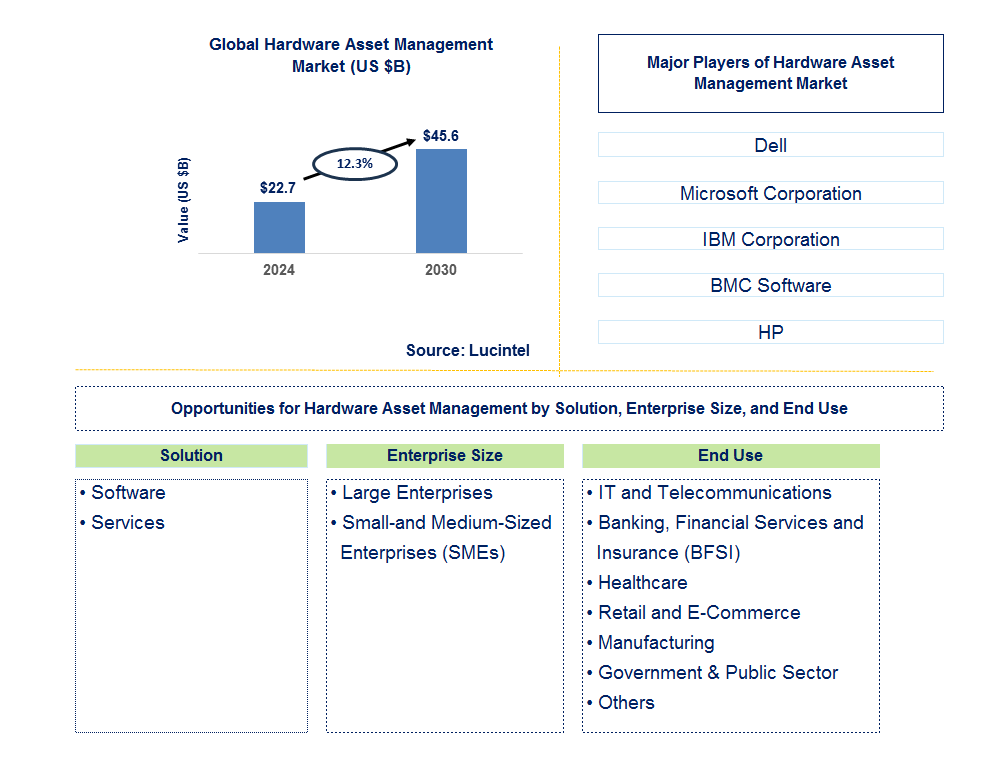
Key data points: The market size in 2030 = $45.6 billion, growth forecast = 12.3% annually for the next 6 years. Scroll below to get more insights. This market report covers trends, opportunities, and forecasts in the global hardware asset management market to 2030 by solution (software and services), enterprise size (large enterprises and small-and medium-sized enterprises (SMEs)), end use (IT and telecommunications, banking, financial services and insurance (BFSI), healthcare, retail and e-commerce, manufacturing, government & public sector, and others), and region (North America, Europe, Asia Pacific, and the Rest of the World)
We'll send your sample report shortly.
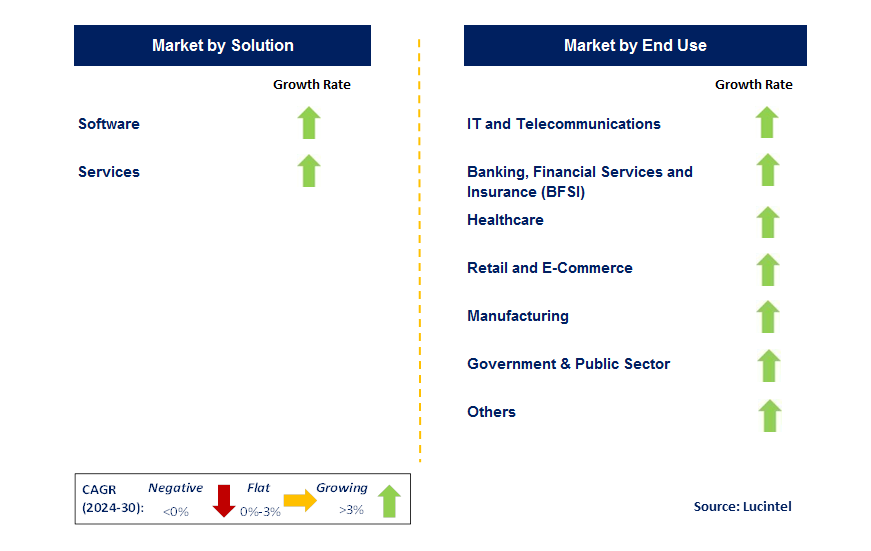
• Lucintel forecasts that, within the solution category, software will remain a larger segment over the forecast period.
• Within the end use category, IT and telecommunication will remain the largest segment over the forecast period.
• In terms of regions, North America is expected to witness the highest growth over the forecast period. Gain valuable insights for your business decisions with our comprehensive 150+ page report.
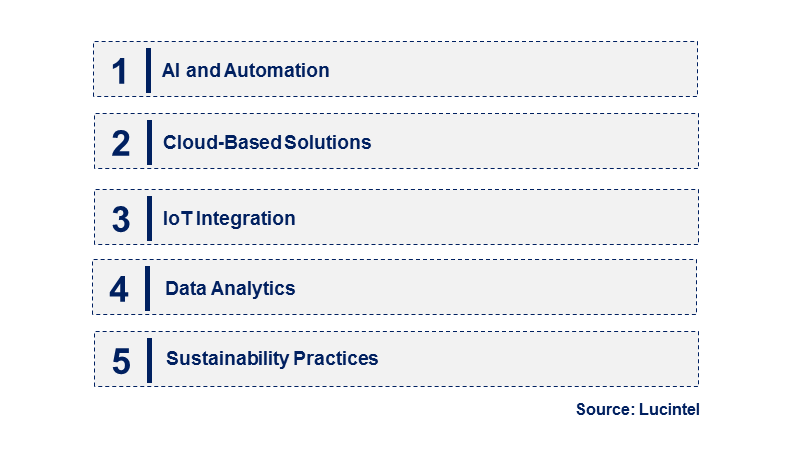
• AI and automation: Increased integration of artificial intelligence and automation technologies to streamline asset tracking and management processes.
• Cloud-based solutions: Growing adoption of cloud-based HAM systems that provide scalability and flexibility for businesses of all sizes.
• IoT integration: The use of Internet of Things (IoT) devices for real-time monitoring and tracking of hardware assets.
• Data analytics: Enhanced focus on data analytics to provide insights into asset utilization, helping organizations make informed decisions.
• Sustainability practices: A shift toward eco-friendly asset management practices, with emphasis on recycling and efficient resource utilization.
• Cybersecurity focus: Increasing awareness of cybersecurity threats, prompting the integration of security features into asset management solutions. These emerging trends reflect a dynamic shift toward smarter, more efficient, and sustainable hardware asset management practices, driven by technological advancements and changing business needs.
• Enhanced tracking technologies: Implementation of advanced tracking solutions such as RFID and GPS to improve asset visibility.
• Integration of AI: Adoption of AI technologies for predictive maintenance, allowing organizations to foresee and mitigate potential hardware failures.
• Increased collaboration: Partnerships between technology providers and businesses to develop tailored HAM solutions that meet specific industry needs.
• Focus on user experience: Development of user-friendly interfaces that simplify asset management tasks and improve user adoption rates.
• Mobile accessibility: Introduction of mobile applications that enable on-the-go access to asset management tools and data.
• Regulatory compliance: Enhancements to HAM solutions to ensure compliance with evolving regulations and industry standards. These recent developments highlight a robust commitment to innovation and the need for organizations to enhance their hardware asset management capabilities in an increasingly complex digital landscape.
• SME Market Expansion: Targeting small and medium-sized enterprises with affordable and scalable asset management solutions can drive market growth.
• Industry-Specific Solutions: Developing tailored HAM solutions for specific industries such as healthcare, finance, and manufacturing can enhance relevance and adoption.
• Integration with ITSM: Combining hardware asset management with IT service management (ITSM) can provide comprehensive solutions for organizations.
• Focus on Data Analytics: Leveraging data analytics to provide actionable insights can attract businesses looking to optimize their asset utilization.
• Growth in Emerging Markets: Expanding operations into emerging markets where digital transformation is accelerating can provide new revenue opportunities.
• Sustainability Initiatives: Developing solutions that focus on sustainable asset management practices can align with global environmental goals. By capitalizing on these strategic growth opportunities, companies can strengthen their position in the hardware asset management market and drive innovation that meets evolving customer needs.
• Rising IT infrastructure costs: Organizations are seeking to optimize their hardware assets to reduce operational costs.
• Digital transformation: The shift toward digital operations is driving demand for effective asset management solutions.
• Increased compliance requirements: Growing regulatory requirements necessitate improved visibility and management of hardware assets.
• Focus on efficiency: Businesses are prioritizing efficiency and productivity, leading to greater investment in asset management tools.
• Remote work trends: The rise of remote work has increased the need for tools that manage distributed hardware assets effectively. Challenges in the hardware asset management market include:
• Data privacy concerns: Heightened awareness of data privacy issues can complicate asset management strategies.
• Integration difficulties: Integrating new asset management solutions with existing systems can be challenging and resource-intensive.
• Market saturation: The proliferation of HAM solutions can lead to confusion among consumers regarding which products best meet their needs.
• Technological obsolescence: Rapid advancements in technology can render existing asset management solutions outdated.
• Skill gaps: Organizations may struggle to find qualified personnel who can effectively utilize advanced HAM tools. While the hardware asset management market is positioned for growth due to various driving factors, addressing the associated challenges will be essential for sustaining success and ensuring long-term viability in a competitive landscape.
• Dell
• Microsoft Corporation
• IBM Corporation
• BMC Software
• HP
• ServiceNow
• Oracle
• Flexera Software
• Ivanti
• Aspera Technologies
• Software
• Services
• Large Enterprises
• Small-and Medium-Sized Enterprises (SMEs)
• IT and Telecommunications
• Banking, Financial Services and Insurance (BFSI)
• Healthcare
• Retail and E-Commerce
• Manufacturing
• Government & Public Sector
• North America
• Europe
• Asia Pacific
• The Rest of the World
• USA: In the USA, the hardware asset management (HAM) market has seen significant advancements driven by the increasing need for organizations to optimize their IT resources. Recent developments include the integration of AI and machine learning into HAM solutions, enabling predictive maintenance and automated asset tracking. Companies are increasingly adopting cloud-based HAM tools to enhance scalability and accessibility. Additionally, compliance with regulatory standards is driving investments in asset management technologies, as businesses seek to improve visibility into their hardware inventory. The rise of remote work has also prompted organizations to implement better tracking of distributed assets.
• Germany: Germany’s hardware asset management market is experiencing steady growth, primarily due to a focus on digital transformation and Industry 4.0 initiatives. Recent developments highlight the increasing adoption of integrated HAM solutions that combine inventory management with financial tracking, allowing for a comprehensive view of asset utilization. German companies are also investing in automation to streamline asset lifecycle management, thereby reducing operational costs. Furthermore, the emphasis on sustainability is driving the adoption of eco-friendly asset management practices, ensuring that companies efficiently manage their hardware while minimizing environmental impact.
• China: The hardware asset management market in China is rapidly expanding, driven by the country's ongoing industrial modernization and digital transformation initiatives. Recent developments include the implementation of advanced tracking technologies, such as RFID and IoT, to enhance asset visibility and management efficiency. Chinese companies are increasingly adopting HAM solutions to manage large volumes of hardware across diverse sectors, including manufacturing and logistics. The government's push for smart manufacturing is further fueling investments in integrated HAM systems that offer real-time analytics and reporting capabilities. Additionally, the growing emphasis on cybersecurity is leading to the incorporation of security features in asset management tools.
• India: In India, the hardware asset management market is gaining traction as businesses focus on optimizing their IT infrastructure. Recent developments include the adoption of affordable, cloud-based HAM solutions that cater to small and medium-sized enterprises (SMEs). Companies are increasingly recognizing the importance of tracking hardware assets to reduce costs and improve efficiency. The rise of remote work has prompted investments in tools that provide visibility into distributed assets, facilitating better management. Additionally, Indian firms are leveraging data analytics to gain insights into asset utilization and lifecycle, helping them make informed decisions.
• Japan: Japan’s hardware asset management market is characterized by a strong emphasis on technological innovation and efficiency. Recent developments involve the integration of AI-driven analytics into HAM solutions, allowing organizations to predict hardware failures and optimize maintenance schedules. Japanese companies are focusing on developing comprehensive asset management strategies that encompass not just tracking, but also sustainability practices, aligning with national environmental goals. The adoption of automation in asset management processes is also on the rise, helping firms streamline operations and reduce manual errors. Furthermore, collaboration between technology providers and businesses is fostering the development of tailored solutions for specific industries.


• Dell
• Microsoft Corporation
• IBM Corporation
• BMC Software
• HP
• ServiceNow
• Oracle
• Flexera Software
• Ivanti
• Aspera Technologies Q6. Which hardware asset management market segment will be the largest in future? Answer: Lucintel forecasts that software will remain the larger segment over the forecast period. Q7. In hardware asset management market, which region is expected to be the largest in next 5 years? Answer: North America is expected to witness the highest growth over the forecast period. Q.8 Do we receive customization in this report? Answer: Yes, Lucintel provides 10% customization without any additional cost.


Choose a license that fits your team. Instant PDF delivery.
Prices exclude taxes. Instant delivery. Custom licensing available on request.
Market Report · July 15, 2026
Market Report · June 26, 2026
Market Report · June 24, 2026
Trusted partner for strategic intelligence and business growth


Receive a complimentary market analysis tailored to your industry. Our analysts will identify key growth opportunities and competitive dynamics specific to your business.

Market size, growth rate, and key trend analysis for your specific sector.

Top competitor positioning and market share analysis.

Strategic recommendations backed by data-driven insights.
Get curated market intelligence and competitive moves straight to your inbox.
By subscribing, you agree to receive our monthly insights. Unsubscribe anytime.
Receive a complimentary market analysis tailored to your industry. Our analysts will identify key growth opportunities and competitive dynamics specific to your business.
Market size, growth rate, and key trend analysis for your specific sector.
Top competitor positioning and market share analysis.
Strategic recommendations backed by data-driven insights.
Get curated market intelligence, emerging trends, and competitive moves straight to your inbox each month.
By subscribing, you agree to receive our monthly insights. Unsubscribe anytime.
We'll send your sample report shortly.