
Market Report · July 15, 2026

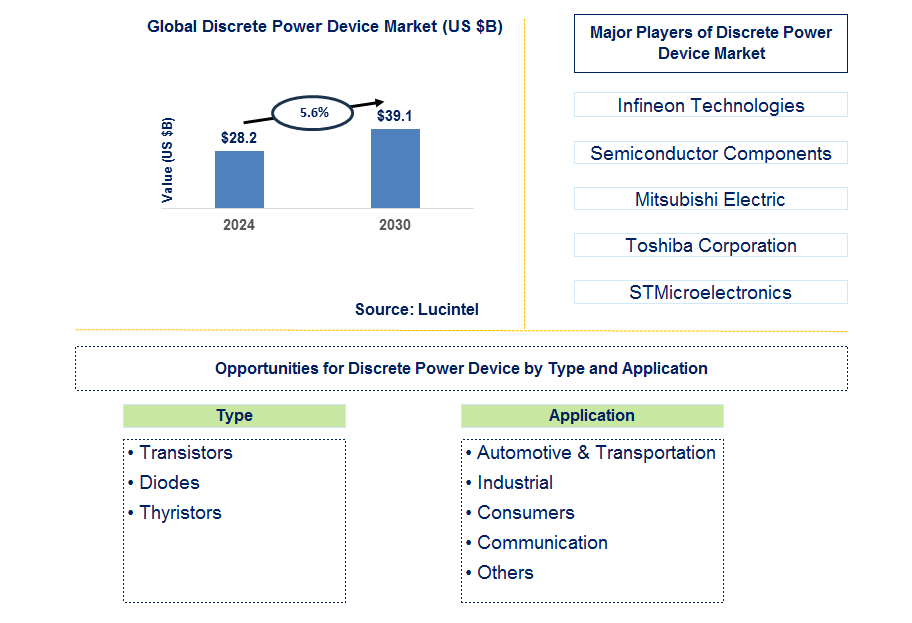
Key data points: The market size in 2030 = $39.1 billion, growth forecast = 5.6% annually next 6 years. Scroll below to get more insights. This market report covers trends, opportunities, and forecast in the global discrete power device market to 2030 by type (transistors, diodes, and thyristors), application (automotive & transportation, industrial, consumers, communication, and others), and region (North America, Europe, Asia Pacific, and the Rest of the World)
We'll send your sample report shortly.
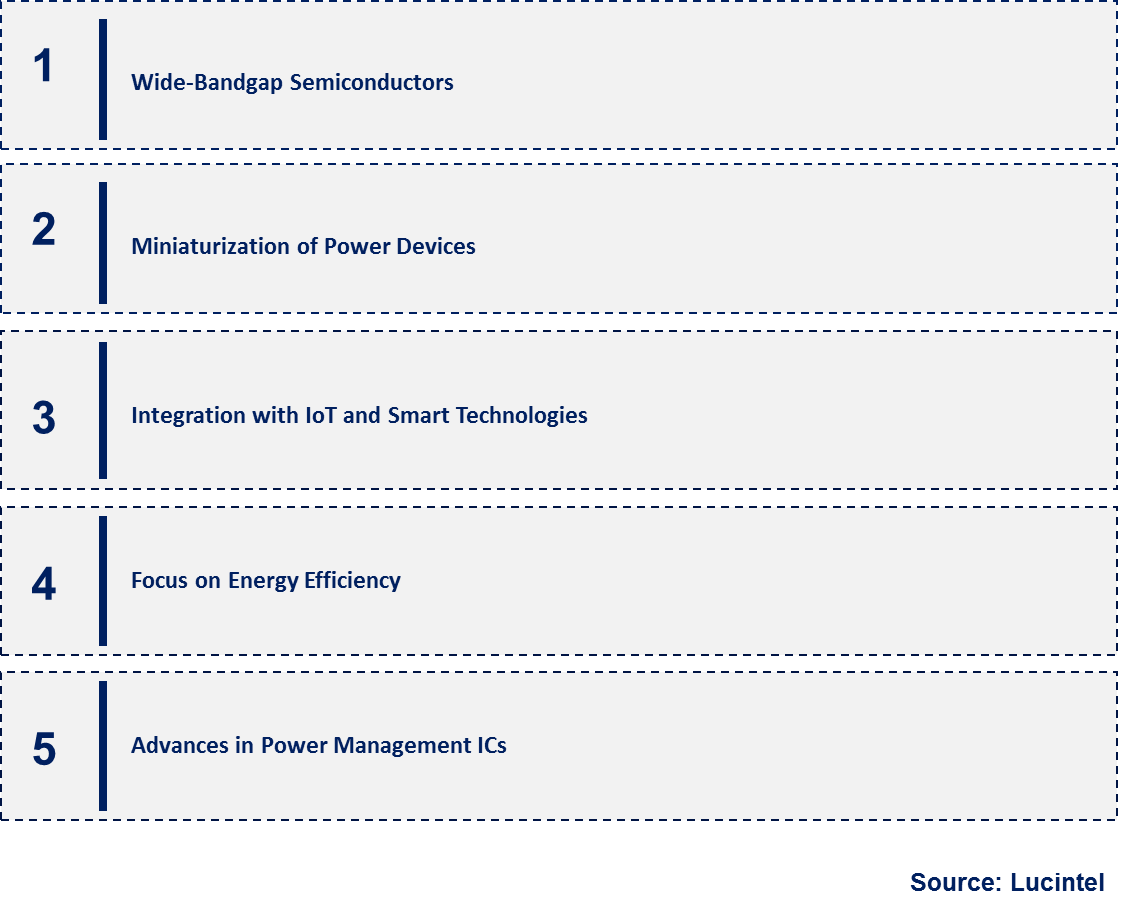
• Wide-Bandgap Semiconductors: Wide-bandgap semiconductors like silicon carbide (SiC) and gallium nitride (GaN) are becoming popular due to their superior performance characteristics such as better efficiency than traditional silicon devices or higher thermal conductivity. These materials enable more efficient power conversion, thus they are increasingly utilized in various applications like EVs as well as renewable energy sources.
• Miniaturization of Power Devices: Miniaturization is a trend that has been observed among power devices so as to meet the requirements of compact portable electronics. Through development in materials and techniques used for manufacturing, smaller yet more powerful designs have been made possible, while maintaining high performances thus reducing size/weight across all electronic applications alike.
• Integration with IoT and Smart Technologies: IoT and smart technologies have allowed discrete power devices’ integration thereby enhancing their functionality and connectivity. This has given rise to intelligent power management systems capable of real-time monitoring thereby controlling inputs, outputs at any given time making them more efficient thus reliable no matter where they are being used for application purposes.
• Focus on Energy Efficiency: Energy efficiency is a critical area when developing discrete power devices. Manufacturers are increasingly focusing on creating devices that consume less energy and improve general power management. This development is in line with global sustainability goals and the need for environmental impact reduction through regulations.
• Advances in Power Management ICs: Innovations concerning integrated circuits (ICs) for controlling power are revolutionizing the control of power in industry. These developments include higher performances, more efficient voltage systems, protective functions among other areas that affect the performance as well as reliability of electronic systems. The above emerging trends have led to technological innovations that are currently shaping the discrete powered device market by enhancing efficiency and meeting all emerging industrial needs. New benchmarks are being set up by focusing on wide band gap semiconductors, miniaturization and energy efficiencies that are providing opportunities for advanced power devices.
• Advancements in Wide-Bandgap Materials: Superior efficiency and thermal performance offered by wide bandgap materials such as SiC and GaN is transforming this technology making it ideal for discrete powered device markets. With these materials there is increased opportunity for higher density of electric power and better conversion rates thus influencing advancement of commercial products like electric cars or renewable energy among others.
• Enhanced Power MOSFETs and IGBTs: In order to achieve much better results on their overall performance enhancement, significant improvements should be done with respect to these two types of devices. By so doing new designs alongside material compositions help reduce losses associated with switching speeds thereby improving overall efficiency when using them in different sections of a modern day electronic system which may include industry machinery to consumer electronic applications.
• Development of Advanced Power Modules: Development of advanced power modules integrating multiple power devices has resulted to more efficient and smaller power management systems. These modules have better thermal management and improved reliability, making them ideal for high-performance applications in the automotive and industrial sectors.
• Innovation in Power Management ICs: The latest innovations on these components have significantly enhanced their performance as well functions. They now contain higher power regulating ability, efficiency as well protection features that will cater adequately for recent demand of complex power managing units found in different electronic devices.
• Focus on Sustainable Power Devices: There is a growing focus on developing sustainable power devices that are environmentally friendly. Materials and processes are advancing towards lower energy consumption and waste as global sustainability goals and regulations demand. These developments play a big role by influencing technological advancements, improving efficiency and broadening application areas in discrete powered device markets. This trend of emphasis on wide band gap materials, cutting edge power modules and overall sustenance has allowed various companies with focus to exploit innovation opportunities.
• Electric Vehicles (EVs): The adoption rate of electric vehicles has driven significant growth prospects for discrete powered devices particularly through battery management and power conversion activities. High-performance SiC- or GaN-based semiconductor designs improve the performance as well as efficiency levels for electrical systems incorporated into EVs thereby propelling demand for powerful electric propulsion technologies like electric cars among others.
• Renewable Energy Systems: The demand for advanced power devices in the renewable energy system, such as solar and wind power systems, is being driven by innovations in power conversion and management technologies, which have boosted their efficiency and reliability, hence creating growth opportunities for discrete power device market.
• Consumer Electronics: Compact and efficient power devices are increasingly required by the consumer electronics industry. Miniaturization and developments in the area of ICs for managing electricity supply have made it easier to achieve enhanced reliability that is also more energy- efficient in applications ranging from wearables to smartphones.
• Industrial Automation: Power management improvement on automation systems and machineries boosted industrial automation activities, thus making it a key growth area for discrete power devices. Advanced power modules and efficient power management ICs are enabling this sector to grow its operational efficiency and reliability.
• Telecommunications Infrastructure: Advanced power devices are being developed on the back of growing telecommunication infrastructure including 5G networks and data centers. For modern telecommunications equipment to handle increased demands of higher reliability and greater availability, they will require high efficiency powered modules plus management systems. These strategic growth opportunities are reshaping the discrete power device market through driving demand within major application areas while influencing technological advancements along these lines. Such factors like electric vehicles (EVs), renewable energy (and) industrial automation shifts focus allowing new possibilities leading into further development of powerful gadgets.
• Technological Advancements: Rapid developments in wide-bandgap semiconductors or materials such as silicon carbide (SiC) & gallium nitride (GaN), plus other related types of solutions for example PMIC has been propelling development within discretely powered electronic marketspace. Innovation is what enhances performance, efficiency or reliability and therefore supports advanced power solutions development.
• Growing Demand for Energy Efficiency: The emphasis on energy efficiency is growing in different industries including discrete power device market. This is because firms need power devices that can save energy and improve their overall management while adhering to global sustainability objectives and regulatory standards.
• Expansion of Electric Vehicles (EVs): Rise in adoption of electrical vehicles has increased the demand for advanced power devices used in converting power as well as managing battery systems. Performance and efficiency of EV power systems are now being enhanced by recent advancements in GeSiC, thus making room for market growth.
• Development of Renewable Energy Systems: The growth in solar-based electric generation, wind-powered plants among others has sharply boosted the demand for advanced power devices. Efficient function of renewable energy system requires technologies enhancing its management and conversion leading to higher demand for them within this market.
• Increasing Focus on Miniaturization: In consumer electronics and other applications, interest continues to rise towards small size yet powerful energy efficient components. Developmental approaches are continuously providing smaller dimensions’ functionality with better performances into various sectors of electronic industry. Challenges in the discrete power device market are:
• High Development Costs: One of the biggest challenges facing the discrete power device market is the high cost cushioning involved in developing advanced types of such products. On some instances, it may be difficult for a company to invest heavily into research & development plus production scaling thus becomes an obstacle.
• Problems with Integration and Compatibility: It can be complex to integrate new power devices into existing systems and ensure compatibility. Companies may face difficulties of seamless operation between different platforms and technologies, which may affect the acceptance of sophisticated power solutions.
• Regulatory and Environmental Constraints: Regulatory requirements and environmental constraints hinder the development and deployment of discrete-power devices. A lot of effort and investment is required for compliance with stringent safety, efficiency, and environmental impact standards. The discrete power device market is being shaped by these drivers as well as challenges that are influencing technology adoption, market dynamics, industry trends. Companies addressing these factors will be better placed to exploit opportunities while mitigating obstacles so as to enhance continued growth as well as innovation in the sector of power devices.
• Infineon Technologies
• Semiconductor Components
• Mitsubishi Electric
• Toshiba Corporation
• STMicroelectronics
• Vishay Intertechnology
• Fuji Electric
• Renesas Electronics
• ROHM
• Nexperia
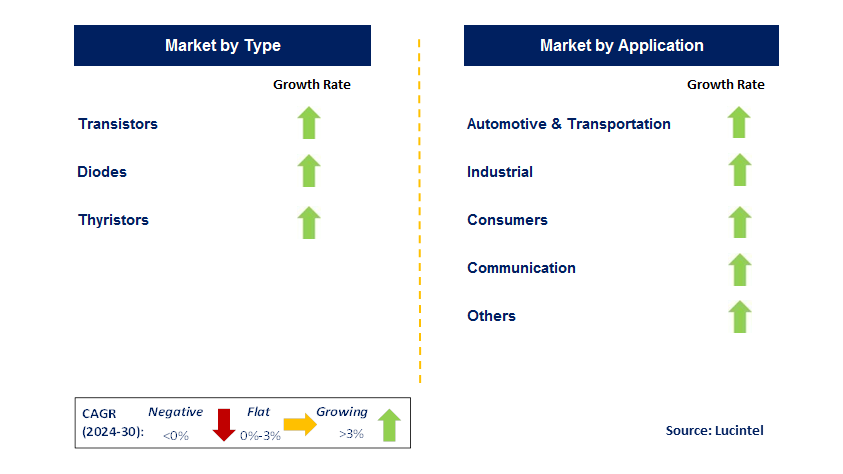
• Transistors
• Diodes
• Thyristors
• Automotive & Transportation
• Industrial
• Consumers
• Communication
• Others
• North America
• Europe
• Asia Pacific
• The Rest of the World
• United States: The discrete power device market in the U.S. is undergoing rapid transformation focusing on high-efficiency power MOSFETs and IGBTs. Silicon carbide (SiC) and gallium nitride (GaN), for instance, are enabling increased power conversion efficiency and better thermal management through wide-bandgap semiconductors; thus EV’s drive to renewable energy systems has informed a much faster rate of adoption.
• China: To support its growing electronics and automotive industries, China is investing heavily in discrete power device technologies. Some recent developments include substantial improvements in SiC and GaN technologies that are being incorporated into high-performance power modules for electric vehicles (EVs) and industrial applications. By supporting semiconductor innovation, the government helps create more capacity for advanced domestic production of these devices.
• Germany: In Germany’s discrete market just like United States’, key focus areas revolve around improving power efficiency and reliability mainly for industrial applications. There have been significant developments regarding integration with Industry 4.0 technologies as well as advances in power management ICs. It can be seen that Germany's strong automotive sector has driven advancements in power electronics particularly for electric or hybrid vehicles while at the same time further developing more efficient energy sources.
• India: With increasing investments from electronics manufacturing companies including those from automotive sector, India is growing its discrete device market fast enough. Advanced power supplies and motor drives also feature important developments like increased adoption of advanced type MOSFETs and IGBTs.These are some of the initiatives by the government to support electronics manufacturing and sustainable energy projects that in turn increases demand for high-performance power devices
• Japan: In terms of discrete power device technology, Japan remains ahead with initiatives aimed at improving device performance and miniaturization. GaN and SiC are two examples of such innovations on nano scale power systems which have enhanced efficiency and improved electrical power density among other applications including consumer electronics and industrial systems. Japan’s commitment to R&D continues to drive advancements in this area.


• Infineon Technologies
• Semiconductor Components
• Mitsubishi Electric
• Toshiba Corporation
• STMicroelectronics
• Vishay Intertechnology
• Fuji Electric
• Renesas Electronics
• ROHM
• Nexperia Q6. Which discrete power device market segment will be the largest in future? Answer: Lucintel forecasts that thyristors will remain the largest segment over the forecast period because it is simple to activate and has control over alternative current (AC) power. Q7. In discrete power device market, which region is expected to be the largest in next 5 years? Answer: APAC will remain the largest region over the forecast period due to growing research & development activities (R&D) activities and presence of key players in this region. Q.8 Do we receive customization in this report? Answer: Yes, Lucintel provides 10% customization without any additional cost.


Choose a license that fits your team. Instant PDF delivery.
Prices exclude taxes. Instant delivery. Custom licensing available on request.
Market Report · July 15, 2026
Market Report · June 26, 2026
Market Report · June 24, 2026
Trusted partner for strategic intelligence and business growth


Receive a complimentary market analysis tailored to your industry. Our analysts will identify key growth opportunities and competitive dynamics specific to your business.

Market size, growth rate, and key trend analysis for your specific sector.

Top competitor positioning and market share analysis.

Strategic recommendations backed by data-driven insights.
Get curated market intelligence and competitive moves straight to your inbox.
By subscribing, you agree to receive our monthly insights. Unsubscribe anytime.
Receive a complimentary market analysis tailored to your industry. Our analysts will identify key growth opportunities and competitive dynamics specific to your business.
Market size, growth rate, and key trend analysis for your specific sector.
Top competitor positioning and market share analysis.
Strategic recommendations backed by data-driven insights.
Get curated market intelligence, emerging trends, and competitive moves straight to your inbox each month.
By subscribing, you agree to receive our monthly insights. Unsubscribe anytime.
We'll send your sample report shortly.