
Market Report · July 15, 2026

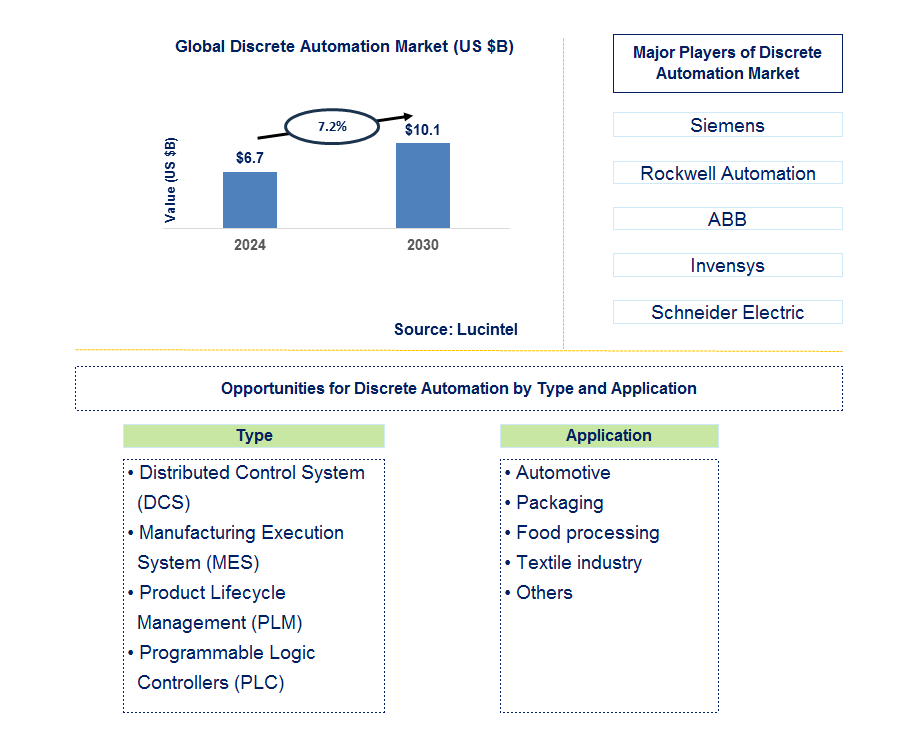
Key data points: The market size in 2030 = $10.1 billion, growth forecast = 7.2% annually next 6 years. Scroll below to get more insights. This market report covers trends, opportunities, and forecast in the global discrete automation market to 2030 by type (distributed control system (DCS), manufacturing execution system (MES), product lifecycle management (PLM), and programmable logic controllers (PLC)), application (automotive, packaging, food processing, textile industry, and others), and region (North America, Europe, Asia Pacific, and the Rest of the World)
We'll send your sample report shortly.
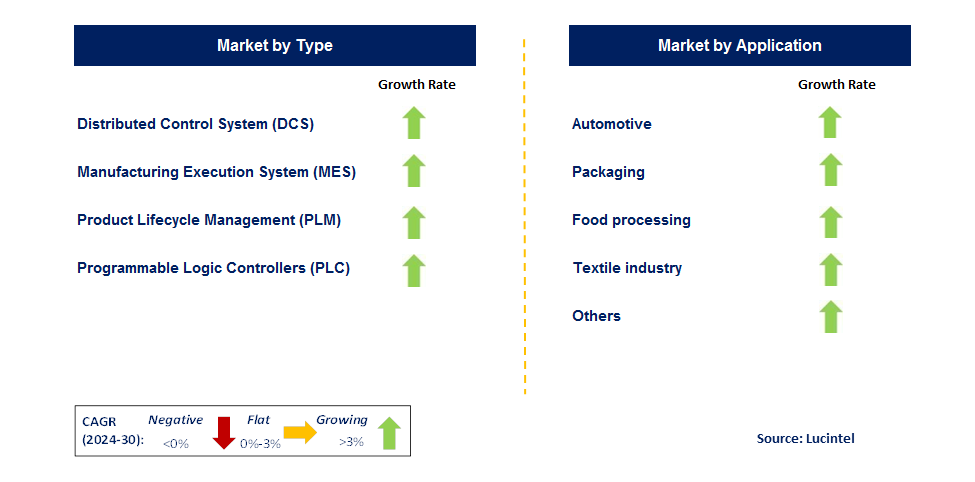
• Growth in AI and Machine Learning Integration: The integration of AI and machine learning into automation systems has the potential to revolutionize manufacturing through predictive maintenance, process optimization, and advanced analytics.AI-driven automation improves decision-making process and operational efficiency which leads to less downtime and increased productivity.
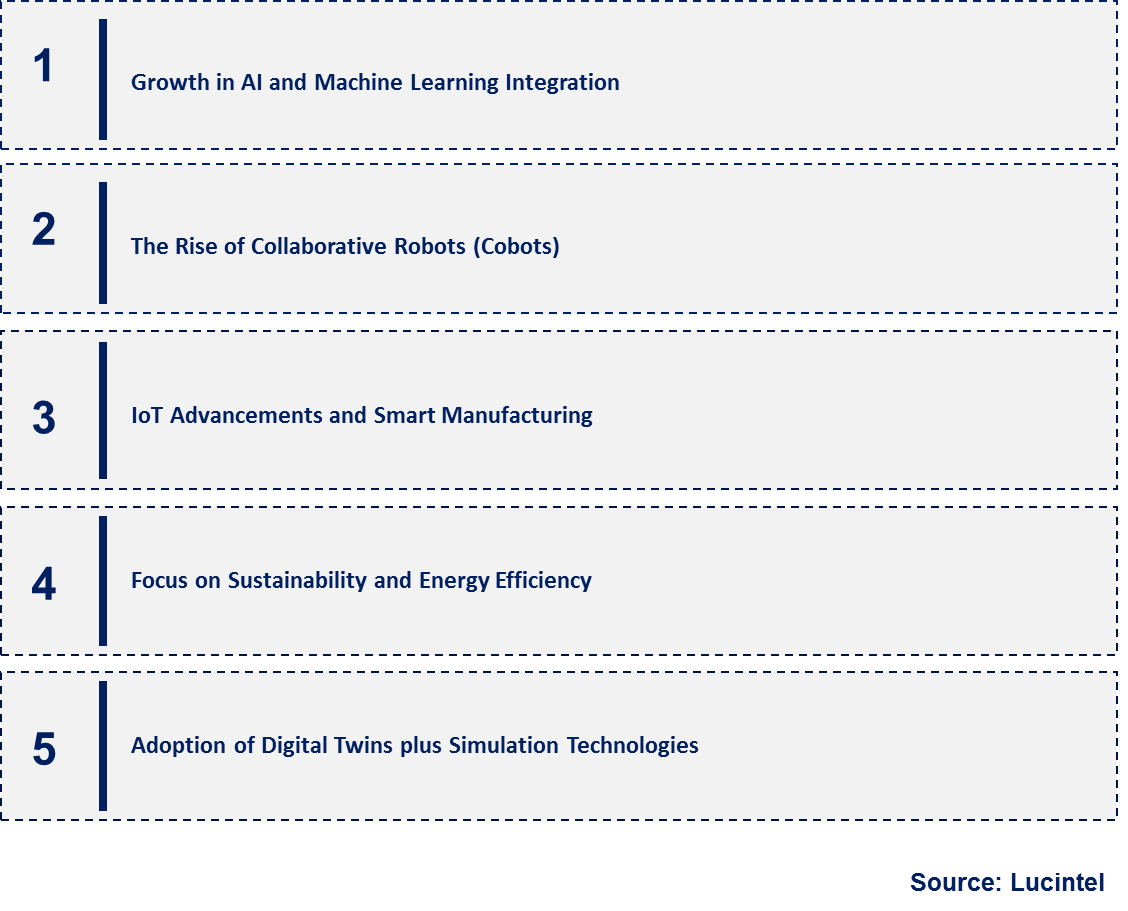
• The Rise of Collaborative Robots (Cobots): Collaborative robots are becoming more popular because they can work together with human workers in a safe manner. Such robots are designed with adaptability as well as ease of programming in mind hence SMEs that seek an increase in productivity without making significant investments on traditional automated systems can find them useful.
• IoT Advancements and Smart Manufacturing: Discrete automation has been transformed by IoT technology connecting various devices within manufacturing floors. Smart manufacturing utilizes the Internet of Things, generating real-time data that supports improved monitoring, control as well as optimization of production processes cutting across all departments of the company enhancing its overall efficiency while reducing costs.
• Focus on Sustainability and Energy Efficiency: Nowadays, there is growing interest among manufacturers for environmentally friendly as well as energy efficient automation solutions. Therefore, companies have invested heavily on technologies that reduce waste coupled with energy consumption thereby supporting sustainability objectives both globally and at national levels.
• Adoption of Digital Twins plus Simulation Technologies: Digital twins together with simulation technologies now form an integral part of discrete automations. They help to develop virtual models that allow for simulation and analysis prior to implementation such as optimizing designs, reduced errors or improvement in overall system performance. Impact of Trends on the Discrete Automation Market: These emerging trends, in addition to driving technological innovation, improving operational efficiencies and addressing industry challenges are reshaping the discrete automation market. New and advanced manufacturing solutions are being set up. The focus on artificial intelligence (AI), Internet of Things (IoT) and sustainability has led to opportunities for more advanced and responsive manufacturing solutions.
• Advanced Robotics Integration: Advanced robotic integrations have improved productivity in various sectors. With greater precision, flexibility and capabilities that allow for adaptable production lines based on complexity, ability to withstand change among others leading to increased operational efficiency at reduced costs.
• AI-Driven Automation Systems: AI-driven automation systems have transformed how companies manage their manufacturing operations. Predictive maintenance is enhanced through use of AI algorithms which optimize process parameters as well as analyze data consequently making entire environments respond faster than ever before.
• Smart Manufacturing Initiatives: Smart manufacturing is gaining momentum as companies adopt IoT and digital technologies to create interconnected and intelligent production systems. This approach enhances real-time monitoring, data analysis as well as process control thereby supporting overall efficiency and productivity within an organization.
• Collaborative Robotics Expansion: Collaborative robotics are expanding to address labor shortages while still enhancing flexibility in production. Cobots are a low cost option for specific tasks in any given production line since they work with humans side by side thus do not require safety barriers or complete separation from humans.
• Sustainability in Automation Solutions: There is growing emphasis on developing sustainable automation solutions aimed at reducing environmental impact plus energy consumption levels associated with industrial activities. Companies invest in green technologies aligned with global sustainability targets and regulations. Impact of Developments on the Market: These developments are significantly impacting the discrete automation market by driving technological advancements, improving operational efficiency, and addressing industry challenges. Those who emphasize the need for smart and sustainable solutions are setting a new benchmark in manufacturing that will spur innovation.
• Robotics in Automotive Manufacturing: In automobile production, robotics has been used to improve efficiency and quality. This sector’s automation solutions have focused on assembly, painting as well as quality control to enhance accuracy and reduce lead times.
• IoT Enabled Smart Factories: One of the growth opportunities arising from IoT technology is smart factories. These factories use interconnected devices and systems to optimize production processes, enhance data collection capabilities for better decision making resulting into overall operational efficiency improvements among others.
• AI-Based Predictive Maintenance: Predictive maintenance through AI is an essential application in discrete automation today. AI can analyze machinery/systems data to predict possible faults thus schedule maintenance proactively which reduces down times thereby prolonging machinery life.
• Customized Automation Solutions: Automation has become more complex due to increased demand for customized products depending on each industry. This enables companies to adapt their automated systems according to different production environments which makes them more flexible while at the same time enhancing productivity.
• Energy-Efficient Automation Technologies: Minimizing energy consumption and environmental impact has led to development of energy-efficient automation technologies. Sustainable automation solutions are essential for companies seeking compliance with regulations as well as cost reduction purposes. Impact of Growth Opportunities: These strategic growth opportunities are changing the discrete automation market as they push for creativity and efficiency in various applications. The focus on robotics, internet of things (IoT), and energy conservation has created new prospects while setting the stage for future advancements in manufacturing.
• Technological Advancements: The improvement in robot technology, artificial intelligence (AI) and IoT has been a catalyst for expansion in discrete automation. These technologies provide more efficient ways of doing work, customize manufacturing processes thereby making them more sophisticated as well as responsive.
• Economic Efficiency: Automation solutions have become an important factor in achieving cost reduction, improving efficiencies among other benefits. More business entities are using automated systems so as to reduce their overall operational expenditures, cut down on human labor costs, all this leading to higher profitability margins.
• Regulatory Compliance: In order to ensure compliance with industry standards and regulations companies have started implementing advanced automation technologies. For instance, corporations will begin using automated systems which enable them meet environmental requirements concerning safety or quality assurance over time.
• Customization and Flexibility: Companies are now demanding customized and flexible automation solutions. Such customizable machines improve adaptability across varied production processes thus enhancing effectiveness within diverse factory set ups.
• Global Competition: To remain competitive in international markets firms have had no option but adopting advanced automation technologies. By enhancing production capabilities through automation, it is possible for a company to have a strategic advantage while also reducing lead times. Challenges in the discrete automation market are:
• High Initial Investment Costs: One of the major challenges facing the discrete automation market is high initial investments required for autonomous systems with high level of sophistication. This can be too expensive for small businesses seeking entry into this market or even those without adequate capitalization rates.
• Integration Complexity: Integrating new automation technologies with existing systems can be complex and challenging. Some of the challenges companies face when integrating automation technologies into their manufacturing systems include ensuring compatibility and enabling smooth operations with various platforms and across equipment.
• Talent Shortage: Finding sufficient skilled workers and engineers who possess knowledge in automation technology is a big challenge. Organizations should therefore invest in training programs to bridge this gap, while ensuring proper implementation as well as maintenance of automation systems. Impact of Drivers and Challenges: In conclusion, these drivers and challenges shape discrete automation market by influencing technological adoption processes, operational approaches, industry dynamics among others. Addressing these factors is key for companies seeking to use automation as competitive advantage for operational excellence.
• Siemens
• Rockwell Automation
• ABB
• Invensys
• Schneider Electric
• Distributed Control System (DCS)
• Manufacturing Execution System (MES)
• Product Lifecycle Management (PLM)
• Programmable Logic Controllers (PLC)
• Automotive
• Packaging
• Food processing
• Textile industry
• Others
• North America
• Europe
• Asia Pacific
• The Rest of the World
• United States: The U.S has experienced a tremendous incorporation of artificial intelligence (AI) and machine learning into automated systems. Firms are now using advanced robots and IoT technologies to smoothen their production processes as well as reduce operating costs. For this reason, there is a move towards smart factories which can produce more with greater flexibility while being able to respond quickly to the changes in market demands.
• China: China is investing heavily on automation so as to support its industrial upgrading program dubbed “Made in China 2025”. In this regard the country is paying attention on strengthening its robotics capabilities in addition to smart automation so that it can lessen reliance on foreign technology while increasing the productivity of its industries.
• Germany: Germany is known for its strong industrial base; therefore it has integrated cyber-physical systems together with IoT into its manufacturing under industry 4.0 plan. It aims at establishing further flexible as well as efficient platforms for production based on the prevalent engineering culture and technological know-how.
• India: India is adopting automation at a rapid rate in order to make the manufacturing sector more competitive as well as efficient. With a view of modernizing infrastructure facilities and enhancing manufacturing capabilities there has been an increased investment in robotics including other digital technologies driven by government’s “Make in India” initiative.
• Japan: Japan continues taking lead in terms of robotics thereby making major breakthroughs especially through collaborative robots alongside AI-driven automations. The country has concentrated on how these technologies can be used in solving problems related to labor shortages within various industries while improving production techniques.


• Siemens
• Rockwell Automation
• ABB
• Invensys
• Schneider Electric Q6. Which discrete automation market segment will be the largest in future? Answer: Lucintel forecasts that distributed control system (DCS) will remain the largest segment over the forecast period because it helps in the enhancement of power generation by simultaneously avoiding the human errors that occurs during the distribution process, as well as it enhances the operational process of industrial verticals. Q7. In discrete automation market, which region is expected to be the largest in next 5 years? Answer: APAC will remain the largest region over the forecast period because of growing industry control system implementation and factory automation, huge customer base, low manufacturing costs, along with availability of cheap labor in this region. Q.8 Do we receive customization in this report? Answer: Yes, Lucintel provides 10% customization without any additional cost.


Choose a license that fits your team. Instant PDF delivery.
Prices exclude taxes. Instant delivery. Custom licensing available on request.
Market Report · July 15, 2026
Market Report · June 26, 2026
Market Report · June 24, 2026
Trusted partner for strategic intelligence and business growth


Receive a complimentary market analysis tailored to your industry. Our analysts will identify key growth opportunities and competitive dynamics specific to your business.

Market size, growth rate, and key trend analysis for your specific sector.

Top competitor positioning and market share analysis.

Strategic recommendations backed by data-driven insights.
Get curated market intelligence and competitive moves straight to your inbox.
By subscribing, you agree to receive our monthly insights. Unsubscribe anytime.
Receive a complimentary market analysis tailored to your industry. Our analysts will identify key growth opportunities and competitive dynamics specific to your business.
Market size, growth rate, and key trend analysis for your specific sector.
Top competitor positioning and market share analysis.
Strategic recommendations backed by data-driven insights.
Get curated market intelligence, emerging trends, and competitive moves straight to your inbox each month.
By subscribing, you agree to receive our monthly insights. Unsubscribe anytime.
We'll send your sample report shortly.