
Market Report · July 31, 2026

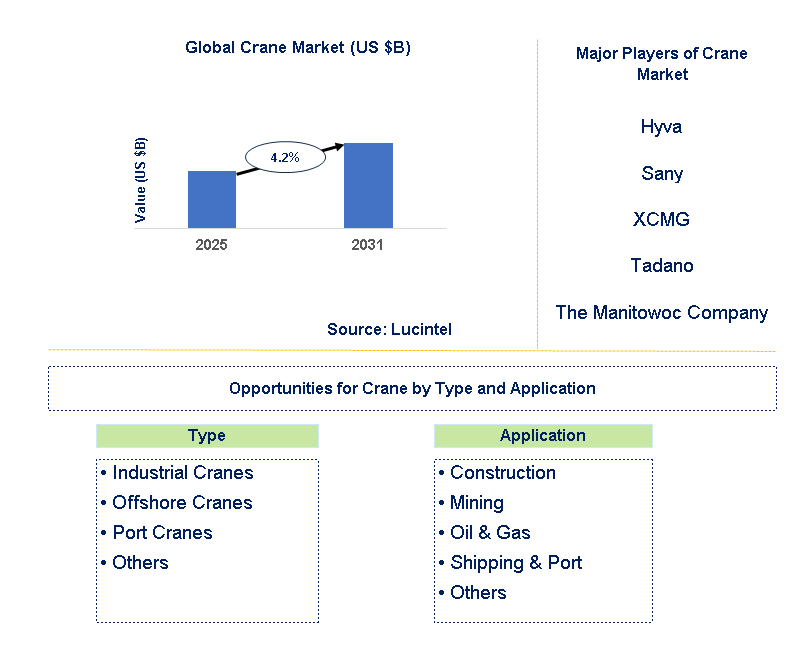
Key data points: The growth forecast = 4.2% annually for the next 7 years. Scroll below to get more insights. This market report covers trends, opportunities and forecasts in crane market to 2031 by type (industrial cranes, offshore cranes, port cranes, others), application (construction, mining, oil & gas, shipping & port, others), and region (North America, Europe, Asia Pacific, and the Rest of the World)
We'll send your sample report shortly.
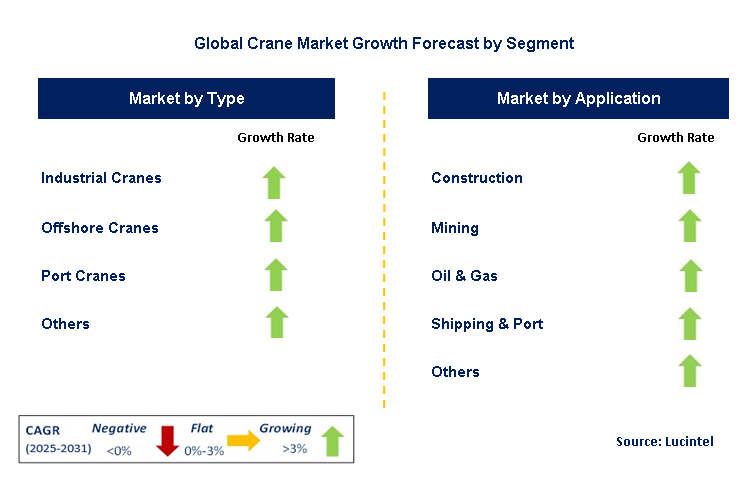
• Lucintel forecasts that, within the type category, industrial crane is expected to witness the highest growth over the forecast period.
• Within the application category, construction is expected to witness the highest growth.
• In terms of region, APAC is expected to witness the highest growth over the forecast period. Gain valuable insights for your business decisions with our comprehensive 150+ page report. Sample figures with some insights are shown below.
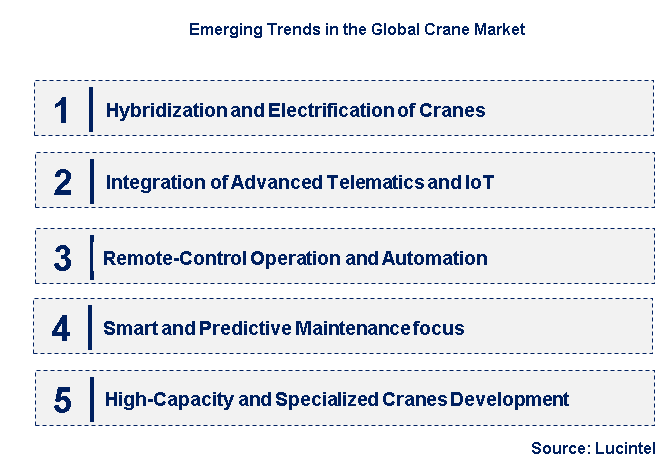
• Hybridization and Electrification of Cranes: This is the growth and use of electric and hybrid-powered crane. Faced with tough emissions rules, higher fuel prices, and a worldwide initiative for sustainability, builders are placing orders for battery-electric and hybrid versions of various types of crane, such as mobile, tower, and port crane. The effect is a major cut in noise pollution and zero or close-to-zero direct emissions in use, which is suitable for city centers, indoor use, and sensitive locations. This also contributes to less expensive operation based on reduced use of fossil fuels.
• Integration of Advanced Telematics and IoT: Telematics and Internet of Things (IoT) are increasingly being integrated into crane systems to enable real-time data gathering on machine performance, location, utilization, and maintenance requirements. The data is remotely monitored and analyzed wirelessly. The effects include improved fleet management, predictive maintenance features, and optimized operating efficiency. Asset performance can be monitored by companies, issues of potential problems before they develop into breakdowns can be detected, downtime minimized, and overall project scheduling and profitability maximized through informed data-based decision-making.
• Remote-Control Operation and Automation: The automation trend in crane encompasses automated load handling, self-leveling systems, and remote-control operation capabilities that enable operators to manage crane at a distance or remotely. This is made possible by the use of sophisticated sensors, cameras, and communication technologies. The implications are largely enhanced safety through the elimination of operators from likely hazardous areas, enhanced accuracy in lifting and setting, and greater efficiency for repetitive operations. This also contributes to filling labor gaps by allowing one operator to be able to run more sophisticated operations.
• Smart and Predictive Maintenance focus: By using data gathered via telematics and AI, operators and manufacturers are adopting smart and predictive maintenance practices. Rather than routine maintenance, equipment is maintained based on its real condition and anticipated wear, avoiding surprise breakdowns. The effect is lower downtime, longer equipment life, and maintenance cost optimization. This preventive strategy guarantees greater equipment availability and reliability, which in turn translates to project continuity and profitability by reducing unexpected operation halts.
• High-Capacity and Specialized Cranes Development: With larger and more complex infrastructure projects, lifting capacity crane and specialist crane are increasingly in demand. These encompass ultra-large crawler crane for wind turbine installation, heavy mobile crane for bridge construction, and bespoke crane for specialist industrial use. The effect is the facilitation of mega-projects that were hitherto problematic because of lifting limitations. This trend pushes technology in structural design, materials, and power systems to deal with heavy loads and survive in different, harsh environments. These nascent trends are essentially transforming the crane market by expanding the limits of what can be done in heavy lifting. The transition towards electrification, intelligent technologies such as telematics and AI, automation, and high-capacity specialized machines is making the industry more efficient, safer, and environmentally friendly. These technologies not only redefine the operational practices but also the value proposition of crane, making them crucial to the ever-increasing complexities of today‘s construction and industrial sectors.
• Spread of Electric and Hybrid Crane Models: A principal recent development is the spread of electric and hybrid crane models across all classes, from mobile to tower crane, and port crane. This is a direct consequence of worldwide environmental policies and increasing focus on decreasing carbon emissions. The effect is a considerable move towards cleaner and less noisy operations, especially for urban construction sites and covered industrial atmospheres. It is also contributing to reduced maintenance and operating expenses because of minimized fuel consumption and lower maintenance needs for the electrical components.
• Artificial Intelligence and Machine Learning Integration for Optimized Performance: The market is witnessing greater incorporation of Artificial Intelligence (AI) and machine learning algorithms in crane operating systems. Such technologies allow automated load balancing, predictive maintenance, collision detection, and optimized planning for lifts. The result is an exponential development in the accuracy, efficiency, and safety of operations. AI enables crane to learn from operating data, adjust to evolving situations, and execute tasks with higher accuracy, mitigating human error and enhancing project schedule overall.
• Enhanced Telematics and Remote Monitoring Capabilities: Advances in telematics and IoT (Internet of Things) have enabled more extensive and insightful remote monitoring of crane in recent times. Machine health, location, fuel usage, and operating parameters can be accessed in real-time by operators and fleet managers from anywhere. The result is much better fleet management, with proactive scheduling of maintenance, optimal utilization of assets, and quick troubleshooting. This decreases downtime, increases equipment life, and offers useful data for decision-making on operations, thereby making the overall profitability better.
• Operator Comfort and Safety with the Latest Ergonomics: Manufacturers are investing heavily in designing operator cabins with enhanced ergonomics, improved visibility, and sophisticated control systems. This includes features like anti-fatigue seating, intuitive digital displays, and advanced camera systems for a 360-degree view. The impact is improved operator well-being, reduced fatigue, and significantly enhanced safety on job sites. By creating more comfortable and safer working environments, companies can attract and retain skilled operators while minimizing the risk of accidents.
• Increase in Demand for Miniature and Specialized Lifting Solutions: There is a significant rise in demand for miniature and specialized crane solutions like mini crane, spider crane, and compact track loaders with lifting attachments. The demand is being fueled by the rising number of urban construction sites with limited space and the requirement for flexible machines for specialized applications. The benefit is increased flexibility and productivity in working on difficult job locations, minimizing the requirement for bigger, less maneuverable machines. The smaller, specialized equipment provides cost-effective solutions for a number of lifting applications. These five major developments are significantly influencing the crane market by introducing an age of unrivalled efficiency, safety, and technological advancement. The extensive use of electric and AI-based crane, augmented with cutting-edge telematics, enhanced operating environments, and increasing demand for niche solutions is revolutionizing the way heavy lifting is executed. These technologies are not only addressing the intricate requirements of current construction and industrial markets but also propelling the industry towards a more productive and eco-friendly future.
• Infrastructure Development (Roads, Bridges, Ports, Airports): The greatest growth prospect is in the world investment in huge infrastructure projects. This entails road construction and upgrading, bridge construction and upgrade, railway development, airport development, and port development, especially in the developing world and for urban regeneration in advanced economies. Cranes, for example, mobile crane, tower crane, and specialty gantry crane, play an integral role in these projects. The effect is a consistent and high demand for various lifting equipment, causing sales, rentals, and aftermarket services as governments invest significant amounts in boosting national and regional connectivity.
• Energy Sector (Renewables, Oil & Gas, Power Plants): Growing energy sector, including both conventional oil and gas facilities and the fast-developing renewable energy sector (wind farms, solar farms, hydropower), offers considerable growth prospects. Cranes are also crucial in the construction and maintenance of wind turbines, solar panels, power plant parts, and oil and gas platforms. The influence is a diversified demand for heavy-lift crane that are usually specialized in extreme heights or difficult terrain. This industry also spurs innovation in lifting capacity, accuracy, and efficiency in the placement of critical components.
• Urban Construction and High-Rise Building Projects: Urbanization and the trend towards building high-rise residential, commercial, and mixed-development buildings in cities globally provide huge growth potential. Tower crane, self-erecting crane, and mobile mini crane play a pivotal role in lifting materials and equipment in limited urban space. The effect is an ongoing need for crane specifically designed to suit urban work sites, with a focus on versatility, fast setup times, and small footprint. This segment also fuels demand for less noisy and greener crane models as a result of urban legislation.
• Industrial and Manufacturing Sector Growth: The development of the industrial and manufacturing industries, such as automotive, heavy machinery, and general manufacturing, generates steady demand for overhead crane, gantry crane, and jib crane. These crane play a crucial role in material handling, assembly line work, and logistics in factory environments. The effect is consistent growth for specific crane types and custom material handling solutions tailored to indoor applications and accurate component placement. The industry also causes demand for automated and semi-automated crane systems to optimize production and safety.
• Maintenance, Repair, and Overhaul (MRO) in Multiple Industries: Outside of new build, strong expansion opportunities exist in the repair, maintenance, and overhaul (MRO) operations of various industries, including currently installed infrastructure, industrial plants, and heavy equipment. Cranes are needed to lift heavy parts to do repair work, upgrade equipment, and perform routine maintenance. The effect is stable, recurring demand for rental crane and specialized service-oriented lifting equipment. This segment emphasizes reliability, quick deployment, and the ability to operate in diverse, often constrained, operational environments for efficient upkeep of assets. These strategic growth drivers are having a deep influence on the crane market by directing investment and innovation into key application areas. Through serving the needs of infrastructure development, the energy industry, urban construction, industrial growth, and MRO activities, the market can find sustained and diversified growth. These opportunities stress the critical position of crane in facilitating global economic growth and responding to changing requirements for effective and safe heavy lifting across a wide range of industries.
• Hyva
• Sany
• XCMG
• Tadano
• The Manitowoc Company
• Cargotec Oyj
• Manitex International
• Liebherr Group
• Terex Corporation
• Sumitomo Heavy Industries Construction Crane
• Industrial Cranes
• Offshore Cranes
• Port Cranes
• Others
• Construction
• Mining
• Oil & Gas
• Shipping & Port
• Others
• North America
• Europe
• Asia Pacific
• The Rest of the World
• United States: In the United States, the crane market is dominated by the Bipartisan Infrastructure Law, which provides significant investment in mega-projects such as highways, bridges, and public facilities. This has fueled demand for different types of crane, especially mobile and specialist models. Electric and hydrogen-powered crane are increasingly being adopted, as seen at the world‘s first hydrogen-powered crane at the Port of Los Angeles, which seeks to have zero emissions. Also, advancements in automation and better safety features are boosting efficiency and popularity of contemporary US-made crane.
• China: The Chinese crane industry is marked by huge government investment in infrastructure such as high-speed rail networks, highways, and city development, usually under the Belt and Road Initiative. Chinese manufacturers such as XCMG and Sani are at the forefront of innovation in advanced high-capacity crane, such as the first hybrid truck crane in the world and the first tower crane smart factory with automated production lines. There is a great thrust towards the merging of Artificial Intelligence and Internet of Things for increased operation ability, efficiency, and security, making China the dominant force in manufacturing and deployment of crane.
• Germany: Germany‘s crane market is premised on high-precision engineering, technology development, and ecological stewardship. Some recent trends have been a strong move towards electric and hybrid crane solutions in line with the goals of European Green Deal. Manufacturers such as Liebherr and Demag are integrating sophisticated telematics, automation, and ergonomic designs to enhance efficiency, safety, and operator comfort. There is a significant market for compact and utility crane for urban building and specialized industrial purposes, an indicator of Germany‘s emphasis on high-quality, efficient, and eco-friendly lifting solutions.
• India: India‘s crane market is experiencing strong growth with aggressive government infrastructure development initiatives like the "Smart Cities Mission" and "Make in India" campaigns. Urbanization and industrialization are propelling demand for various types of crane, ranging from mobile to fixed crane. Although there are issues with new emission standards (Bharat Stage CEV-V), the market is adjusting with international manufacturers increasing their footprints. There is also a growing trend in crane leasing services owing to their affordability and versatility, supporting different levels of manufacturing and construction projects.
• Japan: Technological advancement, strict safety requirements, and energy efficiency are the hallmark features of Japan‘s crane market. Recent advancements involve ongoing investment in sophisticated hydraulic crane fitted with intelligent machine control technology by players such as Komatsu. There is a high emphasis placed on creating environmentally friendly crane solutions, such as hybrid and electric crane, to minimize the environmental footprint. The market also enjoys huge public infrastructure investments, for example, urban renewal projects and preparations for big events such as EXPO 2025, which boost demand for safe and innovative lifting equipment.


• Hyva
• Sany
• XCMG
• Tadano
• The Manitowoc Company
• Cargotec Oyj
• Manitex International
• Liebherr Group
• Terex Corporation
• Sumitomo Heavy Industries Construction Crane Q5. Which crane market segment will be the largest in future? Answer: Lucintel forecasts that, within the type category, industrial crane is expected to witness the highest growth over the forecast period. Q6. In crane market, which region is expected to be the largest in next 5 years? Answer: In terms of region, APAC is expected to witness the highest growth over the forecast period. Q7. Do we receive customization in this report? Answer: Yes, Lucintel provides 10% customization without any additional cost.


Choose a license that fits your team. Instant PDF delivery.
Prices exclude taxes. Instant delivery. Custom licensing available on request.
Market Report · July 31, 2026
Market Report · July 17, 2026
Market Report · May 18, 2026
Trusted partner for strategic intelligence and business growth


Receive a complimentary market analysis tailored to your industry. Our analysts will identify key growth opportunities and competitive dynamics specific to your business.

Market size, growth rate, and key trend analysis for your specific sector.

Top competitor positioning and market share analysis.

Strategic recommendations backed by data-driven insights.
Get curated market intelligence and competitive moves straight to your inbox.
By subscribing, you agree to receive our monthly insights. Unsubscribe anytime.
Receive a complimentary market analysis tailored to your industry. Our analysts will identify key growth opportunities and competitive dynamics specific to your business.
Market size, growth rate, and key trend analysis for your specific sector.
Top competitor positioning and market share analysis.
Strategic recommendations backed by data-driven insights.
Get curated market intelligence, emerging trends, and competitive moves straight to your inbox each month.
By subscribing, you agree to receive our monthly insights. Unsubscribe anytime.
We'll send your sample report shortly.