
Pipeline Safety Market Trends and Forecast
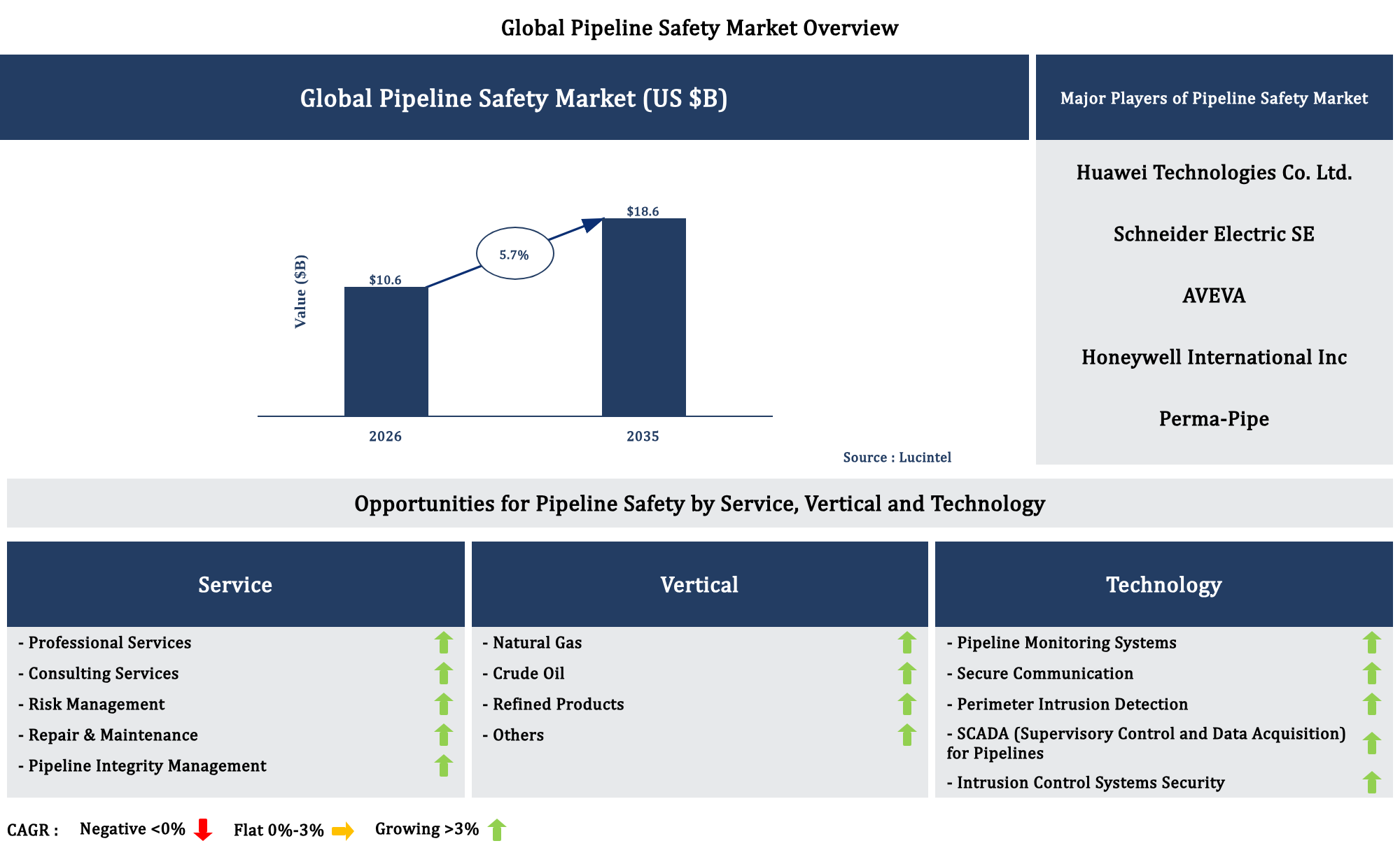
The future of the global pipeline safety market looks promising with opportunities in the pipeline monitoring system, secure communication, perimeter intrusion detection, scada (supervisory control and data acquisition) for pipelines, and intrusion control systems security markets. The global pipeline safety market is expected to reach an estimated $18,692 million by 2035 with a CAGR of 5.7% from 2026 to 2035. The major drivers for this market are the growing demand for energy transportation infrastructure, the rising adoption of advanced leak detection technologies, and the increasing demand for government focus on environmental protection.
• Lucintel forecasts that, within the service category, pipeline integrity is expected to witness the highest growth over the forecast period.
• Within the technology category, scada (supervisory control and data acquisition) is expected to witness the highest growth.
• In terms of region, APAC is expected to witness the highest growth over the forecast period.
Gain valuable insights for your business decisions with our comprehensive 150+ page report. Sample figures with some insights are shown below.
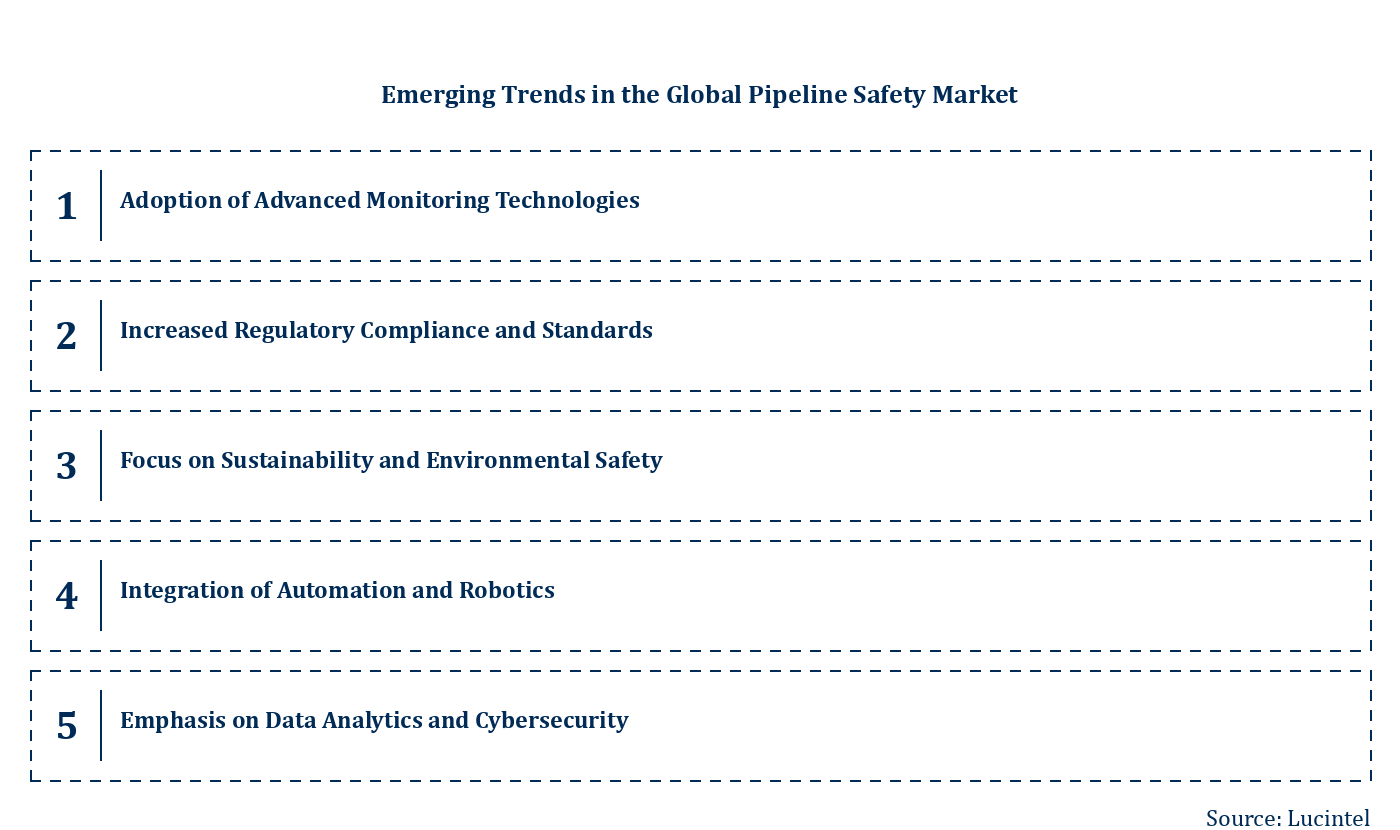
Emerging Trends in the Pipeline Safety Market
The pipeline safety market is experiencing significant transformation driven by technological advancements, regulatory changes, and increasing safety concerns. As pipelines remain critical for energy and resource transportation, ensuring their safety is paramount to prevent environmental hazards, economic losses, and human risks. Emerging trends are shaping the future landscape of pipeline safety, emphasizing innovation, automation, and sustainability. These developments are not only enhancing safety protocols but also improving operational efficiency and compliance standards. Understanding these key trends is essential for stakeholders to adapt strategies, invest in new technologies, and meet evolving regulatory requirements effectively.
• Adoption of Advanced Monitoring Technologies: The market is witnessing a surge in the use of smart sensors, drones, and IoT devices that enable real-time pipeline monitoring. These technologies provide continuous data on pressure, temperature, and structural integrity, allowing for early detection of leaks or damages. This proactive approach reduces response times, minimizes environmental impact, and enhances safety. The integration of AI and machine learning further improves predictive maintenance, leading to more efficient and cost-effective safety management.
• Increased Regulatory Compliance and Standards: Governments and industry bodies are implementing stricter safety regulations and standards to mitigate pipeline risks. These include mandatory safety audits, environmental impact assessments, and safety management systems. Compliance ensures operational safety and reduces legal liabilities. Companies are investing in training, certification, and infrastructure upgrades to meet these evolving standards, which in turn drives market growth and innovation in safety solutions.
• Focus on Sustainability and Environmental Safety: There is a growing emphasis on environmentally friendly pipeline safety practices. This includes the development of eco-safe materials, leak detection systems that minimize environmental damage, and procedures that reduce carbon footprint. Sustainability initiatives are influencing market offerings, encouraging companies to adopt greener technologies and practices that align with global environmental goals, thereby enhancing corporate responsibility and public trust.
• Integration of Automation and Robotics: Automation is transforming pipeline safety management through robotic inspection devices, automated shutdown systems, and remote operation capabilities. These innovations reduce human exposure to hazardous environments and improve inspection accuracy. Robotics enable access to difficult terrains and hazardous zones, ensuring comprehensive safety checks. This trend enhances operational efficiency, reduces downtime, and supports rapid response to safety incidents.
• Emphasis on Data Analytics and Cybersecurity: The increasing reliance on digital systems necessitates robust data analytics and cybersecurity measures. Advanced analytics help interpret vast amounts of safety data, identify patterns, and predict potential failures. Cybersecurity is critical to protect pipeline control systems from cyber threats that could cause disruptions or safety breaches. Strengthening these areas ensures the integrity of safety operations and builds resilience against emerging digital risks.
These trends are collectively reshaping the pipeline safety market by fostering innovation, enhancing regulatory compliance, and promoting sustainable practices. The integration of advanced technologies and data-driven approaches is leading to safer, more efficient pipeline operations. As these developments continue, the market is poised for significant growth, driven by the need for reliable, environmentally responsible, and technologically advanced safety solutions.
Recent Developments in the Pipeline Safety Market
The pipeline safety market is experiencing rapid advancements driven by increasing regulatory requirements, technological innovations, and a focus on environmental protection. These developments aim to enhance safety protocols, reduce accidents, and improve operational efficiency across pipeline infrastructure globally. As industries and governments prioritize pipeline integrity, new solutions and strategies are emerging to address complex safety challenges. This evolving landscape presents significant opportunities for stakeholders to innovate, invest, and improve pipeline safety standards worldwide.
• Growing Adoption of Smart Sensor Technology: Sensors enable real-time monitoring of pipeline conditions, detecting leaks, corrosion, and pressure changes promptly. This technology reduces response times, minimizes environmental damage, and prevents accidents, thereby increasing safety and operational efficiency. The market benefits from increased demand for predictive maintenance solutions, fostering innovation and expanding the scope of pipeline safety management.
• Implementation of Advanced Data Analytics: Data analytics tools analyze vast amounts of pipeline data to identify risk patterns and optimize maintenance schedules. This approach enhances decision-making, reduces downtime, and prevents failures. The integration of AI-driven analytics is transforming safety protocols, making pipelines more resilient and reliable, which attracts investments and boosts market growth.
• Regulatory Enhancements and Compliance Standards: Governments worldwide are tightening safety regulations, requiring stricter inspection, monitoring, and reporting procedures. These regulatory changes compel pipeline operators to upgrade safety systems, adopt new technologies, and improve safety culture. Consequently, the market experiences increased demand for compliance solutions, fostering innovation and ensuring safer pipeline operations.
• Increased Focus on Corrosion Prevention and Control: Corrosion remains a major threat to pipeline integrity. Recent developments include advanced coatings, cathodic protection, and corrosion monitoring systems. These innovations extend pipeline lifespan, reduce maintenance costs, and prevent leaks or failures. The emphasis on corrosion control drives market growth by promoting safer, more durable pipeline infrastructure.
• Expansion of Pipeline Safety Training and Workforce Development: Enhanced training programs and workforce certifications are being implemented to improve safety practices. Skilled personnel are crucial for effective pipeline management and emergency response. This focus on human capital development ensures better safety outcomes, reduces accidents, and supports the adoption of new safety technologies, thereby strengthening the overall pipeline safety market.
The overall impact of these developments is a safer, more reliable pipeline infrastructure that minimizes environmental risks and operational disruptions. Increased technological integration and stricter regulations are driving market growth, attracting investments, and fostering innovation. As safety standards improve globally, the pipeline safety market is poised for sustained expansion, supporting sustainable energy and resource transportation.
Strategic Growth Opportunities in the Pipeline Safety Market
The pipeline safety market is experiencing significant growth driven by increasing infrastructure development, stringent safety regulations, and technological advancements. As the demand for secure and efficient pipeline operations rises globally, companies are investing in innovative safety solutions. This expansion presents numerous opportunities for market players to enhance safety protocols, adopt new technologies, and expand their geographic reach, ultimately ensuring safer pipeline networks and minimizing environmental and operational risks.
• Growing Adoption of Advanced Monitoring Systems to Prevent Pipeline Failures: The integration of IoT sensors, real-time data analytics, and predictive maintenance tools is transforming pipeline safety. These technologies enable early detection of leaks, corrosion, and other anomalies, reducing downtime and environmental hazards. As regulations tighten, companies are increasingly investing in these solutions to ensure compliance and operational efficiency, creating substantial growth opportunities in safety monitoring.
• Increasing Investments in Pipeline Integrity Management Solutions: Ensuring pipeline integrity is critical for safety and regulatory compliance. Market players are developing comprehensive integrity management systems that include inspection, maintenance, and repair technologies. The rising need to prevent catastrophic failures and environmental damage is driving investments in these solutions, fostering market expansion and innovation in non-destructive testing and corrosion monitoring.
• Rising Demand for Safety Training and Workforce Development Programs: As pipeline networks expand and regulations become more stringent, the need for skilled personnel grows. Companies are focusing on safety training programs, simulation-based learning, and certification courses to enhance workforce competence. This trend supports safer operations, reduces accidents, and opens avenues for training service providers to develop specialized safety education solutions.
• Expansion of Safety Solutions in Emerging Markets: Rapid infrastructure development in regions like Asia-Pacific and the Middle East presents new opportunities for pipeline safety solutions. Local governments and companies are prioritizing safety to meet international standards and attract investments. Market players are expanding their presence, customizing safety products, and establishing partnerships to tap into these emerging markets, fueling overall industry growth.
• Adoption of Digital Twin Technology for Proactive Safety Management: Digital twins create virtual replicas of pipeline systems, enabling real-time simulation and predictive analysis. This technology allows operators to anticipate potential failures and optimize maintenance schedules proactively. As digital transformation accelerates, the adoption of digital twin solutions is expected to significantly enhance safety management, reduce costs, and improve decision-making processes across the pipeline industry.
The overall impact of these opportunities is poised to significantly enhance pipeline safety standards, reduce operational risks, and foster sustainable growth within the market, benefiting stakeholders through improved safety, compliance, and technological innovation.
Pipeline Safety Market Driver and Challenges
The pipeline safety market is influenced by a complex interplay of technological advancements, economic conditions, and regulatory frameworks. As pipelines become more extensive and sophisticated, ensuring their safety is paramount to prevent environmental hazards, economic losses, and safety risks. Innovations in monitoring and detection technologies, coupled with stricter government regulations, drive market growth. Conversely, economic fluctuations and the high costs associated with safety upgrades pose significant challenges. The evolving landscape requires stakeholders to adapt continuously to maintain pipeline integrity and safety standards. Understanding these drivers and challenges is essential for strategic planning and sustainable growth within the market.
The factors responsible for driving the pipeline safety market include:-
• Technological Innovations: The development of advanced monitoring systems, such as smart sensors, drones, and real-time data analytics, enhances pipeline safety by enabling early detection of leaks, corrosion, and other faults. These innovations reduce downtime, prevent environmental damage, and lower maintenance costs, thereby encouraging industry adoption. As technology becomes more affordable and effective, companies are increasingly investing in safety solutions, which propels market growth significantly.
• Regulatory Compliance and Government Policies: Governments worldwide are implementing stringent safety regulations and standards to prevent pipeline failures and environmental hazards. These regulations compel pipeline operators to adopt advanced safety measures, conduct regular inspections, and maintain high safety standards. The increasing enforcement of such policies drives demand for safety solutions, fostering market expansion and encouraging innovation in safety technologies.
• Growing Infrastructure and Pipeline Network Expansion: The rising demand for oil, gas, and other pipeline-transferred resources necessitates the expansion and modernization of existing pipeline networks. This growth increases the risk of accidents and failures, prompting operators to invest in safety measures. The ongoing infrastructure development, especially in emerging economies, creates a substantial market for pipeline safety solutions to ensure secure and reliable transportation.
• Increasing Focus on Environmental and Safety Concerns: Environmental awareness and safety concerns are prompting companies to prioritize pipeline integrity. The potential environmental impact of leaks and failures has led to increased investments in safety technologies that monitor and prevent such incidents. This focus on sustainability and safety standards boosts market demand for innovative safety solutions that minimize environmental risks and ensure compliance.
The challenges in the pipeline safety market are:
• High Implementation and Maintenance Costs: Deploying advanced safety technologies and conducting regular inspections require significant capital investment. Small and medium-sized pipeline operators often find these costs prohibitive, which can hinder widespread adoption. Additionally, ongoing maintenance and upgrades add to the financial burden, potentially limiting market growth, especially in regions with budget constraints.
• Complex Regulatory Environment: While regulations drive safety improvements, the varying standards across different regions create compliance complexities. Navigating diverse legal frameworks can be challenging for multinational companies, leading to increased operational costs and delays. The need to adapt safety measures to meet different regulatory requirements complicates market expansion and technology deployment.
• Technological Integration and Data Management Challenges: Integrating new safety technologies with existing pipeline infrastructure can be complex. Managing vast amounts of data generated by monitoring systems requires sophisticated analytics and cybersecurity measures. Ensuring seamless integration and data security poses technical challenges, which can delay implementation and increase costs, thereby impacting overall market growth.
The pipeline safety market is shaped by technological advancements, regulatory pressures, and infrastructure development, which collectively promote growth. However, high costs, regulatory complexities, and technological integration issues present significant hurdles. These drivers and challenges influence the pace and direction of market evolution, requiring stakeholders to innovate strategically. Overall, the market‘s future depends on balancing technological progress with cost-effective solutions and navigating regulatory landscapes effectively to ensure safe, sustainable pipeline operations.
List of Pipeline Safety Companies
Companies in the market compete on the basis of product quality offered. Major players in this market focus on expanding their manufacturing facilities, R&D investments, infrastructural development, and leverage integration opportunities across the value chain. With these strategies pipeline safety companies cater increasing demand, ensure competitive effectiveness, develop innovative products & technologies, reduce production costs, and expand their customer base. Some of the pipeline safety companies profiled in this report include-
• Huawei Technologies Co. Ltd.
• Schneider Electric SE
• AVEVA
• Honeywell International Inc
• Perma-Pipe
• ABB Group
• Rockwell Automation Inc
Pipeline Safety Market by Segment
The study includes a forecast for the global pipeline safety market by service, vertical, technology, and region.
Pipeline Safety Market by Service [Value from 2019 to 2035]:
• Professional Services
• Consulting Services
• Risk Management
• Repair & Maintenance
• Pipeline Integrity Management
Pipeline Safety Market by Vertical [Value from 2019 to 2035]:
• Natural Gas
• Crude Oil
• Refined Products
• Others
Pipeline Safety Market by Technology [Value from 2019 to 2035]:
• Pipeline Monitoring Systems
• Secure Communication
• Perimeter Intrusion Detection
• SCADA (Supervisory Control and Data Acquisition) for Pipelines
• Intrusion Control Systems Security
Pipeline Safety Market by Region [Value from 2019 to 2035]:
• North America
• Europe
• Asia Pacific
• The Rest of the World
Country Wise Outlook for the Pipeline Safety Market
The pipeline safety market is experiencing rapid growth driven by increasing infrastructure development, stringent safety regulations, and technological advancements worldwide. Countries are investing heavily to enhance pipeline integrity, prevent leaks, and ensure environmental and public safety. Innovations such as smart sensors, real-time monitoring, and automation are transforming the industry. Governments are implementing stricter standards, prompting companies to adopt advanced safety solutions. The market‘s evolution reflects a global commitment to reducing pipeline failures and environmental risks, fostering innovation and collaboration across sectors. This dynamic landscape varies by region, influenced by local policies, technological adoption, and infrastructure needs.
• United States: The U.S. market is advancing with significant investments in pipeline integrity management and safety technologies. Regulatory agencies like PHMSA are enforcing stricter safety standards, encouraging the adoption of smart monitoring systems and leak detection technologies. The focus is on modernizing aging infrastructure and integrating digital solutions for real-time data analysis. Companies are also investing in automation and predictive maintenance to prevent failures and enhance safety. The U.S. government’s emphasis on environmental protection and safety compliance continues to drive market growth and innovation.
• China: China is rapidly expanding its pipeline network to support its energy demands, with a focus on safety and efficiency. The government has implemented rigorous safety regulations and standards to prevent accidents amid rapid infrastructure development. Technological adoption includes advanced sensors, automation, and real-time monitoring systems to ensure pipeline integrity. China is also investing in smart pipeline management systems and digital technologies to improve safety oversight. The market is driven by the need to modernize aging pipelines and reduce environmental risks associated with pipeline failures.
• Germany: Germany’s pipeline safety market is characterized by strict regulatory frameworks and high technological standards. The country emphasizes safety in its energy transition, integrating renewable energy sources and modernizing existing pipelines. Innovations such as smart sensors, automated inspection tools, and data analytics are widely adopted to enhance safety and operational efficiency. Germany’s focus on environmental sustainability and safety compliance influences market developments, with a strong emphasis on risk management and preventive maintenance. The market is also driven by EU regulations and the need to upgrade aging infrastructure.
• India: India is witnessing significant growth in pipeline safety due to expanding energy infrastructure and increasing safety awareness. The government has introduced stringent safety standards and regulations to prevent pipeline accidents. Adoption of advanced monitoring systems, leak detection technologies, and automation is increasing across the sector. The focus is on modernizing aging pipelines, especially in remote and rural areas, to ensure safety and environmental protection. Investment in digital technologies and safety management systems is rising, driven by the need to reduce accidents and improve operational efficiency.
• Japan: Japan’s pipeline safety market is driven by stringent safety regulations and technological innovation. The country emphasizes risk management, especially in earthquake-prone regions, by adopting advanced seismic monitoring and automated inspection systems. Japan invests in smart sensors, real-time monitoring, and data analytics to enhance pipeline safety and reliability. The focus is on upgrading aging infrastructure and integrating safety measures into existing pipelines. Government policies promote safety standards aligned with environmental sustainability, fostering continuous technological advancements and safety improvements in the pipeline sector.
Features of the Global Pipeline Safety Market
Market Size Estimates: Pipeline safety market size estimation in terms of value ($M).
Trend and Forecast Analysis: Market trends (2019 to 2025) and forecast (2026 to 2035) by various segments and regions.
Segmentation Analysis: Pipeline safety market size by service, vertical, technology, and region in terms of value ($M).
Regional Analysis: Pipeline safety market breakdown by North America, Europe, Asia Pacific, and Rest of the World.
Growth Opportunities: Analysis of growth opportunities in different service, vertical, technology, and regions for the pipeline safety market.
Strategic Analysis: This includes M&A, new product development, and competitive landscape of the pipeline safety market.
Analysis of competitive intensity of the industry based on Porter’s Five Forces model.
FAQ
Q1. What is the pipeline safety market size?
Answer: The global pipeline safety market is expected to reach an estimated $18,692 million by 2035.
Q2. What is the growth forecast for pipeline safety market?
Answer: The global pipeline safety market is expected to grow with a CAGR of 5.7% from 2026 to 2035.
Q3. What are the major drivers influencing the growth of the pipeline safety market?
Answer: The major drivers for this market are the growing demand for energy transportation infrastructure, the rising adoption of advanced leak detection technologies, and the increasing demand for government focus on environmental protection.
Q4. What are the major segments for pipeline safety market?
Answer: The future of the pipeline safety market looks promising with opportunities in the pipeline monitoring system, secure communication, perimeter intrusion detection, scada (supervisory control and data acquisition) for pipelines, and intrusion control systems security markets.
Q5. Who are the key pipeline safety market companies?
Answer: Some of the key pipeline safety companies are as follows:
• Huawei Technologies Co. Ltd.
• Schneider Electric SE
• AVEVA
• Honeywell International Inc
• Perma-Pipe
• ABB Group
• Rockwell Automation Inc
Q6. Which pipeline safety market segment will be the largest in future?
Answer: Lucintel forecasts that, within the service category, pipeline integrity is expected to witness the highest growth over the forecast period.
Q7. In pipeline safety market, which region is expected to be the largest in next 8 years?
Answer: In terms of region, APAC is expected to witness the highest growth over the forecast period.
Q8. Do we receive customization in this report?
Answer: Yes, Lucintel provides 10% customization without any additional cost.
This report answers following 11 key questions:
Q.1. What are some of the most promising, high-growth opportunities for the pipeline safety market by service (professional services, consulting services, risk management, repair & maintenance, and pipeline integrity management), vertical (natural gas, crude oil, refined products, and others), technology (pipeline monitoring systems, secure communication, perimeter intrusion detection, SCADA (supervisory control and data acquisition) for pipelines, and intrusion control systems security), and region (North America, Europe, Asia Pacific, and the Rest of the World)?
Q.2. Which segments will grow at a faster pace and why?
Q.3. Which region will grow at a faster pace and why?
Q.4. What are the key factors affecting market dynamics? What are the key challenges and business risks in this market?
Q.5. What are the business risks and competitive threats in this market?
Q.6. What are the emerging trends in this market and the reasons behind them?
Q.7. What are some of the changing demands of customers in the market?
Q.8. What are the new developments in the market? Which companies are leading these developments?
Q.9. Who are the major players in this market? What strategic initiatives are key players pursuing for business growth?
Q.10. What are some of the competing products in this market and how big of a threat do they pose for loss of market share by material or product substitution?
Q.11. What M&A activity has occurred in the last 5 years and what has its impact been on the industry?
For any questions related to Pipeline Safety Market, Pipeline Safety Market Size, Pipeline Safety Market Growth, Pipeline Safety Market Analysis, Pipeline Safety Market Report, Pipeline Safety Market Share, Pipeline Safety Market Trends, Pipeline Safety Market Forecast, Pipeline Safety Companies, write Lucintel analyst at email: helpdesk@lucintel.com. We will be glad to get back to you soon.