
'
...

The Impact of COVID-19 is included in Trenchless Pipe Relining Market Report. Buy it today to get an advantage.

Request the impact of COVID-19 on your product or industry


Trenchless Pipe Relining Market Trends and Forecast

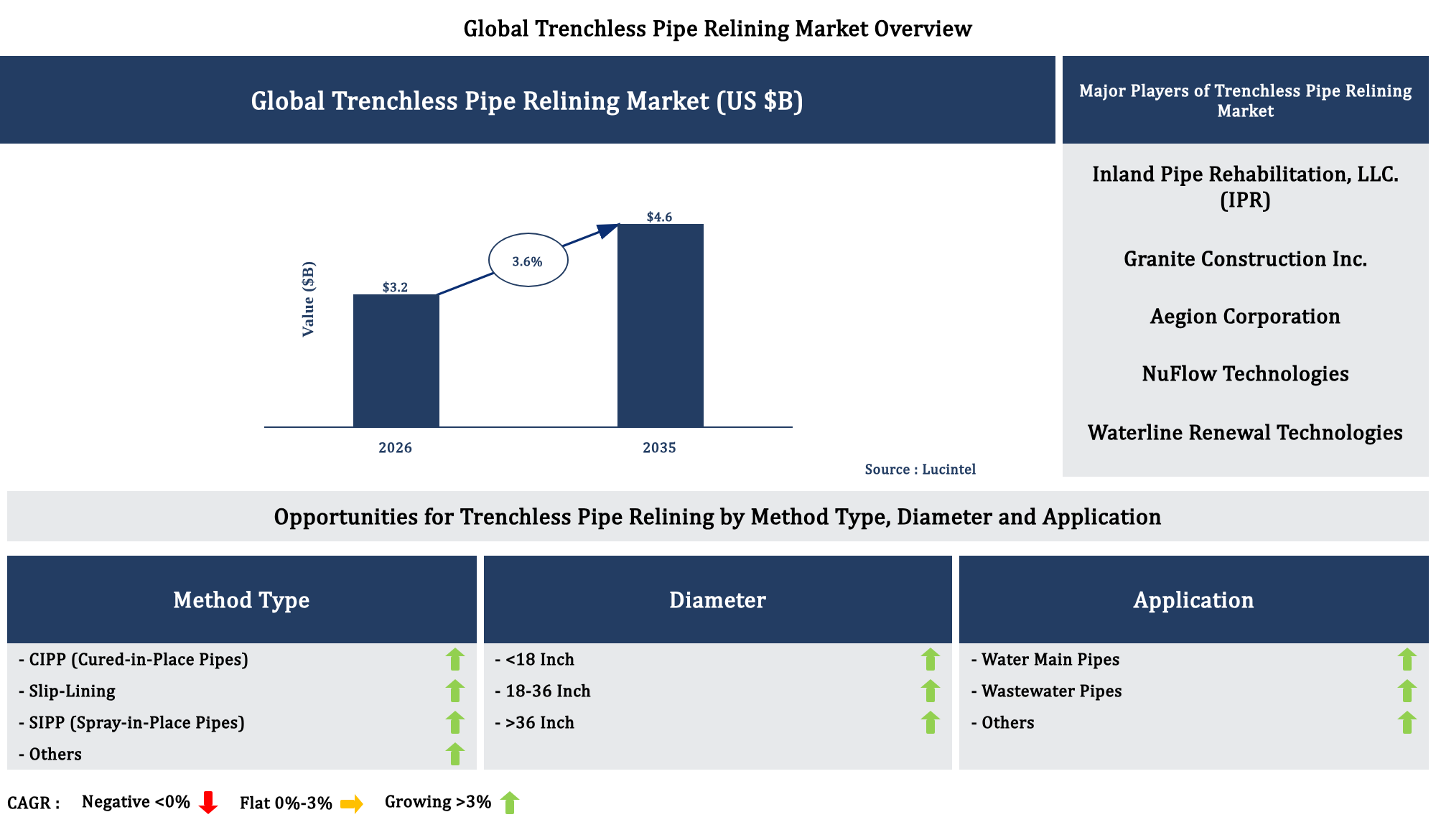
The future of the global trenchless pipe relining market looks promising with opportunities in the water main pipe and wastewater pipe markets. The global trenchless pipe relining market is expected to reach an estimated $4,653 million by 2035 with a CAGR of 3.6% from 2026 to 2035. The major drivers for this market are the growing need to avoid road digging & surface disruption, the increasing demand for faster project completion & reduced downtime, and the rising issues of water leakage & pipeline failures.

• Lucintel forecasts that, within the method type category, CIPP (cured-in-place pipe) is expected to witness the highest growth over the forecast period.
• Within the application category, wastewater pipe is expected to witness higher growth.
• In terms of region, APAC is expected to witness the highest growth over the forecast period.
Gain valuable insights for your business decisions with our comprehensive 150+ page report. Sample figures with some insights are shown below.
Trenchless Pipe Relining Market Trends and Forecast

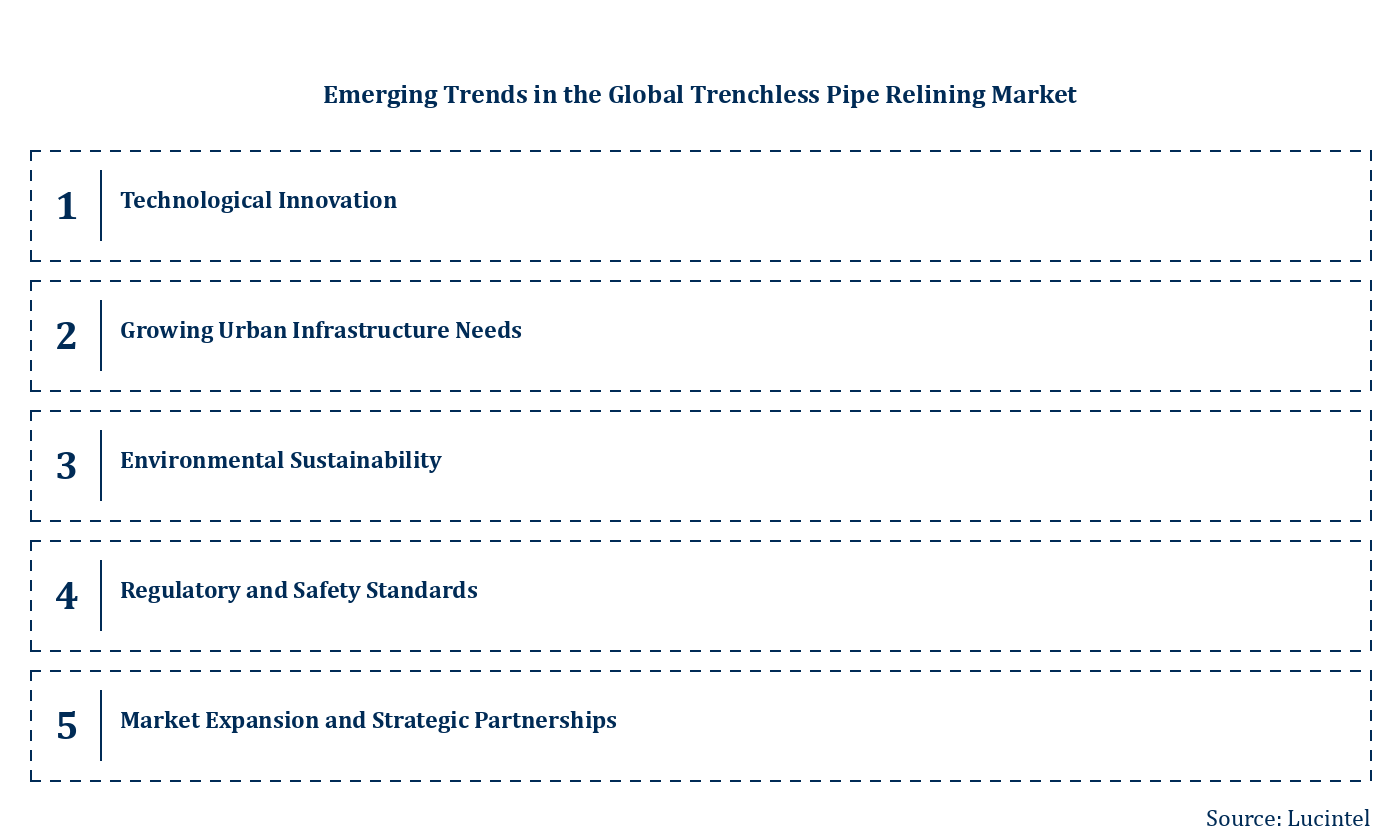
Emerging Trends in the Trenchless Pipe Relining Market

The trenchless pipe relining market is experiencing rapid growth driven by technological advancements, increasing urban infrastructure needs, and a focus on sustainable and cost-effective solutions. As cities expand and aging pipelines require maintenance, innovative methods like trenchless relining are gaining popularity over traditional excavation techniques. This market is also influenced by regulatory pressures for environmentally friendly practices and the rising demand for minimal disruption during repairs. Companies are investing in research and development to improve materials and application techniques, making trenchless relining more accessible and efficient. These developments are transforming the industry landscape, offering smarter, faster, and less invasive pipeline repair options.

• Technological Innovation: The integration of advanced materials and equipment is revolutionizing trenchless relining. Innovations such as flexible liners, epoxy resins, and robotic installation methods enhance durability, ease of installation, and versatility. These technological improvements allow for faster project completion, reduced labor costs, and the ability to repair complex pipeline geometries. As technology continues to evolve, the market will see increased adoption of smarter, more efficient relining solutions, expanding the scope of applications and improving overall service quality.
• Growing Urban Infrastructure Needs: Rapid urbanization is driving demand for efficient pipeline maintenance and replacement. Aging infrastructure in cities worldwide necessitates cost-effective and minimally disruptive repair methods. Trenchless relining offers a solution that reduces traffic congestion, minimizes surface disruption, and shortens project timelines. This trend is particularly prominent in densely populated areas where traditional excavation is impractical. The increasing focus on urban infrastructure resilience is expected to sustain high growth rates in the market, encouraging municipalities and private companies to adopt trenchless technologies.
• Environmental Sustainability: The market is witnessing a shift towards eco-friendly repair solutions. Trenchless relining reduces soil disturbance, minimizes waste, and lowers carbon emissions compared to traditional excavation methods. The use of environmentally safe materials and techniques aligns with global sustainability goals and regulatory standards. This trend is attracting environmentally conscious clients and government agencies, fostering market growth. As sustainability becomes a core consideration, innovations aimed at reducing environmental impact will continue to shape product development and project execution strategies.
• Regulatory and Safety Standards: Stringent regulations and safety standards are influencing market dynamics. Governments and industry bodies are implementing guidelines that favor trenchless methods due to their safety, reduced environmental impact, and efficiency. Compliance with these standards is becoming a key factor for market players, encouraging investment in compliant technologies and training. This regulatory environment not only ensures safer operations but also boosts confidence among clients, leading to increased adoption of trenchless relining solutions across various sectors.
• Market Expansion and Strategic Partnerships: The market is witnessing increased collaborations between equipment manufacturers, service providers, and material suppliers. Strategic partnerships facilitate innovation, improve service offerings, and expand geographic reach. Emerging markets in Asia-Pacific and Latin America present significant growth opportunities, prompting companies to establish local operations and alliances. These collaborations help in customizing solutions to regional needs, enhancing market penetration, and accelerating adoption rates. As the market expands globally, such partnerships will be crucial in driving innovation, reducing costs, and ensuring widespread availability of trenchless relining services.

Technological advancements, urban infrastructure demands, environmental considerations, regulatory frameworks, and strategic collaborations are collectively reshaping the trenchless pipe relining market. These trends are fostering a shift towards more sustainable, efficient, and accessible pipeline repair solutions, ultimately transforming how infrastructure maintenance is approached worldwide.
Emerging Trends in the Trenchless Pipe Relining Market

Recent Developments in the Trenchless Pipe Relining Market

The trenchless pipe relining market has experienced significant advancements driven by technological innovations, increasing urban infrastructure projects, and a focus on sustainable solutions. These developments are transforming traditional pipe repair methods, offering faster, cost-effective, and less disruptive alternatives. As cities grow and infrastructure ages, the demand for efficient pipe rehabilitation techniques continues to rise, prompting industry players to innovate and expand their offerings. The following key developments highlight the current trajectory and future potential of this evolving market.

• Technological Innovations in Pipe Lining: The integration of advanced materials and robotic technologies has revolutionized pipe relining. Innovations such as cured-in-place pipe (CIPP) with enhanced durability and flexibility enable repairs in complex and hard-to-reach areas. These advancements reduce installation time, improve quality, and extend pipe lifespan, making trenchless relining more attractive for municipal and industrial applications. The market benefits from increased efficiency and broader application scope, fostering growth and competitiveness.
• Adoption of Eco-Friendly Materials: Growing environmental concerns have driven the development of sustainable relining materials. Biodegradable resins and low-VOC (volatile organic compound) compounds are now being used, reducing environmental impact. These eco-friendly options appeal to municipalities and contractors committed to green practices, boosting market adoption. The shift towards sustainable materials not only aligns with regulatory standards but also enhances brand reputation, encouraging wider industry acceptance and expanding market opportunities.
• Rising Infrastructure Investment: Governments worldwide are increasing investments in urban infrastructure renewal, including water and sewage systems. This surge in funding accelerates demand for trenchless pipe relining solutions, especially in aging cities with deteriorating pipelines. The focus on minimizing disruption and cost savings makes relining an ideal choice. As infrastructure projects multiply, the market experiences heightened activity, creating new opportunities for service providers and equipment manufacturers to expand their reach and capabilities.
• Expansion of Service Providers and Market Reach: The market has seen a proliferation of specialized service providers offering trenchless relining solutions across various regions. Strategic partnerships, acquisitions, and technological collaborations have expanded service networks, enabling faster project delivery and broader geographic coverage. This competitive landscape fosters innovation, improves customer service, and reduces costs. As providers diversify their offerings, the market becomes more accessible, encouraging adoption in emerging economies and underserved areas.
• Integration of Data and IoT Technologies: The incorporation of data analytics, sensors, and IoT devices into relining processes enhances project monitoring and quality control. Real-time data collection allows for precise assessment of pipe conditions and project progress, reducing errors and increasing efficiency. These technologies facilitate predictive maintenance and asset management, leading to longer-lasting repairs. The market benefits from improved transparency, reduced operational costs, and increased customer confidence, positioning it for sustained growth and technological leadership.

The overall impact of these developments is a more efficient, sustainable, and accessible trenchless pipe relining market. Enhanced technological capabilities, eco-friendly practices, increased infrastructure investments, expanded service networks, and digital integration are collectively driving growth, reducing costs, and improving service quality. These factors are positioning the market for long-term expansion, meeting the evolving needs of urban infrastructure management worldwide.

Strategic Growth Opportunities in the Trenchless Pipe Relining Market

The trenchless pipe relining market is experiencing rapid growth driven by increasing urban infrastructure projects, the need for cost-effective and minimally invasive repair solutions, and rising environmental concerns. Technological advancements and regulatory support further propel market expansion. Key applications across residential, commercial, and municipal sectors present significant opportunities for industry players to innovate and capture market share. Strategic investments and partnerships are essential to capitalize on these emerging trends and meet the growing demand for efficient pipeline rehabilitation solutions.

• Growing Demand for Minimally Invasive Pipeline Repair Solutions: The increasing need to reduce disruption and excavation costs in urban infrastructure projects is driving the adoption of trenchless pipe relining. This method offers a less invasive alternative to traditional pipe replacement, minimizing surface disruption, reducing project timelines, and lowering overall costs. As urban areas expand and aging infrastructure deteriorates, the demand for efficient, eco-friendly repair techniques continues to rise, creating substantial growth opportunities for market players.
• Technological Innovations Enhancing Relining Techniques: Advances in materials, such as epoxy resins and flexible liners, along with improved installation methods, are expanding the capabilities of trenchless relining. Innovations like robotic installation and real-time monitoring systems improve precision, safety, and efficiency. These technological developments enable the relining of more complex pipe networks, including those with challenging diameters or access points, thereby broadening application scope and market potential.
• Increasing Government Initiatives and Regulatory Support: Governments worldwide are implementing policies and standards promoting infrastructure maintenance and environmental sustainability. Funding programs and regulations favor trenchless technologies due to their reduced environmental impact and cost savings. Such supportive policies incentivize municipalities and private entities to adopt relining solutions, fostering market growth. Compliance with safety and environmental standards further encourages industry adoption, opening avenues for market expansion and innovation.
• Rising Demand Across Residential, Commercial, and Municipal Sectors: The need for pipeline rehabilitation spans multiple sectors, including residential buildings, commercial complexes, and municipal water and sewer systems. Aging infrastructure and increasing urbanization drive the demand for reliable, durable, and cost-effective relining solutions. The versatility of trenchless pipe relining in various applications ensures sustained growth opportunities, with market players focusing on sector-specific innovations and customized solutions to meet diverse client needs.
• Strategic Collaborations and Expanding Service Networks: Partnerships between equipment manufacturers, service providers, and technology developers are crucial for advancing relining solutions. Expanding service networks and establishing regional hubs improve accessibility and reduce project lead times. These collaborations facilitate knowledge sharing, innovation, and market penetration, especially in emerging regions. Strengthening distribution channels and after-sales support enhances customer confidence, enabling companies to capitalize on the growing demand and secure a competitive edge in the market.

The overall impact of these opportunities is a robust expansion of the trenchless pipe relining market, driven by technological, regulatory, and sector-specific factors. Industry players that leverage these growth avenues through innovation, strategic partnerships, and targeted investments will be well-positioned to meet rising demand and sustain long-term growth in this evolving landscape.

Trenchless Pipe Relining Market Driver and Challenges

The trenchless pipe relining market is influenced by a variety of technological, economic, and regulatory factors that shape its growth and development. Advances in technology have enabled more efficient and less invasive pipe repair methods, while economic factors such as urbanization and infrastructure investments drive demand. Regulatory standards and environmental considerations also play a crucial role in shaping industry practices and adoption rates. Additionally, challenges related to skilled labor shortages and high initial costs impact market expansion. Understanding these drivers and challenges is essential for stakeholders to navigate the evolving landscape and capitalize on emerging opportunities within this sector.

The factors responsible for driving the trenchless pipe relining market include:-
• Technological Innovation: The development of advanced relining materials and techniques, such as cured-in-place pipe (CIPP) and spray lining, has revolutionized pipe repair. These innovations reduce the need for excavation, minimize disruption, and improve repair durability. As technology continues to evolve, the market benefits from increased efficiency, safety, and cost-effectiveness, encouraging adoption across municipal, industrial, and residential sectors. The ability to quickly and reliably restore pipelines with minimal surface disruption is a significant driver, especially in densely populated urban areas where traditional methods are impractical.
• Urbanization and Infrastructure Development: Rapid urban growth worldwide necessitates extensive pipeline maintenance and upgrades. Aging infrastructure, coupled with increasing demand for reliable water, sewage, and gas services, propels the need for trenchless solutions. Governments and private entities are investing heavily in infrastructure projects, favoring trenchless methods for their cost savings and reduced environmental impact. This trend ensures a steady demand for relining services, especially in congested city environments where traditional excavation is challenging and disruptive.
• Environmental Regulations and Sustainability: Stricter environmental standards are encouraging the adoption of eco-friendly pipe repair solutions. Trenchless relining methods produce less waste, reduce soil disturbance, and lower carbon emissions compared to traditional excavation. These environmentally conscious practices align with global sustainability goals, prompting municipalities and companies to prefer trenchless options. The market benefits from increased regulatory support and incentives for sustainable infrastructure maintenance, fostering growth in regions with stringent environmental policies.
• Cost Efficiency and Time Savings: Trenchless pipe relining offers significant cost and time advantages over conventional excavation methods. Reduced labor, equipment, and surface restoration costs, combined with faster project completion times, make it an attractive option for clients. This economic benefit drives widespread adoption among utility companies and contractors seeking to optimize budgets and minimize service disruptions. As project timelines become more critical, the market experiences increased demand for quick, reliable relining solutions that deliver long-term savings.
• Growing Adoption in Residential and Commercial Sectors: The increasing need for reliable plumbing and sewer systems in residential and commercial buildings fuels market growth. Property owners and facility managers prefer trenchless relining for its minimal disruption and longevity. The rise in renovation and maintenance activities, coupled with awareness of trenchless benefits, expands the customer base. This trend is particularly prominent in urban areas where space constraints and the desire to avoid surface damage make trenchless methods the preferred choice.

The challenges facing this Market include:-
• Skilled Labor Shortage: The specialized nature of trenchless pipe relining requires trained technicians with expertise in advanced materials and techniques. A shortage of skilled labor hampers the industry’s ability to meet growing demand, leading to project delays and increased costs. Training programs and technological advancements are needed to bridge this gap, but the current shortage remains a significant obstacle to market expansion, especially in emerging regions where workforce development is limited.
• High Initial Investment Costs: Despite long-term savings, the upfront costs of trenchless relining equipment and materials can be substantial. Small and medium-sized service providers may find it difficult to justify or afford these investments, limiting market accessibility. This financial barrier can slow adoption, particularly in regions with budget constraints or where traditional methods are still preferred due to familiarity and lower initial costs.
• Regulatory and Permitting Challenges: Navigating complex regulatory frameworks and obtaining necessary permits can delay project execution. Variations in standards across regions and lengthy approval processes pose hurdles for market players. Compliance costs and bureaucratic procedures may discourage smaller firms from entering the market or undertaking certain projects, thereby constraining overall growth and innovation within the industry.

The trenchless pipe relining market is driven by technological advancements, urbanization, environmental considerations, cost efficiencies, and expanding applications across sectors. However, challenges such as skilled labor shortages, high initial costs, and regulatory complexities pose significant hurdles. These factors collectively influence the market’s trajectory, requiring stakeholders to innovate, adapt, and collaborate to sustain growth and overcome obstacles. The overall impact is a dynamic industry poised for continued expansion, provided these challenges are effectively managed.

List of Trenchless Pipe Relining Companies

Companies in the market compete on the basis of product quality offered. Major players in this market focus on expanding their manufacturing facilities, R&D investments, infrastructural development, and leverage integration opportunities across the value chain. With these strategies trenchless pipe relining companies cater increasing demand, ensure competitive effectiveness, develop innovative products & technologies, reduce production costs, and expand their customer base. Some of the trenchless pipe relining companies profiled in this report include-
• Inland Pipe Rehabilitation, LLC. (IPR)
• Granite Construction Inc.
• Aegion Corporation
• NuFlow Technologies
• Waterline Renewal Technologies
• Per Aarsleff
• SAK Construction, LLC

Trenchless Pipe Relining Market by Segment

The study includes a forecast for the global trenchless pipe relining market by method type, diameter, application, and region.

Trenchless Pipe Relining Market by Method Type [Value from 2019 to 2035]:


• CIPP (Cured-in-Place Pipes)
• Slip-Lining
• SIPP (Spray-in-Place Pipes)
• Others

Trenchless Pipe Relining Market by Diameter [Value from 2019 to 2035]:


• <18 Inch
• 18-36 Inch
• >36 Inch

Trenchless Pipe Relining Market by Application [Value from 2019 to 2035]:


• Water Main Pipes
• Wastewater Pipes
• Others

Trenchless Pipe Relining Market by Region [Value from 2019 to 2035]:


• North America
• Europe
• Asia Pacific
• The Rest of the World

Country Wise Outlook for the Trenchless Pipe Relining Market

The trenchless pipe relining market has experienced significant growth driven by increasing urban infrastructure projects, environmental concerns, and technological advancements. Countries are adopting innovative solutions to reduce construction time, minimize disruption, and improve pipeline longevity. Regulatory frameworks and investment in smart city initiatives further propel market expansion. Each country’s unique infrastructure needs and technological adoption rates influence their market dynamics, leading to diverse development patterns across regions.

• United States: The US market has seen rapid adoption of trenchless relining technologies, driven by aging infrastructure and government funding initiatives. Innovations in epoxy resins and robotic installation methods have improved efficiency and durability. Urban areas are increasingly replacing traditional pipe replacement with relining solutions to reduce costs and minimize traffic disruptions. Regulatory support and public-private partnerships are fostering market growth, with a focus on sustainable and environmentally friendly practices.
• China: China’s market is expanding due to rapid urbanization and infrastructure development. The government’s emphasis on smart city projects and modernization of water and sewage systems has accelerated adoption. Advanced relining techniques, including cured-in-place pipe (CIPP) and spray lining, are widely used. Domestic manufacturers are investing heavily in R&D to develop cost-effective and efficient solutions, making China a key player in the global market.
• Germany: Germany’s market is characterized by high standards for quality and environmental sustainability. The focus is on upgrading existing pipelines with minimal excavation, utilizing innovative relining materials and techniques. Strict regulations and a mature infrastructure sector drive demand for durable and eco-friendly solutions. The adoption of digital technologies for inspection and monitoring enhances the efficiency of relining projects, supporting market growth.
• India: India’s market is witnessing rapid growth due to expanding urban populations and aging infrastructure. The government’s initiatives for urban renewal and sanitation projects are boosting demand for trenchless relining. Cost-effective and locally manufactured solutions are preferred, with a focus on improving water supply and sewage systems. Increasing awareness of the benefits of trenchless technology is encouraging adoption across municipal and private sectors.
• Japan: Japan’s market is driven by the need to upgrade aging infrastructure and implement disaster-resistant solutions. Advanced materials and robotic technologies are used to ensure high-quality, long-lasting relining. The country’s focus on smart infrastructure and disaster preparedness influences market trends. Government policies promote sustainable practices, and technological innovation continues to enhance the efficiency and reliability of relining methods.
Lucintel Analytics Dashboard

Features of the Global Trenchless Pipe Relining Market

Market Size Estimates: Trenchless pipe relining market size estimation in terms of value ($M).
Trend and Forecast Analysis: Market trends (2019 to 2025) and forecast (2026 to 2035) by various segments and regions.
Segmentation Analysis: Trenchless pipe relining market size by method type, diameter, application, and region in terms of value ($M).
Regional Analysis: Trenchless pipe relining market breakdown by North America, Europe, Asia Pacific, and Rest of the World.
Growth Opportunities: Analysis of growth opportunities in different method type, diameter, application, and regions for the trenchless pipe relining market.
Strategic Analysis: This includes M&A, new product development, and competitive landscape of the trenchless pipe relining market.
Analysis of competitive intensity of the industry based on Porter’s Five Forces model.

Lucintel Consulting Services

FAQ

Q1. What is the trenchless pipe relining market size?
Answer: The global trenchless pipe relining market is expected to reach an estimated $4,653 million by 2035.
Q2. What is the growth forecast for trenchless pipe relining market?
Answer: The global trenchless pipe relining market is expected to grow with a CAGR of 3.6% from 2026 to 2035.
Q3. What are the major drivers influencing the growth of the trenchless pipe relining market?
Answer: The major drivers for this market are the growing need to avoid road digging & surface disruption, the increasing demand for faster project completion & reduced downtime, and the rising issues of water leakage & pipeline failures.
Q4. What are the major segments for trenchless pipe relining market?
Answer: The future of the trenchless pipe relining market looks promising with opportunities in the water main pipe and wastewater pipe markets.
Q5. Who are the key trenchless pipe relining market companies?
Answer: Some of the key trenchless pipe relining companies are as follows:
• Inland Pipe Rehabilitation, LLC. (IPR)
• Granite Construction Inc.
• Aegion Corporation
• NuFlow Technologies
• Waterline Renewal Technologies
• Per Aarsleff
• SAK Construction, LLC
Q6. Which trenchless pipe relining market segment will be the largest in future?
Answer: Lucintel forecasts that, within the method type category, CIPP (cured-in-place pipe) is expected to witness the highest growth over the forecast period.
Q7. In trenchless pipe relining market, which region is expected to be the largest in next 8 years?
Answer: In terms of region, APAC is expected to witness the highest growth over the forecast period.
Q8. Do we receive customization in this report?
Answer: Yes, Lucintel provides 10% customization without any additional cost.

This report answers following 11 key questions:

Q.1. What are some of the most promising, high-growth opportunities for the trenchless pipe relining market by method type (CIPP (cured-in-place pipes), slip-lining, SIPP (spray-in-place pipes), and others), diameter (<18 inch, 18-36 inch, and >36 inch), application (water main pipes, wastewater pipes, and others), and region (North America, Europe, Asia Pacific, and the Rest of the World)?
Q.2. Which segments will grow at a faster pace and why?
Q.3. Which region will grow at a faster pace and why?
Q.4. What are the key factors affecting market dynamics? What are the key challenges and business risks in this market?
Q.5. What are the business risks and competitive threats in this market?
Q.6. What are the emerging trends in this market and the reasons behind them?
Q.7. What are some of the changing demands of customers in the market?
Q.8. What are the new developments in the market? Which companies are leading these developments?
Q.9. Who are the major players in this market? What strategic initiatives are key players pursuing for business growth?
Q.10. What are some of the competing products in this market and how big of a threat do they pose for loss of market share by material or product substitution?
Q.11. What M&A activity has occurred in the last 5 years and what has its impact been on the industry?

For any questions related to Trenchless Pipe Relining Market, Trenchless Pipe Relining Market Size, Trenchless Pipe Relining Market Growth, Trenchless Pipe Relining Market Analysis, Trenchless Pipe Relining Market Report, Trenchless Pipe Relining Market Share, Trenchless Pipe Relining Market Trends, Trenchless Pipe Relining Market Forecast, Trenchless Pipe Relining Companies, write Lucintel analyst at email: helpdesk@lucintel.com. We will be glad to get back to you soon.
                                           Table of Contents

            1. Executive Summary

            2. Market Overview

                        2.1 Background and Classifications
                        2.2 Supply Chain

            3. Market Trends & Forecast Analysis

                        3.1 Macroeconomic Trends and Forecasts
                        3.2 Industry Drivers and Challenges
                        3.3 PESTLE Analysis
                        3.4 Patent Analysis
                        3.5 Regulatory Environment
                        3.6 Global Trenchless Pipe Relining Market Trends and Forecast

            4. Global Trenchless Pipe Relining Market by Method Type

                        4.1 Overview
                        4.2 Attractiveness Analysis by Method Type
                        4.3 CIPP (Cured-in-Place Pipes) : Trends and Forecast (2019 to 2035)
                        4.4 Slip-Lining : Trends and Forecast (2019 to 2035)
                        4.5 SIPP (Spray-in-Place Pipes) : Trends and Forecast (2019 to 2035)
                        4.6 Others : Trends and Forecast (2019 to 2035)

            5. Global Trenchless Pipe Relining Market by Diameter

                        5.1 Overview
                        5.2 Attractiveness Analysis by Diameter
                        5.3 <18 Inch : Trends and Forecast (2019 to 2035)
                        5.4 18-36 Inch : Trends and Forecast (2019 to 2035)
                        5.5 >36 Inch : Trends and Forecast (2019 to 2035)

            6. Global Trenchless Pipe Relining Market by Application

                        6.1 Overview
                        6.2 Attractiveness Analysis by Application
                        6.3 Water Main Pipes : Trends and Forecast (2019 to 2035)
                        6.4 Wastewater Pipes : Trends and Forecast (2019 to 2035)
                        6.5 Others : Trends and Forecast (2019 to 2035)

            7. Regional Analysis

                        7.1 Overview
                        7.2 Global Trenchless Pipe Relining Market by Region

            8. North American Trenchless Pipe Relining Market

                        8.1 Overview
                        8.2 North American Trenchless Pipe Relining Market by Method Type
                        8.3 North American Trenchless Pipe Relining Market by Application
                        8.4 The United States Trenchless Pipe Relining Market
                        8.5 Canadian Trenchless Pipe Relining Market
                        8.6 Mexican Trenchless Pipe Relining Market

            9. European Trenchless Pipe Relining Market

                        9.1 Overview
                        9.2 European Trenchless Pipe Relining Market by Method Type
                        9.3 European Trenchless Pipe Relining Market by Application
                        9.4 German Trenchless Pipe Relining Market
                        9.5 French Trenchless Pipe Relining Market
                        9.6 Italian Trenchless Pipe Relining Market
                        9.7 Spanish Trenchless Pipe Relining Market
                        9.8 The United Kingdom Trenchless Pipe Relining Market

            10. APAC Trenchless Pipe Relining Market

                        10.1 Overview
                        10.2 APAC Trenchless Pipe Relining Market by Method Type
                        10.3 APAC Trenchless Pipe Relining Market by Application
                        10.4 Chinese Trenchless Pipe Relining Market
                        10.5 Indian Trenchless Pipe Relining Market
                        10.6 Japanese Trenchless Pipe Relining Market
                        10.7 South Korean Trenchless Pipe Relining Market
                        10.8 Indonesian Trenchless Pipe Relining Market

            11. ROW Trenchless Pipe Relining Market

                        11.1 Overview
                        11.2 ROW Trenchless Pipe Relining Market by Method Type
                        11.3 ROW Trenchless Pipe Relining Market by Application
                        11.4 Middle Eastern Trenchless Pipe Relining Market
                        11.5 South American Trenchless Pipe Relining Market
                        11.6 African Trenchless Pipe Relining Market

            12. Competitor Analysis

                        12.1 Product Portfolio Analysis
                        12.2 Operational Integration
                        12.3 Porter’s Five Forces Analysis
                                    • Competitive Rivalry
                                    • Bargaining Power of Buyers
                                    • Bargaining Power of Suppliers
                                    • Threat of Substitutes
                                    • Threat of New Entrants
                        12.4 Market Share Analysis

            13. Opportunities & Strategic Analysis

                        13.1 Value Chain Analysis
                        13.2 Growth Opportunity Analysis
                                    13.2.1 Growth Opportunity by Method Type
                                    13.2.2 Growth Opportunity by Diameter
                                    13.2.3 Growth Opportunity by Application
                                    13.2.4 Growth Opportunity by Region
                        13.3 Emerging Trends in the Global Trenchless Pipe Relining Market
                        13.4 Strategic Analysis
                                    13.4.1 New Product Development
                                    13.4.2 Certification and Licensing
                                    13.4.3 Mergers, Acquisitions, Agreements, Collaborations, and Joint Ventures

            14. Company Profiles of the Leading Players Across the Value Chain

                        14.1 Competitive Analysis Overview
                        14.2 Inland Pipe Rehabilitation, LLC. (IPR)
                                    • Company Overview
                                    • Trenchless Pipe Relining Market Business Overview
                                    • New Product Development
                                    • Merger, Acquisition, and Collaboration
                                    • Certification and Licensing
                        14.3 Granite Construction Inc.
                                    • Company Overview
                                    • Trenchless Pipe Relining Market Business Overview
                                    • New Product Development
                                    • Merger, Acquisition, and Collaboration
                                    • Certification and Licensing
                        14.4 Aegion Corporation
                                    • Company Overview
                                    • Trenchless Pipe Relining Market Business Overview
                                    • New Product Development
                                    • Merger, Acquisition, and Collaboration
                                    • Certification and Licensing
                        14.5 NuFlow Technologies
                                    • Company Overview
                                    • Trenchless Pipe Relining Market Business Overview
                                    • New Product Development
                                    • Merger, Acquisition, and Collaboration
                                    • Certification and Licensing
                        14.6 Waterline Renewal Technologies
                                    • Company Overview
                                    • Trenchless Pipe Relining Market Business Overview
                                    • New Product Development
                                    • Merger, Acquisition, and Collaboration
                                    • Certification and Licensing
                        14.7 Per Aarsleff
                                    • Company Overview
                                    • Trenchless Pipe Relining Market Business Overview
                                    • New Product Development
                                    • Merger, Acquisition, and Collaboration
                                    • Certification and Licensing
                        14.8 SAK Construction, LLC
                                    • Company Overview
                                    • Trenchless Pipe Relining Market Business Overview
                                    • New Product Development
                                    • Merger, Acquisition, and Collaboration
                                    • Certification and Licensing

            15. Appendix

                        15.1 List of Figures
                        15.2 List of Tables
                        15.3 Research Methodology
                        15.4 Disclaimer
                        15.5 Copyright
                        15.6 Abbreviations and Technical Units
                        15.7 About Us
                        15.8 Contact Us

                                               List of Figures


            Chapter 1

                        Figure 1.1: Trends and Forecast for the Global Trenchless Pipe Relining Market

            Chapter 2

                        Figure 2.1: Usage of Trenchless Pipe Relining Market
                        Figure 2.2: Classification of the Global Trenchless Pipe Relining Market
                        Figure 2.3: Supply Chain of the Global Trenchless Pipe Relining Market

            Chapter 3

                        Figure 3.1: Trends of the Global GDP Growth Rate
                        Figure 3.2: Trends of the Global Population Growth Rate
                        Figure 3.3: Trends of the Global Inflation Rate
                        Figure 3.4: Trends of the Global Unemployment Rate
                        Figure 3.5: Trends of the Regional GDP Growth Rate
                        Figure 3.6: Trends of the Regional Population Growth Rate
                        Figure 3.7: Trends of the Regional Inflation Rate
                        Figure 3.8: Trends of the Regional Unemployment Rate
                        Figure 3.9: Trends of Regional Per Capita Income
                        Figure 3.10: Forecast for the Global GDP Growth Rate
                        Figure 3.11: Forecast for the Global Population Growth Rate
                        Figure 3.12: Forecast for the Global Inflation Rate
                        Figure 3.13: Forecast for the Global Unemployment Rate
                        Figure 3.14: Forecast for the Regional GDP Growth Rate
                        Figure 3.15: Forecast for the Regional Population Growth Rate
                        Figure 3.16: Forecast for the Regional Inflation Rate
                        Figure 3.17: Forecast for the Regional Unemployment Rate
                        Figure 3.18: Forecast for Regional Per Capita Income
                        Figure 3.19: Driver and Challenges of the Trenchless Pipe Relining Market

            Chapter 4

                        Figure 4.1: Global Trenchless Pipe Relining Market by Method Type in 2019, 2025, and 2035
                        Figure 4.2: Trends of the Global Trenchless Pipe Relining Market ($M) by Method Type
                        Figure 4.3: Forecast for the Global Trenchless Pipe Relining Market ($M) by Method Type
                        Figure 4.4: Trends and Forecast for CIPP (Cured-in-Place Pipes) in the Global Trenchless Pipe Relining Market (2019-2035)
                        Figure 4.5: Trends and Forecast for Slip-Lining in the Global Trenchless Pipe Relining Market (2019-2035)
                        Figure 4.6: Trends and Forecast for SIPP (Spray-in-Place Pipes) in the Global Trenchless Pipe Relining Market (2019-2035)
                        Figure 4.7: Trends and Forecast for Others in the Global Trenchless Pipe Relining Market (2019-2035)

            Chapter 5

                        Figure 5.1: Global Trenchless Pipe Relining Market by Diameter in 2019, 2025, and 2035
                        Figure 5.2: Trends of the Global Trenchless Pipe Relining Market ($M) by Diameter
                        Figure 5.3: Forecast for the Global Trenchless Pipe Relining Market ($M) by Diameter
                        Figure 5.4: Trends and Forecast for <18 Inch in the Global Trenchless Pipe Relining Market (2019-2035)
                        Figure 5.5: Trends and Forecast for 18-36 Inch in the Global Trenchless Pipe Relining Market (2019-2035)
                        Figure 5.6: Trends and Forecast for >36 Inch in the Global Trenchless Pipe Relining Market (2019-2035)

            Chapter 6

                        Figure 6.1: Global Trenchless Pipe Relining Market by Application in 2019, 2025, and 2035
                        Figure 6.2: Trends of the Global Trenchless Pipe Relining Market ($M) by Application
                        Figure 6.3: Forecast for the Global Trenchless Pipe Relining Market ($M) by Application
                        Figure 6.4: Trends and Forecast for Water Main Pipes in the Global Trenchless Pipe Relining Market (2019-2035)
                        Figure 6.5: Trends and Forecast for Wastewater Pipes in the Global Trenchless Pipe Relining Market (2019-2035)
                        Figure 6.6: Trends and Forecast for Others in the Global Trenchless Pipe Relining Market (2019-2035)

            Chapter 7

                        Figure 7.1: Trends of the Global Trenchless Pipe Relining Market ($M) by Region (2019-2025)
                        Figure 7.2: Forecast for the Global Trenchless Pipe Relining Market ($M) by Region (2026-2035)

            Chapter 8

                        Figure 8.1: Trends and Forecast for the North American Trenchless Pipe Relining Market (2019-2035)
                        Figure 8.2: North American Trenchless Pipe Relining Market by Method Type in 2019, 2025, and 2035
                        Figure 8.3: Trends of the North American Trenchless Pipe Relining Market ($M) by Method Type (2019-2025)
                        Figure 8.4: Forecast for the North American Trenchless Pipe Relining Market ($M) by Method Type (2026-2035)
                        Figure 8.5: North American Trenchless Pipe Relining Market by Diameter in 2019, 2025, and 2035
                        Figure 8.6: Trends of the North American Trenchless Pipe Relining Market ($M) by Diameter (2019-2025)
                        Figure 8.7: Forecast for the North American Trenchless Pipe Relining Market ($M) by Diameter (2026-2035)
                        Figure 8.8: Trends and Forecast for the United States Trenchless Pipe Relining Market ($M) (2019-2035)
                        Figure 8.9: Trends and Forecast for the Mexican Trenchless Pipe Relining Market ($M) (2019-2035)
                        Figure 8.10: Trends and Forecast for the Canadian Trenchless Pipe Relining Market ($M) (2019-2035)

            Chapter 9

                        Figure 9.1: Trends and Forecast for the European Trenchless Pipe Relining Market (2019-2035)
                        Figure 9.2: European Trenchless Pipe Relining Market by Method Type in 2019, 2025, and 2035
                        Figure 9.3: Trends of the European Trenchless Pipe Relining Market ($M) by Method Type (2019-2025)
                        Figure 9.4: Forecast for the European Trenchless Pipe Relining Market ($M) by Method Type (2026-2035)
                        Figure 9.5: European Trenchless Pipe Relining Market by Diameter in 2019, 2025, and 2035
                        Figure 9.6: Trends of the European Trenchless Pipe Relining Market ($M) by Diameter (2019-2025)
                        Figure 9.7: Forecast for the European Trenchless Pipe Relining Market ($M) by Diameter (2026-2035)
                        Figure 9.8: Trends and Forecast for the German Trenchless Pipe Relining Market ($M) (2019-2035)
                        Figure 9.9: Trends and Forecast for the French Trenchless Pipe Relining Market ($M) (2019-2035)
                        Figure 9.10: Trends and Forecast for the Spanish Trenchless Pipe Relining Market ($M) (2019-2035)
                        Figure 9.11: Trends and Forecast for the Italian Trenchless Pipe Relining Market ($M) (2019-2035)
                        Figure 9.12: Trends and Forecast for the United Kingdom Trenchless Pipe Relining Market ($M) (2019-2035)

            Chapter 10

                        Figure 10.1: Trends and Forecast for the APAC Trenchless Pipe Relining Market (2019-2035)
                        Figure 10.2: APAC Trenchless Pipe Relining Market by Method Type in 2019, 2025, and 2035
                        Figure 10.3: Trends of the APAC Trenchless Pipe Relining Market ($M) by Method Type (2019-2025)
                        Figure 10.4: Forecast for the APAC Trenchless Pipe Relining Market ($M) by Method Type (2026-2035)
                        Figure 10.5: APAC Trenchless Pipe Relining Market by Diameter in 2019, 2025, and 2035
                        Figure 10.6: Trends of the APAC Trenchless Pipe Relining Market ($M) by Diameter (2019-2025)
                        Figure 10.7: Forecast for the APAC Trenchless Pipe Relining Market ($M) by Diameter (2026-2035)
                        Figure 10.8: Trends and Forecast for the Japanese Trenchless Pipe Relining Market ($M) (2019-2035)
                        Figure 10.9: Trends and Forecast for the Indian Trenchless Pipe Relining Market ($M) (2019-2035)
                        Figure 10.10: Trends and Forecast for the Chinese Trenchless Pipe Relining Market ($M) (2019-2035)
                        Figure 10.11: Trends and Forecast for the South Korean Trenchless Pipe Relining Market ($M) (2019-2035)
                        Figure 10.12: Trends and Forecast for the Indonesian Trenchless Pipe Relining Market ($M) (2019-2035)

            Chapter 11

                        Figure 11.1: Trends and Forecast for the ROW Trenchless Pipe Relining Market (2019-2035)
                        Figure 11.2: ROW Trenchless Pipe Relining Market by Method Type in 2019, 2025, and 2035
                        Figure 11.3: Trends of the ROW Trenchless Pipe Relining Market ($M) by Method Type (2019-2025)
                        Figure 11.4: Forecast for the ROW Trenchless Pipe Relining Market ($M) by Method Type (2026-2035)
                        Figure 11.5: ROW Trenchless Pipe Relining Market by Diameter in 2019, 2025, and 2035
                        Figure 11.6: Trends of the ROW Trenchless Pipe Relining Market ($M) by Diameter (2019-2025)
                        Figure 11.7: Forecast for the ROW Trenchless Pipe Relining Market ($M) by Diameter (2026-2035)
                        Figure 11.8: Trends and Forecast for the Middle Eastern Trenchless Pipe Relining Market ($M) (2019-2035)
                        Figure 11.9: Trends and Forecast for the South American Trenchless Pipe Relining Market ($M) (2019-2035)
                        Figure 11.10: Trends and Forecast for the African Trenchless Pipe Relining Market ($M) (2019-2035)

            Chapter 12

                        Figure 12.1: Porter’s Five Forces Analysis of the Global Trenchless Pipe Relining Market
                        Figure 12.2: Market Share (%) of Top Players in the Global Trenchless Pipe Relining Market (2025)

            Chapter 13

                        Figure 13.1: Growth Opportunities for the Global Trenchless Pipe Relining Market by Method Type
                        Figure 13.2: Growth Opportunities for the Global Trenchless Pipe Relining Market by Diameter
                        Figure 13.3: Growth Opportunities for the Global Trenchless Pipe Relining Market by Application
                        Figure 13.4: Growth Opportunities for the Global Trenchless Pipe Relining Market by Region
                        Figure 13.5: Emerging Trends in the Global Trenchless Pipe Relining Market

                                               List of Tables


            Chapter 1

                        Table 1.1: Growth Rate (%, 2024-2025) and CAGR (%, 2026-2035) of the Trenchless Pipe Relining Market by Method Type, Diameter, and Application
                        Table 1.2: Attractiveness Analysis for the Trenchless Pipe Relining Market by Region
                        Table 1.3: Global Trenchless Pipe Relining Market Parameters and Attributes

            Chapter 3

                        Table 3.1: Trends of the Global Trenchless Pipe Relining Market (2019-2025)
                        Table 3.2: Forecast for the Global Trenchless Pipe Relining Market (2026-2035)

            Chapter 4

                        Table 4.1: Attractiveness Analysis for the Global Trenchless Pipe Relining Market by Method Type
                        Table 4.2: Market Size and CAGR of Various Method Type in the Global Trenchless Pipe Relining Market (2019-2025)
                        Table 4.3: Market Size and CAGR of Various Method Type in the Global Trenchless Pipe Relining Market (2026-2035)
                        Table 4.4: Trends of CIPP (Cured-in-Place Pipes) in the Global Trenchless Pipe Relining Market (2019-2025)
                        Table 4.5: Forecast for CIPP (Cured-in-Place Pipes) in the Global Trenchless Pipe Relining Market (2026-2035)
                        Table 4.6: Trends of Slip-Lining in the Global Trenchless Pipe Relining Market (2019-2025)
                        Table 4.7: Forecast for Slip-Lining in the Global Trenchless Pipe Relining Market (2026-2035)
                        Table 4.8: Trends of SIPP (Spray-in-Place Pipes) in the Global Trenchless Pipe Relining Market (2019-2025)
                        Table 4.9: Forecast for SIPP (Spray-in-Place Pipes) in the Global Trenchless Pipe Relining Market (2026-2035)
                        Table 4.10: Trends of Others in the Global Trenchless Pipe Relining Market (2019-2025)
                        Table 4.11: Forecast for Others in the Global Trenchless Pipe Relining Market (2026-2035)

            Chapter 5

                        Table 5.1: Attractiveness Analysis for the Global Trenchless Pipe Relining Market by Diameter
                        Table 5.2: Market Size and CAGR of Various Diameter in the Global Trenchless Pipe Relining Market (2019-2025)
                        Table 5.3: Market Size and CAGR of Various Diameter in the Global Trenchless Pipe Relining Market (2026-2035)
                        Table 5.4: Trends of <18 Inch in the Global Trenchless Pipe Relining Market (2019-2025)
                        Table 5.5: Forecast for <18 Inch in the Global Trenchless Pipe Relining Market (2026-2035)
                        Table 5.6: Trends of 18-36 Inch in the Global Trenchless Pipe Relining Market (2019-2025)
                        Table 5.7: Forecast for 18-36 Inch in the Global Trenchless Pipe Relining Market (2026-2035)
                        Table 5.8: Trends of >36 Inch in the Global Trenchless Pipe Relining Market (2019-2025)
                        Table 5.9: Forecast for >36 Inch in the Global Trenchless Pipe Relining Market (2026-2035)

            Chapter 6

                        Table 6.1: Attractiveness Analysis for the Global Trenchless Pipe Relining Market by Application
                        Table 6.2: Market Size and CAGR of Various Application in the Global Trenchless Pipe Relining Market (2019-2025)
                        Table 6.3: Market Size and CAGR of Various Application in the Global Trenchless Pipe Relining Market (2026-2035)
                        Table 6.4: Trends of Water Main Pipes in the Global Trenchless Pipe Relining Market (2019-2025)
                        Table 6.5: Forecast for Water Main Pipes in the Global Trenchless Pipe Relining Market (2026-2035)
                        Table 6.6: Trends of Wastewater Pipes in the Global Trenchless Pipe Relining Market (2019-2025)
                        Table 6.7: Forecast for Wastewater Pipes in the Global Trenchless Pipe Relining Market (2026-2035)
                        Table 6.8: Trends of Others in the Global Trenchless Pipe Relining Market (2019-2025)
                        Table 6.9: Forecast for Others in the Global Trenchless Pipe Relining Market (2026-2035)

            Chapter 7

                        Table 7.1: Market Size and CAGR of Various Regions in the Global Trenchless Pipe Relining Market (2019-2025)
                        Table 7.2: Market Size and CAGR of Various Regions in the Global Trenchless Pipe Relining Market (2026-2035)

            Chapter 8

                        Table 8.1: Trends of the North American Trenchless Pipe Relining Market (2019-2025)
                        Table 8.2: Forecast for the North American Trenchless Pipe Relining Market (2026-2035)
                        Table 8.3: Market Size and CAGR of Various Method Type in the North American Trenchless Pipe Relining Market (2019-2025)
                        Table 8.4: Market Size and CAGR of Various Method Type in the North American Trenchless Pipe Relining Market (2026-2035)
                        Table 8.5: Market Size and CAGR of Various Diameter in the North American Trenchless Pipe Relining Market (2019-2025)
                        Table 8.6: Market Size and CAGR of Various Diameter in the North American Trenchless Pipe Relining Market (2026-2035)
                        Table 8.7: Trends and Forecast for the United States Trenchless Pipe Relining Market (2019-2035)
                        Table 8.8: Trends and Forecast for the Mexican Trenchless Pipe Relining Market (2019-2035)
                        Table 8.9: Trends and Forecast for the Canadian Trenchless Pipe Relining Market (2019-2035)

            Chapter 9

                        Table 9.1: Trends of the European Trenchless Pipe Relining Market (2019-2025)
                        Table 9.2: Forecast for the European Trenchless Pipe Relining Market (2026-2035)
                        Table 9.3: Market Size and CAGR of Various Method Type in the European Trenchless Pipe Relining Market (2019-2025)
                        Table 9.4: Market Size and CAGR of Various Method Type in the European Trenchless Pipe Relining Market (2026-2035)
                        Table 9.5: Market Size and CAGR of Various Diameter in the European Trenchless Pipe Relining Market (2019-2025)
                        Table 9.6: Market Size and CAGR of Various Diameter in the European Trenchless Pipe Relining Market (2026-2035)
                        Table 9.7: Trends and Forecast for the German Trenchless Pipe Relining Market (2019-2035)
                        Table 9.8: Trends and Forecast for the French Trenchless Pipe Relining Market (2019-2035)
                        Table 9.9: Trends and Forecast for the Spanish Trenchless Pipe Relining Market (2019-2035)
                        Table 9.10: Trends and Forecast for the Italian Trenchless Pipe Relining Market (2019-2035)
                        Table 9.11: Trends and Forecast for the United Kingdom Trenchless Pipe Relining Market (2019-2035)

            Chapter 10

                        Table 10.1: Trends of the APAC Trenchless Pipe Relining Market (2019-2025)
                        Table 10.2: Forecast for the APAC Trenchless Pipe Relining Market (2026-2035)
                        Table 10.3: Market Size and CAGR of Various Method Type in the APAC Trenchless Pipe Relining Market (2019-2025)
                        Table 10.4: Market Size and CAGR of Various Method Type in the APAC Trenchless Pipe Relining Market (2026-2035)
                        Table 10.5: Market Size and CAGR of Various Diameter in the APAC Trenchless Pipe Relining Market (2019-2025)
                        Table 10.6: Market Size and CAGR of Various Diameter in the APAC Trenchless Pipe Relining Market (2026-2035)
                        Table 10.7: Trends and Forecast for the Japanese Trenchless Pipe Relining Market (2019-2035)
                        Table 10.8: Trends and Forecast for the Indian Trenchless Pipe Relining Market (2019-2035)
                        Table 10.9: Trends and Forecast for the Chinese Trenchless Pipe Relining Market (2019-2035)
                        Table 10.10: Trends and Forecast for the South Korean Trenchless Pipe Relining Market (2019-2035)
                        Table 10.11: Trends and Forecast for the Indonesian Trenchless Pipe Relining Market (2019-2035)

            Chapter 11

                        Table 11.1: Trends of the ROW Trenchless Pipe Relining Market (2019-2025)
                        Table 11.2: Forecast for the ROW Trenchless Pipe Relining Market (2026-2035)
                        Table 11.3: Market Size and CAGR of Various Method Type in the ROW Trenchless Pipe Relining Market (2019-2025)
                        Table 11.4: Market Size and CAGR of Various Method Type in the ROW Trenchless Pipe Relining Market (2026-2035)
                        Table 11.5: Market Size and CAGR of Various Diameter in the ROW Trenchless Pipe Relining Market (2019-2025)
                        Table 11.6: Market Size and CAGR of Various Diameter in the ROW Trenchless Pipe Relining Market (2026-2035)
                        Table 11.7: Trends and Forecast for the Middle Eastern Trenchless Pipe Relining Market (2019-2035)
                        Table 11.8: Trends and Forecast for the South American Trenchless Pipe Relining Market (2019-2035)
                        Table 11.9: Trends and Forecast for the African Trenchless Pipe Relining Market (2019-2035)

            Chapter 12

                        Table 12.1: Product Mapping of Trenchless Pipe Relining Suppliers Based on Segments
                        Table 12.2: Operational Integration of Trenchless Pipe Relining Manufacturers
                        Table 12.3: Rankings of Suppliers Based on Trenchless Pipe Relining Revenue

            Chapter 13

                        Table 13.1: New Product Launches by Major Trenchless Pipe Relining Producers (2019-2025)
                        Table 13.2: Certification Acquired by Major Competitor in the Global Trenchless Pipe Relining Market
 
.

Buy full report or by chapter as follows

Price by License Type:
[-] Hide Chapter Details
[Chapter Number] [Chapter Name] [Chapter Number Of Pages] [Chapter Price]
Title/Chapter Name Pages Price
Full Report: Trenchless Pipe Relining Market Report: Trends, Forecast and Competitive Analysis to 2035 Full Report $ 4,850
A 150 Page Report
Lucintel has been in the business of market research and management consulting since 2000 and has published over 1000 market intelligence reports in various markets / applications and served over 1,000 clients worldwide. This study is a culmination of four months of full-time effort performed by Lucintel's analyst team. The analysts used the following sources for the creation and completion of this valuable report:
  • In-depth interviews of the major players in this market
  • Detailed secondary research from competitors’ financial statements and published data 
  • Extensive searches of published works, market, and database information pertaining to industry news, company press releases, and customer intentions
  • A compilation of the experiences, judgments, and insights of Lucintel’s professionals, who have analyzed and tracked this market over the years.
Extensive research and interviews are conducted across the supply chain of this market to estimate market share, market size, trends, drivers, challenges, and forecasts. Below is a brief summary of the primary interviews that were conducted by job function for this report.
 
Thus, Lucintel compiles vast amounts of data from numerous sources, validates the integrity of that data, and performs a comprehensive analysis. Lucintel then organizes the data, its findings, and insights into a concise report designed to support the strategic decision-making process. The figure below is a graphical representation of Lucintel’s research process. 
 

Please sign in below to get report brochure - Trenchless Pipe Relining Market Report.

At Lucintel, we respect your privacy and maintain the confidentiality of information / data provided by you
(Please enter your corporate email. * These fields are mandatory )

Follow us on