
Market Report · July 15, 2026

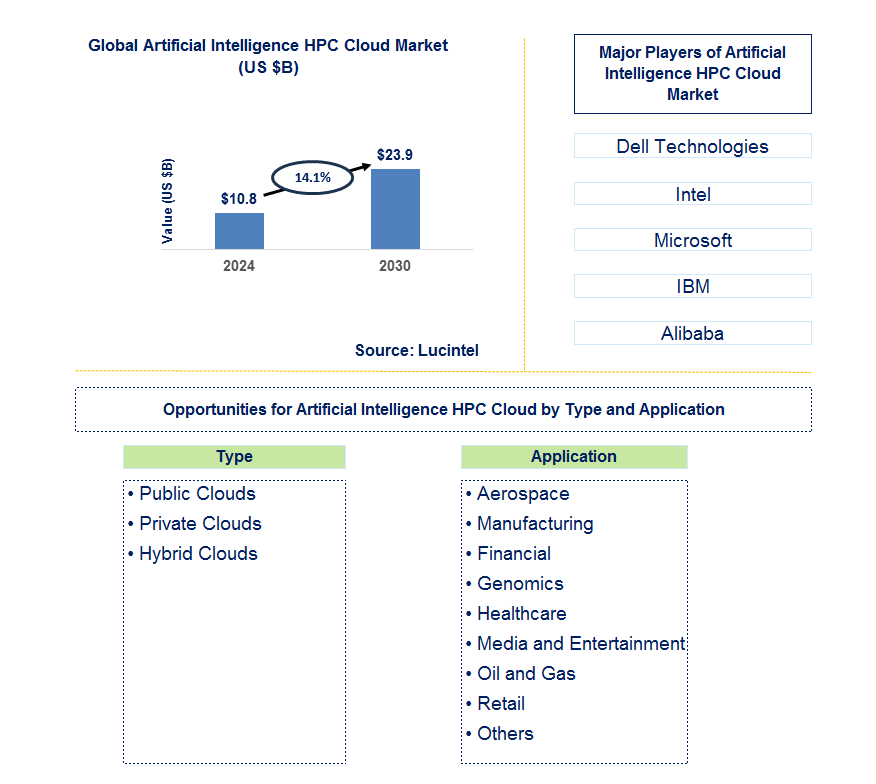
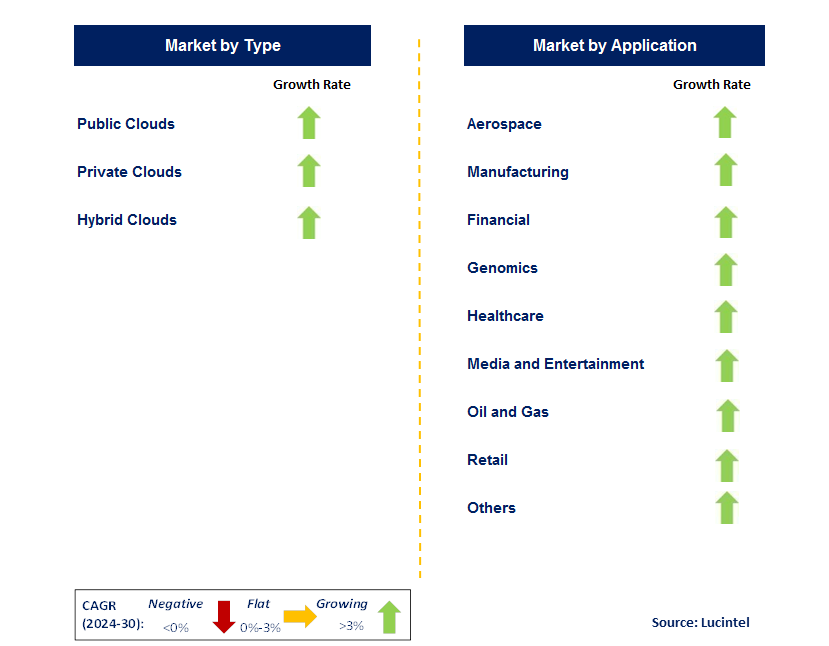
Key data points: The market size in 2030 = $23.9 billion, growth forecast = 14.1% annually next 6 years. Scroll below to get more insights. This market report covers trends, opportunities, and forecast in the global artificial intelligence hpc cloud market to 2030 by type (public clouds, private clouds, and hybrid clouds), application (aerospace, manufacturing, financial, genomics, healthcare, media and entertainment, oil and gas, retail, and others), and region (North America, Europe, Asia Pacific, and the Rest of the World)
We'll send your sample report shortly.
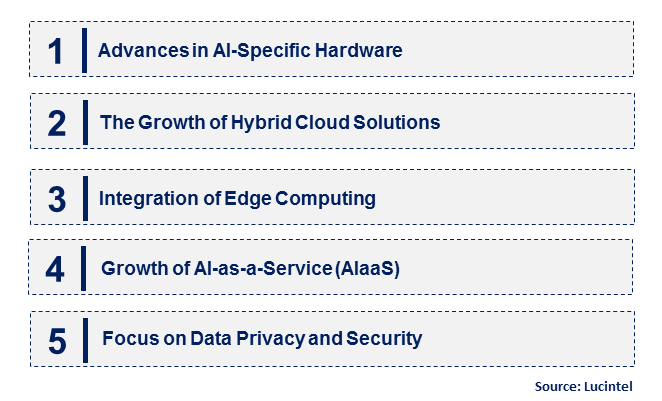
• Advances in AI-Specific Hardware: Such technologies include specialized computer chips like GPUs, TPUs and other customized AI chips which are developing at an alarming rate. Through these processors, AI workloads have been made faster hence speeding up training as well as inference processes. Google and NVIDIA are some companies that have come up with these types of hardware solutions thus propelling innovations regarding artificial intelligence (AI) plus high-performance computing (HPC) clouds.
• The Growth of Hybrid Cloud Solutions: The rise of hybrid cloud solutions is due to the need for flexible and scalable artificial intelligence HPC by organizations. Corporations can optimize their artificial intelligence workload management and data handling efficiency through merging on-site infrastructure and public or private cloud sources. This means that hybrid cloud setups offer more agility, lower costs/ cost-effectiveness as well as better control over data making them suitable for different types of AI needs including compliance requirements having significant impact.
• Integration of Edge Computing: Edge computing is incorporating into the AI HPC cloud solutions to tackling latency and bandwidth problems. It shortens distances, it reduces the need for data to travel long distances towards central cloud servers so that real-time AI applications and faster decision-making can be done using edge computing. This shift has implications particularly for IoT, self-driving cars and intelligent cities.
• Growth of AI-as-a-Service (AIaaS): AI-as-a-Service (AIaaS) is evolving thus enabling businesses to access AI tools and platforms without significant internal infrastructural investments. For example, AIaaS offerings from cloud providers allow companies to subscribe to advanced AI capabilities like ML and NLP. As a result, this trend provides easy adoption paths for artificial intelligence as well as promotes creativity across different sectors.
• Focus on Data Privacy and Security: Since there is immense data being handled by most of these AIs which are also in form of clouds with HPC features, security along with privacy issues become topmost priority. That’s why those who offer Cloud services have not hesitated in implementing topnotch encryption tactics in order to secure crucial information all times while adhering to regulatory requirements too. Therefore, this concern relating security becomes vital so as not to compromise trust or enable probable threats against artificial intelligence based systems.
• Expansion of AI Research and Collaboration: Academia, industry, and the government are increasingly collaborating within the AI HPC cloud market. Research partnerships and collaborative platforms are driving innovation in HPC infrastructure and AI technologies. These collaborations seek to fast-track progress on AI-related challenges especially in healthcare, climate modeling, natural language processing among others.
• Emergence of Green Computing Initiatives: Green computing initiatives are becoming a significant trend in the AI HPC cloud market. To minimize their environmental impact through energy efficiency and sustainability programs, companies are adopting green data centers and HPC infrastructure. This is consistent with worldwide efforts towards curbing climate changes as well as promoting eco-friendly AI solutions development. These emerging trends are redefining the AI HPC cloud market by advancing hardware capabilities, incorporating edge computing, expanding offerings for AIaaS, while also placing an emphasis on data privacy. Furthermore, industry focus on research collaboration and sustainability is a vital driver for innovation and in addressing key challenges that come with it.
• Advanced AI Cloud Platforms Launched: Amazon Web Services (AWS), Microsoft Azure, and Google Cloud are among major cloud providers who have launched advanced artificial intelligence (AI) clouds. These platforms come with up-to-the-minute GPU’s/TPU’s tailored for Artificial intelligence training and inference thus enabling businesses to speed up their AI projects and efficiently handle large scale data processing tasks.
• Introduction of Custom AI Chips: To cater for the demands of high-performance computing workloads, companies are developing custom AI chips. Examples of such hardware include NVIDIA’s A100 GPUs and Google’s TPUs which optimize on Artificial Intelligence processing enabling faster model training as well as improved predictions. These advances foster innovation in the provision of AI and HPC cloud services.
• The Growth of AIaaS Offerings: As a result, AI-as-a-Service (AIaaS) has grown and companies can access this advanced technology whenever they want it. This is done through subscription-based models that involves cloud providers offering various AI services such as machine learning, data analytics, and natural language processing. The expansion is facilitative to the adoption of broader technologies in the artificial intelligence field thus supporting different industry applications.
• Hybrid Cloud Solutions Expansion: Hybrid cloud solutions are becoming more popular as organizations look for flexibility and scalability in their AI HPC environments. This means that combining on-site infrastructure with public or private clouds can help businesses optimize their artificial intelligence workloads, improve data management and comply with regulations.
• Edge Computing Integration: Moreover, edge computing is being merged with AI HPC cloud solutions to address the issues of latency and wide bandwidths. In this case, processing the data at the edge reduces the demand for transmitting information to centralized cloud servers which enhances performance as well as facilitates real-time AI applications for use cases like autonomous vehicles or Internet of Things (IoT) devices.
• Data privacy and security are becoming major concerns with AI High-Performance Computing (HPC) Clouds handling sensitive information. Advanced Encryption, Access Controls and Compliance measures being implemented by cloud providers help to protect data as well as ensures regulatory compliance. These improvements address security fears, which inspire trust in AI-powered applications.
• Increased Funding for AI Research: AI research and development is seeing increasing investments through partnerships between academic institutions, industry leaders, and governments. Collaborative efforts have led to innovation in artificial intelligence technology and HPC infrastructure leading to advancements in healthcare, climate modeling, autonomous systems among others. These developments are advancing the AI HPC cloud market by enhancing processing capabilities, expanding service offerings, and integrating cutting-edge technologies. As well as dealing with some of the key challenges such as hybrid solutions edge computing data security that propagate growth in the sector.
• More AIaaS Solutions Expansion: Expanding AI-as-a-Service (AIaaS) solutions creates a growth opportunity of providing businesses with scalable and flexible access to AI tools. By way of example, AIaaS offers organizations an affordable way of integrating advanced AI capabilities into their business operations.
• Specialized AI Hardware Development: To grow, a company may opt to invest in specialized artificial intelligence hardware like custom GPUs and TPUs. These hardware solutions are crafted for optimizing workloads related to artificial intelligence, enhancing processing power and speeding up model training thereby driving the advancements in Artificial Intelligence HPC Cloud services.
• Edge Computing Integration: Integration of edge computing with AI HPC cloud solutions creates possibilities for addressing latency and bandwidth issues. What this means is that edge computing facilitates real-time applications of artificial intelligence by processing data at the point it is generated hence improving performance especially in cases such as Internet of Things (IoT) and self-driving cars.
• Hybrid Cloud Models Adoption: The adoption hybrid cloud models provide chances for growth by combining on-premises resources together with the cloud ones. Such hybrid options deliver flexibility, scalability, and cost-effectiveness which allow organizations to manage their data more efficiently while optimizing their Artificial Intelligence workloads.
• Data Privacy and Compliance Focus: Addressing security concerns and regulatory needs by emphasizing data privacy and compliance in AI HPC cloud solutions is a growth opportunity. When they implement advanced encryption and access controls, trust is built among customers while ensuring compliance with data protection regulations. These are the opportunities for growth that shape the AI HPC cloud market by promoting innovation, enhancing capabilities and expanding the reach of AI technologies. The focus on AIaaS, specialized hardware, edge computing, and data protection supports expansion into new markets as well as addressing important challenges.
• Dell Technologies
• Intel
• Microsoft
• IBM
• Alibaba
• Amazon Web Services
• PARATERA
• Tencent
• Penguin Computing
• Public Clouds
• Private Clouds
• Hybrid Clouds
• Aerospace
• Manufacturing
• Financial
• Genomics
• Healthcare
• Media and Entertainment
• Oil and Gas
• Retail
• Others
• North America
• Europe
• Asia Pacific
• The Rest of the World
• United States: In the US, tremendous strides have been made towards merging artificial intelligence with high-performance computing (HPC) cloud solutions. On the other hand, Amazon Web Services (AWS), as well as Microsoft Azure, has recently released highly developed machine learning services which utilize top-notch TPUs and GPUs to boost their processing power. An increasing number of businesses use NVIDIA’s GPUs and Google’s Tensor Processing Units (TPUs) specifically for purposes of training AI models and performing data analytics. Furthermore, there is a growing emphasis on hybrid clouds and edge computing that make it easier to implement flexible AI applications at scale.
• China: China is heavily investing in its AI HPC cloud services, which are being increasingly built out by major tech players like Alibaba, Tencent and Huawei. The country is building its own AI-specific hardware such as Ascend AI processors to strengthen cloud-based AI services. To facilitate the development of AI for national applications, China continues to upgrade its high-performance computing (HPC) infrastructure. They intend to build a healthy AI ecosystem that includes large data centers and high-speed connectivity.
• Germany: Germany has been developing its AI HPC cloud infrastructure focusing on European data sovereignty and performance. In addition to fostering university-industry collaborations in advancing artificial intelligence research and application domains, there have also been significant trends of investment into German companies and research institutions geared towards deploying regulation-friendly A.I driven cloud solutions. These efforts include establishing data centers with cutting-edge facilities for enabling the next wave of innovation in artificial intelligence computing as well as integrating AI with traditional HPC resources.
• India: The growth of AI HPC cloud services in India is powered by the government initiatives and private sector investments. Initiatives such as Digital India, which aim at enhancing HPC capabilities on the cloud, are being used by the Indian government to promote AI and digital infrastructure. Consequently, companies are now adopting AI cloud solutions to support various sectors including health care, finance, and agriculture. This has resulted in a push towards making AI and HPC more accessible as well as affordable to foster innovation locally that can address local challenges.
• Japan: Japan has improved its AI HPC cloud capabilities focusing on high-speed data processing along with integration of AI technologies. For example, major Japanese tech companies like NEC and Fujitsu have created AI-enhanced cloud solutions with huge investments in next generation of HPC infrastructure. Moreover, it is concentrating on constructing cooperative platforms for R&D oriented towards Artificial Intelligence (AI). In addition, these efforts from Japan seek to strengthen its position in the global market for artificial intelligence while supporting developments in fields such as robotics and smart manufacturing.
• Dell Technologies
• Intel
• Microsoft
• IBM
• Alibaba
• Amazon Web Services
• PARATERA
• Tencent
• Penguin Computing Q6. Which artificial intelligence HPC cloud market segment will be the largest in future? Answer: Lucintel forecasts that public is expected to witness highest growth over the forecast period. Q7. In artificial intelligence HPC cloud market, which region is expected to be the largest in next 5 years? Answer: North America is expected to witness highest growth over the forecast period due to presence of key players in the region. Q.8 Do we receive customization in this report? Answer: Yes, Lucintel provides 10% customization without any additional cost.


Choose a license that fits your team. Instant PDF delivery.
Prices exclude taxes. Instant delivery. Custom licensing available on request.
Market Report · July 15, 2026
Market Report · June 26, 2026
Market Report · June 24, 2026
Trusted partner for strategic intelligence and business growth


Receive a complimentary market analysis tailored to your industry. Our analysts will identify key growth opportunities and competitive dynamics specific to your business.

Market size, growth rate, and key trend analysis for your specific sector.

Top competitor positioning and market share analysis.

Strategic recommendations backed by data-driven insights.
Get curated market intelligence and competitive moves straight to your inbox.
By subscribing, you agree to receive our monthly insights. Unsubscribe anytime.
Receive a complimentary market analysis tailored to your industry. Our analysts will identify key growth opportunities and competitive dynamics specific to your business.
Market size, growth rate, and key trend analysis for your specific sector.
Top competitor positioning and market share analysis.
Strategic recommendations backed by data-driven insights.
Get curated market intelligence, emerging trends, and competitive moves straight to your inbox each month.
By subscribing, you agree to receive our monthly insights. Unsubscribe anytime.
We'll send your sample report shortly.