
Market Report · July 15, 2026

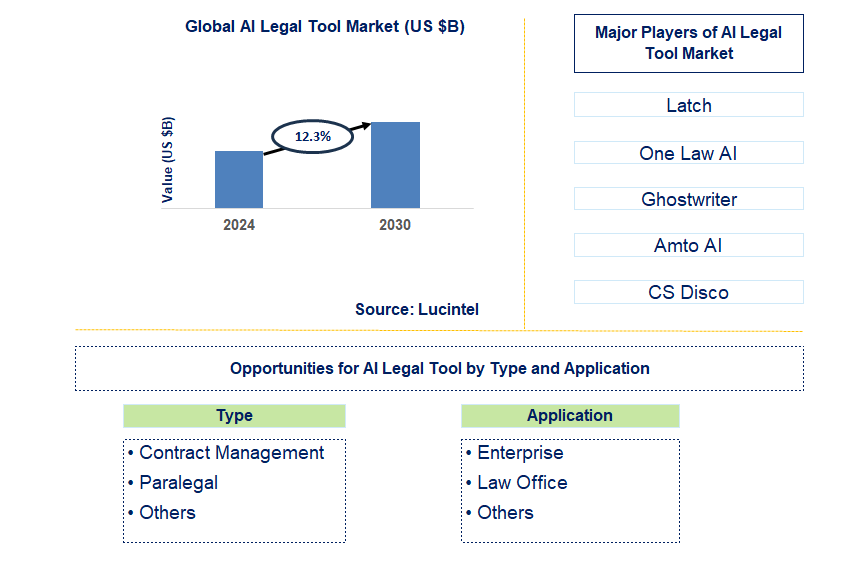
Key data points: The growth forecast = 12.3% annually for the next 6 years. Scroll below to get more insights. This market report covers trends, opportunities, and forecasts in the global AI legal tool market to 2030 by type (contract management, paralegal, and others), application (enterprise, law office, and others), and region (North America, Europe, Asia Pacific, and the Rest of the World)
We'll send your sample report shortly.
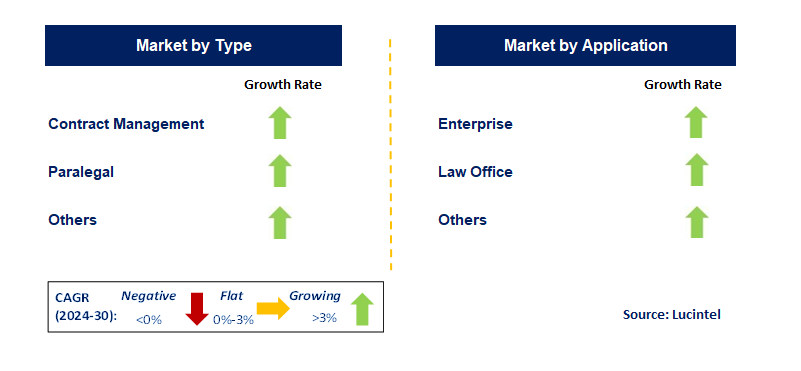
• Lucintel forecasts that, within the type category, the contract management segment is expected to witness higher growth over the forecast period.
• Within the application category, the enterprise is expected to witness higher growth.
• In terms of regions, APAC is expected to witness the highest growth over the forecast period. Gain valuable insights for your business decisions with our comprehensive 150+ page report.
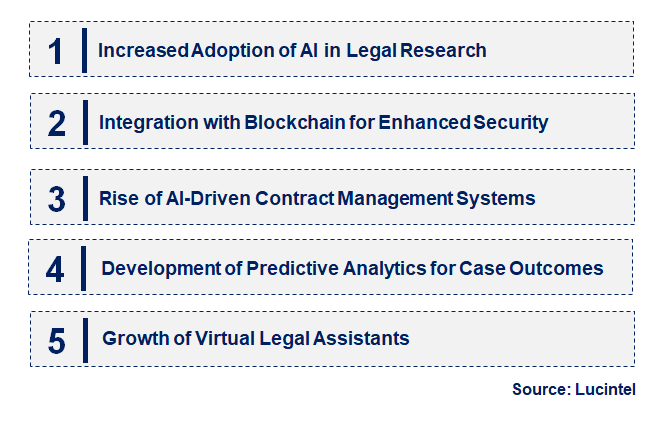
• Increased Adoption of AI in Legal Research: AI tools are enhancing legal research capabilities by quickly analyzing vast amounts of legal data and providing actionable insights. This reduces research time and increases accuracy in case preparation.
• Integration with Blockchain for Enhanced Security: The combination of AI and blockchain is improving the security and integrity of legal documents and transactions. This integration ensures transparent and tamper-proof record keeping.
• Rise of AI-Driven Contract Management Systems: AI-powered contract management systems are streamlining contract creation, review, and monitoring. These systems automate routine tasks and reduce the risk of errors in contract management.
• Development of Predictive Analytics for Case Outcomes: AI tools are increasingly using predictive analytics to forecast case outcomes based on historical data. This trend helps legal professionals strategize better and improve decision-making.
• Growth of Virtual Legal Assistants: AI-driven virtual assistants are becoming more common, providing real-time support for routine legal tasks and client interactions. This trend enhances the efficiency and accessibility of legal services. These trends are driving significant changes in the AI legal tool market, leading to greater efficiency, improved security, and enhanced decision-making capabilities. They reflect a shift toward more integrated and intelligent legal solutions.
• Enhanced Natural Language Processing (NLP) Capabilities: Advances in NLP are improving AI’s ability to understand and interpret legal language, making it more effective in contract analysis and legal document review.
• Expansion of AI Solutions for Compliance: New AI tools are being developed to help firms comply with complex regulatory requirements. These solutions automate compliance checks and reduce the risk of legal infractions.
• Growth in AI-Powered E-Discovery Tools: AI technologies are making e-discovery processes more efficient by automating the identification and analysis of relevant documents, which speeds up legal investigations and litigation.
• Introduction of AI for Legal Analytics: AI-driven legal analytics tools are being introduced to provide insights into legal trends and case outcomes, helping firms make more informed decisions and strategies.
• Development of AI-Driven Risk Management Solutions: AI tools are being designed to assess and mitigate legal risks, providing proactive solutions to manage potential legal issues before they escalate. These developments are enhancing the functionality and efficiency of AI legal tools, driving innovation in legal processes, and addressing complex challenges in the legal industry.
• AI for Document Automation: The increasing need for efficient document management creates opportunities for AI tools that automate the creation and review of legal documents, improving accuracy and reducing manual workload.
• AI in Legal Research: There is a growing demand for AI solutions that enhance legal research capabilities by quickly analyzing large volumes of legal data, providing valuable insights and reducing research time.
• AI for Compliance Monitoring: As regulatory environments become more complex, AI tools that automate compliance monitoring and reporting are in high demand, helping firms stay compliant and avoid legal issues.
• AI in Case Prediction: AI tools that use predictive analytics to forecast case outcomes offer significant growth potential, assisting legal professionals in strategizing and decision making based on historical data.
• AI-Driven Virtual Assistants: The rise of virtual legal assistants presents opportunities for AI tools that provide real-time support and interaction, enhancing client service and streamlining legal workflows. These growth opportunities are shaping the AI legal tool market by addressing key needs and challenges within the legal industry, driving innovation and expanding the application of AI in legal practices.
• Technological Advancements: Continuous improvements in AI technology, such as enhanced NLP and machine learning algorithms, are driving the adoption of AI legal tools and expanding their capabilities.
• Demand for Efficiency: The increasing need for efficiency and cost reduction in legal processes is fueling the adoption of AI tools that automate routine tasks and streamline workflows.
• Regulatory Compliance: Growing regulatory requirements across industries are driving the demand for AI tools that assist with compliance monitoring and risk management.
• Data-Driven Decision Making: The emphasis on data-driven decision-making in the legal field is driving the development of AI tools that provide insights and predictive analytics for better legal strategies.
• Improved Access to Legal Services: AI tools are improving access to legal services by offering affordable and scalable solutions, making legal assistance more accessible to a broader audience. Challenges in the AI legal tool market are:
• Data Privacy Concerns: The use of AI in legal tools raises concerns about data privacy and security, as sensitive legal information needs to be protected from unauthorized access.
• Regulatory Uncertainty: The evolving regulatory landscape around AI and data usage poses challenges for the development and deployment of AI legal tools, requiring compliance with various legal standards.
• High Implementation Costs: The initial cost of implementing AI legal tools can be high, which may be a barrier for smaller firms and organizations looking to adopt these technologies. These drivers and challenges are shaping the AI legal tool market by influencing technology adoption, regulatory compliance, and operational efficiency. Addressing these factors is crucial for the continued growth and effectiveness of AI in the legal sector.
• Latch
• One Law AI
• Ghostwriter
• Amto AI
• CS Disco
• Westlaw Edge
• Lex Machina
• Contract Management
• Paralegal
• Others
• Enterprise
• Law Office
• Others
• North America
• Europe
• Asia Pacific
• The Rest of the World
• United States: The US has seen a surge in AI legal startups focusing on automating contract review and legal research. Companies like LegalZoom and ROSS Intelligence are leveraging AI to enhance legal workflows, improve access to legal services, and reduce costs.
• Chinese: In Chinese, AI legal tools are increasingly used for regulatory compliance and intellectual property management. Government-backed initiatives are promoting the use of AI for legal document analysis and case prediction, reflecting a push towards integrating AI into the broader legal infrastructure.
• Germany: Germany is witnessing advancements in AI-powered legal assistants that support legal professionals with document automation and client management. The focus is on enhancing the efficiency of traditional legal practices and ensuring compliance with EU regulations.
• Indian: Indian is leveraging AI for improving legal research and case management, especially in the context of a growing legal tech industry. Startups are emerging to provide AI-driven solutions for contract management and dispute resolution.
• Japan: In Japan, there is a growing interest in AI legal tools for streamlining legal processes and improving accuracy in legal document preparation. Japanese firms are exploring AI for both in-house legal departments and law firms, aiming to increase productivity.


• Latch
• One Law AI
• Ghostwriter
• Amto AI
• CS Disco
• Westlaw Edge
• Lex Machina Q5. Which AI legal tool market segment will be the largest in future? Answer: Lucintel forecasts that contract management segment is expected to witness higher growth over the forecast period. Q6. In AI legal tool market, which region is expected to be the largest in next 5 years? Answer: APAC is expected to witness the highest growth over the forecast period. Q.7 Do we receive customization in this report? Answer: Yes, Lucintel provides 10% customization without any additional cost.


Choose a license that fits your team. Instant PDF delivery.
Prices exclude taxes. Instant delivery. Custom licensing available on request.
Market Report · July 15, 2026
Market Report · June 26, 2026
Market Report · June 24, 2026
Trusted partner for strategic intelligence and business growth


Receive a complimentary market analysis tailored to your industry. Our analysts will identify key growth opportunities and competitive dynamics specific to your business.

Market size, growth rate, and key trend analysis for your specific sector.

Top competitor positioning and market share analysis.

Strategic recommendations backed by data-driven insights.
Get curated market intelligence and competitive moves straight to your inbox.
By subscribing, you agree to receive our monthly insights. Unsubscribe anytime.
Receive a complimentary market analysis tailored to your industry. Our analysts will identify key growth opportunities and competitive dynamics specific to your business.
Market size, growth rate, and key trend analysis for your specific sector.
Top competitor positioning and market share analysis.
Strategic recommendations backed by data-driven insights.
Get curated market intelligence, emerging trends, and competitive moves straight to your inbox each month.
By subscribing, you agree to receive our monthly insights. Unsubscribe anytime.
We'll send your sample report shortly.