
Market Report · July 15, 2026

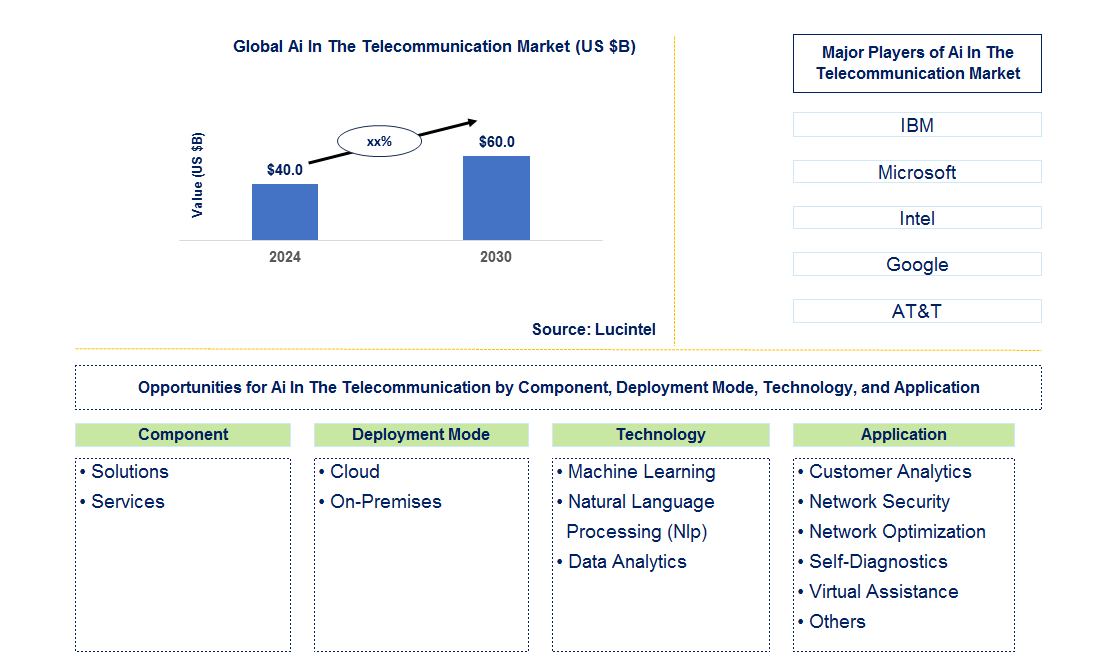
Key data points: The market size in 2030 = $10,373.6 million, growth forecast = 42.3% annually for the next 6 years. Scroll below to get more insights. This market report covers trends, opportunities, and forecasts in the global ai in the telecommunication market to 2030 by component (solutions and services), deployment mode (cloud and on-premises), technology (machine learning, natural language processing (NLP), and data analytics), application (customer analytics, network security, network optimization, self-diagnostics, virtual assistance, and others), and region (North America, Europe, Asia Pacific, and the Rest of the World)
We'll send your sample report shortly.
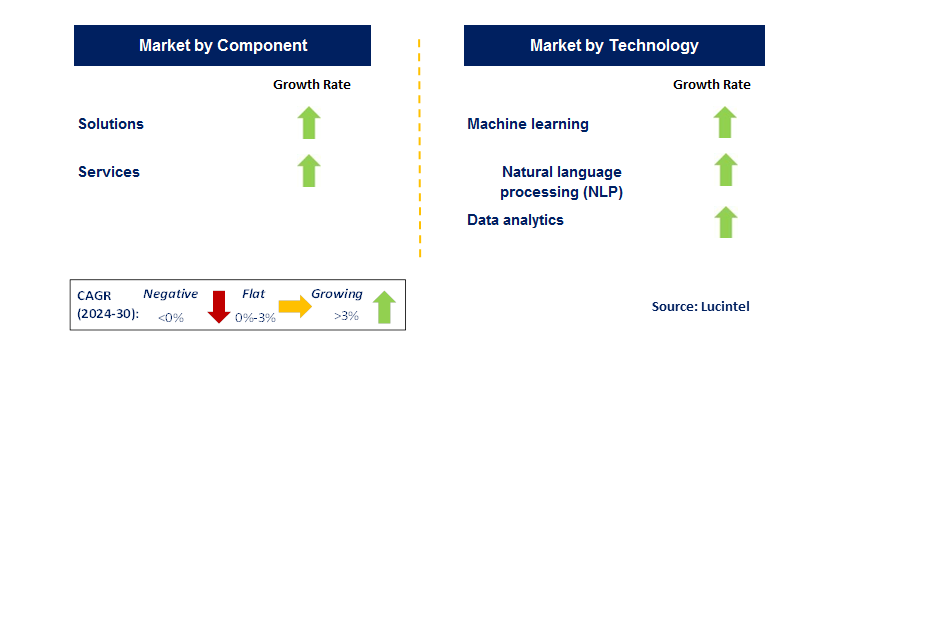
• Lucintel forecasts that within the componnet category, service will remain a higher growing segment over the forecast period due to rising awareness among telecommunication enterprises regarding the benefits of the AI technology in the telecommunication industry, growing adoption of AI for various applications, as well as increasing utilization of AI-enabled smartphones.
• Within the application category, virtual assistance will remain the highest growing segment over the forecast period due to its ability to handle customer queries while offering personalized recommendations and perform tasks like bill payments or service activations.
• In terms of region, North America is expected to witness the highest growth over the forecast period due to increasing number of telecom companies using automation and AI for customer service and network optimization purposes in this region. Gain valuable insights for your business decisions with our comprehensive 150+ page report. A more than 150-page report is developed to help in your business decisions.
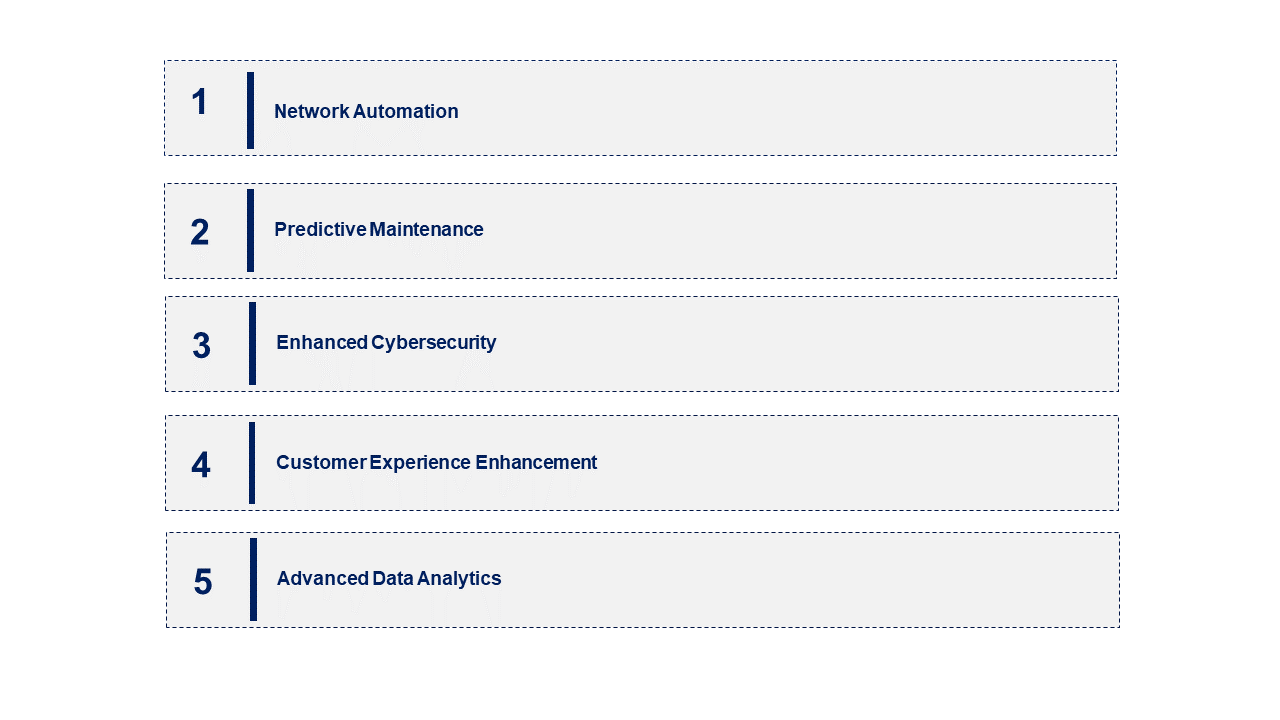
• Network Automation: Artificial intelligence (AI)-based network automation is revolutionizing telecommunications by reducing manual intervention and enhancing operational efficiency. Using such tools, operators can save costs while at the same time optimizing performance via real-time monitoring and forecasting traffic levels minimizing failure incidences thereby boosting service reliability.
• Predictive Maintenance: Predictive maintenance using AI is increasingly becoming popular among telecom networks because it allows proactive management of infrastructure. By interpreting data from various network assets, including switches and routers etc., this kind of AI algorithms predict possible troubles before they actually occur minimizing outages as well as keeping a stable network alive.
• Enhanced Cybersecurity: AI enhances cybersecurity by identifying and dealing with threats as they arise. AI-backed security systems can detect unusual trends and potential weak points more accurately than conventional methods, guaranteeing greater defense against cyber attacks and the integrity of telecommunications networks.
• Customer Experience Enhancement: AI technologies are enhancing customer service through intelligent virtual assistants and personalized recommendations. AI-powered chatbots and support systems can ably handle customer inquiries, provide tailored solutions that lead to better user satisfaction as well as better support that is more accurate.
• Advanced Data Analytics: Through employing AI in advanced data analytics, telecom operators have access to a deeper understanding of their customers’ behaviors and networks performance. Big data analysis done by machine learning techniques enable companies to make informed choices on what services they should offer optimize them as well as create focused advertising to ensure the needs of the client are met. These trends impact significantly the AI telecommunications market by promoting innovation and efficiency in operations. Telecommunication industry’s future revolves around network automation, predictive maintenance, enhanced cybersecurity, customer experience enhancement, advanced data analytics; hence making artificial intelligence crucial for its development.
• AI-Powered Network Management: To achieve optimum performance at minimal cost levels this firms are presently taking up AIPowered Networking Management Systems . With help from real-time information analysis about network usage patterns , issue prediction and maintenance automation, AI algorithms ensure that the networks are more efficient and dependable.
• Intelligent Virtual Assistants: The use of artificial intelligence (AI) based virtual assistants is revolutionizing customer service in the telecommunication industry. The role of these systems is to handle customer queries, offer support services and personalize transactions thereby improving quality of service while reducing human intervention needs.
• Enhanced Fraud Detection: AI technology has been used to enhance fraud detection and prevention in telecommunication networks . Machine learning techniques find out any non-genuine activities as well as strange usage patterns within networks aiding organizations in identifying risks before they escalate into monetary losses.
• 5G Network Optimization: The optimization of 5G network deployments using AI is crucial for this new technology . In this case, AI enables efficient management of network resources thus ensuring that these services provide a highly reliable and high performance experience to its users while also being able to support various applications.
• Smart Infrastructure Integration: Telecommunications companies are integrating AI with smart infrastructure projects such as smart cities and IoT systems. Through this application, AI can aid the administration of interconnected devices and infrastructure which helps achieve enhanced operations efficiency thus improved user experiences in urban areas. These developments are driving the evolution of AI in telecommunications whereby improvement network management, customer service capabilities among others were realized.AI integration will redefine the sector creating newer opportunities while setting stage for future transformations.
• AI-Based Network Optimization: AI-based network optimization holds great potential for growth through the improvement of network performance and efficiency. This makes it a crucial area for investment and development since the AI tools analyze network data too so as to optimize traffic management, reduce latency, and improve overall quality of services.
• Predictive Analytics to Gain Customer Insights: AI powered predictive analytics can offer valuable insights into customers’ behaviors and preferences. Using historical data, trends, patterns, etc., telecom companies may customize their offers, improve customer retention rates and create targeted marketing strategies.
• AI-Driven Customer Support: The use of artificial intelligence (AI) in customer support such as chatbots or virtual assistants is an opportunity for growth because it improves service efficiency as well as user experience. Such systems will be able to handle inquiries using artificial intelligence technology while reducing operational costs through quick problem resolution and personalized assistance.
• Intelligent Network Security: AI reinforces the network security by detecting real-time threats against it.AI-driven intelligent security systems can recognize possible vulnerabilities that could be exploited to launch attacks thereby ensuring integrity of telecom networks given growing cybersecurity threats.
• Smart Infrastructure With IoT Integration: For integration with smart infrastructure and IoT solutions in telecoms, artificial intelligence plays a critical role.By managing interconnected devices, data flows among others; AI facilitates development of smart cities plus other advanced infrastructure projects fostering innovation as well as efficiency. These strategic growth opportunities are reshaping the AI telecommunications market by opening paths towards innovation and improved operational capabilities By leveraging AI in network optimization, customer support, security, and smart infrastructure; telecommunications firms can boost their competitive edge while adapting to evolving market conditions
• Technological Advancements: Fast-paced development of AI technologies such as machine learning (ML) and data analytics has been boosting the telecommunications sector. By enabling better network management, improved customer service, as well as efficient operations; there is great value creation for telecom companies through these technologies.
• Growing Need for Network Efficiency: AI adoption is driven by increasing demand for efficient and reliable networks due to 5G expansion and IoT proliferation.AI based technologies are able to optimize network performance, traffic control etc., thus ensuring quality services match contemporary telecommunications sector requirements.
• Enhancing Customer Experience: Telecoms are focusing on improving customer experiences by making them personalized with the help of AI. As a result thereof, customer interactions will be upgraded with using virtual assistants powered by artificial intelligence technology chatbots that take it beyond traditional approaches predictive analytics etc., leading to higher satisfaction levels plus loyalty.
• Cost Reduction And Automation: AI provides opportunities for cost reduction and automation within telecommunication industry.By automating repetitive tasks while optimizing resource usage; there could be reduced costs since operational expenses can be saved through this means thereby boosting efficiency which makes it worth being invested in for firms interested in streamlining workflows.
• Utilization of Big Data: AI driven analytics from the increasing volume of data generated in telecommunications can be achieved. This technology offers valuable insights through the analysis of large datasets thereby facilitating better decision making, enhanced service provision and targeted strategy formulation. Challenges in the ai in the telecommunication market are:
• Privacy and Security Concerns Regarding Data: Data privacy and security concerns are raised following the use AI in telecommunication sector. To build trust with and protect customers’ data it is important to adhere to regulations while preventing data breach acts that may put sensitive information at risk.
• High Costs of Implementation: Implementing advanced artificial intelligence technologies can be costly which is a problem for many smaller players in telecoms industry. At this point it becomes significant to balance between investing right and getting returns, as well as managing costs effectively to ensure smooth AI integration process.
• Integration with Legacy Systems: It is not easy integrating AI with existing legacy systems since they are complex processes that require careful planning and execution by telecom companies upgrading infrastructure before they are implemented in order to avoid disruptions but maximize returns The market for AI in Telecommunications is being pushed forward by growth drivers such as technological advancements, network efficiency, customer experience, cost reduction, and big data utilization. However, several challenges such as privacy issues linked to data protection, high implementation costs together with integration with legacy systems need to be properly addressed so as to have successful AI adoption and growth realized within an organization.
• IBM
• Microsoft
• Intel
• AT&T
• Cisco Systems
• Nuance Communications
• Sentient Technologies
• H2O.ai
• Infosys
• Solutions
• Services
• Cloud
• On-Premises
• Machine Learning
• Natural Language Processing (NLP)
• Data Analytics
• Customer Analytics
• Network Security
• Network Optimization
• Self-Diagnostics
• Virtual Assistance
• Others
• North America
• Europe
• Asia Pacific
• The Rest of the World
• United States: AI integration into telecommunications aims at improving 5G networks, using AI for preventive maintenance as well as facilitating improved customer experience through intelligent virtual assistants. AT&T and Verizon among others have embraced AI-driven network optimization together with real-time analytics which facilitate efficiency and innovation within service delivery.
• China: China's telecom giants like Huawei or ZTE use AI for smart city projects and advanced 5G networks. China has also been adopting these technologies to enhance their network security, optimize their networks' performance, while large-scale data management also forms part of its strategy towards attaining technological supremacy in telecommunication sector.
• Germany: In Germany there is emphasis on using it for automating networks & cyber security. Deutsche Telekom invests into AI-powered solutions for network optimization or fraud detection whereas stringent German regulations ensure privacy & security when implementing AIs applications.
• India: In India the application of artificial intelligence (AI) aims at enhancing networking management system as well as customers services across telecommunication industries. Companies are now turning to spectrum management by use of artificial intelligence (AI), predictive maintenance among other social economic factors aimed at engrossing both rural and urban areas customers hence driving growth in the sector.
• Japan: The AI integration of IoT in Japan’s telecommunications is pursued as part of attempts to develop smart infrastructure. NTT, for instance, is putting money into artificial intelligence-driven solutions meant for network management or customer service; thus, complying with Japanese goals of technological sophistication and smart city development.


• IBM
• Microsoft
• Intel
• AT&T
• Cisco Systems
• Nuance Communications
• Sentient Technologies
• H2O.ai
• Infosys Q6. Which AI in the telecommunication market segment will be the largest in future? Answer: Lucintel forecasts that service will remain the higher growing segment over the forecast period due to rising awareness among telecommunication enterprises regarding the benefits of the AI technology in the telecommunication industry, growing adoption of AI for various applications, as well as increasing utilization of AI-enabled smartphones. Q7. In AI in the global telecommunication market , which region is expected to be the largest in next 5 years? Answer: North America is expected to witness highest growth over the forecast period due to increasing number of telecom companies using automatio n and AI for customer service and network optimization purposes in this region. Q.8 Do we receive customization in this report? Answer: Yes, Lucintel provides 10% customization without any additional cost.


Choose a license that fits your team. Instant PDF delivery.
Prices exclude taxes. Instant delivery. Custom licensing available on request.
Market Report · July 15, 2026
Market Report · June 26, 2026
Market Report · June 24, 2026
Trusted partner for strategic intelligence and business growth


Receive a complimentary market analysis tailored to your industry. Our analysts will identify key growth opportunities and competitive dynamics specific to your business.

Market size, growth rate, and key trend analysis for your specific sector.

Top competitor positioning and market share analysis.

Strategic recommendations backed by data-driven insights.
Get curated market intelligence and competitive moves straight to your inbox.
By subscribing, you agree to receive our monthly insights. Unsubscribe anytime.
Receive a complimentary market analysis tailored to your industry. Our analysts will identify key growth opportunities and competitive dynamics specific to your business.
Market size, growth rate, and key trend analysis for your specific sector.
Top competitor positioning and market share analysis.
Strategic recommendations backed by data-driven insights.
Get curated market intelligence, emerging trends, and competitive moves straight to your inbox each month.
By subscribing, you agree to receive our monthly insights. Unsubscribe anytime.
We'll send your sample report shortly.