
Market Report · July 22, 2026

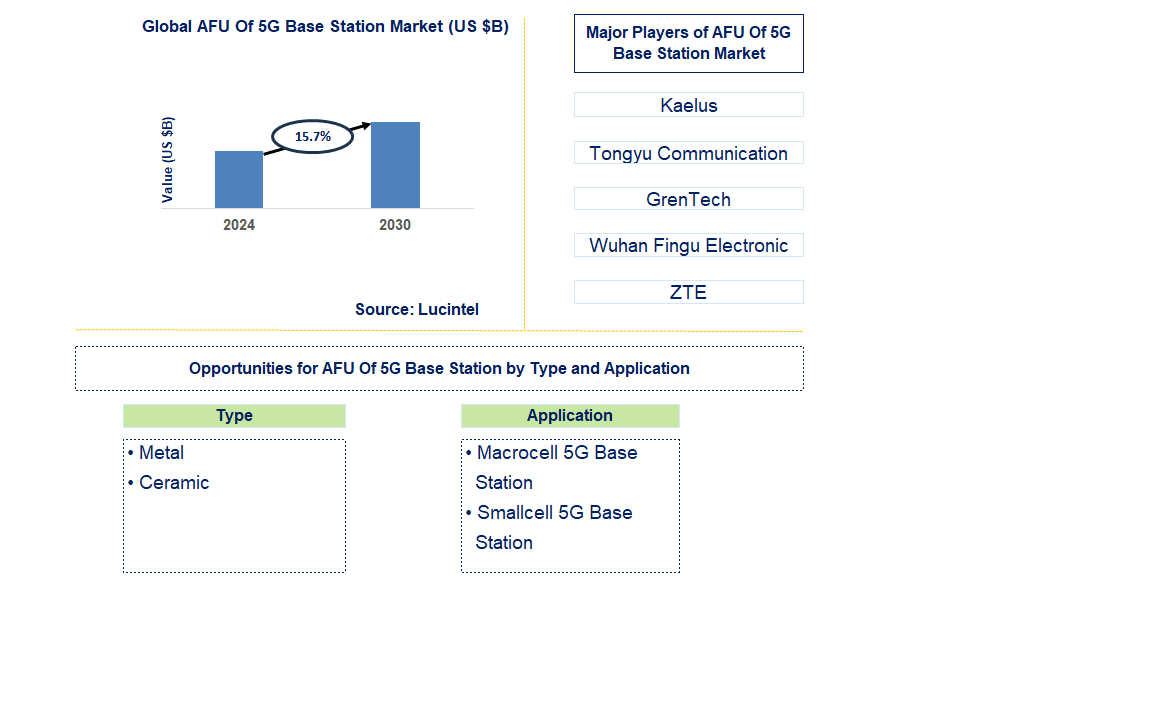
Key data points: The growth forecast = 15.7% annually for the next 6 years. Scroll below to get more insights. This market report covers trends, opportunities, and forecasts in the global afu of 5g base station market to 2030 by type (metal and ceramic), application (macrocell 5G base station and smallcell 5G base station), and region (North America, Europe, Asia Pacific, and the Rest of the World)
We'll send your sample report shortly.
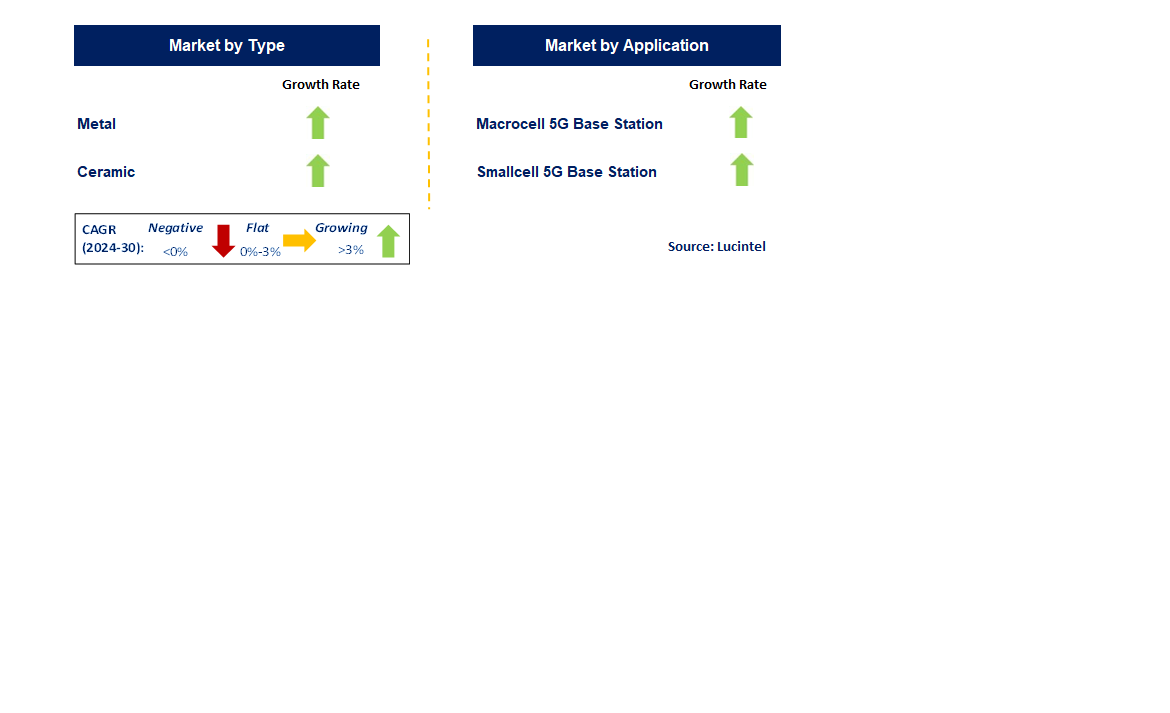
• Lucintel forecasts that, within the type category, metal will remain the larger segment over the forecast period due to superior electrical and thermal properties.
• Within the application category, the macrocell 5G base station will remain the larger segment due to wider coverage and lower cost of deployment.
• In terms of regions, APAC is expected to witness the highest growth over the forecast period due to increased demand for mobile broadband services. Gain valuable insights for your business decisions with our comprehensive 150+ page report.
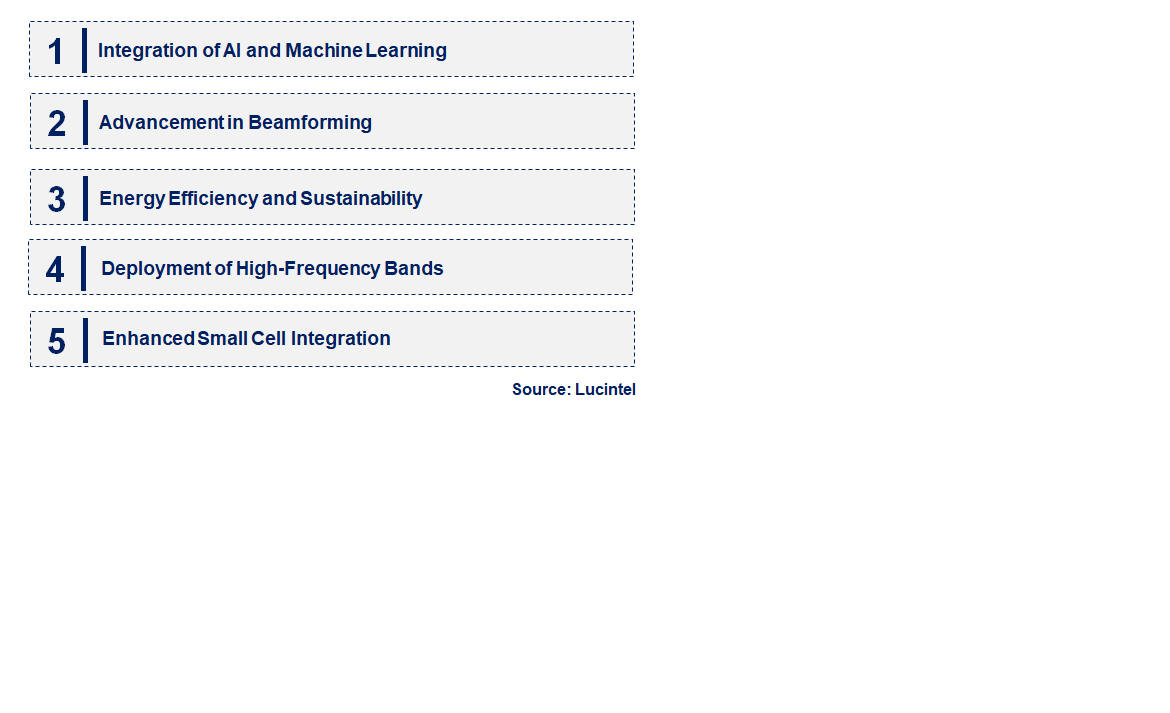
• Integration of AI and Machine Learning: AI and machine learning are being integrated into AFU systems to optimize network performance and predict maintenance needs. This trend enhances the efficiency of base stations, improves network reliability, and reduces operational costs.
• Advancement in Beamforming: Advanced beamforming technologies are being implemented to enhance the strength of signals and coverage. Therefore, this trend offers a more focused signal boost that improves performance and reduces interference in highly populated areas.
• Energy Efficiency and Sustainability: To achieve such targets, there is an increasing trend of developing energy-efficient AFU systems. Energy technologies and environmentally sustainable practices are becoming important factors in the design and implementation of the 5G base station.
• Deployment of High-Frequency Bands: There is a proliferation in the use of higher frequency bands, such as millimeter wave frequency bands, in AFU system technology for increased data rates and higher network capacity. This trend is vital to counter the increasing pressure posed by 5G services and applications.
• Enhanced Small Cell Integration: Network coverage and spatial capacity, especially in urban scenarios, have been enhanced through the integration of AFUs with small cell technology. High-density deployments of small cells and high-performance AFUs help improve the overall 5G network experience. These trends are improving AFU technology, and future 5G networks will be more powerful, reliable, and efficient. The adoption of artificial intelligence, focus on energy consumption, advanced beamforming, and higher frequency bands are changing the AFU market, contributing to the rapid growth and improvement of 5G networks.
• Deployment of Advanced Beamforming Technologies: The use of advanced beamforming techniques in system deployment is improving the ability to direct signals and minimize interference. This development enhances network performance, especially in crowded places where better coverage is needed and higher data rates are expected.
• Expansion into Higher Frequency Bands: The expansion of vertical combiner technologies based on the concept of a metal strip provides opportunities to transfer data and create networks operating in AFU-based systems faster. This expansion aligns with the increasing demand in the market for 5G services and applications that require high speeds.
• Focus on Energy Efficiency: New types of AFUs are adopting modern low-energy consumption approaches to reduce energy use. This focus on sustainable development now meets regulatory needs and reduces the ecological impact of the telecommunications business.
• Integration with Small Cells: AFUs are being deployed with small cell technology to facilitate wider enhancements in urban areas. This integration allows for dense deployment of networks, ensuring better service in congested areas.
• Advancements in AI and Machine Learning: AI and machine learning are being applied to optimize the performance of the AFU and forecast maintenance requirements. These improvements make it easier to manage the network and shorten downtime, which enhances network reliability. These trends are driving the development of new technologies aimed at improving the performance, efficiency, and coverage of 5G networks. The internal structure of base stations for 5G networks is being perfected with advanced beamforming, high-frequency bands, energy efficiency, and integration of AI.
• Smart City Infrastructure: The utilization of AFUs in smart city projects offers opportunities due to the support of rapid accessibility for various IoT devices and urban management systems. The advanced technology of AFUs provides the capability for quick data transfer and network management in smart cities.
• Industrial IoT Applications: The potential to embed AFUs in the industrial IoT domain can improve the level of connectivity and facilitate knowledge processing. This development benefits advanced manufacturing, automation, and comprehensive supervision propositions.
• Enhanced Mobile Broadband Services: AFUs facilitate important functions in mobile broadband services, such as HD video and online gaming. This growth opportunity is driven by the changing needs of consumers who desire fast and reliable mobile internet.
• Public Safety and Emergency Services: Public safety and emergency services benefit from AFUs by extending communication coverage and enhancing the reliability of radios. This growth opportunity allows for the establishment of stable communication networks for first responders.
• Healthcare and Telemedicine: Challenges include barriers and lack of internet connectivity during research. The growth of telecommunications services, such as AFUs, enables overcoming these challenges. This growth opportunity expands healthcare service provision by facilitating remote consultations and transmission of medical information. All these growing opportunities indicate that AFU technology has numerous applications in smart cities, industrial IoT, mobile broadband, public safety, and healthcare. Focusing on these domains will foster creativity and development in the growing market of 5G base stations.
• Technological Advancements: The introduction of new technology features, such as advanced beamforming and integration of the high-frequency band of AFU technology, boosts the AFU market. Each of these technologies increases performance, capacity, and network efficiency to meet the requirements of 5G services.
• Increased Demand for 5G Services: There is a significant driver stemming from the increase in the need for high-speed and low-latency services. The growing demand for enhanced connectivity in both urban and rural environments calls for the growth and modernization of AFU technologies.
• Focus on Energy Efficiency: Energy-efficient AFU market-oriented solutions represent an appropriate market strategy. The use of energy-saving technologies and sustainability measures helps cut operating expenses and comply with established regulations.
• Expansion of Smart Cities: The rise in smart cities and the growth of industrial IoT applications lead to a higher requirement for superior AFUs. These applications necessitate robust and reliable connectivity, which drives the advancement of AFU technology.
• Government Support and Investments: Government backing and investments in 5G infrastructure boost the growth of the AFU market. Advancements in technology and deployment are driven by policies and financing directed towards the expansion of the 5G network. Challenges in the AFU of the 5G base station market include:
• High Production Costs: Developing and producing advanced AFU unit types entails certain expenses that can be substantial. This, overall, reduces the prices and profitability margins of products for sale, presenting a major problem for market players.
• Regulatory Compliance: This process typically involves overcoming regulatory hurdles, which can be quite a herculean task, especially in areas where region-specific requirements must be followed. Regulations dictate market entry and practices.
• Competition and Market Saturation: The level of competition and service saturation in the marketplace is a cause for concern. There is a need for product differentiation and discontinuation of mere product marketing if the AFU market is to remain attractive.
• Adoption of technology and changing trends, such as an increase in the demand for 5G services while being more energy efficient, are fueling the growth of the AFU market. On the other hand, market forces like high production costs, regulatory compliance, and competition concerns have impacted market dynamics. These factors need to be addressed to foster growth in the 5G base station AFU market.
• Kaelus
• Tongyu Communication
• GrenTech
• Wuhan Fingu Electronic Technology
• ZTE
• Metal
• Ceramic
• Macrocell 5G Base Station
• Smallcell 5G Base Station
• North America
• Europe
• Asia Pacific
• The Rest of the World
• United States: The U.S. is now experiencing rapid growth in 5G network deployment. Active devices such as the active front-end unit are being installed during the upgrading of base stations by most telecom operators. Such upgrades are mainly targeted toward capacity expansion and latency reduction. There are substantial deployments of high-frequency bands and improvements in beamforming techniques that lead to positive expansions in network coverage.
• China: China is the leader in 5G junction and is optimizing its AFU technology to deploy networks on a massive scale. Efforts have been made to adopt high-frequency 5G antennas with modern front-end units. The focus is on enhancing network quality concerning the demand for 5G within urban and rural areas.
• Germany: Germany continues with the implementation of 5G and, behind these developments, is pushing for compliance with eco-friendly requirements by introducing energy-saving AFU solutions. German telecom operators are utilizing new AFU technologies to improve network reliability for high-speed data services. There is a significant driving force for deploying AFU as a component of the smart city framework alongside Industry 4.0 movements.
• India: In the context of India, the market for 5G base stations is just opening up. However, positive factors concerning the development of AFU technology are present. Indian telecom companies are interested in comparatively inexpensive AFU designs to enable rapid 5G introduction. These programs are also geared toward improving regional coverage and capacity in high population density areas.
• Japan: Japan continues to evolve its 5G architecture, emphasizing high-speed and performance AFU units for newer applications of IoT and smart cities. Japanese telecom operators are investing in the next generation of AFU to enhance network performance and transmission of high-speed data in urban and rural regions.


• Kaelus
• Tongyu Communication
• GrenTech
• Wuhan Fingu Electronic Technology
• ZTE Q5. Which AFU of 5G base station market segment will be the largest in future? Answer: Lucintel forecasts that metal will remain the larger segment over the forecast period due to superior electrical and thermal properties. Q6. In AFU of 5G base station market, which region is expected to be the largest in next 5 years? Answer: APAC is expected to witness the highest growth over the forecast period due to increased demand for mobile broadband services. Q.7 Do we receive customization in this report? Answer: Yes, Lucintel provides 10% customization without any additional cost.


Choose a license that fits your team. Instant PDF delivery.
Prices exclude taxes. Instant delivery. Custom licensing available on request.
Market Report · July 22, 2026
Market Report · July 17, 2026
Market Report · July 17, 2026
Trusted partner for strategic intelligence and business growth


Receive a complimentary market analysis tailored to your industry. Our analysts will identify key growth opportunities and competitive dynamics specific to your business.

Market size, growth rate, and key trend analysis for your specific sector.

Top competitor positioning and market share analysis.

Strategic recommendations backed by data-driven insights.
Get curated market intelligence and competitive moves straight to your inbox.
By subscribing, you agree to receive our monthly insights. Unsubscribe anytime.
Receive a complimentary market analysis tailored to your industry. Our analysts will identify key growth opportunities and competitive dynamics specific to your business.
Market size, growth rate, and key trend analysis for your specific sector.
Top competitor positioning and market share analysis.
Strategic recommendations backed by data-driven insights.
Get curated market intelligence, emerging trends, and competitive moves straight to your inbox each month.
By subscribing, you agree to receive our monthly insights. Unsubscribe anytime.
We'll send your sample report shortly.