
Report Feature
X-Ray Crystallography Market Trends and Forecast
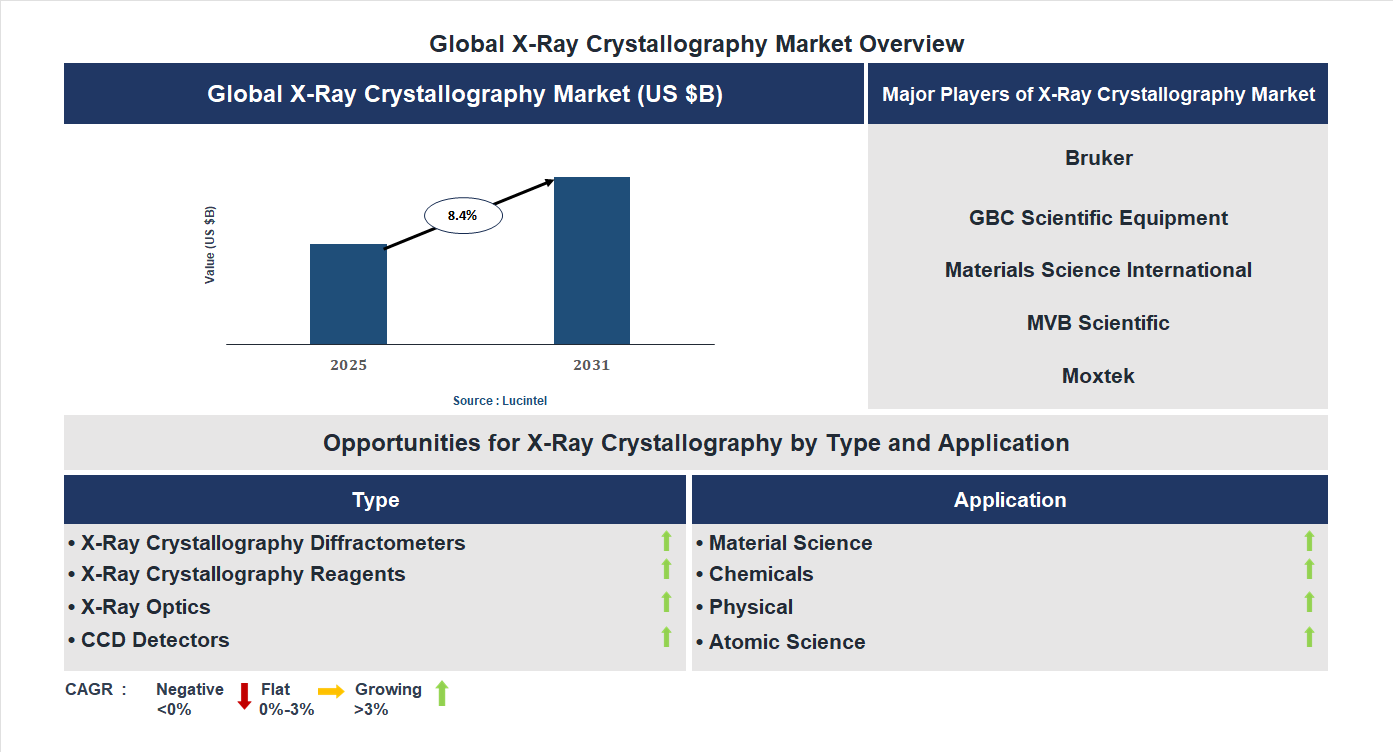
The future of the global X-ray crystallography market looks promising with opportunities in the material science, chemical, physical, and atomic science markets. The global X-ray crystallography market is expected to grow with a CAGR of 8.4% from 2025 to 2031. The major drivers for this market are the increasing demand for drug discovery techniques, the rising need for precise material characterization, and the growing adoption in structural biology research.• Lucintel forecasts that, within the type category, X-ray crystallography diffractometer is expected to witness the highest growth over the forecast period.
• Within the application category, material science is expected to witness the highest growth.
• In terms of region, APAC is expected to witness the highest growth over the forecast period. Gain valuable insights for your business decisions with our comprehensive 150+ page report. Sample figures with some insights are shown below.
Emerging Trends in the X-Ray Crystallography Market
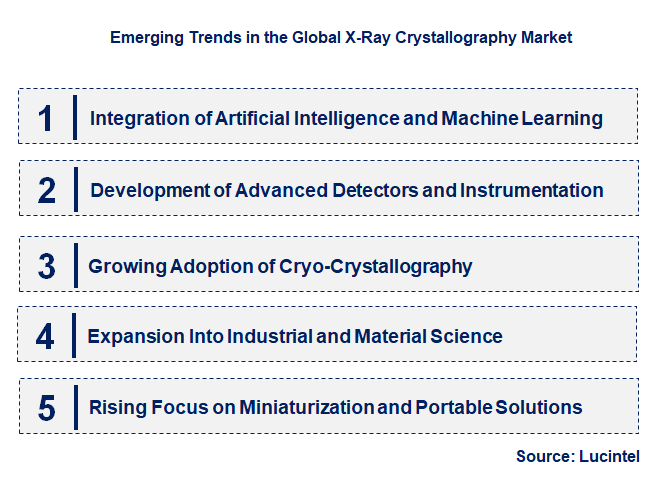
The X-ray crystallography market is experiencing rapid evolution driven by technological advancements, increasing research activities, and expanding applications across various industries such as pharmaceuticals, materials science, and biotechnology. As the demand for precise structural analysis grows, market players are adopting innovative solutions to enhance accuracy, efficiency, and affordability. These developments are not only transforming traditional methodologies but also opening new avenues for scientific discovery and industrial applications. The following key trends highlight the dynamic nature of this market and its trajectory toward greater sophistication and integration with emerging technologies.• Integration of Artificial Intelligence and Machine Learning: AI and machine learning algorithms are increasingly being incorporated into crystallography workflows to automate data analysis, improve accuracy, and accelerate structure determination. These technologies enable faster processing of complex datasets, reduce human error, and facilitate the discovery of novel compounds. As a result, research productivity is enhanced, and the potential for breakthroughs in drug development and materials science is significantly increased. This integration is expected to revolutionize the efficiency and scope of crystallographic studies.
• Development of Advanced Detectors and Instrumentation: Innovations in detector technology, such as hybrid pixel detectors and faster CCDs, are improving data collection speed and resolution. Enhanced instrumentation allows for more precise measurements, even with smaller or less perfect crystals, broadening the range of samples that can be analyzed. These advancements reduce experimental time and costs while increasing data quality, making crystallography more accessible and reliable for researchers. The continuous evolution of hardware is pivotal in pushing the boundaries of structural analysis.
• Growing Adoption of Cryo-Crystallography: Cryo-crystallography, which involves flash-freezing samples to preserve their native state, is gaining popularity due to its ability to study delicate biological molecules without damage. This technique enables high-resolution imaging of proteins, viruses, and other biomolecules, facilitating drug discovery and structural biology research. Its adoption is driven by improvements in cryo-electron microscopy and related technologies, making it a vital tool for understanding complex biological systems. The trend enhances the capability to analyze previously challenging samples, expanding the scope of biological research.
• Expansion into Industrial and Material Science Applications: Beyond pharmaceuticals, X-ray crystallography is increasingly used in materials science, nanotechnology, and semiconductor industries. It helps in characterizing new materials, understanding crystal defects, and developing advanced nanostructures. This diversification broadens the market base and drives demand for specialized equipment and expertise. As industries seek to innovate with novel materials, crystallography becomes essential for quality control, research, and development, fueling market growth and technological diversification.
• Rising Focus on Miniaturization and Portable Solutions: The development of compact, portable crystallography devices is making structural analysis more accessible outside traditional laboratory settings. These solutions are particularly useful for field research, on-site quality control, and educational purposes. Miniaturization reduces costs and increases flexibility, enabling broader adoption across various sectors. This trend democratizes access to crystallography, fosters real-time analysis, and accelerates research timelines, ultimately transforming how and where structural analysis is conducted. In summary, these emerging trends are collectively reshaping the X-ray crystallography market by enhancing technological capabilities, expanding application areas, and increasing accessibility. They are driving faster, more accurate, and more versatile structural analysis, which in turn accelerates scientific discovery and industrial innovation. As these trends continue to evolve, the market is poised for significant growth and increased integration with cutting-edge technologies, ensuring its pivotal role in advancing multiple scientific disciplines.
Recent Development in the X-Ray Crystallography Market
The X-ray crystallography market has experienced significant advancements driven by technological innovations, increasing research activities, and expanding applications across various industries such as pharmaceuticals, materials science, and biotechnology. These developments are shaping the future landscape of structural analysis, enabling more precise, faster, and cost-effective solutions. As the demand for detailed molecular insights grows, key innovations are emerging to meet these needs, fostering market growth and diversification. The following are five recent key developments that are influencing this markets trajectory and competitive dynamics.• Enhanced Detector Technologies: Improved detector sensitivity and resolution have increased data accuracy and reduced analysis time, enabling researchers to obtain clearer structural images faster. This advancement enhances the efficiency of crystallography experiments, leading to quicker drug discovery and material development processes.
• Integration of AI and Machine Learning: The incorporation of artificial intelligence and machine learning algorithms into crystallography software has streamlined data processing, pattern recognition, and structure prediction. This integration accelerates analysis, reduces human error, and broadens accessibility for non-expert users, thus expanding market reach.
• Development of Portable Crystallography Devices: The advent of portable X-ray crystallography instruments allows in-field analysis and real-time data collection outside traditional laboratory settings. This innovation broadens application scopes, especially in environmental studies, forensic analysis, and on-site pharmaceutical testing.
• Advances in Cryo-Crystallography: Improvements in cryo-cooling techniques and equipment have enabled the study of delicate biological samples at near-atomic resolution without damage. This development is crucial for structural biology, facilitating drug design and understanding complex biomolecular interactions.
• Expansion of Software and Data Management Solutions: The growth of sophisticated software platforms for data collection, analysis, and storage has optimized workflow efficiency. Enhanced data management supports large-scale projects and collaborative research, fostering innovation and reducing operational costs. In summary, these recent developments are significantly impacting the X-ray crystallography market by increasing accuracy, efficiency, and accessibility. They are enabling faster discovery processes, expanding application areas, and reducing costs, which collectively drive market growth and competitiveness. As technological innovations continue, the market is poised for sustained expansion and diversification across multiple sectors.
Strategic Growth Opportunities in the X-Ray Crystallography Market
The X-ray crystallography market is experiencing rapid growth driven by advancements in technology, increasing applications in pharmaceuticals, materials science, and biotechnology. As industries seek more precise structural analysis tools, key applications are expanding, creating significant opportunities for market players. These developments are shaping the future landscape of the market, fostering innovation, and enhancing research capabilities across various sectors. Understanding these growth opportunities is essential for stakeholders aiming to capitalize on emerging trends and maintain competitive advantage in this dynamic environment.• Pharmaceutical Development: Accelerating Drug Discovery : X-ray crystallography enables detailed visualization of molecular structures, facilitating faster drug design and development. This reduces time-to-market for new medications and improves success rates in identifying effective compounds, thereby boosting pharmaceutical innovation and market growth.
• Materials Science Innovation: Enhancing Material Properties : The technique helps analyze crystal structures of new materials, leading to the development of stronger, lighter, and more durable materials. This impacts industries such as aerospace, electronics, and energy storage by enabling the creation of advanced materials with tailored properties.
• Biotechnology Advancements: Structural Biology Insights : In biotechnology, X-ray crystallography provides critical insights into protein and enzyme structures. This supports the development of biotherapeutics and personalized medicine, expanding the market for biologics and improving treatment options.
• Academic and Research Institutions: Supporting Fundamental Discoveries : Universities and research centers utilize X-ray crystallography for fundamental scientific research. This fosters innovation, enhances scientific understanding, and drives the development of new applications, thereby expanding the market’s scope.
• Quality Control and Certification: Ensuring Product Integrity : Industries such as pharmaceuticals and chemicals rely on X-ray crystallography for quality assurance and certification. This ensures product consistency, safety, and compliance with regulatory standards, reinforcing market stability and growth. In summary, these key growth opportunities across applications are significantly impacting the X-ray crystallography market by driving technological advancements, expanding application areas, and fostering innovation. This dynamic environment is attracting increased investments and collaborations, ultimately propelling market expansion and establishing X-ray crystallography as an indispensable tool across multiple industries.
X-Ray Crystallography Market Driver and Challenges
The X-ray crystallography market is influenced by a variety of technological, economic, and regulatory factors that shape its growth trajectory. Advances in imaging technology and computational methods have significantly enhanced the precision and speed of crystal structure determination. Economic factors such as increased funding for pharmaceutical and biotechnology research drive demand for detailed molecular analysis. Regulatory frameworks promoting drug discovery and development further stimulate market expansion. However, challenges like high operational costs, complex sample preparation, and regulatory hurdles can impede growth. Understanding these drivers and challenges is essential for stakeholders aiming to capitalize on emerging opportunities within this dynamic market. The factors responsible for driving the X-ray crystallography market include:-• Technological Advancements: The continuous development of high-resolution detectors, synchrotron radiation sources, and cryo-electron microscopy has revolutionized the field. These innovations enable faster, more accurate structure determination, reducing time and costs. Improved software algorithms for data processing also enhance efficiency, making it accessible to a broader range of research institutions. As technology evolves, the ability to analyze complex biomolecules and materials expands, fueling market growth and opening new avenues for research and application.
• Growing Pharmaceutical and Biotechnology Sectors: The increasing focus on drug discovery and personalized medicine has significantly boosted demand for X-ray crystallography. It is essential for elucidating the 3D structures of proteins and other biomolecules, which aids in targeted drug design. The rising prevalence of chronic diseases and the need for novel therapeutics further propel this demand. As pharmaceutical companies invest heavily in structural biology, the market benefits from sustained growth driven by innovation and the need for detailed molecular insights.
• Rising Research and Development Activities: Governments, academic institutions, and private companies are investing heavily in R&D to understand complex biological systems. X-ray crystallography plays a crucial role in these efforts, especially in structural biology, materials science, and nanotechnology. Increased funding and collaborative projects accelerate the development of new methodologies and applications, expanding the market. The proliferation of research initiatives worldwide ensures a steady demand for advanced crystallography equipment and services, fostering innovation and market expansion.
• Increasing Adoption in Material Science: Beyond biological applications, X-ray crystallography is increasingly used in materials science for analyzing crystalline structures of new materials, semiconductors, and nanomaterials. This diversification broadens the market scope, attracting industries focused on developing advanced materials with specific properties. The demand for high-performance materials in electronics, energy storage, and aerospace sectors drives the adoption of crystallography techniques, contributing to overall market growth.
• Expansion of Academic and Industrial Research: The global increase in research activities across universities, research institutes, and industries fuels demand for crystallography tools. As educational institutions incorporate advanced structural analysis techniques into their curricula, the need for accessible and affordable equipment rises. Industrial research, especially in pharmaceuticals, chemicals, and materials, relies heavily on crystallography for product development and quality control. This expanding research landscape sustains market growth and encourages technological innovation. The challenges facing this X-ray crystallography market include:-
• High Operational and Equipment Costs: The cost of acquiring and maintaining advanced X-ray crystallography equipment is substantial. High capital investment, coupled with ongoing expenses for maintenance, upgrades, and specialized consumables, can be prohibitive, especially for smaller institutions. These financial barriers limit widespread adoption and slow market penetration in emerging regions. Additionally, the need for highly skilled personnel to operate complex instruments further adds to operational costs, impacting overall profitability and growth potential.
• Complex Sample Preparation and Data Analysis: Preparing high-quality crystals suitable for X-ray analysis is often a time-consuming and technically demanding process. Variability in crystal quality can lead to delays and inconsistent results. Moreover, data processing and interpretation require specialized expertise and sophisticated software, which can be a barrier for new entrants. These complexities hinder rapid adoption and can increase project timelines, affecting the efficiency and scalability of research and industrial applications.
• Regulatory and Intellectual Property Challenges: Stringent regulatory frameworks governing the use of certain materials and data sharing can pose hurdles. Intellectual property rights related to structural data may restrict access and collaboration, slowing innovation. Additionally, compliance with safety standards and export controls can complicate international collaborations and market expansion. Navigating these regulatory landscapes requires significant effort and resources, potentially limiting market growth in highly regulated regions. In summary, the X-ray crystallography market is driven by technological innovations, expanding applications in pharmaceuticals, materials science, and research activities. However, high costs, complex procedures, and regulatory challenges present significant barriers. The interplay of these factors influences the market’s growth trajectory, with opportunities for innovation and expansion balanced by operational and regulatory hurdles. Overall, strategic investments in technology and collaboration, alongside addressing regulatory concerns, will be crucial for sustained growth in this evolving landscape.
List of X-Ray Crystallography Companies
Companies in the market compete on the basis of product quality offered. Major players in this market focus on expanding their manufacturing facilities, R&D investments, infrastructural development, and leverage integration opportunities across the value chain. With these strategies X-ray crystallography companies cater increasing demand, ensure competitive effectiveness, develop innovative products & technologies, reduce production costs, and expand their customer base. Some of the X-ray crystallography companies profiled in this report include-• Bruker
• GBC Scientific Equipment
• Materials Science International
• MVB Scientific
• Moxtek
• PANalytical
• Rigaku
X-Ray Crystallography Market by Segment
The study includes a forecast for the global X-ray crystallography market by type, application, and region.X-Ray Crystallography Market by Type [Value from 2019 to 2031]:
• X-Ray Crystallography Diffractometers
• X-Ray Crystallography Reagents
• X-Ray Optics
• CCD Detectors
X-Ray Crystallography Market by Application [Value from 2019 to 2031]:
• Material Science
• Chemicals
• Physical
• Atomic Science
X-Ray Crystallography Market by Region [Value from 2019 to 2031]:
• North America
• Europe
• Asia Pacific
• The Rest of the World
Country Wise Outlook for the X-Ray Crystallography Market
The X-ray crystallography market has experienced significant advancements driven by technological innovations, increasing research activities, and expanding applications across pharmaceuticals, materials science, and biotechnology sectors. Countries are investing heavily in research infrastructure and adopting cutting-edge techniques to enhance structural analysis capabilities. The United States remains a leader in innovation, while China, Germany, India, and Japan are rapidly expanding their market presence through government initiatives, industry collaborations, and increased R&D funding. These developments are shaping the future landscape of the market, fostering more precise, efficient, and cost-effective crystallography solutions worldwide.• United States: The US continues to lead in X-Ray Crystallography with major investments in research institutions and biotech companies. Recent advancements include the integration of cryo-electron microscopy with traditional crystallography, improving structural resolution. The development of high-throughput screening techniques and automation has accelerated drug discovery processes. Additionally, US-based companies are focusing on software innovations for data analysis, making structural determination faster and more accurate. Government agencies like NIH and NSF are funding projects to develop next-generation crystallography tools, further strengthening the countrys market position.
• China: China has rapidly expanded its X-Ray Crystallography capabilities through substantial government funding and industry collaborations. Recent developments include the establishment of state-of-the-art research facilities and the adoption of synchrotron radiation sources for high-resolution analysis. Chinese researchers are increasingly publishing in top-tier journals, indicating growing expertise. The market is also witnessing increased commercialization of crystallography equipment, with local manufacturers gaining global competitiveness. These efforts are aimed at supporting Chinas ambitions in pharmaceuticals, materials science, and biotechnology, positioning the country as a key player in the global market.
• Germany: Germany remains a prominent hub for X-Ray Crystallography, driven by its strong academic and industrial research sectors. Recent advancements include the deployment of advanced synchrotron facilities and the integration of artificial intelligence in data processing. German companies are innovating in the development of compact, user-friendly crystallography instruments, expanding accessibility for smaller labs. The country is also focusing on sustainable and energy-efficient solutions for crystallography research. Collaborative projects between universities and industry are fostering innovation, particularly in pharmaceuticals and materials research, maintaining Germany’s competitive edge in the market.
• India: India is witnessing rapid growth in the X-Ray Crystallography market, supported by increased government initiatives and private sector investments. Recent developments include the establishment of new research centers equipped with advanced crystallography instruments and synchrotron facilities. Indian scientists are making notable contributions to structural biology and drug discovery, aided by improved infrastructure. The market is also seeing a rise in local manufacturing of crystallography equipment, reducing dependence on imports. These advancements are aligned with India’s broader goals of becoming a global hub for biotech and pharmaceutical research, boosting the countrys market share and innovation capacity.
• Japan: Japan continues to advance in X-Ray Crystallography through technological innovation and strategic collaborations. Recent developments include the enhancement of synchrotron radiation facilities and the adoption of next-generation detectors for higher resolution analysis. Japanese research institutions are focusing on integrating crystallography with other structural biology techniques, such as NMR and cryo-EM, to provide comprehensive insights. The industry is also emphasizing miniaturization and automation of crystallography instruments to improve usability and efficiency. Japan’s strong emphasis on R&D and innovation sustains its position as a key player in the global market, particularly in pharmaceuticals and advanced materials.

Features of the Global X-Ray Crystallography Market
Market Size Estimates: X-ray crystallography market size estimation in terms of value ($B). Trend and Forecast Analysis: Market trends (2019 to 2024) and forecast (2025 to 2031) by various segments and regions. Segmentation Analysis: X-ray crystallography market size by type, application, and region in terms of value ($B). Regional Analysis: X-ray crystallography market breakdown by North America, Europe, Asia Pacific, and Rest of the World. Growth Opportunities: Analysis of growth opportunities in different type, application, and regions for the X-ray crystallography market. Strategic Analysis: This includes M&A, new product development, and competitive landscape of the X-ray crystallography market. Analysis of competitive intensity of the industry based on Porter’s Five Forces model.
FAQ
Q1. What is the growth forecast for X-ray crystallography market? Answer: The global X-ray crystallography market is expected to grow with a CAGR of 8.4% from 2025 to 2031. Q2. What are the major drivers influencing the growth of the X-ray crystallography market? Answer: The major drivers for this market are the increasing demand for drug discovery techniques, the rising need for precise material characterization, and the growing adoption in structural biology research. Q3. What are the major segments for X-ray crystallography market? Answer: The future of the X-ray crystallography market looks promising with opportunities in the material science, chemical, physical, and atomic science markets. Q4. Who are the key X-ray crystallography market companies? Answer: Some of the key X-ray crystallography companies are as follows:• Bruker
• GBC Scientific Equipment
• Materials Science International
• MVB Scientific
• Moxtek
• PANalytical
• Rigaku Q5. Which X-ray crystallography market segment will be the largest in future? Answer: Lucintel forecasts that, within the type category, X-ray crystallography diffractometer is expected to witness the highest growth over the forecast period. Q6. In X-ray crystallography market, which region is expected to be the largest in next 5 years? Answer: In terms of region, APAC is expected to witness the highest growth over the forecast period. Q7. Do we receive customization in this report? Answer: Yes, Lucintel provides 10% customization without any additional cost.
Table of Contents
List of Figures
List of Tables
Methodology
- In-depth interviews of the major players in this market
- Detailed secondary research from competitors’ financial statements and published data
- Extensive searches of published works, market, and database information pertaining to industry news, company press releases, and customer intentions
- A compilation of the experiences, judgments, and insights of Lucintel’s professionals, who have analyzed and tracked this market over the years.


Buy Now
Choose a license that fits your team. Instant PDF delivery.
Prices exclude taxes. Instant delivery. Custom licensing available on request.
Key Questions
- • What are some of the most promising, high-growth opportunities for the X-ray crystallography market by type (X-ray crystallography diffractometers, X-ray crystallography reagents, X-ray optics, and CCD detectors), application (material science, chemicals, physical, and atomic science), and region (North America, Europe, Asia Pacific, and the Rest of the World)?
- • Which segments will grow at a faster pace and why?
- • Which region will grow at a faster pace and why?
- • What are the key factors affecting market dynamics? What are the key challenges and business risks in this market?
- • What are the business risks and competitive threats in this market?
- • What are the emerging trends in this market and the reasons behind them?
- • What are some of the changing demands of customers in the market?
- • What are the new developments in the market? Which companies are leading these developments?
- • Who are the major players in this market? What strategic initiatives are key players pursuing for business growth?
- • What are some of the competing products in this market and how big of a threat do they pose for loss of market share by material or product substitution?
- • What M&A activity has occurred in the last 5 years and what has its impact been on the industry? For any questions related to X-Ray Crystallography Market, X-Ray Crystallography Market Size, X-Ray Crystallography Market Growth, X-Ray Crystallography Market Analysis, X-Ray Crystallography Market Report, X-Ray Crystallography Market Share, X-Ray Crystallography Market Trends, X-Ray Crystallography Market Forecast, X-Ray Crystallography Companies, write Lucintel analyst at email: helpdesk@lucintel.com. We will be glad to get back to you soon.


