
Report Feature
Wireless Telecommunication Service Market Trends and Forecast
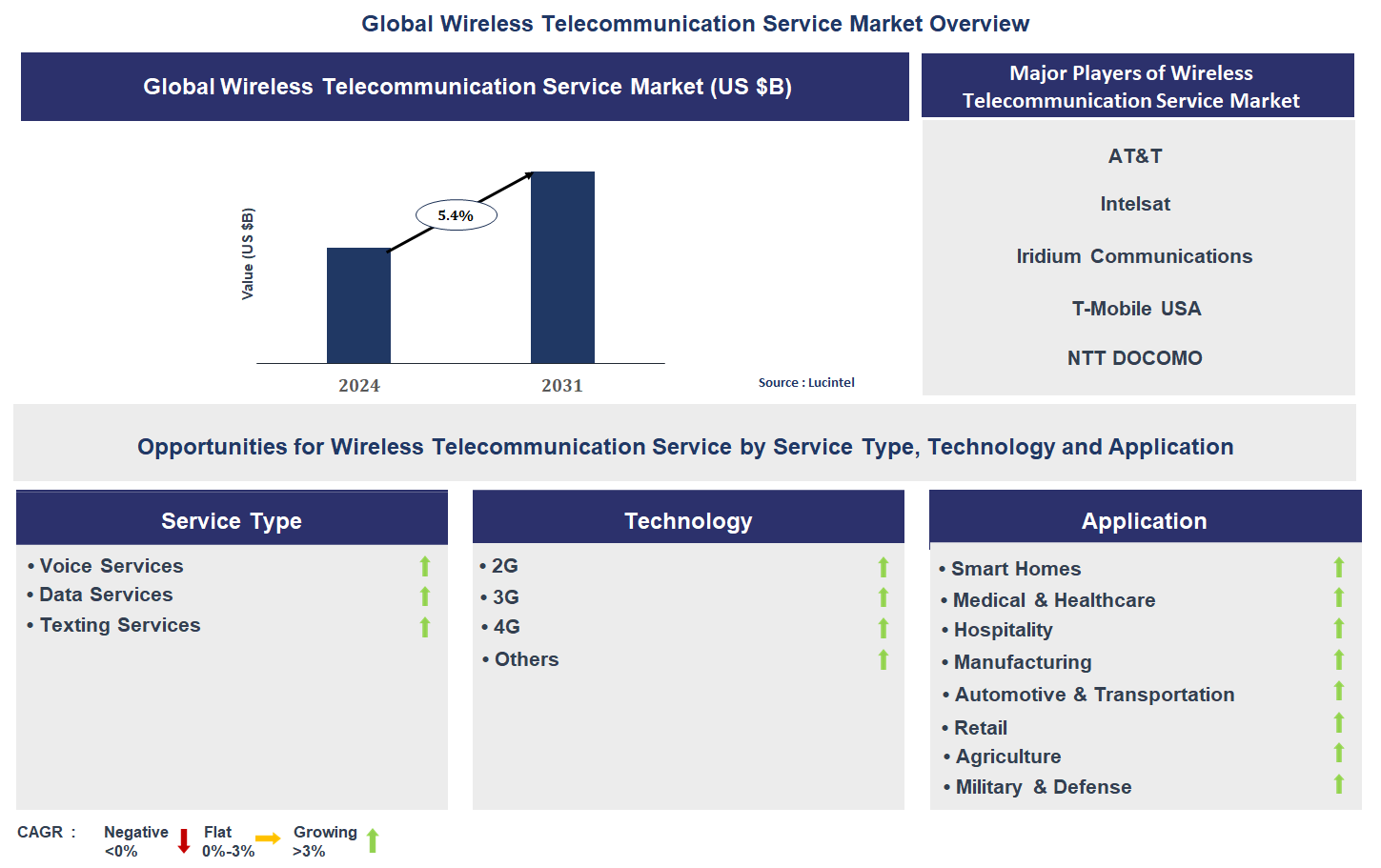
The future of the global wireless telecommunication service market looks promising with opportunities in the smart home, medical & healthcare, hospitality, manufacturing, automotive & transportation, retail, agriculture, and military & defense markets. The global wireless telecommunication service market is expected to grow with a CAGR of 5.4% from 2025 to 2031. The major drivers for this market are the increasing demand for mobile connectivity, the rising adoption of 5G technology, and the growing need for high-speed internet.• Lucintel forecasts that, within the service type category, data service is expected to witness the highest growth over the forecast period.
• Within the application category, smart home is expected to witness the highest growth.
• In terms of region, APAC is expected to witness the highest growth over the forecast period. Gain valuable insights for your business decisions with our comprehensive 150+ page report. Sample figures with some insights are shown below.
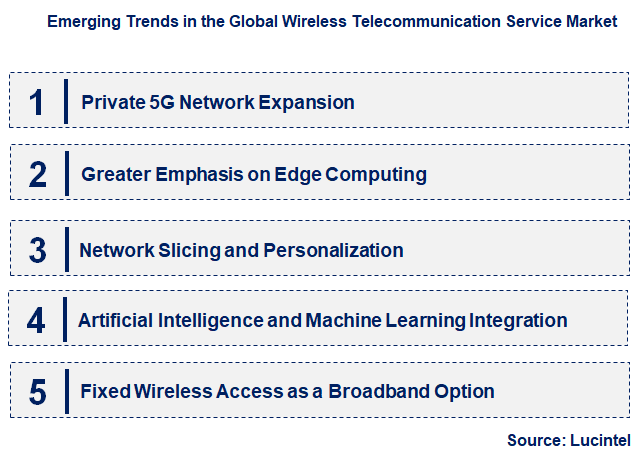
Emerging Trends in the Wireless Telecommunication Service Market
The wireless telecommunication service market is being transformed by a number of pivotal new trends driving the industry to increased technological advancement, enhanced efficiency, and wider application. These trends have a direct response to the need for smarter, more connected, and scalable connectivity solutions globally. The market is shifting away from a mere utility and evolving into a fundamental data processing, security, and power management core platform. This is revolutionizing the delivery of services and is creating new avenues for smart technologies and automation.• Private 5G Network Expansion: One of the key trends is the expansion of private 5G networks for business. Enterprises in industries such as manufacturing and logistics are implementing their own dedicated networks to provide secure, dependable, and low-latency connectivity for their activities. The outcome is a new and profitable business-to-business (B2B) market for telecommunications companies. This trend is opening doors for carriers to offer network as a service and for equipment vendors to offer private network solutions that are tailored to customer needs.
• Greater Emphasis on Edge Computing: A new trend is the move toward edge computing, which means that data is processed closer to where it is being created instead of shipping it off to a central cloud. This is critical for low-latency applications such as autonomous vehicles, AR, and VR. The effect is a nimbler and more effective network. Telecommunications operators are strategically placing mini data centers at the edge of the network to host these applications, presenting themselves as an essential element of the digital value chain.
• Network Slicing and Personalization: One major trend is utilizing network slicing, whereby operators can define several virtual networks on one physical 5G infrastructure. Every slice is configurable to address the unique needs of a specific application or a customer, for example, for a telemedicine service or smart factory. The effect is a scalable and flexible model for delivering services. This is facilitating telcos to provide premium, a la carte services to enterprise customers and effectively manage network resources to address fluctuating demands.
• Artificial Intelligence and Machine Learning Integration: One of the top trends is the rise of more integration of machine learning and artificial intelligence in network operations. AI-based systems are being utilized for predictive maintenance, network optimization, and automated resource allocation. The effect is a more intelligent, more robust, and cost-efficient network. AI is assisting carriers in dealing with the intricacy of contemporary networks, with the ability to predict potential failures before they happen and modify network parameters automatically to enhance performance and the quality of the customer experience.
• Fixed Wireless Access as a Broadband Option: A new trend is the rising popularity of FWA as an affordable substitute for traditional fiber or cable broadband. FWA employs 5G technology in providing fast internet to businesses and households without the necessity of a wired physical connection. The effect is a new source of revenue for wireless providers and an ending to the digital divide in rural and remote areas. This is also contributing to more competition in the residential internet market. These trends are combined to redefine the market by making wireless telecommunication services more intelligent, flexible, and indispensable for a myriad of industries and applications, putting the industry in a position to experience strong future growth.
Recent Development in the Wireless Telecommunication Service Market
The wireless telecommunication service market is experiencing vibrant development, mirroring a robust worldwide appetite for advanced and effective connectivity solutions. These developments are not just incremental but are in fact revolutionizing the industry’s landscape. The emphasis is on enhancing the accuracy of connectivity, taking it into new areas of application, and developing more affordable ways of production. This is a critical time for the market as it continues to rise in significance across industries ranging from the automotive and medical to consumer electronics and industrial automation.• National 5G Deployments: One of the significant developments is the rapid deployment of 5G networks across an entire country in major markets globally. The large carriers are competing aggressively to install new infrastructure that supports 5G’s greater speed and reduced latency. The effect is a fundamental change in wireless technology. This huge investment is a condition for new innovations in connected devices and applications and is one of the most significant drivers of competition among worldwide service providers.
• Fixed Wireless Access Adoption Rate Growth: One of the major trends is the growth in the adoption rate of FWA as a residential internet solution. Using existing cellular networks, FWA offers a quick and dependable substitute for standard wired broadband offerings. The effect is a new revenue stream for mobile carriers and a means of delivering high-speed internet to rural and suburban regions. This is disrupting the broadband marketplace and is fostering increased competition.
• Emphasis on Open RAN Technology: The most recent evolution is increased enthusiasm for Open Radio Access Network (Open RAN) technology. Open RAN enables carriers to combine hardware and software from multiple vendors, dispelling the conventional dependency on a single source. The effect is more flexibility and lower expenses for the deployment of the network. This is providing a more diverse and competitive market for equipment makers and is enabling carriers to create more tailored networks.
• Strategic Enterprise Partnerships: One of the notable advancements is strategic partnerships among telecom companies and cloud providers to provide bundled enterprise solutions. These collaborations bring together the bandwidth of 5G and the processing capacity of cloud computing and edge computing. The effect is a merged and robust solution for enterprises across industries such as manufacturing, logistics, and healthcare. This is putting carriers as a critical partner in the digital transformation of a company.
• Launch of New Consumer Service Plans: One of the emerging developments is the launch of new consumer service plans that are customized to the 5G capabilities. Some of these plans include those with unlimited data, higher speeds for video streaming and gaming, and streaming services bundling with a phone plan. The effect is monetization of 5G infrastructure and a new model for attracting and retaining customers in a very competitive marketplace. These initiatives are fueling consumer adoption of 5G devices and services. Collectively, these developments are transforming the market by making wireless telecommunication services more adaptable, integrated, and indispensable to a broad set of industries, setting the stage for a future of ubiquitous and indispensable use.
Strategic Growth Opportunities in the Wireless Telecommunication Service Market
The wireless telecommunication service market presents many strategic opportunities for growth across major applications based on the expanding global need for intelligent systems and advanced automation. Firms that can best exploit these opportunities will be poised for future success. Opportunities stretch into specialized markets that have a use for the specialized characteristics of wireless telecommunication services. Strategic expansion will be driven by the capacity to innovate in the interpretation of data, miniaturization, and service delivery to fulfill the changing needs of different industries.• Industrial IoT and Smart Manufacturing: One of the major strategic growth prospects is offering committed wireless solutions for the industrial IoT and smart manufacturing. These involve rolling out private 5G networks, which provide secure, dependable, and low-latency connectivity to robotics, automated factory assembly lines, and real-time machine monitoring. The effect is gaining access to a high-value B2B market that relies on dependable connectivity to optimize operational efficiency, safety, and productivity.
• Connected and Autonomous Vehicles: The automotive industry is a significant strategic growth opportunity. Wireless services for telematics, in-car infotainment, and vehicle-to-everything (V2X) communication are increasingly in demand. The effect is an enormous and high-volume market segment that places importance on security, reliability, and low latency for facilitating advanced driver-assistance systems and autonomous driving. By facilitating the underlying communication infrastructure for these vehicles, carriers can gain a substantial portion of this new market.
• Healthcare and Remote Patient Monitoring: The healthcare industry is a high-growth strategic market. There is increasing demand for secure and reliable wireless services for remote patient monitoring, telemedicine, and medical devices. The result is a high-payoff and high-stakes market where reliability and low latency are essential for patient safety and positive health outcome. Businesses can offer solutions that allow real-time data transmission and support the trend toward more personalized and preventative care.
• Smart City and Infrastructure Management: One of the most important strategic growth opportunities is in the smart city and infrastructure management areas. Wireless services play a critical role in tying together a city’s multiple systems, such as smart streetlights, traffic systems, and public safety networks. The result is a flexible market with the potential to develop new product categories for urban planning and resource management. By offering a solid communications foundation for a city’s infrastructure, carriers can become an integral part of making more efficient and sustainable cities.
• High-Speed Fixed Wireless Access: The FWA residential and small business market is a top strategic growth area. By providing high-speed internet service over a wireless network, carriers can compete head-to-head with traditional cable and fiber providers. The effect is a vast, high-volume market with especially high appeal in regions with no or limited access to high-speed wired broadband. FWA is a great method for carriers to make money on existing 5G infrastructure and increase their number of customers. These strategic growth opportunities are affecting the market by propelling specialization and innovation. The industry is heading toward a world where customized, high-performance wireless telecommunication service solutions are the determinants of success in several high-impact industries.
Wireless Telecommunication Service Market Driver and Challenges
The wireless telecommunication service industry is influenced by a blend of strong drivers and huge challenges. The drivers are largely the answer to a worldwide trend to become more interlinked and the demand for more effective and smarter devices. The challenges, in contrast, are the technical intricacies of production, security, and unstandardized circumstances. The long-term success of the market will depend on its capacity to utilize its drivers of growth whilst methodically resolving its barriers. The interaction between these forces will determine the pace and direction of the industry’s evolution. The factors responsible for driving the wireless telecommunication service market include: 1. Explosive Growth in 5G Technology: The biggest solitary driver is the massive roll-out of 5G networks. The technology allows for the high speeds and low latency demanded by next-generation applications such as the IoT, AR, and connected cars, which is driving a huge and sustained need for wireless services and carriers’ new method to grow their total addressable market. 2. Exponential Expansion of Internet of Things (IoT): IoT device growth across all industries, from consumer electronics to industrial equipment, is one of the significant drivers. With every new connected device, there comes a wireless service, which becomes a significant driver of the market growth. Not only is it driving data consumption, but it is also generating demand for new categories of low-power and wide-area network services. 3. Rising Demand for Mobile Data: The world demand for mobile data is a strong impeller, fueled by the massive adoption of smartphones and data-hungry applications such as video streaming and online gaming. This is compelling carriers to invest in network upgrades and capacity additions to support the ongoing demand for faster and more dependable connectivity, which is consequently driving market revenue. 4. Cloud and Edge Computing innovations: Cloud and edge computing are some of the most important drivers of the market. Both technologies need low-latency and strong networks to have error-free data transmission and processing. With increasing adoption of cloud-based services by businesses and consumers, there is a greater need for wireless services, which is generating new demand. 5. Government Plans and Digital Evolution: Other government plans to enhance digital inclusion and smart city initiatives are important catalysts. Through offering incentives and capital investment straightaway for network growth, especially in rural and underserved geographies, governments are reducing hurdles for telecom operators and opening up new possibilities for market expansion and societal progress. Challenges in the wireless telecommunication service market are: 1. High Capital Costs: One of the biggest issues is the enormous amount of capital spent to deploy network infrastructure, especially for 5G. The expense of buying up spectrum licenses and constructing new cell towers and other equipment is staggering, and this puts great financial pressure on carriers and can result in consolidation and reduced competition. 2. Severe Competition and Pricing Erosion: The industry experiences severe competition and ongoing price erosion. With numerous carriers competing for few customers, there is always pressure to reduce prices and provide more data, which can dilute profitability and make it challenging for firms to justify a huge investment in network upgrades. 3. Issues of Regulatory and Spectrum Management: The wireless telecommunication industry is governed by a highly dynamic and complex regulatory framework. Problems related to spectrum allocation, network neutrality, and consumer privacy of data create uncertainty and can be a serious challenge for carriers. Crossing these regulatory hurdles increases the complexity and cost of a business. In sum, wireless telecommunication service market is fueled by powerful forces of technological innovation and a worldwide trend toward a more integrated world. Yet, it has to overcome hurdles in terms of the costliness of its systems, fierce rivalry, and its complicated regulatory landscape to reach its full potential. The industry’s future success will depend on its ability to provide solutions that are not only high-performance and versatile but also affordable, secure, and easily integrated into a wide range of applications.List of Wireless Telecommunication Service Companies
Companies in the market compete on the basis of product quality offered. Major players in this market focus on expanding their manufacturing facilities, R&D investments, infrastructural development, and leverage integration opportunities across the value chain. With these strategies wireless telecommunication service companies cater increasing demand, ensure competitive effectiveness, develop innovative products & technologies, reduce production costs, and expand their customer base. Some of the wireless telecommunication service companies profiled in this report include-• AT&T
• Intelsat
• Iridium Communications
• T-Mobile USA
• NTT DOCOMO
• China Mobile
• Hawaiian Telcom
• Softbank Telecom Corp.
• U.S. Cellular
• New-Cell
Wireless Telecommunication Service Market by Segment
The study includes a forecast for the global wireless telecommunication service market by service type, technology, application, and region.Wireless Telecommunication Service Market by Service Type [Value from 2019 to 2031]:
• Voice Services
• Data Services
• Texting Services
Wireless Telecommunication Service Market by Technology [Value from 2019 to 2031]:
• 2G
• 3G
• 4G
• Others
Wireless Telecommunication Service Market by Application [Value from 2019 to 2031]:
• Smart Homes
• Medical & Healthcare
• Hospitality
• Manufacturing
• Automotive & Transportation
• Retail
• Agriculture
• Military & Defense
Wireless Telecommunication Service Market by Region [Value from 2019 to 2031]:
• North America
• Europe
• Asia Pacific
• The Rest of the World
Country Wise Outlook for the Wireless Telecommunication Service Market
The wireless telecommunication service market is also going through an era of substantial change, driven by the universal uptake of 5G technology and the ongoing growth of the Internet of Things (IoT). The market is evolving from simple voice and data services to one where highly tailored, ultra-low-latency solutions are being offered for a host of different industries. Current innovations revolve around enhancing network efficiency, broadening coverage, and launching new services that take advantage of next-generation network capabilities.• United States: In the United States, the latest innovations are mainly concentrated on the nationwide deployment of 5G networks, especially on C-Band and millimeter-wave spectrums. There is a high priority on 5G deployment into rural and remote communities, with carriers making big bets on network densification. A fundamental development is the growing monetization of 5G through new services, including private 5G networks for business and fixed wireless access (FWA) as a rival to traditional broadband. The market is also witnessing increased collaborations between telecommunication companies and cloud players to support edge computing solutions.
• China: China’s wireless telecommunication service market is growing at a meteoric rate, fueled by a huge government-led initiative for the country-wide deployment of 5G. With infrastructure investment running into billions of dollars, China boasts the world’s largest 5G network in terms of coverage and subscriber base. One of the major developments is the integration of 5G into industry and smart city use cases, such as smart manufacturing, connected cars, and smart surveillance systems. The market also continues to experience a robust government and industry emphasis on the evolution of future standards like 6G.
• Germany: The market for Germany is defined by robust emphasis on high-quality, high-reliability networks for industrial use. Recent focus has been on the build-out of 5G networks to aid the nation’s Industry 4.0 plans, with a special focus on private campus networks. One of the primary developments is the collaboration between industrial players and telecom operators to build tailored network slices for targeted use cases such as real-time robotics and automated logistics. The industry is also witnessing increased emphasis on energy-efficient and sustainable network operations.
• India: India’s wireless telecommunication services market is in the high-growth stage, driven by a cheap and fast 5G rollout and rising smartphone penetration. With a huge population base, the emphasis is on offering high-speed data at an affordable price, leading to a dramatic rise in data consumption. One of the major developments is the rural digitally inclusive reach enabled by different government programs and installation of new tower infrastructure. The market also witnesses intense competition among leading operators, leading to innovative and low-cost data plans.
• Japan: Japan’s market has a tradition of mobile technology innovation going back many years. Recent trends focus on developing 5G services with new-age features such as high-speed connectivity for connected cars and smart home systems. One of the most significant developments is the expanding application of AI and automation in network management to enhance efficiency and decrease operational expenses. The market also places strong emphasis on creating new applications and services that make use of 5G’s low latency and high capacity, like augmented reality (AR) and virtual reality (VR) content.

Features of the Global Wireless Telecommunication Service Market
Market Size Estimates: Wireless telecommunication service market size estimation in terms of value ($B). Trend and Forecast Analysis: Market trends (2019 to 2024) and forecast (2025 to 2031) by various segments and regions. Segmentation Analysis: Wireless telecommunication service market size by service type, technology, application, and region in terms of value ($B). Regional Analysis: Wireless telecommunication service market breakdown by North America, Europe, Asia Pacific, and Rest of the World. Growth Opportunities: Analysis of growth opportunities in different service types, technologies, applications, and regions for the wireless telecommunication service market. Strategic Analysis: This includes M&A, new product development, and competitive landscape of the wireless telecommunication service market. Analysis of competitive intensity of the industry based on Porter’s Five Forces model.
FAQ
Q1. What is the growth forecast for wireless telecommunication service market? Answer: The global wireless telecommunication service market is expected to grow with a CAGR of 5.4% from 2025 to 2031. Q2. What are the major drivers influencing the growth of the wireless telecommunication service market? Answer: The major drivers for this market are the increasing demand for mobile connectivity, the rising adoption of 5g technology, and the growing need for high-speed internet. Q3. What are the major segments for wireless telecommunication service market? Answer: The future of the wireless telecommunication service market looks promising with opportunities in the smart home, medical & healthcare, hospitality, manufacturing, automotive & transportation, retail, agriculture, and military & defense markets. Q4. Who are the key wireless telecommunication service market companies? Answer: Some of the key wireless telecommunication service companies are as follows:• AT&T
• Intelsat
• Iridium Communications
• T-Mobile USA
• NTT DOCOMO
• China Mobile
• Hawaiian Telcom
• Softbank Telecom Corp.
• U.S. Cellular
• New-Cell Q5. Which wireless telecommunication service market segment will be the largest in future? Answer: Lucintel forecasts that, within the service type category, data service is expected to witness the highest growth over the forecast period. Q6. In wireless telecommunication service market, which region is expected to be the largest in next 5 years? Answer: In terms of region, APAC is expected to witness the highest growth over the forecast period. Q7. Do we receive customization in this report? Answer: Yes, Lucintel provides 10% customization without any additional cost.
Table of Contents
List of Figures
List of Tables
Methodology
- In-depth interviews of the major players in this market
- Detailed secondary research from competitors’ financial statements and published data
- Extensive searches of published works, market, and database information pertaining to industry news, company press releases, and customer intentions
- A compilation of the experiences, judgments, and insights of Lucintel’s professionals, who have analyzed and tracked this market over the years.


Buy Now
Choose a license that fits your team. Instant PDF delivery.
Prices exclude taxes. Instant delivery. Custom licensing available on request.
Key Questions
- • What are some of the most promising, high-growth opportunities for the wireless telecommunication service market by service type (voice services, data services, and texting services), technology (2G, 3G, 4G, and others), application (smart homes, medical & healthcare, hospitality, manufacturing, automotive & transportation, retail, agriculture, and military & defense), and region (North America, Europe, Asia Pacific, and the Rest of the World)?
- • Which segments will grow at a faster pace and why?
- • Which region will grow at a faster pace and why?
- • What are the key factors affecting market dynamics? What are the key challenges and business risks in this market?
- • What are the business risks and competitive threats in this market?
- • What are the emerging trends in this market and the reasons behind them?
- • What are some of the changing demands of customers in the market?
- • What are the new developments in the market? Which companies are leading these developments?
- • Who are the major players in this market? What strategic initiatives are key players pursuing for business growth?
- • What are some of the competing products in this market and how big of a threat do they pose for loss of market share by material or product substitution?
- • What M&A activity has occurred in the last 5 years and what has its impact been on the industry? For any questions related to Wireless Telecommunication Service Market, Wireless Telecommunication Service Market Size, Wireless Telecommunication Service Market Growth, Wireless Telecommunication Service Market Analysis, Wireless Telecommunication Service Market Report, Wireless Telecommunication Service Market Share, Wireless Telecommunication Service Market Trends, Wireless Telecommunication Service Market Forecast, Wireless Telecommunication Service Companies, write Lucintel analyst at email: helpdesk@lucintel.com. We will be glad to get back to you soon.


