
Report Feature
Wireless Room Thermostat Market Trends and Forecast
The future of the global wireless room thermostat market looks promising with opportunities in the residential, commercial, and industrial markets. The global wireless room thermostat market is expected to grow with a CAGR of 11.5% from 2025 to 2031. The major drivers for this market are the increasing demand for energy-efficient solutions, the rising adoption of smart home systems, and the growing need for remote temperature control.• Lucintel forecasts that, within the product type category, programmable is expected to witness the highest growth over the forecast period.
• Within the application category, residential is expected to witness the highest growth.
• In terms of region, North America is expected to witness the highest growth over the forecast period. Gain valuable insights for your business decisions with our comprehensive 150+ page report. Sample figures with some insights are shown below.

Emerging Trends in the Wireless Room Thermostat Market
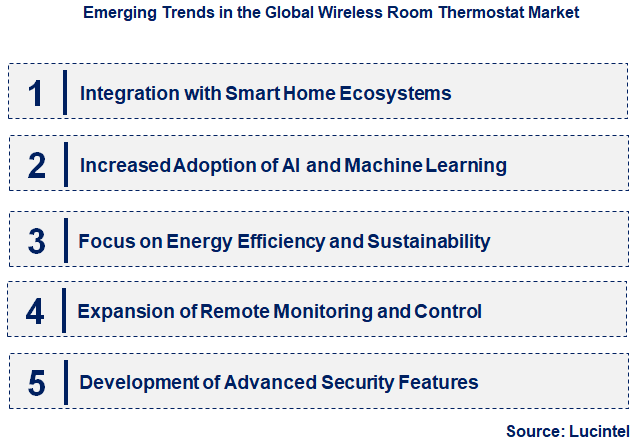
The wireless room thermostat market is experiencing rapid growth driven by technological advancements, increasing demand for energy efficiency, and the shift towards smart home automation. As consumers and businesses seek more convenient, cost-effective, and sustainable solutions, the market is evolving with innovative features and integration capabilities. These developments are not only enhancing user experience but also transforming how heating, ventilation, and air conditioning (HVAC) systems are managed. The following key trends highlight the major shifts shaping this market, reflecting its trajectory towards smarter, more connected, and energy-conscious environments.• Integration with Smart Home Ecosystems: The trend of integrating wireless thermostats with broader smart home systems is gaining momentum. Consumers prefer devices that seamlessly connect with voice assistants, security systems, and other IoT devices. This integration allows for centralized control, automation, and remote management, enhancing convenience and energy efficiency. Manufacturers are focusing on compatibility with popular platforms like Alexa, Google Assistant, and Apple HomeKit, which broadens market appeal and drives adoption.
• Increased Adoption of AI and Machine Learning: Artificial intelligence and machine learning are increasingly embedded in wireless thermostats to enable predictive and adaptive functionalities. These technologies analyze user behavior, weather patterns, and occupancy data to optimize heating and cooling schedules automatically. The result is improved energy savings, enhanced comfort, and reduced operational costs. As AI capabilities become more sophisticated, thermostats are evolving into intelligent systems that learn and adapt over time, transforming user experience and operational efficiency.
• Focus on Energy Efficiency and Sustainability: Growing environmental concerns and rising energy costs are pushing consumers and businesses to adopt energy-efficient solutions. Wireless thermostats now feature advanced sensors, zoning capabilities, and real-time energy consumption monitoring. These features help optimize HVAC performance, reduce wastage, and support sustainability goals. Governments and regulatory bodies are also promoting energy-efficient appliances, further accelerating market growth and innovation in this segment.
• Expansion of Remote Monitoring and Control: The proliferation of mobile apps and cloud connectivity has made remote management of thermostats more accessible and reliable. Users can control and monitor their HVAC systems from anywhere, at any time, via smartphones or tablets. This trend enhances convenience, allows for better energy management, and provides insights into usage patterns. It also facilitates maintenance and troubleshooting, reducing downtime and operational costs for service providers and end-users alike.
• Development of Advanced Security Features: As wireless thermostats become more connected, cybersecurity concerns are rising. Manufacturers are incorporating advanced security protocols, encryption, and user authentication to protect against hacking and unauthorized access. These security features are critical for maintaining user trust and safeguarding sensitive data. The focus on security is driving innovation in firmware updates, intrusion detection, and secure communication standards, ensuring that the growth of connected thermostats does not compromise user safety or privacy. In summary, these trends are collectively reshaping the wireless room thermostat market by making devices smarter, more secure, and more integrated with modern lifestyles. They are driving increased adoption, improving energy efficiency, and fostering sustainable practices. As technology continues to advance, the market is poised for significant growth, with innovative solutions that cater to the evolving needs of consumers and businesses in a connected world.
Recent Development in the Wireless Room Thermostat Market
The wireless room thermostat market is experiencing rapid growth driven by technological advancements and increasing demand for energy-efficient solutions. Innovations in smart home integration and IoT connectivity are transforming the industry landscape. Market players are focusing on developing user-friendly, customizable thermostats that enhance comfort and reduce energy costs. The expansion of smart infrastructure and rising awareness about sustainable living are further fueling this growth. These developments are creating new opportunities for manufacturers, service providers, and consumers alike, shaping the future of home automation and energy management.• Growing Adoption of Smart Home Technology: The increasing integration of wireless thermostats with smart home systems is expanding market reach. Consumers seek convenience, remote control, and automation, driving demand for connected devices. This trend enhances energy efficiency and user experience, encouraging more households and commercial spaces to adopt wireless thermostats. Manufacturers are investing in compatibility features and app-based controls, which boost sales and market penetration. The shift towards smart living environments is significantly impacting industry growth and innovation.
• Advancements in IoT and Connectivity: The evolution of IoT technology is enabling seamless communication between thermostats and other smart devices. Enhanced connectivity options like Wi-Fi, Zigbee, and Z-Wave improve reliability and ease of installation. These advancements facilitate real-time data collection, remote monitoring, and predictive maintenance, reducing operational costs. As IoT becomes more sophisticated, the market benefits from increased product functionalities and integration capabilities, attracting tech-savvy consumers and expanding the market scope.
• Focus on Energy Efficiency and Sustainability: Rising environmental concerns and government regulations are pushing for energy-efficient solutions. Wireless thermostats with smart algorithms optimize heating and cooling schedules, reducing energy consumption. The adoption of renewable energy sources and green building standards further accelerates this trend. Manufacturers are developing eco-friendly products with features like adaptive learning and occupancy sensing. This focus on sustainability not only helps consumers lower utility bills but also aligns with global efforts to combat climate change, thereby expanding market opportunities.
• Development of User-Friendly and Customizable Devices: Ease of use and personalization are key drivers in market growth. Modern wireless thermostats offer intuitive interfaces, voice control, and customizable settings to suit individual preferences. These features improve user engagement and satisfaction, encouraging wider adoption. Companies are investing in ergonomic designs and multilingual support to cater to diverse markets. The ability to tailor climate control solutions enhances customer loyalty and opens avenues for premium product segments, significantly impacting market expansion.
• Increasing Commercial and Industrial Applications: The demand for wireless thermostats is rising beyond residential use, especially in commercial and industrial sectors. These environments require precise temperature control, remote management, and energy monitoring. Wireless solutions offer scalability and flexibility, making them ideal for large facilities, offices, and manufacturing plants. The integration with building management systems enhances operational efficiency. This diversification into new sectors broadens the market base, stimulates innovation, and drives overall industry growth. The overall impact of these developments is a dynamic, expanding market characterized by innovative, energy-efficient, and user-centric solutions. The integration of smart technologies and sustainability initiatives is fostering new growth avenues, attracting a broader customer base, and encouraging industry players to innovate continuously. These trends are positioning the wireless room thermostat market for sustained growth and technological leadership.
Strategic Growth Opportunities in the Wireless Room Thermostat Market
The wireless room thermostat market is experiencing rapid expansion driven by increasing demand for smart home automation, energy efficiency, and remote management solutions. Technological advancements and the integration of IoT devices are creating new opportunities for manufacturers and service providers. As consumers and businesses seek more convenient, cost-effective climate control options, the market is poised for significant growth across various applications, including residential, commercial, and industrial sectors.• Expansion into Smart Home Ecosystems: Wireless room thermostats are increasingly integrated into comprehensive smart home systems, allowing users to control heating and cooling remotely via smartphones or voice assistants. This integration enhances user convenience, energy savings, and system automation, driving adoption among homeowners seeking connected living solutions. Manufacturers are focusing on compatibility with popular platforms, creating a seamless user experience that boosts market penetration.
• Growing Adoption in Commercial Buildings: The commercial sector is adopting wireless thermostats to optimize energy management and reduce operational costs. These devices enable real-time monitoring and control of HVAC systems across large facilities, improving efficiency and comfort. The ability to remotely manage multiple zones and integrate with building management systems makes wireless thermostats attractive for property managers and facility operators, fueling market growth in this segment.
• Advancements in IoT and Connectivity Technologies: The integration of IoT, Wi-Fi, Bluetooth, and Zigbee technologies is enhancing the functionality and reliability of wireless thermostats. These advancements facilitate better data collection, predictive maintenance, and personalized climate control. As connectivity becomes more robust and secure, the market will benefit from increased device interoperability, leading to smarter, more efficient heating and cooling solutions across various applications.
• Rising Focus on Energy Efficiency and Sustainability: Increasing awareness of energy conservation and environmental impact is driving demand for smart thermostats that optimize energy use. Wireless devices enable precise temperature control, scheduling, and adaptive learning, reducing energy wastage. Governments and organizations are promoting energy-efficient building standards, further encouraging adoption. This focus on sustainability is expected to propel market growth as consumers and businesses seek eco-friendly climate control options.
• Implementation of AI and Machine Learning for Enhanced Control: Incorporating AI and machine learning algorithms into wireless thermostats allows for predictive analytics and adaptive climate management. These technologies enable devices to learn user preferences, optimize energy consumption, and detect anomalies proactively. The result is improved comfort, reduced costs, and increased device intelligence, making these thermostats more appealing. As AI integration becomes more widespread, the market will see a shift toward highly autonomous, intelligent climate control solutions. The overall market outlook indicates that these growth opportunities will significantly influence the expansion and innovation within the wireless room thermostat market, fostering smarter, more efficient, and user-centric climate control solutions worldwide.
Wireless Room Thermostat Market Driver and Challenges
The wireless room thermostat market is influenced by a variety of technological, economic, and regulatory factors that shape its growth trajectory. Advances in smart home technology and IoT integration are driving demand for more efficient and user-friendly heating solutions. Economic factors such as rising energy costs and increasing consumer awareness about energy conservation are also significant. Additionally, regulatory standards aimed at reducing carbon emissions and promoting sustainable building practices are encouraging the adoption of wireless thermostats. However, the market faces challenges related to high initial costs, cybersecurity concerns, and compatibility issues with existing systems. Understanding these drivers and challenges is essential for stakeholders to navigate the evolving landscape effectively. The factors responsible for driving the wireless room thermostat market include:• Technological Innovation: The rapid development of IoT-enabled devices has revolutionized home automation, making wireless thermostats more intelligent, customizable, and easy to install. These devices can learn user preferences, optimize energy consumption, and integrate seamlessly with other smart home systems. The proliferation of mobile apps allows users to control their heating remotely, enhancing convenience and energy efficiency. As technology continues to evolve, the market is expected to see increased adoption driven by improved functionalities and user experience.
• Rising Energy Costs and Sustainability Initiatives: Increasing energy prices worldwide are prompting consumers and businesses to seek cost-effective heating solutions. Wireless thermostats help reduce energy wastage by providing precise control over heating systems, leading to significant savings. Governments and regulatory bodies are also promoting energy-efficient building standards, incentivizing the adoption of smart thermostats. This trend aligns with global sustainability goals, encouraging market growth as stakeholders aim to reduce carbon footprints and comply with environmental regulations.
• Growing Smart Home Market: The expanding smart home ecosystem is a major driver for wireless thermostats. Consumers are increasingly investing in connected devices that enhance comfort, security, and energy management. Wireless thermostats serve as a core component of smart home automation, integrating with voice assistants, security systems, and other IoT devices. The rising adoption of smart home technology across residential and commercial sectors fuels demand, creating new opportunities for manufacturers and service providers.
• Regulatory and Policy Support: Governments worldwide are implementing policies to promote energy efficiency and reduce greenhouse gas emissions. Incentives, rebates, and stricter building codes are encouraging the adoption of wireless thermostats. For example, initiatives aimed at reducing energy consumption in commercial buildings and new residential constructions are fostering market growth. Regulatory support not only accelerates adoption but also ensures that products meet specific standards, boosting consumer confidence and market stability.
• Increasing Adoption of Wireless and Remote Control Technologies: The convenience of remote control and automation features is a significant factor driving market growth. Wireless thermostats enable users to manage heating systems from anywhere via smartphones or tablets, offering enhanced comfort and energy savings. This flexibility appeals to tech-savvy consumers and those seeking efficient energy management solutions. As wireless communication technologies become more reliable and affordable, their adoption in thermostats is expected to rise, further expanding the market. The challenges in the wireless room thermostat market are:
• High Initial Costs: Despite long-term savings, the upfront investment for wireless thermostats can be a barrier for many consumers. The cost of advanced devices, installation, and integration with existing systems can be prohibitive, especially in price-sensitive markets. This initial expense may slow down widespread adoption, particularly among small businesses and residential users with limited budgets. Overcoming this challenge requires effective marketing, financing options, and demonstrating clear cost benefits.
• Cybersecurity Concerns: As wireless thermostats are connected to the internet, they are vulnerable to hacking and cyberattacks. Security breaches can compromise user privacy, disrupt heating systems, and lead to data theft. These concerns pose a significant challenge for manufacturers and consumers alike, necessitating robust security protocols and regular updates. Addressing cybersecurity risks is critical to building trust and ensuring the safe adoption of wireless home automation devices.
• Compatibility and Standardization Issues: The market faces challenges related to device interoperability and standardization. Different manufacturers often use proprietary protocols, making it difficult for devices to communicate seamlessly. Lack of universal standards can lead to compatibility issues, limiting consumer choices and complicating installation processes. Establishing industry-wide standards and promoting open protocols are essential to facilitate integration, enhance user experience, and accelerate market growth. In summary, the wireless room thermostat market is driven by technological advancements, energy efficiency initiatives, the expansion of smart home ecosystems, regulatory support, and the convenience of remote control features. However, high initial costs, cybersecurity risks, and compatibility issues present significant hurdles. These drivers and challenges collectively influence market dynamics, with technological innovation and regulatory backing likely to propel growth, while cost and security concerns may temper it. Navigating these factors will be crucial for stakeholders aiming to capitalize on emerging opportunities and address potential risks in this evolving market.
List of Wireless Room Thermostat Companies
Companies in the market compete on the basis of product quality offered. Major players in this market focus on expanding their manufacturing facilities, R&D investments, infrastructural development, and leverage integration opportunities across the value chain. With these strategies wireless room thermostat companies cater increasing demand, ensure competitive effectiveness, develop innovative products & technologies, reduce production costs, and expand their customer base. Some of the wireless room thermostat companies profiled in this report include-• Honeywell International Inc.
• Nest Labs
• Emerson Electric Co.
• Schneider Electric SE
• Johnson Controls International plc
• Siemens AG
• Ecobee Inc.
• Danfoss A/S
• Carrier Global Corporation
• Lennox International Inc.
Wireless Room Thermostat Market by Segment
The study includes a forecast for the global wireless room thermostat market by product type, connectivity, distribution channel, application, and region.Wireless Room Thermostat Market by Product Type [Value from 2019 to 2031]:
• Programmable
• Non-Programmable
• Smart Thermostats
Wireless Room Thermostat Market by Connectivity [Value from 2019 to 2031]:
• Wi-Fi
• Zigbee
• Z-Wave
• Bluetooth
• Others
Wireless Room Thermostat Market by Distribution Channel [Value from 2019 to 2031]:
• Online
• Offline
Wireless Room Thermostat Market by Application [Value from 2019 to 2031]:
• Residential
• Commercial
• Industrial
Wireless Room Thermostat Market by Region [Value from 2019 to 2031]:
• North America
• Europe
• Asia Pacific
• The Rest of the World
Country Wise Outlook for the Wireless Room Thermostat Market
The wireless room thermostat market has experienced significant growth driven by technological advancements, increasing demand for energy efficiency, and smart home integration. As countries adopt innovative solutions to optimize energy consumption and enhance comfort, market dynamics are shifting rapidly. Key players are focusing on developing smarter, more user-friendly devices, while regulatory policies promote sustainable practices. The following summaries highlight recent developments in the United States, China, Germany, India, and Japan, reflecting their unique market trends and technological progress.• United States: The US market has seen a surge in smart thermostat adoption, driven by rising energy costs and government incentives for energy-efficient devices. Major companies are integrating AI and machine learning to improve user experience and optimize energy use. The adoption of voice-controlled thermostats and compatibility with smart home ecosystems like Alexa and Google Assistant have increased significantly. Additionally, there is a growing focus on remote monitoring and control features, enhancing convenience for consumers.
• China: China’s wireless room thermostat market is expanding rapidly due to urbanization and government policies promoting energy conservation. Local manufacturers are innovating with affordable, feature-rich devices that support IoT connectivity. The integration of wireless thermostats with smart city initiatives and building automation systems is gaining momentum. E-commerce platforms are playing a vital role in increasing product accessibility, and there is a rising trend of customized solutions tailored to residential and commercial sectors.
• Germany: The German market emphasizes energy efficiency and sustainability, with strict regulations encouraging the adoption of smart thermostats. Companies are focusing on developing devices with high precision, durability, and compatibility with renewable energy systems. The market is also witnessing increased adoption of wireless thermostats in retrofit projects and new constructions. Consumer awareness about environmental impact and energy savings is driving demand for advanced, eco-friendly solutions.
• India: The Indian market is witnessing rapid growth due to increasing urbanization, rising disposable incomes, and government initiatives promoting smart and energy-efficient homes. Local and international players are introducing affordable wireless thermostats with basic features suitable for the Indian climate. The focus is on integrating these devices with mobile apps for remote control and monitoring. The market is also benefiting from expanding infrastructure and the growing adoption of IoT in residential and commercial buildings.
• Japan: Japan’s market is characterized by high technological adoption and a focus on energy conservation. The demand for wireless thermostats is driven by aging infrastructure and the need for efficient heating and cooling systems. Companies are developing compact, highly reliable devices with advanced sensors and connectivity options. The integration of wireless thermostats with home automation and energy management systems is increasing. Consumer preference for innovative, energy-saving solutions is shaping the market’s evolution, supported by government policies promoting smart energy use.

Features of the Global Wireless Room Thermostat Market
Market Size Estimates: Wireless room thermostat market size estimation in terms of value ($B). Trend and Forecast Analysis: Market trends (2019 to 2024) and forecast (2025 to 2031) by various segments and regions. Segmentation Analysis: Wireless room thermostat market size by various segments, such as by product type, connectivity, distribution channel, application, and region in terms of value ($B). Regional Analysis: Wireless room thermostat market breakdown by North America, Europe, Asia Pacific, and Rest of the World. Growth Opportunities: Analysis of growth opportunities in different product types, connectivity, distribution channels, applications, and regions for the wireless room thermostat market. Strategic Analysis: This includes M&A, new product development, and competitive landscape of the wireless room thermostat market. Analysis of competitive intensity of the industry based on Porter’s Five Forces model.
FAQ
Q1. What is the growth forecast for wireless room thermostat market? Answer: The global wireless room thermostat market is expected to grow with a CAGR of 11.5% from 2025 to 2031. Q2. What are the major drivers influencing the growth of the wireless room thermostat market? Answer: The major drivers for this market are the increasing demand for energy-efficient solutions, the rising adoption of smart home systems, and the growing need for remote temperature control. Q3. What are the major segments for wireless room thermostat market? Answer: The future of the wireless room thermostat market looks promising with opportunities in the residential, commercial, and industrial markets. Q4. Who are the key wireless room thermostat market companies? Answer: Some of the key wireless room thermostat companies are as follows:• Honeywell International Inc.
• Nest Labs
• Emerson Electric Co.
• Schneider Electric SE
• Johnson Controls International plc
• Siemens AG
• Ecobee Inc.
• Danfoss A/S
• Carrier Global Corporation
• Lennox International Inc. Q5. Which wireless room thermostat market segment will be the largest in future? Answer: Lucintel forecasts that, within the product type category, programmable is expected to witness the highest growth over the forecast period. Q6. In wireless room thermostat market, which region is expected to be the largest in next 5 years? Answer: In terms of region, North America is expected to witness the highest growth over the forecast period. Q7. Do we receive customization in this report? Answer: Yes, Lucintel provides 10% customization without any additional cost.
Table of Contents
List of Figures
List of Tables
Methodology
- In-depth interviews of the major players in this market
- Detailed secondary research from competitors’ financial statements and published data
- Extensive searches of published works, market, and database information pertaining to industry news, company press releases, and customer intentions
- A compilation of the experiences, judgments, and insights of Lucintel’s professionals, who have analyzed and tracked this market over the years.


Buy Now
Choose a license that fits your team. Instant PDF delivery.
Prices exclude taxes. Instant delivery. Custom licensing available on request.
Key Questions
- • What are some of the most promising, high-growth opportunities for the wireless room thermostat market by product type (programmable, non-programmable, and smart thermostats), connectivity (Wi-Fi, zigbee, Z-wave, bluetooth, and others), distribution channel (online and offline), application (residential, commercial, and industrial), and region (North America, Europe, Asia Pacific, and the Rest of the World)?
- • Which segments will grow at a faster pace and why?
- • Which region will grow at a faster pace and why?
- • What are the key factors affecting market dynamics? What are the key challenges and business risks in this market?
- • What are the business risks and competitive threats in this market?
- • What are the emerging trends in this market and the reasons behind them?
- • What are some of the changing demands of customers in the market?
- • What are the new developments in the market? Which companies are leading these developments?
- • Who are the major players in this market? What strategic initiatives are key players pursuing for business growth?
- • What are some of the competing products in this market and how big of a threat do they pose for loss of market share by material or product substitution?
- • What M&A activity has occurred in the last 6 years and what has its impact been on the industry? For any questions related to Wireless Room Thermostat Market, Wireless Room Thermostat Market Size, Wireless Room Thermostat Market Growth, Wireless Room Thermostat Market Analysis, Wireless Room Thermostat Market Report, Wireless Room Thermostat Market Share, Wireless Room Thermostat Market Trends, Wireless Room Thermostat Market Forecast, Wireless Room Thermostat Companies, write Lucintel analyst at email: helpdesk@lucintel.com. We will be glad to get back to you soon.


