
Market Report · July 29, 2026

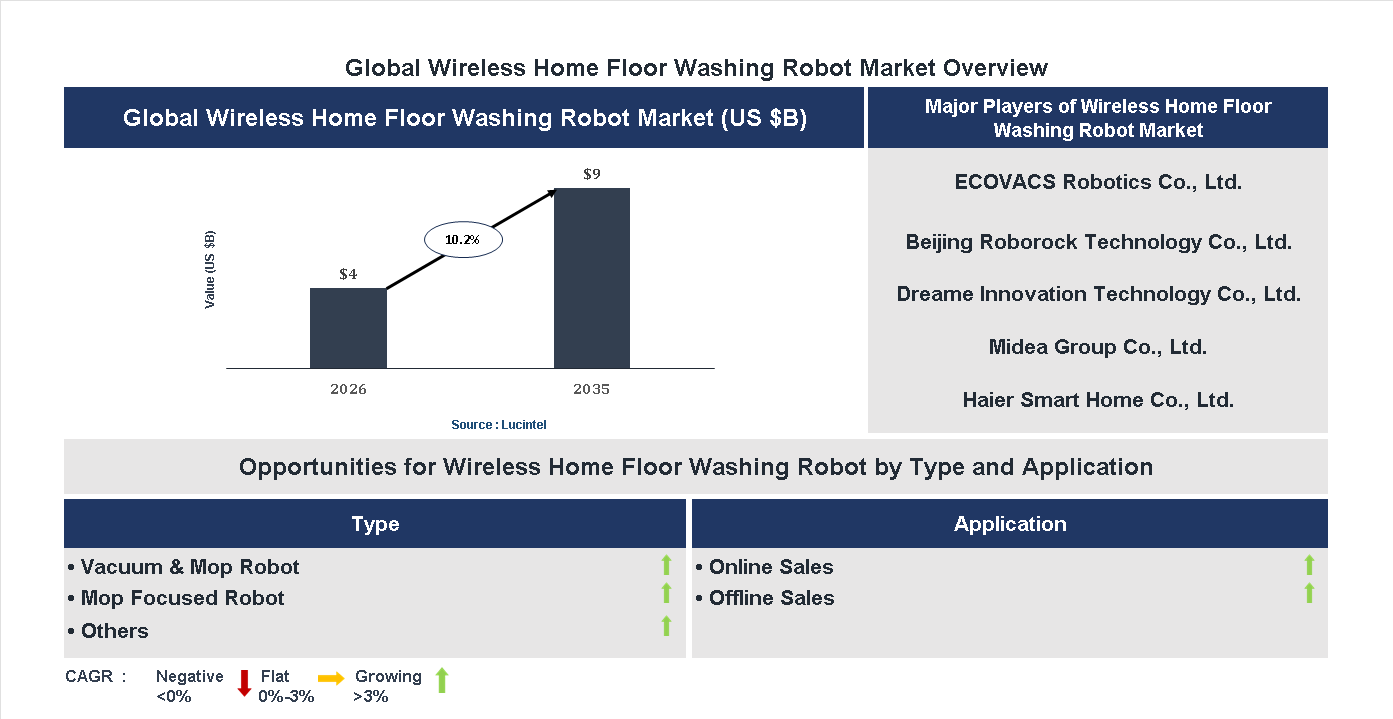
Key data points: The market size in 2035 = $9 billion, growth forecast = 10.2% annually for the next 8 years. Scroll below to get more insights. This market report covers trends, opportunities and forecasts in wireless home floor washing robot market to 2035 by type (vacuum & mop robot, mop focused robot, and others), application (online sales and offline sales), and region (North America, Europe, Asia Pacific, and the Rest of the World)
We'll send your sample report shortly.
• Lucintel forecasts that, within the type category, vacuum & mop robot is expected to witness higher growth over the forecast period.
• Within the application category, online sale is expected to witness higher growth.
• In terms of region, APAC is expected to witness the highest growth over the forecast period. Gain valuable insights for your business decisions with our comprehensive 150+ page report. Sample figures with some insights are shown below.
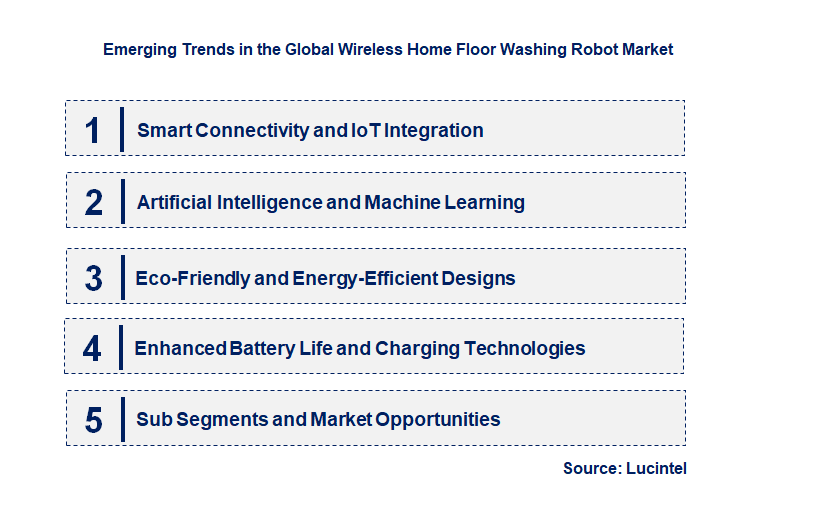
• Smart Connectivity and IoT Integration: The integration of Internet of Things (IoT) technology allows robots to connect seamlessly with smartphones and smart home systems. This enables users to schedule cleaning, monitor progress, and customize cleaning modes remotely. Enhanced connectivity improves user convenience and allows for real-time updates, making the robots more intuitive and user-friendly. As IoT adoption increases, market players are focusing on developing more sophisticated control apps and voice command features, which significantly enhance the overall user experience and operational efficiency.
• Artificial Intelligence and Machine Learning: AI-powered robots are becoming more intelligent, capable of navigating complex home layouts, avoiding obstacles, and optimizing cleaning paths. Machine learning algorithms enable these devices to adapt to different floor surfaces and cleaning patterns over time. This results in more effective cleaning with less user intervention. The incorporation of AI also allows for predictive maintenance and self-diagnosis, reducing downtime and service costs. As AI technology advances, robots are expected to become increasingly autonomous, offering a more personalized and efficient cleaning experience.
• Eco-Friendly and Energy-Efficient Designs: Consumers are increasingly prioritizing sustainability, prompting manufacturers to develop eco-friendly models that consume less power and use environmentally safe cleaning agents. These robots often feature energy-saving modes and recyclable materials, aligning with global environmental standards. The focus on sustainability not only appeals to eco-conscious consumers but also helps companies meet regulatory requirements. As environmental concerns grow, the market will see a rise in innovative, green cleaning solutions that balance performance with ecological responsibility.
• Enhanced Battery Life and Charging Technologies: Longer battery life is critical for uninterrupted cleaning sessions, especially in larger homes. Advances in battery technology, such as lithium-ion and solid-state batteries, are enabling robots to operate for extended periods on a single charge. Additionally, rapid charging and automatic docking stations improve convenience by minimizing downtime. These innovations allow for more comprehensive cleaning routines and reduce the need for manual intervention. As battery technology continues to evolve, market offerings will become more reliable and capable, further boosting consumer confidence and adoption rates.
• Sub Segments and Market Opportunities: The market is segmented based on product features, such as robotic models with mopping functions, multi-surface adaptability, and voice control capabilities. Sub segments like premium models with advanced AI and connectivity features are experiencing rapid growth, catering to tech-savvy consumers. Residential applications dominate, but commercial segments, including hospitality and healthcare facilities, are emerging as lucrative opportunities. Additionally, regional markets such as North America and Asia-Pacific are witnessing significant expansion due to rising disposable incomes and smart home adoption. These sub segments highlight diverse consumer needs and open avenues for targeted product development. These emerging trends are fundamentally reshaping the wireless home floor washing robot market by enhancing functionality, user experience, and sustainability. The integration of IoT and AI technologies is driving smarter, more autonomous devices, while eco-friendly designs and improved battery solutions are aligning with consumer values and operational demands. As these trends continue to evolve, the market is poised for substantial growth, innovation, and increased adoption across residential and commercial sectors.
• Technological Innovations in AI and Sensor Technology: The integration of advanced AI and sensors allows robots to navigate complex home layouts, avoid obstacles, and optimize cleaning paths. This results in more efficient cleaning, reduced operational time, and better adaptability to different floor types. Enhanced sensor accuracy also minimizes damage to furniture and walls, increasing consumer confidence. As a result, market penetration is expanding, especially among tech-savvy homeowners seeking smarter cleaning solutions.
• Expansion of Connectivity and IoT Integration: The incorporation of IoT technology enables seamless connectivity between robots and other smart home devices via mobile apps and voice assistants. Users can schedule cleaning sessions, monitor progress, and receive alerts remotely. This integration enhances user convenience and control, fostering higher adoption rates. Manufacturers are also developing ecosystems where multiple devices work together, creating comprehensive smart home environments that boost overall market growth.
• Growing Consumer Demand for Automated Cleaning Solutions: Increasing urbanization and busy lifestyles are driving consumers to seek time-saving, automated cleaning options. Wireless home floor washing robots offer a practical solution, reducing manual effort and ensuring consistent cleanliness. The affordability of these devices is improving, making them accessible to a wider demographic. This demand is encouraging manufacturers to innovate and expand product lines, further fueling market expansion and consumer adoption.
• Product Diversification and Feature Enhancement: Companies are introducing varied models with features like mopping, vacuuming, and multi-surface cleaning capabilities. Some robots now include voice control, app customization, and longer battery life. These innovations cater to diverse consumer needs and preferences, increasing market appeal. Enhanced features also enable competitive differentiation, encouraging brand loyalty and market share growth, especially in premium segments.
• Market Penetration in Emerging Economies: Rising disposable incomes and increasing awareness of smart home technology are driving market growth in developing regions. Manufacturers are tailoring products to local needs and price points, expanding distribution channels, and establishing local partnerships. This regional expansion is opening new revenue streams, accelerating overall market growth, and fostering global adoption of wireless home floor washing robots. The overall impact of these developments is a dynamic, expanding market characterized by increased innovation, broader consumer access, and integration into smart home ecosystems. These trends are making automated cleaning solutions more efficient, affordable, and user-friendly, thereby transforming household maintenance and driving sustained market growth.
• Smart Home Integration and Connectivity Opportunities: The integration of wireless home floor washing robots with smart home systems enhances user convenience and control. Features like voice commands, app-based management, and automation routines are driving adoption. As consumers increasingly adopt IoT-enabled devices, manufacturers are developing robots compatible with popular platforms such as Alexa, Google Assistant, and Apple HomeKit. This connectivity improves user experience, enables remote monitoring, and facilitates seamless integration into existing smart home ecosystems, expanding market reach and customer satisfaction.
• Growing Demand for Eco-Friendly and Energy-Efficient Cleaning Solutions: Consumers are prioritizing environmentally sustainable products, prompting manufacturers to develop eco-friendly wireless robots. These devices use less water and energy, incorporate biodegradable cleaning agents, and reduce chemical usage. Innovations in battery technology and energy management further enhance efficiency. The demand for green cleaning solutions aligns with global sustainability goals, encouraging companies to invest in eco-conscious product lines, which appeal to environmentally aware consumers and regulatory bodies, thereby expanding market opportunities.
• Expansion in Commercial and Industrial Cleaning Applications: The adoption of wireless home floor washing robots is extending beyond residential use into commercial and industrial sectors. Facilities such as offices, hospitals, hotels, and shopping malls require efficient, autonomous cleaning solutions to maintain hygiene standards. These robots offer benefits like consistent cleaning, reduced labor costs, and improved safety. Manufacturers are customizing robots with larger capacities, specialized brushes, and enhanced navigation to meet the specific needs of these sectors, opening new revenue streams and market segments.
• Technological Advancements in Navigation and Cleaning Efficiency: Continuous innovation in navigation systems, such as LiDAR, AI, and machine learning, improves the precision and efficiency of wireless robots. These advancements enable better obstacle detection, mapping, and route optimization, resulting in faster and more thorough cleaning. Enhanced sensors and smarter algorithms allow robots to adapt to complex environments, increasing reliability and user trust. As technology progresses, these improvements will drive higher adoption rates and set new standards for cleaning performance in the market.
• Rising Consumer Preference for Compact and Aesthetic Designs: The demand for sleek, compact, and aesthetically pleasing wireless home floor washing robots is increasing among consumers. Modern designs focus on minimalism, ease of storage, and compatibility with contemporary home decor. Smaller, lightweight devices are easier to maneuver and store, appealing to urban dwellers with limited space. Manufacturers are investing in innovative materials and design techniques to create visually appealing products that blend seamlessly into home environments, boosting consumer interest and market penetration. These growth opportunities collectively shape a promising future for the wireless home floor washing robot market. By leveraging technological innovations, eco-friendly solutions, and expanding applications, companies can enhance product offerings and capture new customer segments. The integration of smart features and aesthetic appeal will further drive adoption, ensuring sustained market growth. Overall, these opportunities will foster increased competition, innovation, and market expansion, benefiting consumers and industry stakeholders alike.
• Technological Innovation: The continuous development of advanced sensors, AI, and machine learning algorithms has improved robot navigation, cleaning efficiency, and user interface, making these devices more reliable and appealing to consumers. Enhanced battery life and smart connectivity features enable seamless integration with smart home ecosystems, increasing adoption. As technology evolves, manufacturers can offer more sophisticated, customizable, and energy-efficient products, fueling market growth.
• Rising Consumer Demand for Smart Home Devices: Consumers increasingly seek automation and convenience in household chores. Wireless home floor washing robots offer time-saving solutions, appealing to busy professionals and families. The proliferation of IoT-enabled devices and smart home platforms encourages consumers to adopt integrated cleaning solutions, boosting sales. This demand is further supported by marketing strategies emphasizing ease of use, safety, and eco-friendliness.
• Economic Growth and Urbanization: Rapid urbanization and rising disposable incomes in emerging economies are expanding the customer base for wireless cleaning robots. Urban dwellers often have limited space and busy lifestyles, making automated cleaning devices highly attractive. Economic development also enables consumers to invest in premium home automation products, including advanced floor washing robots, thereby expanding market reach.
• Product Innovation and Diversification: Manufacturers are continuously innovating to introduce new features such as multi-surface cleaning, obstacle avoidance, and app-controlled operations. Diversification into different price segments allows targeting a broader consumer base, from budget-conscious buyers to premium users. These innovations enhance user experience and differentiate products in a competitive market, driving sales and market penetration.
• Strategic Partnerships and Market Expansion: Collaborations between robot manufacturers and technology providers, retail chains, and online platforms facilitate wider distribution and brand visibility. Expansion into untapped markets through localized products and marketing strategies helps capture new customer segments. These partnerships also enable access to advanced technologies and shared expertise, accelerating product development and market growth. The challenges facing the wireless home floor washing robot market include:-
• Regulatory and Safety Standards: Stringent safety, environmental, and energy efficiency regulations can pose barriers to market entry and product development. Compliance costs and delays in certification processes may hinder innovation and slow down product launches. Variations in regulations across regions also complicate global expansion strategies, requiring manufacturers to adapt products to meet diverse standards.
• High Competition and Price Pressure: The market is highly competitive, with numerous established players and new entrants vying for market share. Price wars and aggressive marketing strategies can erode profit margins and limit innovation investments. Differentiating products through features and quality becomes essential but challenging in a crowded marketplace, impacting overall profitability.
• Technological Limitations and Consumer Trust: Despite advancements, challenges such as limited battery life, navigation errors, and difficulty handling complex layouts persist. These technological limitations can affect user satisfaction and trust, leading to negative reviews and reduced adoption. Overcoming these issues requires significant R&D investment, which may increase costs and impact pricing strategies. The wireless home floor washing robot market is shaped by rapid technological advancements, increasing consumer demand, and economic growth, which collectively drive expansion. However, regulatory hurdles, intense competition, and technological limitations pose significant challenges. Navigating these factors requires strategic innovation, compliance, and market adaptation. Overall, the markets future growth hinges on balancing these drivers and challenges to deliver reliable, affordable, and innovative solutions that meet evolving consumer needs.
• ECOVACS Robotics Co., Ltd.
• Beijing Roborock Technology Co., Ltd.
• Dreame Innovation Technology Co., Ltd.
• Midea Group Co., Ltd.
• Haier Smart Home Co., Ltd.
• Xiaomi
• SharkNinja, Inc.
• BISSELL Inc.
• Dyson
• Alfred Kärcher SE & Co. KG
• Vacuum & Mop Robot
• Mop Focused Robot
• Others
• Online Sales
• Offline Sales
• North America
• Europe
• Asia Pacific
• The Rest of the World
• United States: The U.S. market has seen rapid adoption of wireless home floor washing robots, driven by high consumer awareness and technological innovation. Major brands are integrating AI-powered navigation systems and voice control compatibility with smart home ecosystems. Companies are also focusing on eco-friendly models with energy-efficient features. The rise of subscription-based services for robot maintenance and upgrades is further boosting market growth. Additionally, increased investment in R&D is leading to more sophisticated cleaning algorithms and better obstacle detection capabilities.
• China: China remains a leading market for wireless home floor washing robots, with rapid urbanization and rising disposable incomes fueling demand. Local manufacturers are offering affordable, feature-rich products with advanced mapping and multi-surface cleaning capabilities. The integration of IoT connectivity allows remote control via smartphones, enhancing user convenience. The market is also witnessing a surge in innovative designs tailored to small living spaces. E-commerce platforms play a crucial role in distribution, and strategic partnerships with tech giants are accelerating product development and adoption.
• Germany: The German market emphasizes high-quality, durable, and energy-efficient wireless home floor washing robots. Consumers prioritize eco-friendly and sustainable products, prompting manufacturers to incorporate environmentally conscious materials and energy-saving features. The adoption of smart sensors for precise cleaning and obstacle avoidance is prominent. Regulatory standards for safety and environmental impact influence product design. The market also benefits from a strong DIY culture, with consumers seeking customizable and easy-to-maintain robots. Collaborations with home automation providers are expanding the integration of these robots into broader smart home systems.
• India: In India, the wireless home floor washing robot market is emerging rapidly, driven by increasing urbanization and rising disposable incomes. Affordability remains a key factor, with local brands offering cost-effective models equipped with basic navigation and cleaning functions. The growing middle class and expanding e-commerce channels are facilitating wider access. Consumers are increasingly adopting smart home devices, creating a favorable environment for growth. Manufacturers are also focusing on compact, lightweight designs suitable for small apartments. The market is expected to expand further as awareness about automation and convenience increases among Indian households.
• Japan: Japans market is characterized by high technological sophistication and a focus on advanced features. Consumers demand robots with precise navigation, multi-surface cleaning, and integration with home automation systems. The adoption of AI and machine learning enhances cleaning efficiency and obstacle detection. Eco-friendly and energy-efficient models are preferred, aligning with Japan’s environmental consciousness. The market also benefits from a mature ecosystem of tech innovation and a high rate of smart home adoption. Companies are investing in R&D to develop quieter, more efficient robots that cater to the preferences of Japanese consumers, fostering steady market growth.


• ECOVACS Robotics Co., Ltd.
• Beijing Roborock Technology Co., Ltd.
• Dreame Innovation Technology Co., Ltd.
• Midea Group Co., Ltd.
• Haier Smart Home Co., Ltd.
• Xiaomi
• SharkNinja, Inc.
• BISSELL Inc.
• Dyson
• Alfred Kärcher SE & Co. KG Q6. Which wireless home floor washing robot market segment will be the largest in future? Answer: Lucintel forecasts that, within the type category, vacuum & mop robot is expected to witness higher growth over the forecast period. Q7. In wireless home floor washing robot market, which region is expected to be the largest in next 5 years? Answer: In terms of region, APAC is expected to witness the highest growth over the forecast period. Q8. Do we receive customization in this report? Answer: Yes, Lucintel provides 10% customization without any additional cost.


Choose a license that fits your team. Instant PDF delivery.
Prices exclude taxes. Instant delivery. Custom licensing available on request.
Market Report · July 29, 2026
Market Report · July 15, 2026
Market Report · July 13, 2026
Trusted partner for strategic intelligence and business growth


Receive a complimentary market analysis tailored to your industry. Our analysts will identify key growth opportunities and competitive dynamics specific to your business.

Market size, growth rate, and key trend analysis for your specific sector.

Top competitor positioning and market share analysis.

Strategic recommendations backed by data-driven insights.
Get curated market intelligence and competitive moves straight to your inbox.
By subscribing, you agree to receive our monthly insights. Unsubscribe anytime.
Receive a complimentary market analysis tailored to your industry. Our analysts will identify key growth opportunities and competitive dynamics specific to your business.
Market size, growth rate, and key trend analysis for your specific sector.
Top competitor positioning and market share analysis.
Strategic recommendations backed by data-driven insights.
Get curated market intelligence, emerging trends, and competitive moves straight to your inbox each month.
By subscribing, you agree to receive our monthly insights. Unsubscribe anytime.
We'll send your sample report shortly.