
Smartphone Market Report: Trends, Forecast and Competitive Analysis to 2035

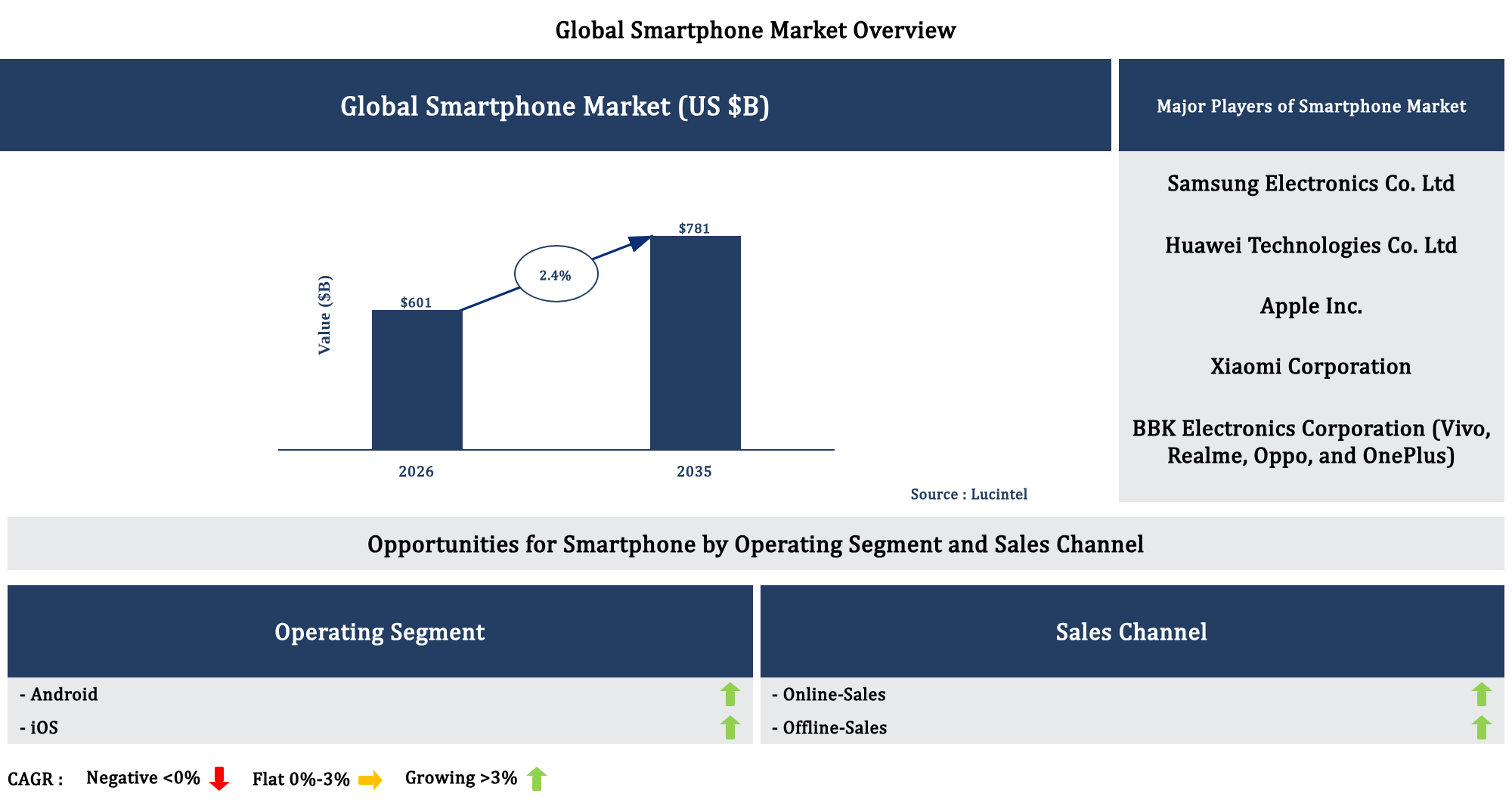
Key data points: The market size in 2035 = $781 billion, growth forecast = 2.4% annually for the next 9 years. Scroll below to get more insights. This market report covers trends, opportunities, and forecasts in the global smartphone market to 2035 by operating segment (android and ios), sales channel (online-sales and offline-sales), and region (North America, Europe, Asia Pacific, and the Rest of the World)

Publisher: Lucintel Last Updated: July 2026
See Pricing

Download Sample Report

| ✨ New Download Sample report — Get instant insights! | ✨ New Download Sample report — Get instant insights!

Smartphone Market Report: Trends, Forecast and Competitive Analysis to 2035

Smartphone Market


The future of the global smartphone market looks promising with opportunities in the online-sales and offline-sales markets. The global smartphone market is expected to reach an estimated $781 billion by 2035 with a CAGR of 2.4% from 2026 to 2035. The major drivers for this market are the increasing demand for advanced smartphone features, the rising adoption of 5g enabled devices and the growing preference for premium smartphones options.

• Lucintel forecasts that, within the operating segment category, android will remain the largest segment over the forecast period as the increasing demand for affordable smartphones.

• Within the sales channel category, offline-sales will remain the largest segment due to the the growing availability of offline service networks.

• In terms of regions, APAC will remain the largest region over the forecast period due to the the growing digitalization and increasing internet penetration.

Gain valuable insights for your business decisions with our comprehensive 150+ page report.
Smartphone Market

Emerging Trends in the Smartphone Market

The smartphone market is undergoing a rapid transformation as hardware innovation, software intelligence, and evolving consumer behaviors converge. As users demand better performance, more immersive experiences, and stronger privacy protections, manufacturers and ecosystem players are rethinking device form factors, connectivity, and business models. Advances in artificial intelligence, display technologies, and network infrastructure are reshaping how smartphones are designed, manufactured, and used globally. At the same time, sustainability pressures and regulatory scrutiny are pushing brands toward greener, more transparent practices. These emerging trends are defining the next generation of smartphones and setting the competitive agenda for the coming decade.
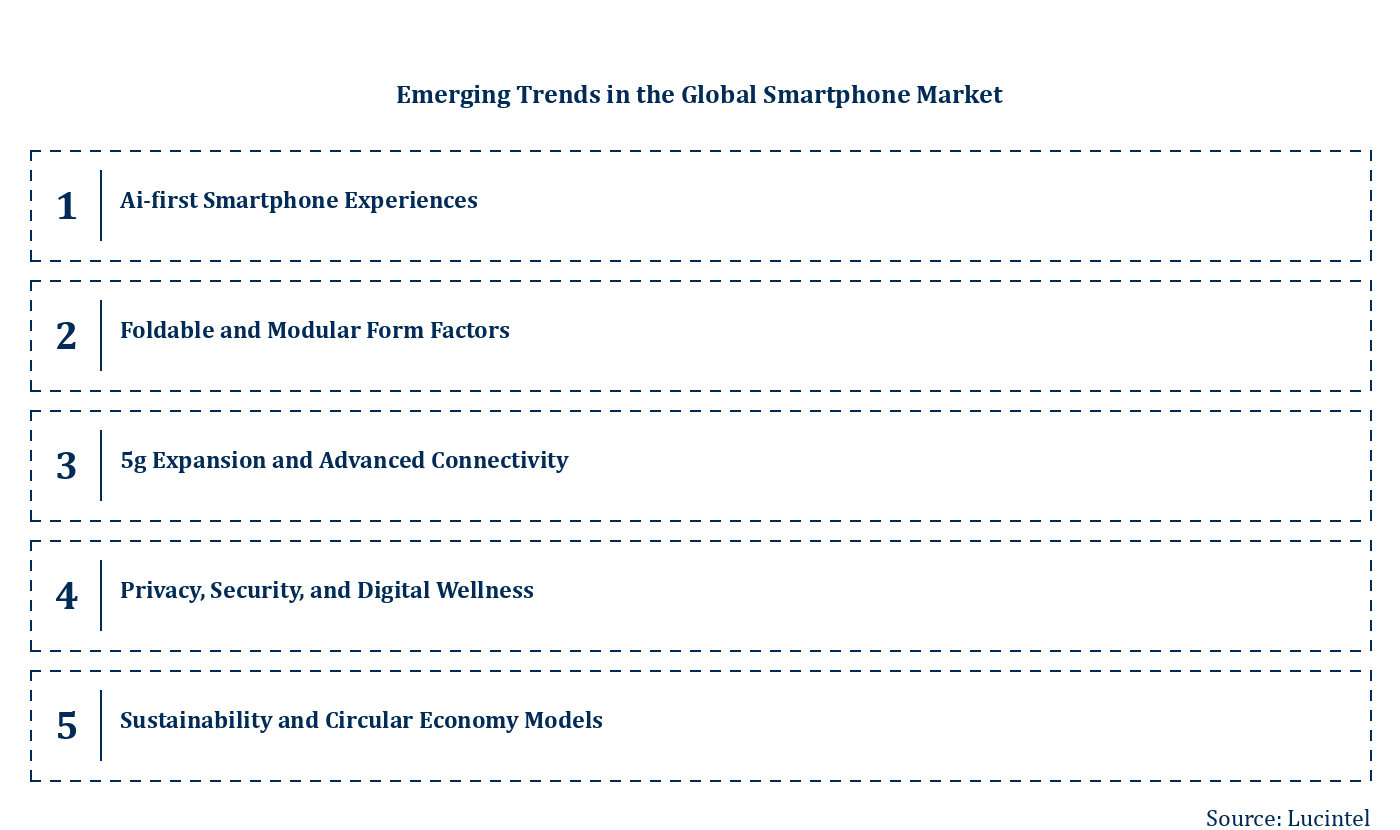
  • AI-first Smartphone Experiences: The smartphone market is rapidly shifting toward AI-first design, where on-device intelligence shapes everything from photography to battery management and real-time translation. Dedicated neural processing units and optimized software frameworks enable faster, more private processing without always relying on the cloud. This trend improves personalization, enabling features such as predictive app actions, context-aware recommendations, and advanced voice assistance. It also differentiates devices beyond raw hardware specifications, pushing brands to compete on AI capabilities and ecosystem depth, while creating new monetization opportunities via premium AI features and services embedded directly into the smartphone experience.
  • Foldable and Modular Form Factors: Foldable and experimental form factors are emerging as premium innovation zones within the smartphone market, redefining what a phone can look like and how it is used. Flexible OLED displays, advanced hinge engineering, and improved durability are making foldables more practical, while dual-screen and rollable concepts trial new productivity and entertainment use cases. At the same time, modular approaches focusing on interchangeable components and accessories aim to extend device longevity and customization. These developments cater to early adopters and professionals, allow vendors to command higher margins, and serve as showcases for technological leadership and brand differentiation.
  • 5G Expansion and Advanced Connectivity: The maturation of 5G networks and ongoing work on 5G-Advanced are transforming the connectivity layer of the smartphone market, enabling lower latency, higher throughput, and more reliable performance. As coverage deepens and spectrum utilization improves, smartphones become central hubs for cloud gaming, AR and VR applications, high-definition video streaming, and real-time collaboration. Enhanced connectivity also supports industrial and enterprise use cases, driving demand for specialized, rugged, or secure devices. This trend encourages chipset innovation, new pricing tiers, and partnerships between device makers, carriers, and content providers to monetize bandwidth-intensive, always-connected experiences.
  • Privacy, Security, and Digital Wellness: Intensifying consumer awareness and tighter regulations are propelling privacy, security, and digital wellness to the forefront of the smartphone market. Manufacturers are integrating secure enclaves, hardware-level encryption, and advanced biometric authentication to protect sensitive data. Operating systems now emphasize permission controls, on-device processing, and privacy dashboards that give users clearer visibility and control. Simultaneously, digital wellness tools help users manage screen time, notifications, and app usage, addressing concerns about addiction and mental health. These features influence purchasing decisions, shape brand trust, and drive competitive differentiation beyond technical specifications and raw performance metrics.
  • Sustainability and Circular Economy Models: Sustainability is emerging as a defining theme in the smartphone market, as regulators and consumers pressure brands to reduce environmental impact across the product lifecycle. Vendors are increasing the use of recycled materials, designing for repairability, and extending software support to lengthen device lifespans. Trade-in programs, certified refurbished devices, and component recycling initiatives support circular economy models that reduce e-waste and open new revenue streams. Transparent reporting on carbon footprints and supply chain ethics is becoming a brand differentiator. This trend reshapes product strategy, pricing, and collaboration with component suppliers, logistics partners, and recyclers.

Smartphone Market by country

Recent Developments in the Smartphone Market

The smartphone market is undergoing a pivotal transformation as hardware innovation converges with software intelligence, connectivity upgrades, and sustainability pressures. Global demand is stabilizing in volume terms, but value and feature complexity are rising as consumers hold devices longer and demand higher performance, better cameras, and more responsible production. At the same time, geopolitics and supply chain realignments are reshaping where and how phones are designed, manufactured, and sold. Developers, chipset vendors, and ecosystem partners are racing to differentiate around artificial intelligence, premium experiences, and emerging form factors that could define the next decade of the smartphone market.

  • On-device Generative AI Integration: Smartphone vendors are embedding specialized NPUs and optimized large language models directly on devices, enabling offline translation, image generation, and personal assistants without constant cloud connectivity. This reduces latency, improves privacy, and opens new use cases in productivity, creativity, and accessibility. As chipsets and operating systems are tuned for AI workloads, differentiation increasingly shifts from camera megapixels to AI experiences, encouraging premium pricing and pushing even mid-range models to adopt AI-ready hardware.
  • Proliferation of Foldable and Flexible Form Factors: Foldable smartphones and experimental rollable displays are moving from niche to more mainstream price tiers, driven by panel cost reductions and improved hinge durability. These devices offer tablet-like screen real estate in pocketable formats, reshaping media consumption, gaming, and multitasking behaviors. Ecosystems are optimizing interfaces and apps for multi-window workflows, while vendors use foldables as halo products to elevate brand perception and margins, even as overall unit volumes remain modest compared with traditional slabs.
  • Intensifying Focus on Sustainability and Circularity: The smartphone market is increasing adoption of recycled materials, modular components, longer software support, and standardized chargers to reduce environmental impact. Policymaker pressure and consumer expectations are driving commitments to repairability, e-waste reduction, and lower carbon footprints across the value chain. Extended OS and security update cycles are becoming a key purchase criterion, supporting longer device lifetimes and expanding refurbished and trade-in programs, which in turn are reshaping residual value dynamics and total cost of ownership.
  • Transition To Advanced Connectivity and Satellite Features: Smartphones are rapidly adopting 5G Advanced-ready modems, Wi-Fi 7, and early direct-to-satellite communication capabilities, enhancing speed, reliability, and coverage. These upgrades unlock richer cloud gaming, AR applications, and enterprise use cases, while satellite-based SOS and messaging features improve safety in remote areas. Network vendors and operators are co-marketing next-generation devices to monetize premium data plans, and the enhanced connectivity stack is becoming a core differentiator, especially in premium and upper mid-range tiers.
  • Supply Chain Diversification and Regionalization: Manufacturers are diversifying production away from single-country dependence, expanding assembly and sourcing across regions in response to geopolitical tensions, trade policies, and pandemic-era disruptions. This shift is altering component procurement, localization strategies, and time-to-market, while encouraging region-specific models and pricing structures. Local manufacturing incentives in markets such as India and Southeast Asia are fostering new hubs for assembly and potentially component fabrication, reshaping competitive dynamics and cost structures throughout the smartphone market.

Strategic Growth Opportunities in the Smartphone Market

The smartphone market is evolving from a saturated hardware arena into a platform for advanced services, connectivity, and intelligent experiences. Growth is shifting toward application-centric opportunities that increase device utility, engagement, and monetization over the product life cycle. As 5G, AI, and cloud ecosystems mature, smartphones are becoming hubs for payments, health monitoring, immersive media, and productivity. These developments create new revenue pools for device makers, app developers, and telecom operators while reshaping user expectations. Strategic focus on high-value applications rather than only specifications will define competitive advantage and long-term growth in the global smartphone market.

  • Mobile Payments and Financial Services: Expanding smartphones as secure wallets and financial access points creates recurring revenue through payment fees, lending, and digital banking services, especially in underbanked segments where devices become primary channels for identity verification, credit scoring, and everyday transactions.
  • Digital Health and Wellness: Integrating smartphones with wearables, sensors, and health apps enables continuous monitoring, telehealth, and personalized wellness programs, driving device stickiness while opening partnerships with insurers, healthcare providers, and employers focused on preventive care and remote diagnostics.
  • Gaming and Immersive Entertainment: Enhancing smartphone capabilities for high-performance gaming, augmented reality, and streaming media generates higher app spending, subscription revenues, and advertising income, supporting ecosystem lock-in through exclusive content, game marketplaces, and optimized hardware-software integration.
  • Productivity and Remote Work: Positioning smartphones as central tools for collaboration, document management, and secure access to enterprise systems boosts adoption of business apps, cloud services, and device management solutions, strengthening relationships with corporate buyers and hybrid workers.
  • Smart Home and IoT Control: Leveraging smartphones as intuitive controllers for smart home devices and broader IoT ecosystems increases cross-selling of connected products and services, encouraging users to remain within a brand’s ecosystem and enabling data-driven personalization across multiple touchpoints.

Smartphone Market Drivers and Challenges

The global smartphone market is shaped by an intricate mix of technological progress, shifting consumer economics, and evolving regulatory expectations. Rapid innovation in hardware, software, and connectivity continues to expand the capabilities of smartphones and broaden their role in everyday life. At the same time, income growth in emerging markets, device financing, and competitive pricing strategies influence purchasing power and upgrade cycles. Regulatory pressures related to data privacy, digital markets, and environmental impact also affect how smartphones are designed, manufactured, and sold. Understanding these drivers and challenges is essential for market participants to position their strategies effectively.

The factors responsible for driving the smartphone market include:

  • Technological Innovation and Feature Differentiation: Continuous advancements in processors, cameras, displays, and battery technology are central drivers of the smartphone market, as consumers increasingly expect each new generation of devices to offer tangible improvements in speed, imaging quality, and overall user experience. Premium features such as high-refresh-rate OLED screens, advanced computational photography, on-device AI processing, and fast charging create strong upgrade incentives and justify pricing tiers. This innovation race pushes vendors to invest heavily in R&D and collaborate closely with component suppliers, reinforcing a cycle where cutting-edge features not only attract tech-savvy users but also gradually diffuse into mid-range segments.
  • Expansion of 5G and Advanced Connectivity: The global rollout of 5G networks is a significant catalyst for smartphone demand because it enables higher data speeds, lower latency, and more reliable connections for bandwidth-intensive applications such as cloud gaming, high-resolution video streaming, and real-time collaboration. As operators accelerate 5G coverage and promote affordable data plans, consumers and enterprises alike are motivated to replace older 4G devices with 5G-capable smartphones. Device makers respond with broader 5G portfolios across price bands, integrating more efficient modems and antennas. This connectivity shift not only drives unit sales but also supports new service ecosystems and recurring revenue models tied to mobile-first digital experiences.
  • Growth of Mobile-First Digital Lifestyles: Increasing reliance on smartphones as primary devices for communication, entertainment, commerce, work, and financial services is a powerful structural driver of the market. In many regions, especially emerging economies, smartphones serve as the main gateway to the internet, underpinning social networking, super apps, mobile banking, and e-commerce. This mobile-first behavior encourages more frequent device usage and accelerates app and service innovation, which in turn heightens expectations for performance, storage, and battery life. As digital content consumption and remote work patterns deepen, consumers view smartphones as essential tools rather than discretionary gadgets, supporting resilient demand even in uncertain economic conditions.
  • Emerging Market Penetration and Affordable Models: The rapid expansion of smartphone adoption in emerging markets significantly contributes to global growth, driven by rising disposable incomes, improved mobile network coverage, and the availability of competitively priced devices. Vendors targeting entry-level and mid-range segments focus on delivering strong value propositions, such as large displays, long battery life, and localized software features, at accessible price points. Financing schemes, installment plans, and refurbished devices further reduce upfront costs, enabling first-time smartphone users to transition from basic phones. As penetration increases, these markets become fertile ground for ecosystem monetization through apps, payments, and services, reinforcing the economic incentive for manufacturers and operators to sustain aggressive market development.

The challenges facing this smartphone market include:

  • Market Saturation and Lengthening Replacement Cycles: In many mature markets, smartphone penetration is near universal, which limits the pool of first-time buyers and forces growth to rely largely on upgrades and switchers between brands. At the same time, improvements in device durability, performance headroom, and software support have lengthened replacement cycles, as consumers hold onto their phones for three years or longer. This saturation reduces annual shipment volumes and intensifies competition for share within relatively stable user bases. Vendors must invest more in marketing, trade-in programs, and differentiated experiences to stimulate upgrades, while facing pressure on margins due to promotional spending and price sensitivity.
  • Component Supply Constraints and Cost Pressures: The smartphone market is vulnerable to disruptions and price volatility across the semiconductor, display, and critical materials supply chains, which can arise from geopolitical tensions, natural disasters, or capacity bottlenecks. Shortages of key components such as advanced chipsets or image sensors can delay product launches, force specification compromises, or require costly spot purchases. At the same time, inflationary pressures and rising logistics costs squeeze profitability, particularly in lower price tiers where competition is fierce. Manufacturers must manage multi-sourced supply strategies, long-term contracts, and design flexibility while balancing device affordability and feature richness, which complicates planning and increases financial risk.
  • Regulatory Scrutiny, Privacy, and Sustainability Demands: Intensifying regulatory focus on digital markets, data privacy, right-to-repair, and environmental sustainability presents complex challenges for smartphone ecosystem players. Stricter rules on app store practices, data collection, and cross-border data flows can alter revenue models and require substantial compliance investments. Environmental regulations and consumer expectations around recyclability, use of recycled materials, and e-waste reduction are pushing manufacturers to redesign devices, extend software support, and develop robust take-back programs, often at additional cost. Navigating diverse regional regulations while maintaining global product platforms and consistent user experiences is increasingly difficult, and missteps may lead to fines, reputational damage, or constraints on key business practices.

The smartphone market is shaped by powerful growth drivers rooted in continuous innovation, expanding connectivity, mobile-centric lifestyles, and rising adoption in emerging economies, all of which support a broad and evolving device ecosystem. At the same time, it is constrained by saturation in mature markets, supply chain volatility, and mounting regulatory and sustainability pressures that challenge traditional business models and profit structures. Stakeholders must balance aggressive feature advancement and market expansion with disciplined cost management, responsible practices, and regulatory alignment. Those able to execute effectively across these dimensions are best positioned to capture long-term value in a highly competitive global landscape.

List of Smartphone Market Companies

Companies in the market compete on the basis of product quality offered. Major players in this market focus on expanding their manufacturing facilities, R&D investments, infrastructural development, and leverage integration opportunities across the value chain. Through these strategies smartphone market companies cater increasing demand, ensure competitive effectiveness, develop innovative products & technologies, reduce production costs, and expand their customer base. Some of the smartphone market companies profiled in this report include-

  • Samsung Electronics Co. Ltd
  • Huawei Technologies Co. Ltd
  • Apple Inc.
  • Xiaomi Corporation
  • BBK Electronics Corporation (Vivo, Realme, Oppo, and OnePlus)
  • Lenovo Group Limited
  • HTC Corporation

Smartphone Market by Segment

The study includes a forecast for the global smartphone market by operating segment, sales channel, and region.

  • Smartphone Market by Operating Segment [Value ($B) from 2019 to 2035]:
    • Android
    • iOS
  • Smartphone Market by Sales Channel [Value ($B) from 2019 to 2035]:
    • Online-Sales
    • Offline-Sales
  • Smartphone Market by Region [Value ($B) from 2019 to 2035]:
    • North America
    • Europe
    • Asia Pacific
    • The Rest of the World

Country Wise Outlook for the Smartphone Market

The global smartphone market is undergoing a period of recalibration as maturation in developed economies converges with rapid adoption in emerging markets. Innovation is shifting from pure hardware upgrades toward integrated experiences built around AI, connectivity, and services ecosystems. Premium segments are pushing boundaries in on-device intelligence, camera capabilities, and satellite connectivity, while mid-range devices are absorbing flagship features at lower prices. Supply chain diversification, 5G densification, and regulatory pressures on app stores and data privacy are reshaping competitive dynamics. Within this landscape, the United States, China, Germany, India, and Japan each exhibit distinct trajectories and strategic priorities.

  • United States: The United States smartphone market is stabilizing at high penetration levels, with growth driven primarily by premium upgrades and 5G device replacement cycles. US brands and platforms are prioritizing on-device generative AI, satellite-enabled emergency features, and tighter integration across phones, wearables, and PCs. Carrier promotions remain crucial for flagship adoption, while eSIM expansion is simplifying switching and international roaming. Regulatory scrutiny of app store policies, digital privacy, and right-to-repair is influencing ecosystem strategies. Foldables, though still niche, are gaining visibility, and refurbished devices are expanding as cost-conscious and sustainability-minded consumers seek more affordable options.
  • China: China’s smartphone market is rebounding with a strong pivot toward high-end domestic brands, driven by national preference and accelerating innovation in camera systems, chips, and AI features. Local OEMs are intensifying competition in foldables and thin-and-light flagships, while aggressively expanding retail and online channels. 5G penetration is already high, so vendors focus on differentiated design, imaging, and ecosystem services like payments, cloud, and in-car integration. The push for homegrown semiconductor and operating system stacks reflects strategic moves to reduce dependence on foreign technology. Domestic competition is intense, compressing margins but accelerating product iteration and feature experimentation.
  • Germany: Germany’s smartphone market is mature and replacement-driven, with consumers prioritizing durability, software support longevity, and security over frequent upgrades. Regulatory emphasis on sustainability, e-waste reduction, and right-to-repair is boosting interest in modular, repairable, and refurbished devices. German buyers increasingly favor mid-to-upper mid-range 5G smartphones that balance performance with long battery life and enterprise-grade security. Enterprise and industrial users influence demand for ruggedized devices and strong device management capabilities. EU-wide rules on standardized charging, app store fairness, and data protection shape product strategies, prompting manufacturers to extend update guarantees and invest in compliance-ready software experiences.
  • India: India remains one of the fastest-growing smartphone markets, driven by first-time buyers upgrading from feature phones and rapid 4G to 5G migration. Competitive pricing and aggressive online sales campaigns are expanding access to feature-rich devices under mid-range price points. Manufacturers are ramping up local assembly and component sourcing in line with government production-linked incentive schemes, turning India into a major export and manufacturing hub. Demand is strong for multilingual interfaces, UPI-enabled payment integration, and video-centric experiences tailored to short-form content and gaming. Domestic and Chinese brands vie for share, while premium segments grow as urban consumers trade up.
  • Japan: Japan’s smartphone market is characterized by high ARPU, operator-centric distribution, and strong demand for compact, high-quality devices. Consumers value camera excellence, water and dust resistance, and reliable performance over extreme spec escalation. Local brands and global players tailor devices with advanced mobile payment capabilities, transit integration, and robust disaster alert features aligned with Japan’s infrastructure. 5G adoption continues through carrier-led campaigns, while eSIM and dual-SIM options expand flexibility for frequent travelers. Aging demographics support demand for accessibility-focused interfaces and simplified modes, and there is growing interest in secure devices for mobile banking, government services, and telehealth.

Features of the Smartphone Market

  • Market Size Estimates: Smartphone market size estimation in terms of value ($B).
  • Trend and Forecast Analysis: Market trends (2019 to 2025) and forecast (2026 to 2035) by various segments and regions.
  • Segmentation Analysis: Smartphone market size by various segments, such as by operating segment, sales channel and region in terms of value ($B).
  • Regional Analysis: Smartphone market breakdown by North America, Europe, Asia Pacific, and the Rest of the World.
  • Growth Opportunities: Analysis of growth opportunities in different operating segment, sales channel and regions for the smartphone market.
  • Strategic Analysis: This includes M&A, new product development, and competitive landscape of the smartphone market.
  • Analysis of competitive intensity of the industry based on Porter's Five Forces model.

Article

Smartphone Market: Which Strategic Forces Are Redefining the Next Decade?

Dallas, July 29, 2026 – The smartphone market is entering a pivotal renewal phase, moving beyond incremental hardware upgrades toward platform-level innovation that fuses devices, cloud, and AI-driven services. Growth is being reshaped by breakthroughs in on-device intelligence, new form factors, satellite connectivity, and sustainability-driven design. Technology companies, operators, content platforms, and component suppliers are all repositioning as smartphones evolve from communication tools into orchestrators of digital life, work, and commerce.

The center of gravity is shifting toward software-defined experiences, ecosystem lock-in, and data-driven revenue models. This creates both disruption and opportunity across hardware manufacturing, semiconductor design, operating systems, telecom networks, and digital services. Markets in Asia-Pacific, North America, and key emerging economies in Africa and Latin America are likely to see the strongest impact as these innovations roll out at scale.

Which Major Trends Are Reshaping Competitive Advantage in the smartphone market?

A defining trend is the acceleration of on-device AI, enabled by increasingly powerful neural processing units and optimized system-on-chip architectures. Smartphones are no longer just endpoints; they are becoming real-time inference engines that personalize experiences while reducing dependence on cloud processing. Another transformative shift is the commercialization of foldable and hybrid form factors that blur boundaries between phones, tablets, and productivity devices. In parallel, satellite and non-terrestrial connectivity are extending coverage beyond traditional cellular footprints, while sustainability imperatives are recalibrating design, materials, and lifecycle economics. Together, these forces are redrawing what users expect from a smartphone and how value is captured along the technology stack.

  • On-device AI is enabling advanced camera computation, real-time translation, predictive user interfaces, and privacy-preserving personalization without constant data offloading to the cloud.
  • Foldable and dual-screen devices are creating new premium tiers and pushing app developers to rethink layout, multitasking, and content experiences.
  • Satellite-enabled messaging and emergency connectivity are emerging as must-have features for differentiation in mature markets and basic access in underserved regions.
  • Sustainability and circularity are turning repairability, recycled materials, and longer software support cycles into core purchase criteria for consumers, enterprises, and regulators.
  • Convergence with wearables, smart home devices, and connected vehicles is positioning smartphones as the command hub for broader technology ecosystems.

How Is On-Device AI Changing the Smartphone Value Proposition?

On-device AI is rapidly moving from a marketing label to a structural differentiator in chip design, operating systems, and user experience strategies. As large language models and generative AI are compressed and optimized for smartphones, devices are beginning to offer context-aware assistance, multimodal search, and intelligent content creation that feel less like apps and more like ambient digital companions. Telcos, app developers, and cloud providers are rethinking architectures to balance local inference with cloud augmentation, optimizing for latency, battery life, and data sovereignty.

  • Semiconductor vendors are embedding dedicated AI accelerators that support camera enhancements, voice processing, gaming, and real-time security threat detection directly on the device.
  • Operating system providers are integrating AI features at the system level, from smart summaries and suggested replies to AI-powered device customization tailored to user behavior.
  • App ecosystems in social media, content creation, and mobile productivity are leveraging on-device AI for video editing, image enhancement, and workflow automation, particularly in creator and prosumer segments.
  • Enterprise mobility solutions are exploring secure on-device AI for document classification, field service assistance, and frontline analytics in industries such as logistics, retail, and healthcare.

Where Will New Form Factors and Immersive Experiences Disrupt Spending Patterns?

Foldable, rollable, and dual-screen smartphones are redefining the premium segment, offering larger displays without sacrificing portability. While the installed base is still relatively small, rapid improvements in hinge durability, display quality, and cost are pushing these devices from niche experimentation toward mainstream aspiration. Regions with high replacement rates and strong carrier subsidies, particularly in East Asia and North America, are becoming early battlegrounds for share in this emerging category. Developers in gaming, media, and productivity are responding with experiences optimized for multi-window and extended canvas use.

  • Foldables are drawing high-value consumers away from traditional flagship slabs, raising average selling prices and creating new upgrade triggers in mature markets.
  • Advanced mobile gaming and streaming are leveraging larger, more immersive displays, encouraging hardware makers to invest in better thermal management and high-refresh-rate panels.
  • Hybrid work and education use cases are boosting demand for devices that can toggle between phone mode and tablet-like productivity, especially in enterprise and prosumer segments.
  • Component suppliers in flexible OLED, ultra-thin glass, and precision mechanics are capturing a growing share of value as form factor innovation becomes a key differentiator.

How Will Satellite Connectivity and 5G Evolution Expand Market Boundaries?

Satellite-enabled features and the ongoing maturation of 5G are extending the smartphone market into geographies and situations previously beyond reliable coverage. Emergency SOS via satellite, basic messaging in remote locations, and non-terrestrial network trials are moving quickly from proof-of-concept to commercial offerings. At the same time, 5G standalone networks and network slicing are creating new enterprise-grade use cases that rely on smartphones as secure, high-performance access points to cloud and edge resources.

  • Smartphone vendors partnering with satellite operators are differentiating devices with safety, travel, and outdoor use cases that appeal to high-spend consumers and enterprise field workers.
  • Emerging markets with patchy terrestrial infrastructure are evaluating hybrid models where satellite-enhanced smartphones leapfrog traditional connectivity gaps.
  • Telecom operators are using advanced 5G features to offer guaranteed bandwidth and low-latency services for industrial, healthcare, and media customers using smartphones as control and monitoring interfaces.
  • App ecosystems in mapping, logistics, disaster management, and remote asset monitoring are experimenting with satellite-aware services that treat connectivity as variable but continuous.

Why Are Sustainability, Regulation, and Lifecycle Management Becoming Strategic in the smartphone market?

Sustainability is shifting from a brand message to a hard requirement, driven by regulatory pressure, enterprise procurement criteria, and consumer expectations. Extended producer responsibility, right-to-repair mandates, and e-waste legislation are forcing new approaches to materials, modularity, and long-term software support. Markets in Europe are leading many regulatory initiatives, but their impact is global because manufacturers standardize designs and policies across regions.

  • Manufacturers are incorporating recycled metals and plastics, redesigning packaging, and disclosing carbon footprints as part of competitive positioning and compliance.
  • Repairability and modularity are influencing device architecture, with independent repair networks and certified refurbishers becoming integral to value chains.
  • Longer operating system and security update commitments are reshaping the replacement cycle, encouraging vendors to monetize more through services and subscriptions.
  • Enterprises are aligning device sourcing strategies with ESG targets, favoring vendors that offer transparent lifecycle data, trade-in programs, and secure recycling.

Which Markets and Sectors Will See the Strongest Impact from These Innovations?

Innovation in the smartphone market will not spread evenly. High-income regions with saturated penetration, such as North America, Western Europe, and developed Asia, will see most disruption in the premium and upper-mid tiers as AI-heavy and foldable devices vie for upgrade cycles. In contrast, fast-growing markets across South and Southeast Asia, Africa, and Latin America will experience disruption through falling 5G smartphone price points, satellite-augmented coverage, and localized AI-driven services that address financial inclusion, agriculture, healthcare, and education.

  • Consumer electronics and retail channels will see margin pressure as feature parity increases, making ecosystem integration, trade-in programs, and financing structures critical for differentiation.
  • Telecom operators in both advanced and emerging economies will need to pivot from hardware-driven promotions to service and content bundling tailored to AI-centric and satellite-capable devices.
  • Financial services providers will leverage smartphones as the primary identity, payment, and lending interface, especially in markets where branch infrastructure is limited.
  • Media, gaming, and creator platforms will compete to exploit larger displays, enhanced GPUs, and on-device content generation to deepen engagement and monetization.

What Are the Key Challenges and Strategic Risks for Stakeholders?

Despite growth opportunities, the smartphone market faces headwinds that could derail ambitions if not managed proactively. Component supply volatility, escalating R&D costs for AI and advanced displays, and geopolitical tensions in semiconductor and assembly hubs introduce systemic risk. At the same time, privacy concerns, antitrust scrutiny, and app store regulation threaten to reshape long-standing business models around data and distribution.

  • High capital intensity in chip design, display manufacturing, and AI research is concentrating power in a handful of vertically integrated players, raising barriers for smaller brands.
  • Data privacy and AI governance concerns are intensifying as on-device intelligence gathers more behavioral signals, prompting regulators to push for transparency and user control.
  • Market saturation and lengthening replacement cycles in many regions are placing pressure on revenue growth, forcing vendors to rely more heavily on subscription services and ecosystem lock-in.
  • Fragmentation of operating systems, app stores, and charging standards in some jurisdictions is complicating global product strategies and raising compliance costs.

Where Do the Most Attractive Opportunities Emerge Across the Technology Industry?

The evolution of the smartphone market creates adjacent growth vectors across hardware, software, and services. Technology industry players that can orchestrate multi-device ecosystems, enable AI at the edge, or provide enabling infrastructure for connectivity and security will be best positioned. Opportunities span semiconductors, cloud platforms, enterprise mobility, and specialist software vendors that can turn smartphones into sector-specific tools.

  • Chipmakers can capture value by offering highly integrated systems-on-chip with robust AI acceleration, low power consumption, and security features optimized for sensitive workloads.
  • Cloud and edge computing providers can position smartphones as intelligent clients within distributed architectures supporting real-time analytics, AR experiences, and industrial monitoring.
  • Enterprise software vendors can develop secure mobile workflows for healthcare, field services, logistics, and manufacturing that leverage device sensors, cameras, and AI engines.
  • Cybersecurity specialists can design mobile-centric zero trust solutions, device attestation services, and secure enclaves tailored to high-risk sectors such as finance and public safety.

What Recent Developments Signal the Direction of Travel for the smartphone market?

Recent product launches, partnership announcements, and policy moves provide clear directional signals about where the smartphone market is heading. Leading vendors are announcing AI-focused flagship devices with dedicated on-device models and enhanced privacy controls. Major operating system updates are introducing system-wide generative AI capabilities, redesigned multitasking experiences for large screens, and deeper integration with wearables and PCs. Satellite operators and smartphone manufacturers are formalizing long-term agreements that move beyond emergency use cases toward broader messaging and data services.

  • Several flagship smartphone launches over the past year have emphasized AI-native features such as real-time transcription, scene-aware camera modes, and device-level personal assistants trained on local data.
  • Foldable device portfolios have expanded with more mid-range options, indicating that manufacturers are preparing for broader adoption beyond ultra-premium niches.
  • Telecom operators in multiple regions have begun commercial trials of satellite-to-smartphone services, signaling a shift toward hybrid terrestrial–non-terrestrial connectivity models.
  • Regulatory bodies have advanced right-to-repair guidelines and app ecosystem rules that will reshape how smartphones are serviced, sold, and monetized over their lifecycle.

How Should Industry Leaders Reposition for the Next Wave of Smartphone Disruption?

As smartphones transition into AI-centric, ecosystem-anchoring devices, strategic focus must shift from unit volumes to lifetime value, cross-device integration, and service-based revenue. Winners will be those that align product roadmaps with on-device intelligence, embrace sustainability as design input rather than constraint, and build partnerships across connectivity, cloud, and content to deliver differentiated experiences. The smartphone market remains intensely competitive, but its next chapter will reward those who treat the device not just as hardware, but as the programmable front end of an increasingly software-defined world.

Top 5 Companies

1. Samsung Electronics Co. Ltd

  • Headquarters: Suwon-si, Gyeonggi-do, South Korea
  • Website: https.www.samsung.com
  • Total Revenue: $211.87 Billion (2023)
  • Establishment Year: 1969

Samsung Electronics Co. Ltd is a leading global technology company and one of the largest smartphone manufacturers worldwide, with its headquarters in Suwon, South Korea and origins dating back to 1969. The company employs hundreds of thousands of people globally across manufacturing, R&D, sales, and services operations. In the smartphone market, Samsung offers a broad portfolio that spans premium flagship Galaxy S and Galaxy Z Fold/Flip devices, upper mid-range Galaxy A series, and entry-level models tailored to emerging markets. Its geographic presence covers North America, Europe, Asia-Pacific, Latin America, the Middle East, and Africa, supported by extensive carrier partnerships, branded stores, and online channels. Samsung has been expanding 5G-capable smartphones across price tiers and investing in foldable form factors to reinforce its premium positioning. Recent geographic initiatives include strengthening local manufacturing and assembly in markets such as India and Vietnam to serve regional demand and optimize supply chains for smartphones. The company has occasionally engaged in targeted acquisitions and strategic investments in areas related to mobile software, imaging, and connectivity to enhance its smartphone ecosystem, while generally relying on strong in-house R&D capabilities for core hardware, displays, and chipsets.

2. Huawei Technologies Co. Ltd

  • Headquarters: Shenzhen, Guangdong, China
  • Website: https.www.huawei.com
  • Total Revenue: $99.18 Billion (2023)
  • Establishment Year: 1987

Huawei Technologies Co. Ltd, headquartered in Shenzhen, China and founded in 1987, is a major information and communications technology company with a significant presence in the global smartphone industry. The company employs well over one hundred thousand staff, including a large proportion dedicated to research and development across China, Europe, and other regions. Huawei’s smartphone portfolio has centered on its P series and Mate series flagship devices, complemented by Nova and Y series models aimed at mid-range and budget segments, with a focus on advanced cameras, in-house Kirin chipsets, and tight integration with its own software and services. Geographically, Huawei has a strong footprint in China and maintains meaningful positions in parts of Europe, the Middle East, Africa, and Latin America, while facing restrictions in some Western markets. In smartphones, the company has diversified with its HarmonyOS ecosystem, AppGallery store, and various smart devices to mitigate limitations around third-party services. Huawei has pursued geographic expansion primarily by deepening local partnerships with carriers and retailers in friendly markets, as well as investing in regional R&D and manufacturing facilities. Mergers and acquisitions directly tied to smartphones have been limited, but Huawei has made strategic moves around components, imaging, and software capabilities to strengthen its smartphone value proposition within regulatory constraints.

3. Apple Inc.

  • Headquarters: Cupertino, California, USA
  • Website: https.www.apple.com
  • Total Revenue: $383.29 Billion (2023)
  • Establishment Year: 1976

Apple Inc., founded in 1976 and headquartered in Cupertino, California, is one of the most influential companies in the global smartphone market, primarily through its iPhone product line. Apple employs over one hundred thousand people worldwide across corporate offices, retail operations, and engineering centers. The company’s smartphone portfolio focuses on a concentrated range of premium and upper mid-tier iPhone models released annually, including Pro and standard variants, supported by long-term software updates and a tightly integrated ecosystem of services and accessories such as Apple Watch, AirPods, and iCloud. Apple’s geographic presence is highly global, with strong positions in North America, Europe, parts of Asia-Pacific including China and Japan, and growing penetration in emerging markets such as India and parts of Southeast Asia. Recent expansion related to smartphones includes scaling retail and online presence in India, diversifying manufacturing and assembly into countries such as India and Vietnam, and deepening carrier and financing partnerships in various regions to increase affordability. Apple’s mergers and acquisitions strategy in smartphones has centered on acquiring companies in areas like mobile processors, modems, camera technology, AI, and augmented reality, integrating these capabilities into the iPhone platform to enhance performance, photography, security, and user experience rather than pursuing large handset brand acquisitions.

4. Xiaomi Corporation

  • Headquarters: Beijing, China
  • Website: https.www.mi.com
  • Total Revenue: $36.79 Billion (2023)
  • Establishment Year: 2010

Xiaomi Corporation, established in 2010 and headquartered in Beijing, China, has rapidly grown into one of the world’s leading smartphone vendors, supported by tens of thousands of employees across R&D, operations, and retail. Xiaomi’s smartphone portfolio spans premium Xiaomi and Xiaomi Ultra flagships, performance-focused Redmi Note models, and highly affordable Redmi and POCO devices, targeting diverse price points with competitive hardware specifications. The company combines online-first sales models with an expanding network of Mi Home and partner stores. Its geographic presence is broad, with particular strength in China, India, and wider Asia, along with notable market shares in Europe, the Middle East, Latin America, and parts of Africa. Xiaomi has actively pursued geographic expansion by entering new emerging markets, increasing local assembly in countries such as India and Indonesia, and strengthening distribution partnerships across Europe and Latin America. In the smartphone domain, Xiaomi focuses on ecosystem lock-in via its MIUI and HyperOS software, AI-enabled cameras, and integration with a wide array of IoT and smart home devices. Mergers and acquisitions specifically centered on smartphones have been selective, with Xiaomi primarily investing in or partnering with component suppliers, camera and imaging technology firms, and software developers to enhance its devices, while retaining its core asset-light, fast-iteration model-based strategy.

5. BBK Electronics Corporation (Vivo, Realme, Oppo, and OnePlus)

  • Headquarters: Dongguan, Guangdong, China
  • Website: https.www.bbk-electronics.com
  • Total Revenue: -
  • Establishment Year: 1995

BBK Electronics Corporation, founded in 1995 and headquartered in Dongguan, China, is a major privately held electronics group that operates several prominent smartphone brands, including Oppo, Vivo, Realme, and OnePlus. Across these brands, the group collectively employs many tens of thousands of people in China, India, Southeast Asia, Europe, and other regions, encompassing R&D centers, manufacturing bases, and sales organizations. BBK’s smartphone market strategy leverages differentiated brand positioning: Oppo and Vivo often emphasize design, imaging, and offline retail presence; Realme focuses on performance and value for younger consumers; and OnePlus targets the mid-to-premium segment with performance-centric devices, often distributed via online channels. BBK’s geographic presence is extensive in China and India and is growing across Southeast Asia, the Middle East, Europe, and parts of Latin America and Africa, with regionalized product lines and strong carrier and retailer partnerships. The group has invested heavily in local manufacturing and assembly, particularly in India and other Asian countries, as part of its smartphone expansion, along with region-specific marketing and sponsorships. While BBK does not frequently publicize group-level mergers and acquisitions dedicated solely to smartphones, its brands engage in strategic collaborations with chipset vendors, camera and lens specialists, and software partners to enhance imaging, charging, and connectivity technologies, thereby strengthening their collective position in the global smartphone market.

Table of Contents

1. Executive Summary

List of Figures

List of Tables

Methodology

Lucintel has been in the business of market research and management consulting since 2000 and has published over 1000 market intelligence reports in various markets / applications and served over 1,000 clients worldwide. This study is a culmination of four months of full-time effort performed by Lucintel's analyst team. The analysts used the following sources for the creation and completion of this valuable report:

  • In-depth interviews of the major players in this market
  • Detailed secondary research from competitors' financial statements and published data
  • Extensive searches of published works, market, and database information pertaining to industry news, company press releases, and customer intentions
  • A compilation of the experiences, judgments, and insights of Lucintel's professionals, who have analyzed and tracked this market over the years.

Extensive research and interviews are conducted across the supply chain of this market to estimate market share, market size, trends, drivers, challenges, and forecasts. Below is a brief summary of the primary interviews that were conducted by job function for this report.

Lucintel's methodology for market research

Thus, Lucintel compiles vast amounts of data from numerous sources, validates the integrity of that data, and performs a comprehensive analysis. Lucintel then organizes the data, its findings, and insights into a concise report designed to support the strategic decision-making process. The figure below is a graphical representation of Lucintel's research process.

Primary interviews by job function

Buy Now

Choose a license that fits your team. Instant PDF delivery.

Market Report

1 User PDF

$4,850
Buy Now

Market Report

2-5 Users PDF

$6,700
Buy Now

Market Report

Corporate PDF

$8,850
Buy Now

Market Report

Global PDF

$10,000
Buy Now

Prices exclude taxes. Instant delivery. Custom licensing available on request.

Frequently Asked Questions

What is the Smartphone Market size?
The global Smartphone Market is expected to reach an estimated $781 billion by 2035.
What is the growth forecast for Smartphone Market?
The global Smartphone Market is expected to grow with a CAGR of 2.4% from 2026 to 2035.
What are the major drivers influencing the growth of the Smartphone Market?
The major drivers for this market are the increasing demand for advanced smartphone features, the rising adoption of 5g enabled devices and the growing preference for premium smartphones options.
What are the major segments for Smartphone Market?
The future of the Smartphone Market looks promising with opportunities in the Online-Sales and Offline-Sales markets.
Who are the key Smartphone Market companies?
Some of the key Smartphone Market companies are as follows: • Samsung Electronics Co. Ltd • Huawei Technologies Co. Ltd • Apple Inc. • Xiaomi Corporation • BBK Electronics Corporation (Vivo, Realme, Oppo, and OnePlus) • Lenovo Group Limited • HTC Corporation
Which Smartphone Market segment will be the largest in future?
Lucintel forecasts that, within the Operating Segment category, Android will remain the largest segment over the forecast period.
In Smartphone Market, which region is expected to be the largest in next 9 years?
In terms of region, APAC is expected to witness the highest growth over the forecast period.
Do we receive customization in this report?
Yes, Lucintel provides 10% customization without any additional cost.

Key Questions

  • What are some of the most promising, high-growth opportunities for the Smartphone Market by Operating Segment (Android and iOS), Sales Channel (Online-Sales and Offline-Sales), and region (North America, Europe, Asia Pacific, and the Rest of the World)?
  • Which segments will grow at a faster pace and why?
  • Which region will grow at a faster pace and why?
  • What are the key factors affecting market dynamics? What are the key challenges and business risks in this market?
  • What are the business risks and competitive threats in this market?
  • What are the emerging trends in this market and the reasons behind them?
  • What are some of the changing demands of customers in the market?
  • What are the new developments in the market? Which companies are leading these developments?
  • Who are the major players in this market? What strategic initiatives are key players pursuing for business growth?
  • What are some of the competing products in this market and how big of a threat do they pose for loss of market share by material or product substitution?
  • What M&A activity has occurred in the last 9 years, and what has its impact been on the industry?
Why Choose Us

The Lucintel Advantage

Trusted partner for strategic intelligence and business growth

25+ Years Excellence

25+ Years Excellence

Quarter century of proven expertise in management consulting and market research across global markets.
Game-Changer Ideas

Game-Changer Ideas

Innovative strategies and actionable insights that help clients become the smartest in their industry.
Global Reach

Global Reach

Extensive coverage across 50+ industries and markets worldwide with localized expertise.
Start Your Growth Journey

Get Your Free
Market Intelligence
Briefing

Receive a complimentary market analysis tailored to your industry. Our analysts will identify key growth opportunities and competitive dynamics specific to your business.

Custom Market Snapshot

Market size, growth rate, and key trend analysis for your specific sector.

Competitive Landscape Overview

Top competitor positioning and market share analysis.

Growth Opportunity Identification

Strategic recommendations backed by data-driven insights.

Subscribe

Subscribe to our Newsletter

Get curated market intelligence and competitive moves straight to your inbox.

By subscribing, you agree to receive our monthly insights. Unsubscribe anytime.

Industry Trends Market Signals Opportunities Competitor Moves