
Market Report · July 24, 2026

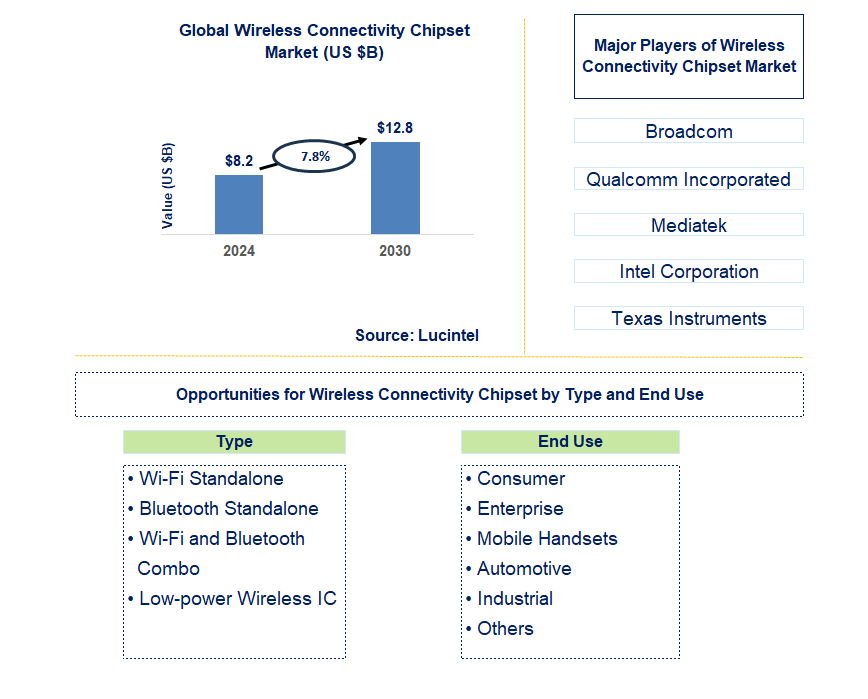
Key data points: The market size in 2030 = $12.8 billion, growth forecast = 7.8% annually for the next 6 years. Scroll below to get more insights. This market report covers trends, opportunities, and forecasts in the global wireless connectivity chipset market to 2030 by type (Wi-Fi standalone, bluetooth standalone, Wi-Fi and bluetooth combo, low-power wireless IC), end use (consumer, enterprise, mobile handsets, automotive, industrial, and others), and region (North America, Europe, Asia Pacific, and the Rest of the World)
We'll send your sample report shortly.
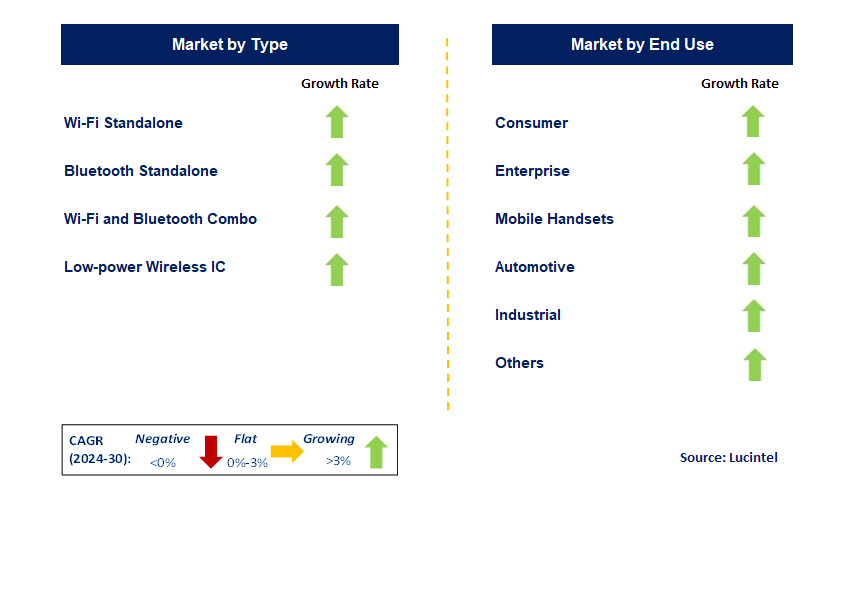
• Lucintel forecasts that, within the type category, Wi-Fi standalone will remain the largest segment over the forecast period growing digitalization across various industries, as well as, growing adoption of digital technology in order to maintain competitiveness, boost productivity, and provide superior customer experiences.
• In terms of regions, APAC is expected to witness highest growth over the forecast period because of growing demand for internet services, rising 5G smartphone availability and cost, as well as the quick uptake of smartphones in both urban and rural locations in the region. Gain valuable insights for your business decisions with our 150+ page report.
• 5G Expansion: The global rollout of 5G technology continues to accelerate, with advancements in chipsets designed to support higher speeds, lower latency, and increased network capacity.
• Wi-Fi 6 and 6E: The adoption of Wi-Fi 6 and the newer Wi-Fi 6E standard is expanding, offering improved performance and efficiency for high-density environments and better support for IoT devices.
• Integration with AI: AI is increasingly integrated into wireless chipsets, enhancing network management, security, and efficiency through intelligent data processing and predictive analytics.
• Increased Focus on IoT: The growth of the Internet of Things (IoT) drives demand for chipsets that support a vast array of connected devices, necessitating advances in power efficiency and communication protocols.
• Sustainability Initiatives: There is a growing emphasis on eco-friendly and sustainable manufacturing practices for chipsets, aligning with global environmental goals and reducing carbon footprints.
• Advancements in Semiconductor Technology: Innovations in semiconductor materials and fabrication techniques are enhancing chipset performance and enabling new features and capabilities. The wireless connectivity chipset market is evolving rapidly with trends that highlight the importance of speed, efficiency, and sustainability. These trends are shaping the future of connectivity and driving industry growth.

• 5G Technology Adoption: The deployment of 5G networks worldwide is driving demand for advanced chipsets that support high-speed data transfer and improved network performance.
• Emergence of Wi-Fi 6 and 6E: The introduction of Wi-Fi 6 and 6E standards is enhancing wireless network efficiency, with chipsets designed to handle increased data traffic and device density.
• Rise of AI Integration: AI technologies are being incorporated into wireless chipsets to optimize network management, enhance security, and improve overall performance.
• Government Initiatives: Various governments are implementing policies and funding programs to support domestic chipset manufacturing and innovation, reducing reliance on international suppliers.
• IoT Expansion: The proliferation of IoT devices is driving advancements in chipsets to support diverse connectivity needs and ensure seamless integration across various applications.
• Focus on Sustainability: There is an increased emphasis on developing eco-friendly chipsets and manufacturing processes to meet environmental regulations and sustainability goals. Recent developments in the wireless connectivity chipset market highlight advancements in 5G, Wi-Fi, AI, and sustainability, reflecting the sector's dynamic evolution and growing importance.
• 5G Infrastructure: Investing in 5G infrastructure presents opportunities for chipset manufacturers to develop high-performance solutions for next-generation networks.
• IoT Applications: The growing IoT ecosystem creates demand for specialized chipsets that support a wide range of connected devices and applications.
• Automotive Sector: The automotive industry’s shift towards connected vehicles and autonomous driving is driving the need for advanced wireless chipsets.
• Smart Home Technology: The expansion of smart home devices offers growth potential for chipsets that enable seamless communication and integration among various home automation systems.
• Healthcare Devices: The rise of telemedicine and connected health devices creates opportunities for chipsets that support reliable and secure wireless communication.
• Industrial Automation: The demand for Industry 4.0 solutions is spurring the development of robust chipsets for industrial IoT and automation applications. Strategic growth opportunities in the wireless connectivity chipset market are emerging across 5G, IoT, automotive, smart home, healthcare, and industrial sectors, reflecting diverse applications and market potential.
• 5G Deployment: The expansion of 5G networks drives demand for advanced chipsets capable of supporting high-speed and low-latency communication.
• Rising IoT Adoption: The proliferation of IoT devices increases the need for chipsets that support diverse connectivity requirements and efficient data processing.
• Technological Advancements: Continuous innovations in wireless technologies, such as Wi-Fi 6 and AI integration, fuel market growth and create new opportunities.
• Government Support: Policies and funding aimed at boosting domestic semiconductor production and innovation contribute to market expansion.
• Consumer Electronics Growth: The increasing demand for smartphones, tablets, and other connected devices drives the need for advanced wireless chipsets. Challenges in the wireless connectivity chipset market include:
• Supply Chain Disruptions: Global semiconductor supply chain issues and shortages can hinder chipset availability and impact market growth.
• Technological Complexity: Rapid advancements in technology pose challenges for chipset manufacturers to keep up with evolving standards and requirements.
• Regulatory Compliance: Meeting diverse regulatory standards across different regions can be challenging for global chipset manufacturers.
• High Development Costs: The cost of research, development, and production for cutting-edge chipsets can be substantial, impacting profitability.
• Market Competition: Intense competition among chipset manufacturers requires continuous innovation and differentiation to maintain market share.
• Cybersecurity Concerns: Ensuring robust security features in chipsets to protect against evolving cyber threats is an ongoing challenge. The wireless connectivity chipset market is driven by 5G, IoT, and technological advancements, but faces challenges related to supply chain issues, technological complexity, and regulatory compliance.
• Broadcom
• Qualcomm Incorporated
• Mediatek
• Intel Corporation
• Texas Instruments Incorporated
• STMicroelectronics
• NXP Semiconductors
• On Semiconductor Corporation
• Infineon Technologies
• Microchip Technology
• Wi-Fi Standalone
• Bluetooth Standalone
• Wi-Fi and Bluetooth Combo
• Low-power Wireless IC
• Consumer
• Enterprise
• Mobile Handsets
• Automotive
• Industrial
• Others
• North America
• Europe
• Asia Pacific
• The Rest of the World
• USA: Recent developments in the U.S. wireless connectivity chipset market are marked by significant advancements in 5G and Wi-Fi 6 technologies. Major American tech companies, including Qualcomm and Intel, are spearheading innovations in 5G chipsets, enabling faster data speeds and enhanced network efficiency. The U.S. is also witnessing increased investments in semiconductor manufacturing, driven by initiatives like the CHIPS Act aimed at boosting domestic production and reducing dependency on foreign suppliers. Furthermore, the integration of artificial intelligence (AI) with wireless chipsets is gaining traction, promising improved performance and smarter network management.
• China: China's wireless connectivity chipset market is rapidly advancing with substantial investments in 5G technology and semiconductor innovation. Chinese tech giants like Huawei and ZTE are leading the development of 5G chipsets, aiming to dominate the global market. The country is also investing in research to develop next-generation chipsets that support the Internet of Things (IoT) and smart cities initiatives. Government policies are encouraging domestic production and reducing reliance on foreign technology. Additionally, China is expanding its influence in the global supply chain through initiatives like the Belt and Road Initiative, impacting the wireless chipset market.
• India: In India, the wireless connectivity chipset market is experiencing growth driven by increasing demand for mobile connectivity and the expansion of digital infrastructure. Companies such as Reliance Jio and Bharti Airtel are investing in 5G technology to enhance network capabilities. The Indian government’s push towards a Digital India initiative is fostering innovation in wireless chipsets, with a focus on affordability and accessibility. Local semiconductor manufacturers are emerging, supported by government incentives and partnerships. The growing consumer electronics market and rising smartphone penetration are also contributing to the development of advanced wireless chipsets.
• Japan: Japan's wireless connectivity chipset market is characterized by cutting-edge technological advancements and a focus on high-speed connectivity. Major Japanese firms like Sony and Toshiba are investing in 5G and Wi-Fi 6 chipsets, aiming to enhance both consumer and industrial applications. Japan is also exploring the integration of wireless chipsets with emerging technologies such as robotics and augmented reality (AR). The country’s emphasis on innovation is supported by government initiatives and collaborations with research institutions. Additionally, Japan’s strong emphasis on quality and precision is driving advancements in chipset performance and reliability.


• Broadcom
• Qualcomm Incorporated
• Mediatek
• Intel Corporation
• Texas Instruments Incorporated
• STMicroelectronics
• NXP Semiconductors
• On Semiconductor Corporation
• Infineon Technologies
• Microchip Technology Q6. Which wireless connectivity chipset market segment will be the largest in future? Answer: Lucintel forecasts that Wi-Fi standalone will remain the largest segment over the forecast period growing digitalization across various industries, as well as, growing adoption of digital technology in order to maintain competitiveness, boost productivity, and provide superior customer experiences. Q7. In wireless connectivity chipset market, which region is expected to be the largest in next 5 years? Answer: APAC is expected to witness highest growth over the forecast period because of growing demand for internet services, rising 5G smartphone availability and cost, as well as the quick uptake of smartphones in both urban and rural locations in the region. Q.8 Do we receive customization in this report? Answer: Yes, Lucintel provides 10% customization without any additional cost.


Choose a license that fits your team. Instant PDF delivery.
Prices exclude taxes. Instant delivery. Custom licensing available on request.
Market Report · July 24, 2026
Market Report · July 20, 2026
Market Report · July 20, 2026
Trusted partner for strategic intelligence and business growth


Receive a complimentary market analysis tailored to your industry. Our analysts will identify key growth opportunities and competitive dynamics specific to your business.

Market size, growth rate, and key trend analysis for your specific sector.

Top competitor positioning and market share analysis.

Strategic recommendations backed by data-driven insights.
Get curated market intelligence and competitive moves straight to your inbox.
By subscribing, you agree to receive our monthly insights. Unsubscribe anytime.
Receive a complimentary market analysis tailored to your industry. Our analysts will identify key growth opportunities and competitive dynamics specific to your business.
Market size, growth rate, and key trend analysis for your specific sector.
Top competitor positioning and market share analysis.
Strategic recommendations backed by data-driven insights.
Get curated market intelligence, emerging trends, and competitive moves straight to your inbox each month.
By subscribing, you agree to receive our monthly insights. Unsubscribe anytime.
We'll send your sample report shortly.