
Semiconductor Grade Neon Gas Market Trends and Forecast
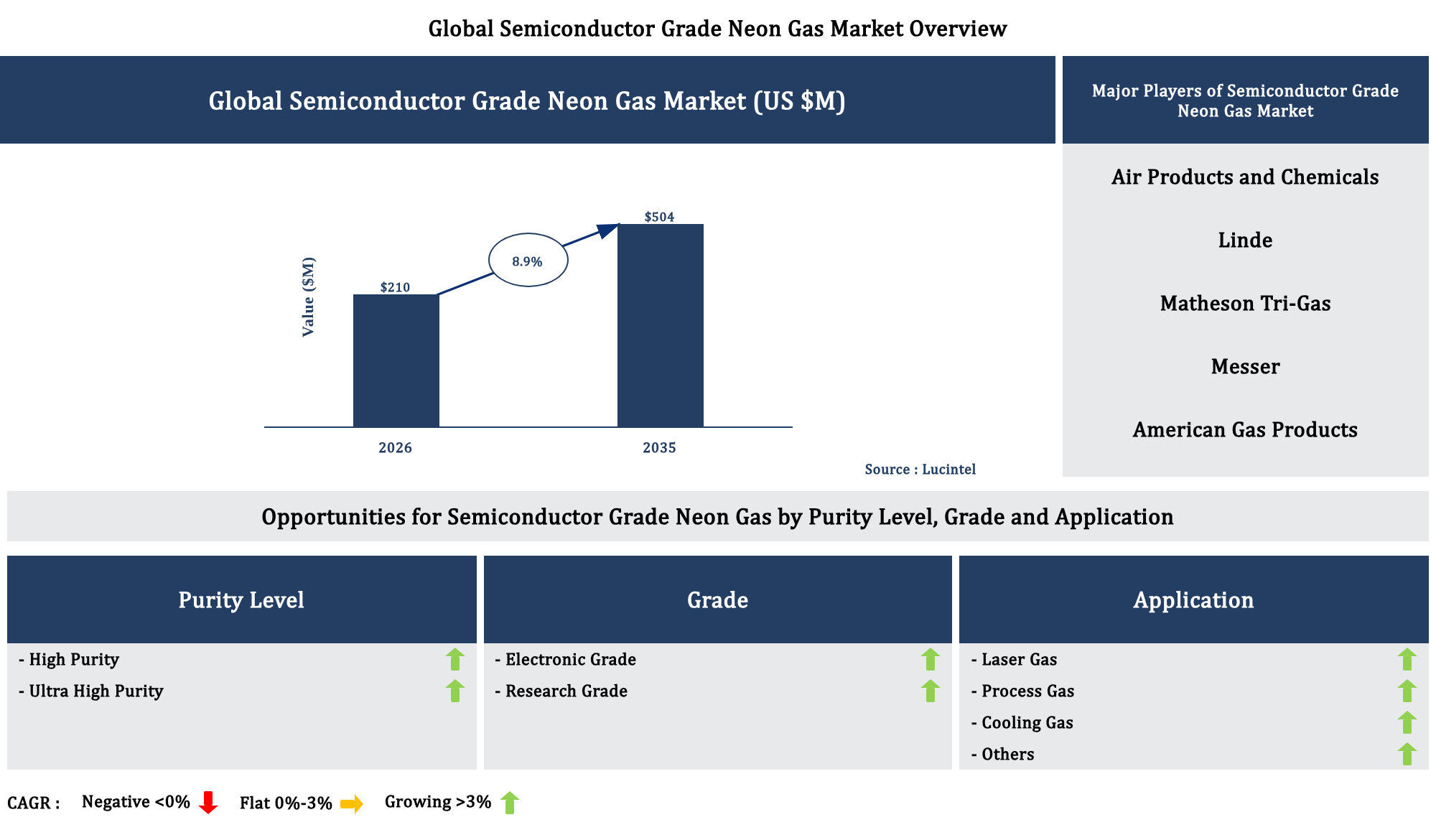
The future of the global semiconductor grade neon gas market looks promising with opportunities in the laser gas, process gas, and cooling gas markets. The global semiconductor grade neon gas market is expected to reach an estimated $504 million by 2035 with a CAGR of 8.9% from 2026 to 2035. The major drivers for this market are the rising demand for high-performance electronic devices, the increasing adoption of advanced duv lithography technologies, and the growing demand for consumer electronics.
• Lucintel forecasts that, within the purity level category, ultra high purity is expected to witness higher growth over the forecast period.
• Within the application category, laser gas is expected to witness the highest growth.
• In terms of region, APAC is expected to witness the highest growth over the forecast period.
Gain valuable insights for your business decisions with our comprehensive 150+ page report. Sample figures with some insights are shown below.
Emerging Trends in the Semiconductor Grade Neon Gas Market
The semiconductor grade neon gas market is experiencing rapid evolution driven by technological advancements, increasing demand for electronic devices, and the need for higher precision in manufacturing processes. As the electronics industry expands, the demand for high-purity gases like neon is surging, prompting innovations in production, supply chain management, and sustainability practices. These developments are reshaping the market landscape, influencing pricing, regional dynamics, and regulatory frameworks. Stakeholders must adapt to these emerging trends to maintain competitiveness and meet the growing needs of the semiconductor industry, which is critical for the global economy and technological progress.
• Rising Demand for Semiconductor Devices: The proliferation of smartphones, computers, and IoT devices is fueling the need for advanced semiconductors. Neon gas is essential in the laser-based lithography processes used to produce these chips, leading to increased consumption. As technology advances, the demand for more precise and smaller semiconductors grows, further boosting neon requirements. This trend underscores the importance of a reliable supply chain and high-quality neon gas to meet manufacturing standards, ultimately driving market growth and innovation in semiconductor fabrication.
• Technological Innovations in Neon Production: New methods such as cryogenic distillation and advanced purification techniques are improving neon production efficiency and purity levels. These innovations reduce costs and enhance the quality of neon gas, which is critical for semiconductor manufacturing. Enhanced production technologies also enable suppliers to meet the rising demand more effectively, ensuring supply stability. As a result, the market benefits from increased competition, better product quality, and the ability to support the evolving needs of high-precision semiconductor fabrication processes.
• Supply Chain Diversification and Regional Shifts: Dependence on a limited number of geographic regions for neon production has exposed vulnerabilities, especially amid geopolitical tensions and supply disruptions. Companies are now diversifying sources and establishing regional production facilities to mitigate risks. Countries like the U.S., China, and Russia are investing in local neon production capabilities. This regional shift enhances supply security, reduces lead times, and influences pricing dynamics, making the market more resilient and responsive to global demand fluctuations.
• Environmental and Sustainability Initiatives: The industry is increasingly adopting eco-friendly practices, such as recycling neon gases and reducing energy consumption during production. These initiatives aim to minimize environmental impact and comply with stricter regulations. Sustainable practices not only improve corporate responsibility but also appeal to environmentally conscious consumers and clients. As sustainability becomes a key criterion, companies investing in greener technologies and processes are gaining competitive advantages, shaping the market toward more responsible and eco-efficient operations.
• Regulatory and Geopolitical Influences: Governments are implementing policies to regulate the production, export, and usage of neon gases, impacting global trade flows. Trade restrictions, sanctions, and export controls can disrupt supply chains and influence market prices. Additionally, geopolitical tensions may lead to shortages or increased costs, prompting companies to seek alternative sources or develop local production. These regulatory and geopolitical factors are critical in shaping market stability, influencing investment decisions, and driving strategic shifts among industry players to ensure supply continuity and compliance.
These emerging trends are collectively transforming the semiconductor grade neon gas market by enhancing supply resilience, driving technological progress, and emphasizing sustainability. They are fostering a more dynamic, competitive, and environmentally conscious industry landscape, which is essential for supporting the ongoing growth and innovation in the semiconductor sector worldwide.
Recent Development in the Semiconductor Grade Neon Gas Market
The semiconductor industry is experiencing rapid technological advancements and increasing demand for high-performance devices. As a critical component in manufacturing processes, semiconductor grade neon gas is gaining prominence due to its essential role in laser-based lithography and etching techniques. Recent developments are shaping the market landscape, driven by innovations, supply chain improvements, and expanding applications. These changes are creating new opportunities for manufacturers and stakeholders, influencing global supply dynamics and market growth trajectories.
• Growing Demand for Advanced Semiconductor Manufacturing: The surge in consumer electronics, AI devices, and 5G infrastructure is fueling the need for high-purity neon gas, essential for laser lithography. This demand is prompting manufacturers to increase production capacity and invest in supply chain resilience, ensuring consistent supply for chip fabrication. The market is thus expanding rapidly, with neon gas becoming a critical resource in semiconductor fabrication, supporting technological innovation and economic growth.
• Technological Innovations Enhancing Neon Gas Applications: Innovations in laser lithography and etching techniques are increasing neon gas efficiency and purity standards. These advancements enable finer chip features and higher yields, reducing costs and improving device performance. As a result, manufacturers are adopting new neon gas formulations and delivery systems, which are transforming the manufacturing process. This evolution is driving market growth by enabling the production of more sophisticated and smaller semiconductor devices.
• Supply Chain Diversification and Strategic Stockpiling: Geopolitical tensions and supply disruptions have prompted companies to diversify neon gas sources and build strategic reserves. Countries are investing in local production facilities and alternative suppliers to mitigate risks. This strategic approach enhances supply security, stabilizes prices, and reduces dependency on limited sources. Consequently, the market is becoming more resilient, attracting investments and fostering long-term growth opportunities for industry players.
• Increasing Environmental and Safety Regulations: Stricter environmental standards and safety protocols are influencing neon gas production and handling practices. Companies are adopting greener production methods and improving safety measures to comply with regulations. These changes are driving innovation in gas purification and containment technologies, which can increase costs but also open new market segments. Overall, these regulations are shaping a more sustainable and compliant market environment, encouraging technological advancements.
• Expansion of Neon Gas Applications Beyond Semiconductors: Neon gas is increasingly used in emerging fields such as quantum computing, medical imaging, and laser manufacturing. This diversification broadens market potential and reduces reliance on traditional semiconductor applications. As new industries adopt neon gas, demand is expected to grow, prompting investments in production capacity and research. This expansion is fostering a more dynamic and resilient market landscape, with opportunities for innovation and cross-sector growth.
The recent developments in the semiconductor grade neon gas market are significantly impacting the industry by enhancing supply stability, fostering technological innovation, and expanding application areas. These factors collectively drive market growth, attract investments, and promote sustainable practices. As the market evolves, stakeholders are better positioned to meet rising global demand, ensuring continued technological progress and economic benefits.
Strategic Growth Opportunities in the Semiconductor Grade Neon Gas Market
The semiconductor grade neon gas market is experiencing rapid expansion driven by increasing demand for advanced electronics and manufacturing processes. As the electronics industry evolves, the need for high-purity gases like neon becomes critical for laser applications, chip fabrication, and display manufacturing. Market players are exploring new sources, improving purity standards, and expanding regional presence to capitalize on emerging opportunities. Strategic investments and technological innovations are expected to further accelerate growth, making neon an indispensable component in semiconductor production.
• Growing Demand for Neon in Laser and Lithography Applications: The increasing use of neon in laser systems for semiconductor lithography and micromachining is a significant growth driver. As chip complexity rises, the need for high-precision laser sources grows, boosting neon consumption. Manufacturers are investing in high-purity neon production to meet stringent quality standards, ensuring consistent performance in advanced manufacturing processes. This trend is expected to continue as the semiconductor industry pushes for smaller, more efficient chips.
• Expansion of Semiconductor Manufacturing Facilities Worldwide: The global expansion of semiconductor fabrication plants, especially in Asia and North America, is creating substantial demand for high-purity neon gas. New fabs require large volumes of neon for plasma etching and other critical processes. Companies are establishing regional supply chains and sourcing strategies to ensure reliable supply, reducing dependency on traditional sources. This regional growth is expected to sustain long-term market expansion and reduce supply chain vulnerabilities.
• Technological Advancements Improving Neon Purity and Efficiency: Innovations in gas purification and handling technologies are enhancing neon’s purity levels, which is crucial for sensitive semiconductor applications. Improved efficiency in neon extraction and recycling processes reduces costs and environmental impact. These advancements enable manufacturers to meet the increasing quality standards demanded by chipmakers, fostering market growth. As technology evolves, the ability to produce ultra-high-purity neon at competitive prices will further stimulate demand.
• Rising Investments in Sustainable and Alternative Gas Sourcing: Environmental concerns and supply chain risks are prompting investments in sustainable neon sourcing methods, including recycling and alternative extraction techniques. Companies are exploring ways to reduce waste and energy consumption during neon production. These initiatives aim to ensure a stable, eco-friendly supply chain, aligning with global sustainability goals. Such investments are expected to lower costs and improve supply security, positively impacting market stability and growth prospects.
• Increasing Adoption of Neon in Emerging Applications Like Quantum Computing: Neon’s unique properties are increasingly being utilized in emerging fields such as quantum computing and advanced photonics. These applications require precise laser sources and high-purity gases, positioning neon as a critical component. As research progresses and new technologies develop, demand for specialized neon grades will rise. This diversification into high-tech sectors offers new revenue streams and long-term growth opportunities for market players.
The overall market outlook remains robust, driven by technological innovation, regional expansion, and diversification into new applications. These opportunities collectively enhance the strategic importance of neon in semiconductor manufacturing, promising sustained growth and innovation in the industry.
Semiconductor Grade Neon Gas Market Driver and Challenges
The semiconductor grade neon gas market is influenced by a variety of technological, economic, and regulatory factors. Rapid advancements in semiconductor manufacturing technology drive demand for high-purity neon gas essential for laser-based lithography processes. Economic fluctuations impact capital investments in semiconductor plants, affecting neon consumption. Regulatory standards concerning environmental safety and gas purity influence production and supply chains. Additionally, geopolitical considerations and supply chain resilience play critical roles in shaping market dynamics. These factors collectively create a complex environment where innovation, compliance, and geopolitical stability are vital for sustained growth and market stability.
The factors responsible for driving the semiconductor grade neon gas market include:-
• Technological Advancements: The continuous evolution of semiconductor manufacturing processes, especially the adoption of extreme ultraviolet (EUV) lithography, increases demand for high-purity neon gas. As chip complexity grows, the need for precise, reliable, and high-quality neon becomes critical, fueling market expansion. Innovations in laser technology and manufacturing techniques further enhance neon’s role, making it indispensable for next-generation semiconductors. This technological progression ensures a steady demand, encouraging investments in production capacity and supply chain development, ultimately supporting market growth.
• Growing Semiconductor Industry: The global surge in demand for consumer electronics, automotive electronics, and data centers has significantly expanded the semiconductor industry. As the industry scales up production to meet rising demand, the need for high-purity gases like neon intensifies. Countries investing heavily in semiconductor fabrication facilities (fabs) are driving regional demand, especially in Asia-Pacific. This growth directly correlates with increased neon consumption, reinforcing the market’s expansion prospects. The expanding industry also prompts technological improvements in neon extraction and purification, ensuring supply meets quality standards.
• Supply Chain Consolidation: The neon gas market is witnessing consolidation among key suppliers, which enhances supply stability and quality control. Major producers are investing in capacity expansion and strategic partnerships to secure long-term supply agreements. This consolidation reduces market fragmentation, improves pricing stability, and ensures consistent quality for semiconductor manufacturers. As supply chain resilience becomes a priority amid geopolitical tensions and pandemic disruptions, such consolidation supports reliable neon availability, fostering confidence among end-users and encouraging further industry investments.
• Regulatory and Environmental Standards: Stringent regulations regarding environmental safety, gas purity, and manufacturing emissions influence the neon gas market. Governments are imposing stricter standards to reduce environmental impact, which compels producers to adopt cleaner, more efficient extraction and purification methods. Compliance increases operational costs but ensures product quality and safety, which are critical for semiconductor manufacturing. These regulations also promote innovation in sustainable production techniques, potentially creating barriers to entry but ensuring long-term market stability and trust among consumers and regulators.
• Price Volatility and Raw Material Availability: Neon gas prices are subject to fluctuations driven by raw material availability, extraction costs, and geopolitical factors. Limited sources of neon, primarily from air separation units, make the market susceptible to supply disruptions. Price volatility can impact semiconductor manufacturers’ procurement strategies and profit margins. Additionally, geopolitical tensions, especially involving major neon-producing countries, can restrict supply, leading to increased prices and supply shortages. Managing these risks requires strategic stockpiling and diversified sourcing, which can influence market stability and growth trajectories.
The challenges in the semiconductor grade neon gas market are:-
• Supply Chain Disruptions: The neon gas supply chain is highly concentrated, with a few countries and companies controlling significant portions of production. Disruptions caused by geopolitical tensions, natural disasters, or pandemics can severely impact supply availability. Such disruptions lead to price spikes and shortages, affecting semiconductor manufacturing schedules and costs. The reliance on a limited number of sources makes the market vulnerable, necessitating diversification and strategic reserves. Overcoming these challenges requires building resilient supply networks and investing in alternative production methods to ensure consistent supply.
• Environmental and Regulatory Compliance Costs: Increasing environmental regulations impose higher compliance costs on neon producers. Implementing cleaner extraction and purification technologies demands significant capital investment, which can raise production costs. These costs may be passed on to consumers, impacting market competitiveness. Additionally, stricter standards may limit production capacity or delay new projects, constraining supply growth. Navigating complex regulatory landscapes requires continuous innovation and adaptation, which can be resource-intensive for producers but essential for long-term sustainability and market access.
• Market Price Fluctuations: Neon prices are highly volatile due to supply-demand imbalances, raw material costs, and geopolitical issues. Price fluctuations create uncertainty for semiconductor manufacturers, complicating procurement planning and budgeting. High prices can lead to increased costs for chip producers, potentially impacting product pricing and profitability. Conversely, price drops may discourage investment in neon production capacity. Managing this volatility involves strategic inventory management and long-term contracts, but market unpredictability remains a significant challenge that can hinder stable growth.
The semiconductor grade neon gas market is shaped by technological innovations, industry growth, supply chain dynamics, regulatory standards, and price volatility. While technological progress and industry expansion drive demand, supply chain vulnerabilities and regulatory costs pose significant challenges. Price fluctuations add further complexity, requiring strategic management by stakeholders. Overall, these drivers and challenges collectively influence market stability, growth prospects, and the strategic decisions of industry participants. A balanced approach focusing on innovation, diversification, and compliance will be essential for sustained success in this evolving market.
List of Semiconductor Grade Neon Gas Companies
Companies in the market compete on the basis of product quality offered. Major players in this market focus on expanding their manufacturing facilities, R&D investments, infrastructural development, and leverage integration opportunities across the value chain. With these strategies semiconductor grade neon gas companies cater increasing demand, ensure competitive effectiveness, develop innovative products & technologies, reduce production costs, and expand their customer base. Some of the semiconductor grade neon gas companies profiled in this report include-
• Air Products and Chemicals
• Linde
• Matheson Tri-Gas
• Messer
• American Gas Products
• Taiyo Nippon Sanso
• Iceblick
• Air Liquide
• Air Water
• Proton Gases
Semiconductor Grade Neon Gas Market by Segment
The study includes a forecast for the global semiconductor grade neon gas market by purity level, grade, application, and region.
Semiconductor Grade Neon Gas Market by Purity Level [Value from 2019 to 2035]:
• High Purity
• Ultra High Purity
Semiconductor Grade Neon Gas Market by Grade [Value from 2019 to 2035]:
• Electronic Grade
• Research Grade
Semiconductor Grade Neon Gas Market by Application [Value from 2019 to 2035]:
• Laser Gas
• Process Gas
• Cooling Gas
• Others
Semiconductor Grade Neon Gas Market by Region [Value from 2019 to 2035]:
• North America
• Europe
• Asia Pacific
• The Rest of the World
Country Wise Outlook for the Semiconductor Grade Neon Gas Market
The semiconductor grade neon gas market has experienced significant shifts driven by technological advancements, geopolitical factors, and supply chain dynamics. As the demand for semiconductors surges globally, countries are investing in production capabilities and diversifying sources to ensure stability. Innovations in manufacturing processes and increased regulatory scrutiny also influence market trends. The following summaries highlight recent developments in the United States, China, Germany, India, and Japan, reflecting their strategic responses and industry progress in this critical sector.
• United States: The U.S. has increased investments in domestic neon gas production facilities to reduce reliance on imports, driven by supply chain disruptions and geopolitical tensions. Major semiconductor manufacturers are collaborating with local suppliers to secure a stable neon supply, and government initiatives aim to bolster the industry through funding and policy support. Technological advancements in neon purification and recycling are also being prioritized to enhance sustainability and cost-efficiency
• China: China is rapidly expanding its neon gas production capacity to meet the rising demand from its burgeoning semiconductor industry. The government has launched strategic projects to develop domestic sources and reduce dependence on foreign imports. Chinese firms are investing in advanced extraction and purification technologies, and several new plants are under construction to ensure supply security. This effort aligns with China‘s broader goal of achieving self-sufficiency in critical semiconductor materials.
• Germany: Germany remains a key player in the European semiconductor supply chain, focusing on high-quality neon gas production and supply chain resilience. Recent developments include upgrades to existing facilities and investments in innovative purification technologies. German companies are also exploring sustainable production methods to meet environmental standards and reduce carbon footprints, positioning themselves as reliable suppliers for European and global markets.
• India: India is making strategic moves to develop its domestic neon gas industry, aiming to support its growing semiconductor manufacturing sector. The government has announced initiatives to establish local production units and improve extraction techniques. Collaborations with international firms are underway to transfer technology and expertise. These efforts are part of India‘s broader vision to become a significant player in the global semiconductor supply chain and reduce import dependency.
• Japan: Japan continues to focus on technological innovation in neon gas production, emphasizing high purity and efficiency. The country is investing in research to improve extraction and recycling processes, ensuring a stable supply for its semiconductor industry. Japanese firms are also exploring environmentally friendly production methods and forming strategic alliances to strengthen supply chain resilience amid global uncertainties. These developments aim to maintain Japan‘s competitive edge in the global semiconductor market.
Features of the Global Semiconductor Grade Neon Gas Market
Market Size Estimates: Semiconductor grade neon gas market size estimation in terms of value ($M).
Trend and Forecast Analysis: Market trends (2019 to 2025) and forecast (2026 to 2035) by various segments and regions.
Segmentation Analysis: Semiconductor grade neon gas market size by purity level, grade, application, and region in terms of value ($M).
Regional Analysis: Semiconductor grade neon gas market breakdown by North America, Europe, Asia Pacific, and Rest of the World.
Growth Opportunities: Analysis of growth opportunities in different purity level, grade, application, and regions for the semiconductor grade neon gas market.
Strategic Analysis: This includes M&A, new product development, and competitive landscape of the semiconductor grade neon gas market.
Analysis of competitive intensity of the industry based on Porter’s Five Forces model.
FAQ
Q1. What is the semiconductor grade neon gas market size?
Answer: The global semiconductor grade neon gas market is expected to reach an estimated $504 million by 2035.
Q2. What is the growth forecast for semiconductor grade neon gas market?
Answer: The global semiconductor grade neon gas market is expected to grow with a CAGR of 8.9% from 2026 to 2035.
Q3. What are the major drivers influencing the growth of the semiconductor grade neon gas market?
Answer: The major drivers for this market are the rising demand for high-performance electronic devices, the increasing adoption of advanced duv lithography technologies, and the growing demand for consumer electronics.
Q4. What are the major segments for semiconductor grade neon gas market?
Answer: The future of the semiconductor grade neon gas market looks promising with opportunities in the laser gas, process gas, and cooling gas markets.
Q5. Who are the key semiconductor grade neon gas market companies?
Answer: Some of the key semiconductor grade neon gas companies are as follows:
• Air Products and Chemicals
• Linde
• Matheson Tri-Gas
• Messer
• American Gas Products
• Taiyo Nippon Sanso
• Iceblick
• Air Liquide
• Air Water
• Proton Gases
Q6. Which semiconductor grade neon gas market segment will be the largest in future?
Answer: Lucintel forecasts that, within the purity level category, ultra high purity is expected to witness higher growth over the forecast period.
Q7. In semiconductor grade neon gas market, which region is expected to be the largest in next 8 years?
Answer: In terms of region, APAC is expected to witness the highest growth over the forecast period.
Q8. Do we receive customization in this report?
Answer: Yes, Lucintel provides 10% customization without any additional cost.
This report answers following 11 key questions:
Q.1. What are some of the most promising, high-growth opportunities for the semiconductor grade neon gas market by purity level (high purity and ultra high purity), grade (electronic grade and research grade), application (laser gas, process gas, cooling gas, and others), and region (North America, Europe, Asia Pacific, and the Rest of the World)?
Q.2. Which segments will grow at a faster pace and why?
Q.3. Which region will grow at a faster pace and why?
Q.4. What are the key factors affecting market dynamics? What are the key challenges and business risks in this market?
Q.5. What are the business risks and competitive threats in this market?
Q.6. What are the emerging trends in this market and the reasons behind them?
Q.7. What are some of the changing demands of customers in the market?
Q.8. What are the new developments in the market? Which companies are leading these developments?
Q.9. Who are the major players in this market? What strategic initiatives are key players pursuing for business growth?
Q.10. What are some of the competing products in this market and how big of a threat do they pose for loss of market share by material or product substitution?
Q.11. What M&A activity has occurred in the last 7 years and what has its impact been on the industry?
For any questions related to Semiconductor Grade Neon Gas Market, Semiconductor Grade Neon Gas Market Size, Semiconductor Grade Neon Gas Market Growth, Semiconductor Grade Neon Gas Market Analysis, Semiconductor Grade Neon Gas Market Report, Semiconductor Grade Neon Gas Market Share, Semiconductor Grade Neon Gas Market Trends, Semiconductor Grade Neon Gas Market Forecast, Semiconductor Grade Neon Gas Companies, write Lucintel analyst at email: helpdesk@lucintel.com. We will be glad to get back to you soon.

