
Report Feature
Wireless Backhaul via Satellite Market Trends and Forecast
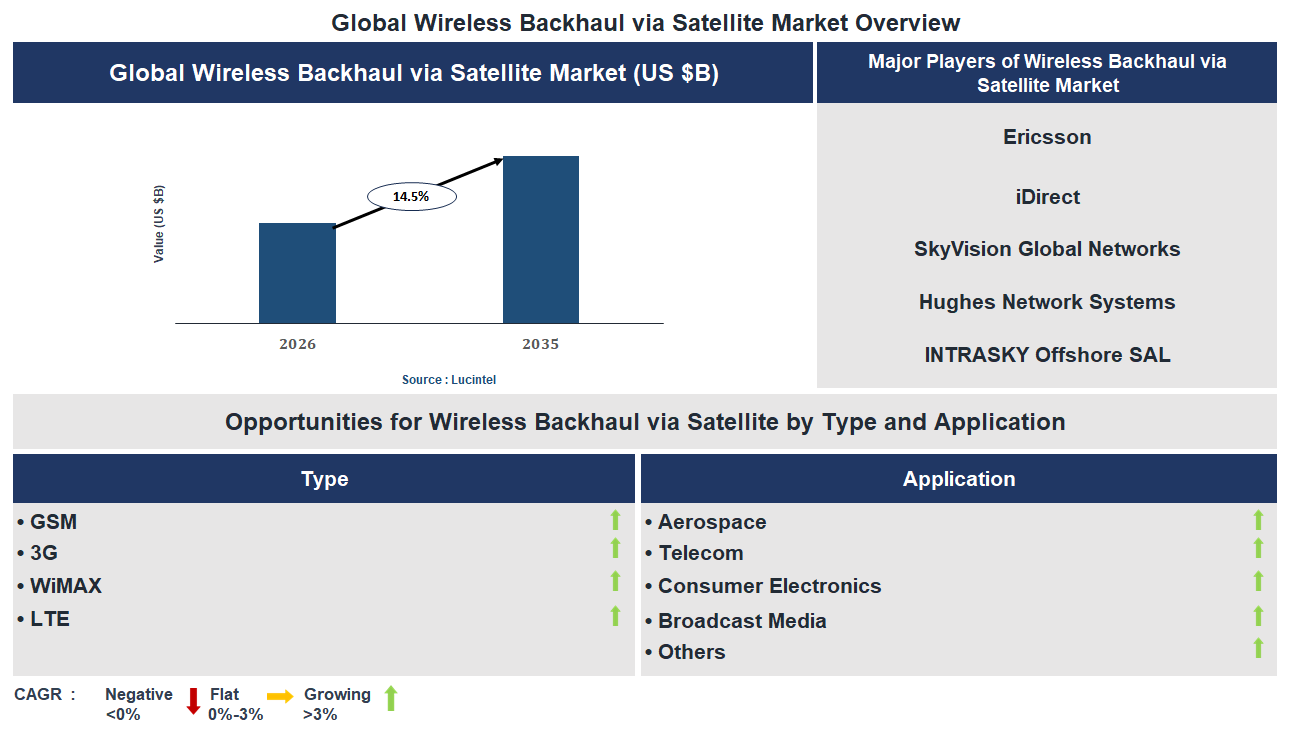
The future of the global wireless backhaul via satellite market looks promising with opportunities in the aerospace, telecom, consumer electronics, and broadcast media markets. The global wireless backhaul via satellite market is expected to reach an estimated $7.3 billion by 2035 with a CAGR of 15.4% from 2026 to 2035. The major drivers for this market are the increasing demand for high-speed internet, the rising need for remote connectivity solutions, and the growing adoption of satellite communication technology.• Lucintel forecasts that, within the type category, LTE is expected to witness the highest growth over the forecast period.
• Within the application category, telecom is expected to witness the highest growth.
• In terms of region, APAC is expected to witness the highest growth over the forecast period. Gain valuable insights for your business decisions with our comprehensive 150+ page report. Sample figures with some insights are shown below.
Emerging Trends in the Wireless Backhaul via Satellite Market
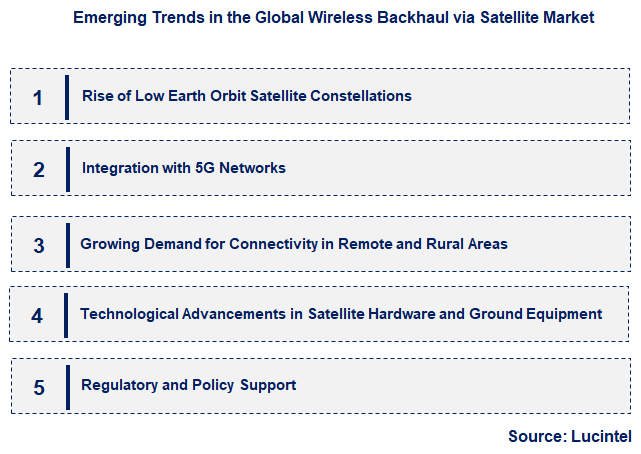
The wireless backhaul via satellite market is experiencing rapid growth driven by increasing demand for reliable connectivity in remote and underserved areas, the proliferation of IoT devices, and advancements in satellite technology. As digital transformation accelerates globally, satellite backhaul solutions are becoming essential for bridging connectivity gaps, especially in rural regions, maritime, and aviation sectors. Innovations in satellite constellations, cost reductions, and regulatory support are further fueling market expansion. These developments are transforming how data is transmitted across vast distances, enabling new business models and improving service quality. The following key trends highlight the market's evolving landscape and its future trajectory.• Rise of Low Earth Orbit Satellite Constellations: LEO satellites offer lower latency and higher bandwidth compared to traditional geostationary satellites. Companies like SpaceX and OneWeb are deploying large constellations, making satellite backhaul more viable for high-speed internet and real-time applications. This trend enhances connectivity in remote areas, reduces latency issues, and supports the growth of IoT and 5G services. The increased deployment of LEO satellites is expected to significantly expand market reach and improve service quality, making satellite backhaul a competitive alternative to terrestrial infrastructure.
• Integration with 5G Networks: The convergence of satellite backhaul with 5G technology is a key trend, enabling seamless connectivity across urban and rural areas. Satellite solutions are increasingly being integrated into 5G networks to provide backhaul support where fiber or microwave links are impractical. This integration enhances network coverage, reduces deployment costs, and accelerates the rollout of 5G services in remote regions. As 5G demands higher bandwidth and lower latency, satellite backhaul is becoming a critical component in achieving ubiquitous connectivity, especially in hard-to-reach locations.
• Growing Demand for Connectivity in Remote and Rural Areas: The need to bridge the digital divide is driving the adoption of satellite backhaul solutions in underserved regions. Governments and private enterprises are investing in satellite infrastructure to provide reliable internet access, support education, healthcare, and economic development. This trend is expanding market opportunities and fostering inclusive growth. As traditional infrastructure faces challenges in remote terrains, satellite backhaul offers a scalable and cost-effective solution, transforming connectivity landscapes and enabling new digital services in previously inaccessible areas.
• Technological Advancements in Satellite Hardware and Ground Equipment: Innovations in satellite payloads, antennas, and ground station technology are improving performance and reducing costs. Phased array antennas, software-defined radios, and miniaturized satellite components enhance flexibility, scalability, and ease of deployment. These advancements enable faster installation, better signal quality, and lower operational expenses. As hardware becomes more sophisticated and affordable, market adoption accelerates, supporting the deployment of larger satellite constellations and expanding service offerings across various sectors.
• Regulatory and Policy Support: Governments and international agencies are increasingly recognizing the strategic importance of satellite backhaul for national connectivity goals. Regulatory frameworks are evolving to facilitate satellite spectrum allocation, licensing, and cross-border cooperation. Supportive policies are encouraging investments and fostering innovation in satellite technology. This trend reduces barriers to market entry, accelerates deployment timelines, and promotes public-private partnerships. Enhanced regulatory support is crucial for scaling satellite backhaul solutions globally, ensuring they meet security, interoperability, and quality standards. In summary, these emerging trends are collectively reshaping the wireless backhaul via satellite market by making satellite connectivity more accessible, affordable, and integrated with next-generation networks. They are driving innovation, expanding market reach, and enabling reliable communication in previously underserved regions, ultimately transforming the global digital landscape.
Recent Development in the Wireless Backhaul via Satellite Market
The wireless backhaul via satellite market is experiencing rapid growth driven by increasing demand for reliable connectivity in remote and underserved areas. Technological advancements and declining satellite launch costs are expanding market reach. Governments and the private sector are investing heavily to improve infrastructure, especially in rural regions. The integration of 5G networks with satellite backhaul is creating new opportunities. This evolving landscape is reshaping how data is transmitted globally, offering scalable, cost-effective solutions for diverse applications.• Growing Demand For Rural Connectivity: The need to bridge the digital divide is fueling satellite backhaul adoption in remote areas, enabling high-speed internet access where terrestrial infrastructure is limited, thus expanding market reach and fostering economic development.
• Advancements in Satellite Technology: Innovations such as high-throughput satellites (HTS) and low Earth orbit (LEO) constellations are increasing capacity and reducing latency, making satellite backhaul more competitive with terrestrial options and attracting new customers.
• Cost Reduction in Satellite Launches: Decreasing launch costs due to reusable rocket technology and increased competition are making satellite deployment more affordable, encouraging service providers to expand networks and invest in new infrastructure.
• Integration with 5G Networks: Combining satellite backhaul with 5G technology enhances network coverage and capacity, especially in rural and hard-to-reach areas, accelerating digital transformation and enabling new services like IoT and smart cities.
• Rising Government and Private Sector Investments: Increased funding and strategic partnerships are supporting satellite backhaul projects, fostering innovation, and expanding market penetration across various regions, particularly in developing countries. These developments are significantly transforming the wireless backhaul via satellite market by improving connectivity, reducing costs, and expanding coverage. The integration of advanced satellite technologies and increased investments are driving growth, making satellite backhaul a vital component of global communication infrastructure. This evolution is poised to enhance digital inclusion and support the expansion of next-generation networks worldwide.
Strategic Growth Opportunities in the Wireless Backhaul via Satellite Market
The wireless backhaul via satellite market is experiencing rapid expansion driven by increasing demand for reliable connectivity in remote and underserved areas. Technological advancements, declining satellite launch costs, and the rise of 5G networks are fueling growth opportunities. As telecom providers seek scalable, cost-effective solutions, satellite backhaul is becoming a vital component for expanding network coverage and capacity. This evolving landscape presents numerous strategic opportunities for industry players to innovate and capture market share.• Expanding Connectivity in Remote and Rural Areas: Satellite backhaul offers a cost-effective solution to extend high-speed internet to underserved regions where terrestrial infrastructure is impractical or too expensive. This opportunity enables telecom operators to bridge the digital divide, improve access to education, healthcare, and economic development, and meet regulatory mandates for universal service. The growing demand for connectivity in these areas is expected to significantly boost satellite backhaul deployments worldwide.
• Supporting 5G Network Deployment in Challenging Terrains: The rollout of 5G requires dense, high-capacity backhaul solutions, especially in difficult terrains like mountains, forests, and islands. Satellite backhaul provides a flexible, rapid deployment option that complements terrestrial networks, ensuring seamless coverage and capacity. This opportunity allows telecom providers to accelerate 5G adoption in hard-to-reach locations, enhance network resilience, and meet increasing data traffic demands driven by IoT, smart cities, and autonomous vehicles.
• Enhancing Disaster Recovery and Network Resilience: Satellite backhaul offers a reliable backup communication link during natural disasters, cyberattacks, or infrastructure failures. This strategic opportunity enables telecom operators and government agencies to maintain critical communication services, ensure business continuity, and restore connectivity swiftly. The growing emphasis on resilient infrastructure and emergency preparedness is expected to drive investments in satellite backhaul solutions for disaster recovery and network redundancy.
• Leveraging Advancements in Satellite Technology for Higher Capacity: Innovations such as high-throughput satellites (HTS) and low Earth orbit (LEO) constellations are significantly increasing backhaul capacity and reducing latency. This technological evolution creates opportunities for service providers to deliver faster, more reliable internet services. The market can capitalize on these advancements by offering scalable, high-capacity solutions tailored to enterprise, government, and consumer needs, thereby expanding market reach and competitiveness.
• Capitalizing on Government Initiatives and Regulatory Support: Governments worldwide are promoting satellite-based connectivity through subsidies, spectrum allocations, and strategic initiatives aimed at bridging digital gaps. This supportive regulatory environment presents opportunities for market growth by enabling partnerships, funding deployments, and fostering innovation. Engaging with policymakers and leveraging public-private collaborations can accelerate market penetration, especially in emerging economies seeking to improve digital infrastructure. The overall impact of these growth opportunities is poised to transform the wireless backhaul via satellite market into a more dynamic, inclusive, and technologically advanced sector. By addressing connectivity challenges, supporting new network architectures, and leveraging technological innovations, industry stakeholders can unlock substantial growth potential and contribute to global digital transformation efforts.
Wireless Backhaul via Satellite Market Driver and Challenges
The wireless backhaul via satellite market is influenced by a range of technological, economic, and regulatory factors that shape its growth and development. Rapid advancements in satellite technology, increasing demand for high-speed connectivity in remote areas, and the need for cost-effective infrastructure are key drivers. Additionally, regulatory policies regarding spectrum allocation and international cooperation impact market expansion. Economic factors such as rising investments in telecommunications infrastructure and the growing adoption of 5G networks further propel this market. However, challenges like high deployment costs, regulatory hurdles, and technological limitations pose significant obstacles. Understanding these drivers and challenges is essential for stakeholders to navigate the evolving landscape effectively. The factors responsible for driving the wireless backhaul via satellite market include:• Technological Advancements: The continuous evolution of satellite technology, including high-throughput satellites (HTS) and low Earth orbit (LEO) constellations, enhances capacity, reduces latency, and improves reliability. These innovations enable faster deployment of backhaul solutions in underserved regions, supporting the expansion of broadband services. As technology becomes more sophisticated and cost-effective, service providers are more inclined to adopt satellite backhaul, especially in remote or difficult-to-reach areas. This technological progress is crucial for meeting the increasing demand for high-speed internet and supporting the growth of IoT and smart city applications, thereby significantly driving market growth.
• Growing Demand for Connectivity in Remote Areas: The increasing need for reliable internet access in rural and remote regions is a major driver. Satellite backhaul offers a viable solution where terrestrial infrastructure is impractical or too costly to deploy. Governments and private enterprises are investing in satellite connectivity to bridge the digital divide, especially in developing countries. This demand is further fueled by the expansion of 4G and 5G networks, which require extensive backhaul infrastructure. As connectivity becomes a fundamental necessity for economic development, education, and healthcare, the market for satellite backhaul is poised for substantial growth.
• Rising Investments in Telecommunications Infrastructure: The global push to enhance telecommunications infrastructure, driven by the proliferation of smart devices and digital services, is a key market driver. Telecom operators are investing heavily in satellite backhaul to complement terrestrial networks, especially in areas with limited fiber optic coverage. The deployment of 5G networks necessitates high-capacity backhaul solutions, which satellite technology can provide efficiently. Additionally, government initiatives and public-private partnerships aimed at expanding digital infrastructure further stimulate investments, making satellite backhaul an attractive option for scalable and flexible connectivity solutions.
• Increasing Adoption of 5G Networks: The rollout of 5G technology is a significant catalyst for the satellite backhaul market. 5G requires high-capacity, low-latency backhaul solutions to support its performance standards. Satellite backhaul offers a complementary solution to fiber and microwave links, especially in areas where terrestrial infrastructure is lacking or challenging to install. The integration of satellite backhaul with 5G networks enables service providers to deliver seamless connectivity, support IoT devices, and facilitate smart city initiatives. This synergy accelerates market growth, as satellite solutions become integral to the global 5G ecosystem.
• Rising Focus on Disaster Recovery and Network Resilience: The increasing frequency of natural disasters and cyber threats underscores the importance of resilient communication networks. Satellite backhaul provides a reliable backup infrastructure that can be quickly activated during terrestrial network failures. Its ability to offer coverage in disaster-stricken or remote areas makes it vital for emergency response and disaster recovery operations. As governments and organizations prioritize network resilience, the demand for satellite backhaul solutions that ensure uninterrupted connectivity is expected to grow, further propelling market expansion. The challenges facing the wireless backhaul via satellite market include:
• High Deployment and Operational Costs: Despite technological advancements, satellite backhaul remains expensive due to high capital expenditure (CAPEX) and operational costs (OPEX). Launching and maintaining satellites, especially LEO constellations, requires significant investment. Additionally, ground infrastructure, such as ground stations and user terminals, adds to the overall costs. These expenses can be prohibitive for smaller service providers or in markets with limited revenue potential. Cost barriers may slow down adoption, particularly in developing regions, and hinder the widespread deployment of satellite backhaul solutions.
• Regulatory and Spectrum Allocation Challenges: The satellite market faces complex regulatory hurdles, including spectrum licensing, international coordination, and compliance with national policies. Spectrum allocation is a critical issue, as overlapping frequencies can cause interference, affecting service quality. Navigating diverse regulatory environments across countries can delay deployment and increase costs. Additionally, geopolitical tensions and restrictions on satellite technology can impede market growth, making regulatory clarity and cooperation essential for expanding satellite backhaul services globally.
• Technological Limitations and Latency Issues: Although advancements have been made, satellite backhaul still faces technological challenges such as latency, especially with geostationary satellites. High latency can impact real-time applications like voice and video communications. While LEO satellites reduce latency, they require large constellations and complex ground infrastructure, which are still evolving. Technological limitations in bandwidth, signal interference, and satellite lifespan also pose challenges. Overcoming these issues is crucial for ensuring reliable, high-quality backhaul services that meet the demands of modern digital applications. In summary, the wireless backhaul via satellite market is driven by technological innovations, increasing demand for connectivity in remote areas, substantial investments in infrastructure, the expansion of 5G networks, and the need for resilient communication systems. However, high costs, regulatory complexities, and technological limitations present significant hurdles. These factors collectively influence the market’s growth trajectory, requiring strategic navigation by industry stakeholders. As technology advances and regulatory frameworks evolve, the market is poised for growth, but addressing these challenges will be essential to unlock its full potential and ensure sustainable development.
List of Wireless Backhaul via Satellite Companies
Companies in the market compete on the basis of product quality offered. Major players in this market focus on expanding their manufacturing facilities, R&D investments, infrastructural development, and leverage integration opportunities across the value chain. With these strategies wireless backhaul via satellite companies cater increasing demand, ensure competitive effectiveness, develop innovative products & technologies, reduce production costs, and expand their customer base. Some of the wireless backhaul via satellite companies profiled in this report include-• Ericsson
• iDirect
• SkyVision Global Networks
• Hughes Network Systems
• INTRASKY Offshore SAL
• NewSat Ltd
• Telefonica S.A
• Telespazio VEGA UK Ltd
• Advantech Wireless
• Cell&Sat
Wireless Backhaul via Satellite Market by Segment
The study includes a forecast for the global wireless backhaul via satellite market by type, application, and region.Wireless Backhaul via Satellite Market by Type [Value from 2019 to 2035]:
• GSM
• 3G
• WiMAX
• LTE
Wireless Backhaul via Satellite Market by Application [Value from 2019 to 2035]:
• Aerospace
• Telecom
• Consumer Electronics
• Broadcast Media
• Others
Wireless Backhaul via Satellite Market by Region [Value from 2019 to 2035]:
• North America
• Europe
• Asia Pacific
• The Rest of the World
Country Wise Outlook for the Wireless Backhaul via Satellite Market
The wireless backhaul via satellite market has experienced significant growth driven by increasing demand for reliable connectivity, expanding digital infrastructure, and advancements in satellite technology. As global connectivity needs evolve, countries are investing in satellite backhaul solutions to bridge coverage gaps, especially in remote and underserved areas. Technological innovations, regulatory support, and strategic partnerships are shaping the market landscape across major economies. Each country’s approach reflects its unique infrastructure challenges and digital ambitions, contributing to a dynamic and competitive environment. The following summarizes recent developments in the United States, China, Germany, India, and Japan within this market.• United States: The US has seen substantial investments in satellite backhaul infrastructure, driven by private sector initiatives and government programs aimed at expanding rural broadband access. Major satellite operators are deploying high-throughput satellites (HTS) to enhance capacity and reduce latency. Regulatory agencies have streamlined licensing processes, encouraging innovation and deployment. Partnerships between satellite providers and telecom companies are accelerating the adoption of satellite backhaul solutions in remote regions, supporting 5G rollout and IoT connectivity.
• China: China is rapidly advancing its satellite backhaul capabilities through government-led projects and domestic satellite manufacturers. The country is focusing on deploying low Earth orbit (LEO) satellite constellations to improve coverage and reduce costs. Strategic collaborations between telecom giants and satellite firms are fostering integrated communication networks. China’s emphasis on self-reliance in satellite technology aims to bolster national security and digital sovereignty, with significant investments in satellite infrastructure to support rural connectivity and smart city initiatives.
• Germany: Germany is prioritizing the integration of satellite backhaul solutions to complement terrestrial networks, especially in rural and mountainous areas. The government and private sector are investing in next-generation satellite systems, including LEO and medium Earth orbit (MEO) satellites, to enhance network resilience and capacity. Regulatory frameworks are evolving to facilitate satellite spectrum allocation and cross-border cooperation. Germany’s focus on sustainable and innovative connectivity solutions is driving the adoption of satellite backhaul for industrial applications and emergency services.
• India: India is witnessing rapid growth in satellite backhaul deployment to address the digital divide and improve connectivity in remote regions. The government’s Digital India initiative and policies promoting satellite communication are fostering market expansion. Several private players and ISRO are collaborating on deploying LEO satellite constellations to provide affordable, high-speed internet. The focus is on supporting rural education, healthcare, and agriculture through reliable satellite links, with ongoing efforts to integrate satellite backhaul into broader telecom infrastructure.
• Japan: Japan is leveraging advanced satellite technology to enhance its communication infrastructure, particularly in disaster-prone areas. The country is investing in high-capacity satellites and innovative backhaul solutions to ensure resilient connectivity. Public-private partnerships are promoting the development of next-generation satellite systems, including LEO constellations, to support 5G and IoT applications. Japan’s emphasis on technological innovation and disaster preparedness is driving the adoption of satellite backhaul to complement terrestrial networks and ensure nationwide coverage.

Features of the Global Wireless Backhaul via Satellite Market
Market Size Estimates: Wireless backhaul via satellite market size estimation in terms of value ($B). Trend and Forecast Analysis: Market trends (2019 to 2025) and forecast (2026 to 2035) by various segments and regions. Segmentation Analysis: Wireless backhaul via satellite market size by type, application, and region in terms of value ($B). Regional Analysis: Wireless backhaul via satellite market breakdown by North America, Europe, Asia Pacific, and Rest of the World. Growth Opportunities: Analysis of growth opportunities in different types, applications, and regions for the wireless backhaul via satellite market. Strategic Analysis: This includes M&A, new product development, and competitive landscape of the wireless backhaul via satellite market. Analysis of competitive intensity of the industry based on Porter’s Five Forces model.
FAQ
Q1. What is the market size and growth forecast for wireless backhaul via satellite market? Answer: The global wireless backhaul via satellite market is expected to reach an estimated $7.3 billion by 2035 and grow with a CAGR of 15.4% from 2026 to 2035. Q2. What are the major drivers influencing the growth of the wireless backhaul via satellite market? Answer: The major drivers for this market are the increasing demand for high-speed internet, the rising need for remote connectivity solutions, and the growing adoption of satellite communication technology. Q3. What are the major segments for wireless backhaul via satellite market? Answer: The future of the wireless backhaul via satellite market looks promising with opportunities in the aerospace, telecom, consumer electronics, and broadcast media markets. Q4. Who are the key wireless backhaul via satellite market companies? Answer: Some of the key wireless backhaul via satellite companies are as follows:• Ericsson
• iDirect
• SkyVision Global Networks
• Hughes Network Systems
• INTRASKY Offshore SAL
• NewSat Ltd
• Telefonica S.A
• Telespazio VEGA UK Ltd
• Advantech Wireless
• Cell&Sat Q5. Which wireless backhaul via satellite market segment will be the largest in future? Answer: Lucintel forecasts that, within the type category, LTE is expected to witness the highest growth over the forecast period. Q6. In wireless backhaul via satellite market, which region is expected to be the largest in next 5 years? Answer: In terms of region, APAC is expected to witness the highest growth over the forecast period. Q7. Do we receive customization in this report? Answer: Yes, Lucintel provides 10% customization without any additional cost.
Table of Contents
List of Figures
List of Tables
Methodology
- In-depth interviews of the major players in this market
- Detailed secondary research from competitors’ financial statements and published data
- Extensive searches of published works, market, and database information pertaining to industry news, company press releases, and customer intentions
- A compilation of the experiences, judgments, and insights of Lucintel’s professionals, who have analyzed and tracked this market over the years.


Buy Now
Choose a license that fits your team. Instant PDF delivery.
Prices exclude taxes. Instant delivery. Custom licensing available on request.
Key Questions
- • What are some of the most promising, high-growth opportunities for the wireless backhaul via satellite market by type (GSM, 3G, WiMAX, and LTE), application (aerospace, telecom, consumer electronics, broadcast media, and others), and region (North America, Europe, Asia Pacific, and the Rest of the World)?
- • Which segments will grow at a faster pace and why?
- • Which region will grow at a faster pace and why?
- • What are the key factors affecting market dynamics? What are the key challenges and business risks in this market?
- • What are the business risks and competitive threats in this market?
- • What are the emerging trends in this market and the reasons behind them?
- • What are some of the changing demands of customers in the market?
- • What are the new developments in the market? Which companies are leading these developments?
- • Who are the major players in this market? What strategic initiatives are key players pursuing for business growth?
- • What are some of the competing products in this market and how big of a threat do they pose for loss of market share by material or product substitution?
- • What M&A activity has occurred in the last 7 years and what has its impact been on the industry? For any questions related to Wireless Backhaul via Satellite Market, Wireless Backhaul via Satellite Market Size, Wireless Backhaul via Satellite Market Growth, Wireless Backhaul via Satellite Market Analysis, Wireless Backhaul via Satellite Market Report, Wireless Backhaul via Satellite Market Share, Wireless Backhaul via Satellite Market Trends, Wireless Backhaul via Satellite Market Forecast, Wireless Backhaul via Satellite Companies, write Lucintel analyst at email: helpdesk@lucintel.com. We will be glad to get back to you soon.


