
Market Report · July 24, 2026

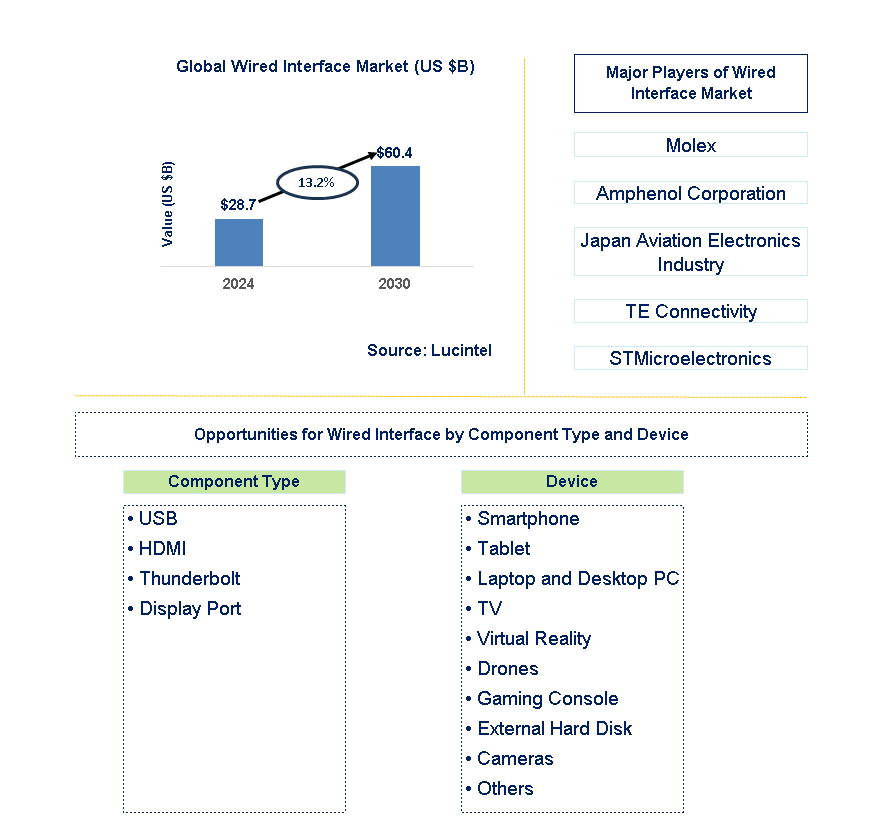
Key data points: The market size in 2030 = $60.4 billion, growth forecast = 13.2% annually for the next 6 years. Scroll below to get more insights. This market report covers trends, opportunities, and forecast in the global wired interface market to 2030 by component type (USB, HDMI, thunderbolt, and display port), device (smartphone, tablet, laptop and desktop PC, TV, virtual reality, drones, gaming console, external hard disk, cameras, and others), and region (North America, Europe, Asia Pacific, and the Rest of the World)
We'll send your sample report shortly.
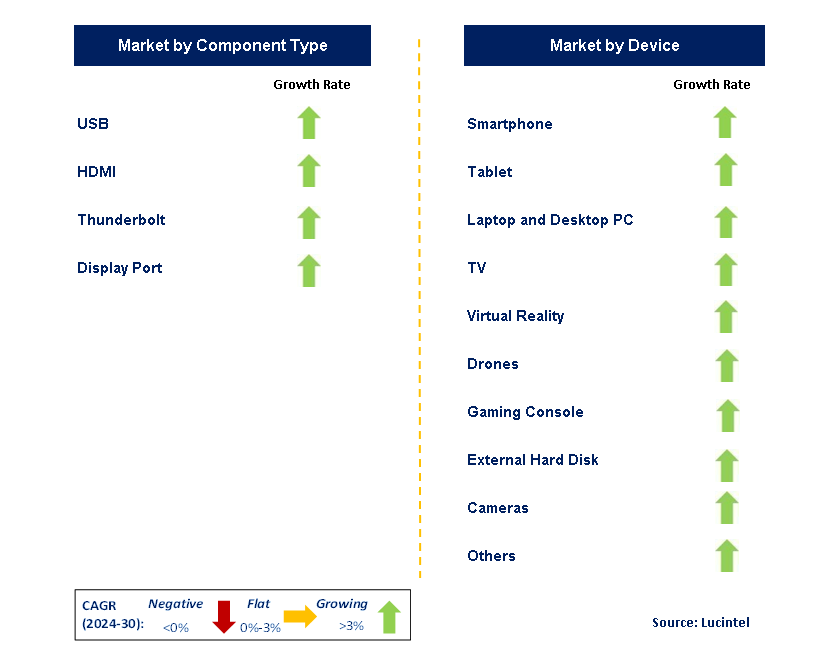
• Lucintel forecasts that, within the component type category, USB is expected to witness the highest growth over the forecast period.
• Within the device category, PCs and laptops will remain the largest segment.
• In terms of regions, North America is expected to witness the highest growth over the forecast period.
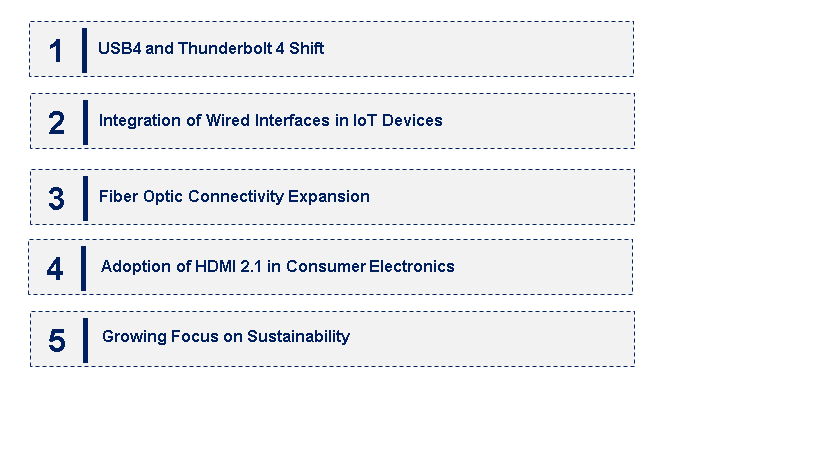
• USB4 and Thunderbolt 4 Shift: USB4 and Thunderbolt 4 are being adopted rapidly in the market, as the two offer faster data transfer speeds, better power supplies, and improved connectivity. They are increasingly becoming common interfaces for new consumer and industrial electronics that set new performance benchmarks and drive further innovation in the wired interface market.
• Integration of Wired Interfaces in IoT Devices: As IoT expands, there is a growing need for wired connections with stable security features in smart homes and industrial settings. This ensures reliable connections within interconnected devices, thus promoting the development of more sophisticated wired interfaces suitable to meet the expanding needs of this industry.
• Fiber Optic Connectivity Expansion: Fiber optic technology has gained prominence due to its superior speed and bandwidth capabilities, particularly in telecommunications and data centers. The expansion of fiber optic networks demands high-performance wired interfaces that can cope with large data volumes, thus redefining connectivity standards and pushing the boundaries of data transmission.
• Adoption of HDMI 2.1 in Consumer Electronics: In consumer electronics, HDMI 2.1 is now being embraced, especially because of the rise in 4K and 8K video content. This leads to the wide integration of HDMI 2.1 devices into televisions, gaming consoles, and other media devices driven by demand for higher resolution and faster refresh rates, thus growing the market.
• Growing Focus on Sustainability: Manufacturers are increasingly focusing on sustainable materials and energy-efficient designs for their wired interfaces due to rising concerns about sustainability. Innovations that meet performance requirements while also reducing environmental impact have been developed to comply with regulatory pressures and meet customer demands for eco-friendly products.
• Introduction of USB4 and Thunderbolt 4 Interfaces: USB4 and Thunderbolt 4 have changed how the wired interface market operates, offering faster speeds than any others available. Consequently, these interfaces have become indispensable in high-performance applications, including data centers, leading to substantial growth and adoption in this sector.
• Increased Usage of Power over Ethernet (PoE): Power over Ethernet (PoE) is increasingly being adopted, especially in IoT and smart buildings. PoE enables both power and data to be sent through one cable, simplifying installations while reducing costs. As such, wired interfaces are now being used across various applications, thus contributing to market expansion.
• HDMI 2.1 Integration into Next-Generation Devices: The introduction of HDMI 2.1 in consumer electronics has made it a key driver for the wired interface market. Increasing demand for 4K and 8K content raises expectations that new devices will support higher resolutions and faster refresh rates as a basic feature with HDMI 2.1, stimulating demands from markets and resulting in innovations.
• Expansion of Fiber Optic Networks: The wired interface market has been significantly impacted by the global spread of fiber optic networks. Fiber optics provide unrivaled speed and bandwidth, making them ideal for telecommunications and data center applications. This innovation has fueled increased demand for advanced wired interfaces that can support these high-performance networks.
• Sustainability Focus on Wired Interface Design: Sustainability is emerging as a major concern within the wired interface market; hence, manufacturers are adhering to regulations demanding ecological materials and energy-efficient designs, even as consumers increasingly prefer green products. This drive toward sustainability is leading to innovative ideas and affecting the future direction of the market.
• Consumer Electronics: The growing use of consumer electronic items that demand high-speed data transfer and power efficiency presents significant growth prospects. As devices become more sophisticated, this has increased the demand for advanced wired interfaces, such as USB4 and Thunderbolt 4, thus driving innovation and market expansion in this sector.
• Automotive Industry: A key area for growth is in the integration of advanced wired interfaces into automotive applications, mainly infotainment systems and autonomous driving technology. The adoption of Ethernet and USB-C in vehicles, where reliable, high-speed connectivity is required, positions the automotive industry as one of the largest markets for wired interfaces.
• Industrial Automation: The emergence of Industry 4.0 and smart manufacturing is creating new opportunities for wired interfaces targeting industrial automation. To support advanced manufacturing processes, Ethernet-based interfaces that have proven reliability in harsh environments are increasingly being employed, thus contributing to growth in this application.
• Telecommunications: Increased fiber optic network coverage, along with the rollout of fifth-generation (5G) technologies, is creating a surge in demand for high-performance wired interfaces across the telecommunications sector. These technologies necessitate modernized connection capabilities with a large capacity to handle significant data volumes with low latency, positioning telecoms as a significant opportunity area for growth through wired interfaces.
• Data Centers: Increasing requirements for data storage capacities and processing power are major drivers of development within the data center sphere. These environments rely on wired interfaces that ensure fast information transfer and energy savings, such as those provided by USB4 or Thunderbolt 4, creating a relevant opportunity space in the wired interface market.
• Technological Advancements: Advances in technology, such as USB4, Thunderbolt 4, and HDMI 2.1, are driving the wired interface market. These technologies offer faster data transfer rates, consume less power, and provide better interconnectivity, meeting the high-performance I/O requirements of several applications.
• Increasing Demand for High-Speed Data Transfer: The proliferation of data-intensive applications in consumer electronics, data centers, and telecommunications is driving the demand for high-speed wired interfaces. This demand fuels innovation and market growth as companies strive to develop faster and more efficient connectivity solutions.
• Expansion of IoT and Smart Devices: The development of IoT and smart devices has significantly impacted the wired interface market. For instance, Ethernet and Power over Ethernet (PoE) have been adopted due to the need for reliable and secure wired connections in industrial settings, such as smart homes.
• Growth in Industrial Automation: The market demand for wired interfaces that can support complex automation systems continues to rise due to Industry 4.0 objectives and smart manufacturing activities. Market growth could experience a boost as businesses within industries appreciate the importance of using Ethernet-based interfaces that guarantee reliability, thus improving worker productivity.
• Expansion of Fiber Optic Networks: The global expansion of fiber optic networks is a major driver of the wired interface market. Fiber optic cables provide significantly higher speeds compared to their conventional wired counterparts, making them highly suitable for use in telecommunication systems requiring high-performance links, such as in data centers where they are used as transceivers for advanced wired interfaces.
• High Costs with Advanced Interfaces: Inexpensive regions may struggle to afford costly technologies like Thunderbolt 3 or HDMI 2. High costs may be one of the challenges experienced during market expansion, making it difficult for these features to be adopted widely.
• Compatibility Issues: As new types of wired interfaces are developed, compatibility with existing devices or systems remains a concern. This poses a significant challenge within the marketplace because it requires seamless integration and interoperability, which can be technical and costly.
• Regulatory and Environmental Concerns: Regulations concerning materials and energy efficiency are increasing, complicating product development processes and raising costs among manufacturers in the wired interface market. Manufacturers must consider stringent regulations governing their products, including internal energy consumption due to environmental standards.
• Molex
• Amphenol Corporation
• Japan Aviation Electronics Industry
• TE Connectivity
• STMicroelectronics
• NXP Semiconductors
• Microchip Technology
• USB
• HDMI
• Thunderbolt
• Display Port
• Smartphone
• Tablet
• Laptop and Desktop PC
• TV
• Virtual Reality
• Drones
• Gaming Console
• External Hard Disk
• Cameras
• Others
• North America
• Europe
• Asia Pacific
• The Rest of the World
• United States: USB4 and Thunderbolt 4 technologies have been widely adopted in the U.S. to enhance data transfer rates for consumer electronics and data centers. Intel and Apple are among several major technology firms leading innovation while the rollout of 5G networks drives the need for advanced wired interfaces.
• China: This sector has expanded due to strong economic growth and a rise in the electronics and semiconductor industries. Local production is boosted by the government’s emphasis on technological self-sufficiency, with Huawei spearheading its devices with advanced interfaces. Additionally, demand for high-speed wired connections is driven by China’s focus on 5G and smart cities.
• Germany: In Germany, the development of motor vehicle components and industrial equipment has seen the wired interface market grow over the years. Industry 4.0 applications are being integrated with sophisticated interfaces, such as USB-C connectors and Ethernet cables, improving communication efficiency between machines and systems in manufacturing organizations. Moreover, interface performance enhancements aimed specifically at industrial environments are areas where German companies invest, thus supporting a robust manufacturing base.
• India: Increasing demand for smartphones and consumer electronics has led to market expansion in India. There has also been encouragement for Indian manufacturers to produce wired interface components under the “Make in India” program, while the extension of fiber optic networks and IT service provision promotes the need for better connectivity options, positioning India as a major player worldwide.
• Japan: Innovations in sectors like entertainment gadgets and automobiles characterize Japan’s wired interface market. High-speed HDMI 2.1-equipped Sony TVs featuring USB-C inputs are among the efforts that have pushed the company to a leadership position in its industry. Additionally, Japan’s government seeks to promote smart cities and IoT adoption, further increasing demand for wired connections and positioning it as a major market.


• Molex
• Amphenol Corporation
• Japan Aviation Electronics Industry
• TE Connectivity
• STMicroelectronics
• NXP Semiconductors
• Microchip Technology
Q6. Which wired interface market segment will be the largest in future?

Choose a license that fits your team. Instant PDF delivery.
Prices exclude taxes. Instant delivery. Custom licensing available on request.
Market Report · July 24, 2026
Market Report · July 20, 2026
Market Report · July 20, 2026
Trusted partner for strategic intelligence and business growth


Receive a complimentary market analysis tailored to your industry. Our analysts will identify key growth opportunities and competitive dynamics specific to your business.

Market size, growth rate, and key trend analysis for your specific sector.

Top competitor positioning and market share analysis.

Strategic recommendations backed by data-driven insights.
Get curated market intelligence and competitive moves straight to your inbox.
By subscribing, you agree to receive our monthly insights. Unsubscribe anytime.
Receive a complimentary market analysis tailored to your industry. Our analysts will identify key growth opportunities and competitive dynamics specific to your business.
Market size, growth rate, and key trend analysis for your specific sector.
Top competitor positioning and market share analysis.
Strategic recommendations backed by data-driven insights.
Get curated market intelligence, emerging trends, and competitive moves straight to your inbox each month.
By subscribing, you agree to receive our monthly insights. Unsubscribe anytime.
We'll send your sample report shortly.