
Report Feature
Wet Shave Market Trends and Forecast
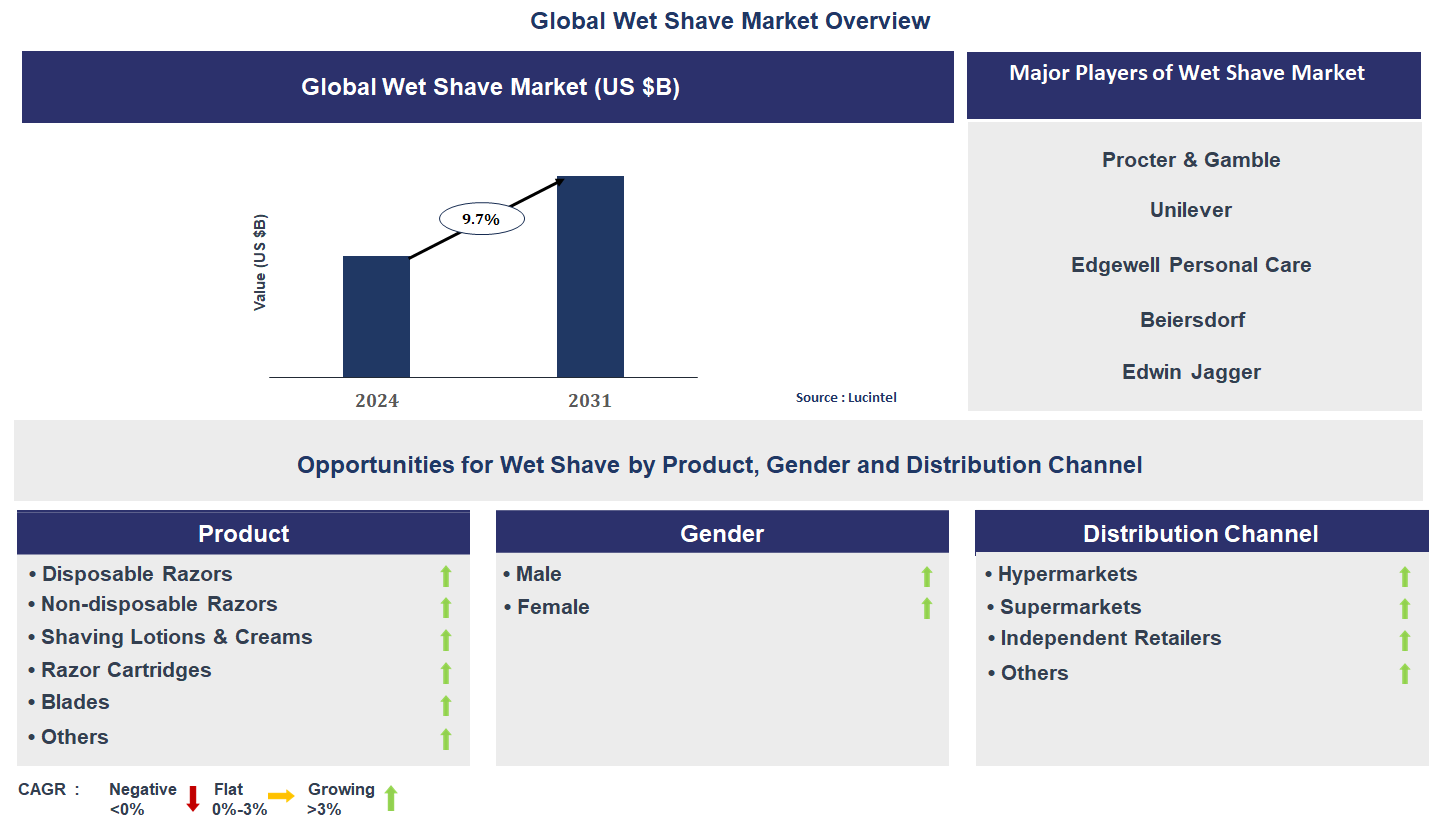
The future of the global wet shave market looks promising with opportunities in the hypermarket, supermarket, and independent retailer markets. The global wet shave market is expected to grow with a CAGR of 9.7% from 2025 to 2031. The major drivers for this market are the increasing preference for traditional shaving methods, the rising demand for eco-friendly shaving products, and the growing interest in grooming self-care routines.• Lucintel forecasts that, within the product category, razor cartridge will remain the largest segment over the forecast period.
• Within the distribution channel category, hypermarket is expected to witness the highest growth.
• In terms of region, APAC is expected to witness the highest growth over the forecast period. Gain valuable insights for your business decisions with our comprehensive 150+ page report. Sample figures with some insights are shown below.
Emerging Trends in the Wet Shave Market
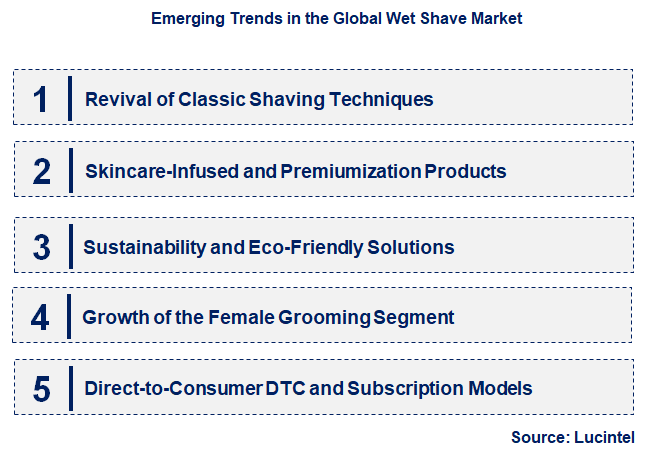
The wet shave category is undergoing a deep transformation, pushing well beyond its age-old role to become a core component of a larger self-care and grooming routine. The transformation is being fueled by consumer needs for more personalized, better-performing, and more sustainable products. The industry is meeting that demand with product design, ingredient, and distribution model innovation. These new trends are not only about new products but about a fundamental shift in the way brands engage with consumers and offer an end-to-end grooming experience that is functional as well as enjoyable.• Revival of Classic Shaving Techniques: There is a significant trend of consumers switching back to classic wet shaving techniques. This involves the use of safety razors, straight razors, shaving brushes, and shaving bowls. This movement is led by a need for a more considered, ritualistic, and high-end shaving experience that is perceived as a form of self-care. It also attracts customers who are interested in more sustainable and long-lasting versions of disposable plastic razors.
• Skincare-Infused and Premiumization Products: Premiumization is a strong trend that is experienced in the market as consumers are willing to spend money on products that are high-quality with extra benefits. This involves the creation of shaving creams and aftershaves that are infused with skincare elements such as hyaluronic acid, aloe vera, and essential oils. These products are made to protect and moisturize the skin, minimize irritation, and deliver a smoother and more comfortable shave.
• Sustainability and Eco-Friendly Solutions: The environment is a key rising trend in the wet shave market. Consumers are growing more and more concerned with the environmental cost of disposable razors. This has created a huge demand for sustainable solutions, including razors with metal handles and exchangeable blades, and shaving soaps in bar form to avoid plastic waste. Companies also employ green packaging and open sourcing of ingredients in order to cater to a new category of consumers who are environmentally conscious.
• Growth of the Female Grooming Segment: The wet shave segment is no longer male-dominated. There is increasing and significant product diversification to address the demands of female customers. Among these are razors with unique handles and blades that are formulated to fit the curves of the body. In addition, shaving creams and gels are being provided that are specifically formulated for sensitive skin and other hair removal requirements. This trend is growing the market size and opening up new grounds for brands to be more innovative in the design of products and marketing.
• Direct-to-Consumer DTC and Subscription Models: Direct-to-consumer DTC and subscription-based shaving services have emerged as a significant trend with the e-commerce boom. Brands are cutting out the middle man and selling products directly to consumers via their websites. This enables more personalized shopping and a steady stream of revenue. Subscription boxes offer consumers a hassle-free method of receiving new blades and products on a regular interval, which generates customer loyalty and minimizes the need to visit the store regularly. These trends are all contributing together to reshape the wet shave market into a consumer-driven, value-based industry. Price is no longer the focus, but product quality, sustainability, and experience. With the use of new technologies and the attention to consumers wants for wellness and health, the brands are building an enriched and competitive market. The ongoing spotlight on natural ingredients, eco-responsibility, and direct-to-consumer personalized models will be key to success.
Recent Development in the Wet Shave Market
The wet shave industry is continuously evolving, thanks to emerging consumer trends and technology. Current developments are pushing the sector towards personalized, green, and quality products. The industry is experiencing a new wave of consumer centricity, with manufacturers spending on product innovation and novel channels of distribution to cater to changing demands. These advancements are not only transforming the products themselves but also how they are sold and promoted, making it a more dynamic and competitive situation.• Launch of Advanced Blade and Razor Technology: One important development is the ongoing innovation in blade and razor technology. Companies are launching new multi-blade systems with flexible heads and lubricating strips to give a closer and more comfortable shave. There is also an emphasis on enhancing the ergonomics of razor handles for a better grip and hand control. This innovation is sparked by consumer demand for an enhanced shaving experience that reduces skin irritation and nicks, allowing the process to be faster and more efficient.
• Expansion of Direct-to-Consumer DTC Subscription Boxes: One of the most important developments has been the emergence of direct-to-consumer DTC subscription box offerings. Brands have introduced a seamless and affordable solution for consumers to obtain shaving products at their doorstep on a recurring basis. This model has upended the conventional retail landscape, providing a more intimate and uniform consumer experience. This trend has also enabled niche, smaller brands to get into the market and vie with traditional players.
• Focus on Natural and Skincare-Based Products: The market is witnessing a trend towards shaving gels, creams, and aftershaves which are formulating with natural and organic ingredients. People are more and more aware of what they apply to their skin, and thus there is a demand for paraben-free, sulfate-free, and artificial dye-free products. Most of these new formulations also contain skincare substances such as shea butter, aloe vera, and vitamin E that moisturize and calm the skin after shaving and during the shaving process.
• Greater Emphasis on Sustainable Products: Sustainability is a dominant trend influencing the wet shave industry. Consumers increasingly prioritize products that minimize environmental waste. This has sparked a revival of safety razors with exchangeable blades as a more environmentally friendly option compared to throwaway plastic razors. Companies are also making products with environmentally friendly packaging and encouraging recycling initiatives for their razors and blades to attract eco-friendly consumers.
• Product Line Expansion for Women Consumers: The wet shave sector has experienced a significant growth in the development of product lines specifically designed for women. Companies are coming up with razors and shaving creams that are customized to address the specific requirements of womens hair removal. These include razors with unique grips and blade pattern for a smooth shave across various body areas. This evolution is creating a new and profitable market segment that is fueling the expansion of the industry as a whole. These evolutions are creating a significant impact in the wet shave market by making it consumer-friendly and innovative. The emphasis has moved from one-size-all to one that provides a wide variety of products to meet specific requirements and values. By adopting sustainability, technology, and direct-to-consumer models, brands are not only addressing the needs of consumers but also building a more competitive and tougher market for the future.
Strategic Growth Opportunities in the Wet Shave Market
The wet shave market offers a number of strategic growth opportunities fueled by changing consumer trends and a need for improved grooming experiences. The business is transitioning from a commodity model to a value model, with products being formulated to fulfill specific consumer requirements. These opportunities are centered around innovation in product development, niche market targeting, and new distribution channels. Through smartly targeting these uses, businesses can open up new revenue sources and establish a loyal clientele in a competitive environment.• Application in the Luxury and Premium Segment: One of the main growth opportunities comes from applying luxury and premiumization to the wet shaving segment. This entails developing premium products with premium quality, for example, razors with distinctive designs and long-lasting materials like stainless steel or precious wood. It also involves providing luxury aftershaves and shaving creams with complex fragrances and quality ingredients. This usage is for consumers who perceive shaving as a ritual and are prepared to pay extra for a high-quality, long-lasting product and luxurious grooming experience.
• Usage in Green and Environmentally Friendly Products: The surge in demand for sustainable products is a big opportunity for growth. The use of environmentally friendly practices can be a strong differentiator. This means creating products that are reusable and generate minimal ecological footprint, like refillable safety razors with biodegradable packaging and recyclable blades. Brands may also emphasize refillable systems and concentrate formulations to minimize waste. This application not only serves to address consumer worries regarding the environment but also forges a positive image for the brand and gains an increasing base of ethically-conscious consumers.
• Application within the Female Grooming Market: The female grooming market represents a significant growth opportunity. Historically, the wet shave category has been aimed at men, but there is considerable and increasing application for products designed specifically for women. This entails creating razors with varying blade angles and handle orientations for women. It also entails creating shaving creams and gels that are designed for sensitive skin and shaving on different body parts.
• Direct-to-Consumer DTC Model Application: Utilizing a direct-to-consumer DTC business model presents a strategic growth prospect. Through direct sales to consumers on their own online stores, brands are able to exclude traditional retail, hence more profit margins. The model also enables a more tailored shopping experience and enables brands to gather useful data about consumer behavior. This application enables subscription services, which enhance customer loyalty and ensure a steady stream of revenue, which is significant for sustained growth.
• Application in Multi-Functional Products: There exists a robust opportunity for growth in the application of multi-functional products. Consumers are seeking more convenience and efficiency in their grooming process. This includes creating products that have multiple functions, like a facial cleanser that also serves as a shaving cream or a razor that has a built-in trimmer along with a blade. These strategic imperatives are influencing the wet shave market by promoting innovation and diversification. They are changing the market from being a price-sensitive commodity space to a value-sensitive consumer goods segment. Through premiumization, sustainability, new market segments, and efficient distribution, businesses can make the business more resilient and profitable. These are not simply sales of razors and creams; they are about redefining the place of shaving in a consumers life and building meaningful relationships through purposeful branding and distinctive experiences.
Wet Shave Market Driver and Challenges
The wet shave market is influenced by a range of major drivers and challenges, which encompass a number of technological, economic, and regulatory forces. These factors are establishing a dynamic landscape in which brands need to innovate continuously in order to stay competitive. A rising population and increased health consciousness on one side are driving a steady demand for grooming products, while the industry is also having to deal with fluctuating prices of raw materials, cutthroat competition, and a move towards non-traditional product formats by consumers on the other. Comprehension of these forces is essential to a strategic market growth and sustainability strategy. The factors responsible for driving the wet shave market include: 1. Increased Grooming Awareness: One of the drivers is the growing consciousness about personal grooming and looks, particularly for men. This is driven by social media, celebrity influences, and a change in cultural thinking. With more people, especially from the emerging markets, focusing on appearance, the shaving products demand is steadily rising. This driver is not only about day-to-day hygiene but about wanting to look good and put on a well-groomed appearance, which is creating a more substantial investment in good-quality razors and accessories. 2. Technological Advancements: Ongoing technological innovation in razor technology and blade technology is the key driver. Companies are creating multi-blade systems with flexible heads that follow the contours of the face and body for a closer, more comfortable shave. The addition of lubricating strips and ergonomic handles further makes the product user-friendly. All these innovations are making consumers switch from older versions, which helps drive sales of the product and market growth. 3. Subscription Models and E-commerce: The rise of e-commerce and subscription models are strong drivers. Online channels provide consumers with the convenience to shop from home, making it a simpler experience. This also provides consumers with access to a greater variety of brands and products, such as niche and craft brands, which drives competition and choice. This driver is especially powerful among young, digital-savvy consumers who prioritize convenience and a carefully curated shopping experience. 4. Urbanization and Growing Disposable Income: Urbanization, especially in Asia-Pacific, is the key driver. With people increasingly moving to the urban sector, they are exposed to contemporary standards of grooming and have more disposable income to invest in personal care products. This demographic change is contributing to a pronounced rise in the consumer market for wet shaving goods and a desire to spend money on high-end brands. This is generating new business opportunities for expansion in earlier untapped markets. 5. Increasing Emphasis on Skincare: One of the primary drivers is the coming together of wet shaving with skincare. There is a growing consumer preference for products that will not only give them a close shave but also moisturize, calm, and age-proof their skin. This has generated a demand for shaving cream and aftershave products containing moisturizing, anti-inflammatory, and anti-aging ingredients. This emphasis on skincare is driving the category up and enabling brands to charge a premium price for their value-added products. Challenges in the wet shave market are: 1. Aggressive Competition and Price Pressure: The wet shave business is extremely competitive and controlled by some large players and numerous smaller direct-to-consumer brands. This aggressive competition frequently results in price wars and heavy marketing expenditures, which can shrink profit margins of all competitors. The business is also subject to price sensitivity from much of the customer base, which can complicate introducing new, premium-priced products without threatening market share. 2. Altering Grooming Practices: One of the biggest challenges is the alteration of grooming practices by consumers, specifically the trend towards having beards and facial hair. Popularity of beards, especially among young men, decreases the shaving frequency, affecting directly the sales of razors and shaving creams. This trend compels brands to become diversified in terms of product lines to offer beard care and grooming products in order to remain competitive and appeal to a wider range of consumers. 3. Competition with Electric Shavers: The market for wet shaves is under considerable competition from the market for electric shavers. Electric shavers are usually seen as more convenient and quicker, and they are also considered less likely to cause nicks or irritation. This convenience aspect is a strong magnet for time-conscious consumers and can shift consumers away from traditional wet shaving, posing a threat to the market. Overall, the wet shave market is being driven by strong drivers like increased grooming consciousness and end-user demand for new, value-added products. These drivers are putting pressure on the market to reward brands for being transparent and product differentiation. Nevertheless, the market has to overcome strong challenges, with stiff competition and a change in consumer preference for alternative products. The capacity of businesses to navigate the challenges while leveraging the drivers will be the key to sustainable growth and will ultimately determine the direction of the future of the market.List of Wet Shave Companies
Companies in the market compete on the basis of product quality offered. Major players in this market focus on expanding their manufacturing facilities, R&D investments, infrastructural development, and leverage integration opportunities across the value chain. With these strategies wet shave companies cater increasing demand, ensure competitive effectiveness, develop innovative products & technologies, reduce production costs, and expand their customer base. Some of the wet shave companies profiled in this report include-• Procter & Gamble
• Unilever
• Edgewell Personal Care
• Beiersdorf
• Edwin Jagger
• Raymond
• Godrej Consumer Products Limited
• D.R. Harris & Co
• Johnson & Johnson Services
• Taylor of Old Bond Street
Wet Shave Market by Segment
The study includes a forecast for the global wet shave market by product, gender, distribution channel, and region.Wet Shave Market by Product [Value from 2019 to 2031]:
• Disposable Razors
• Non-disposable Razors
• Shaving Lotions & Creams
• Razor Cartridges
• Blades
• Others
Wet Shave Market by Gender [Value from 2019 to 2031]:
• Male
• Female
Wet Shave Market by Distribution Channel [Value from 2019 to 2031]:
• Hypermarkets
• Supermarkets
• Independent Retailers
• Others
Wet Shave Market by Region [Value from 2019 to 2031]:
• North America
• Europe
• Asia Pacific
• The Rest of the World
Country Wise Outlook for the Wet Shave Market
The wet shave market globally is experiencing dramatic change due to a mix of tradition, technology, and evolving consumer values. Though traditional blades and razors continue to dominate, the market is witnessing a shift towards more refined, eco-friendly, and personalized products. Industry players are reacting to consumers calls for quality ingredients, advanced blade technology, and environmentally friendly options. This has created an increase in direct-to-consumer subscription products and a revival of older methods of shaving.• United States: The United States wet shave market is dominated by intense competition and a strong emphasis on direct-to-consumer brands. Recent trends consist of the ongoing expansion of subscription models, with Dollar Shave Club and Harrys leading the disruption of the conventional retail scene. There is also a discernible move in the direction of premiumization, where consumers are looking for high-quality, durable products and premium shaving experiences. Innovation is at the forefront, with brands launching innovative blade technology and ergonomic handles.
• China: Chinas wet shave market is growing strongly, driven by increasing disposable incomes and the expanding male grooming culture. Recent trends revolve around product diversification and the impact of e-commerce. Although traditional razors are widely in use, there is a growing demand for electric shavers as well as multi-functional grooming products. Chinese shoppers are deeply influenced by social media, with brands using media such as TikTok and Weibo to advertise new product launches and grooming habits.
• Germany: The German wet shave market is mature and stable, with a strong focus on precision engineering, sustainability, and strength. Recent trends involve a clear customer desire for quality, long-lasting items, and this has revived the use of traditional safety razors. German consumers are also very green-conscious, which has pushed sales of products with minimal or returnable packaging and fill-up systems. Companies are prioritizing delivering an old-fashioned, tried-and-tested shaving experience, with a strong shift away from throwaway plastic razors towards more robust and greener products.
• India: The Indian wet shave industry is witnessing a fundamental transformation, spurred by urbanization and increasing awareness towards personal grooming. Some of the new developments are a high trend of premiumization, where consumers prefer to pay higher prices for superior and branded products. Demand for electric shavers and grooming kits with multiple functions is also increasing, particularly among the youth. The growth of e-commerce has been a key trend, enabling both urban and rural consumers to purchase a broader range of products.
• Japan: The Japanese wet shave market is a combination of technology and ancient tradition. Developments in recent times are concentrated on developing a better and ritualistic shaving experience. Japanese consumers value precision and a desire for products with close, comfortable, and irritation-free shaves. This has generated innovation in blade technology and the formulation of specialized shaving creams and lotions. Disposable and cartridge razors continue to be widely used due to convenience, but there is a very good niche market for classic high-end safety razors and shaving brushes.

Features of the Global Wet Shave Market
Market Size Estimates: Wet shave market size estimation in terms of value ($B). Trend and Forecast Analysis: Market trends (2019 to 2024) and forecast (2025 to 2031) by various segments and regions. Segmentation Analysis: Wet shave market size by product, gender, distribution channel, and region in terms of value ($B). Regional Analysis: Wet shave market breakdown by North America, Europe, Asia Pacific, and Rest of the World. Growth Opportunities: Analysis of growth opportunities in different products, gender, distribution channels, and regions for the wet shave market. Strategic Analysis: This includes M&A, new product development, and competitive landscape of the wet shave market. Analysis of competitive intensity of the industry based on Porter’s Five Forces model.
FAQ
Q1. What is the growth forecast for wet shave market? Answer: The global wet shave market is expected to grow with a CAGR of 9.7% from 2025 to 2031. Q2. What are the major drivers influencing the growth of the wet shave market? Answer: The major drivers for this market are the increasing preference for traditional shaving methods, the rising demand for eco-friendly shaving products, and the growing interest in grooming self-care routines. Q3. What are the major segments for wet shave market? Answer: The future of the wet shave market looks promising with opportunities in the hypermarket, supermarket, and independent retailer markets. Q4. Who are the key wet shave market companies? Answer: Some of the key wet shave companies are as follows:• Procter & Gamble
• Unilever
• Edgewell Personal Care
• Beiersdorf
• Edwin Jagger
• Raymond
• Godrej Consumer Products Limited
• D.R. Harris & Co
• Johnson & Johnson Services
• Taylor of Old Bond Street Q5. Which wet shave market segment will be the largest in future? Answer: Lucintel forecasts that, within the product category, razor cartridge will remain the largest segment over the forecast period. Q6. In wet shave market, which region is expected to be the largest in next 5 years? Answer: In terms of region, APAC is expected to witness the highest growth over the forecast period. Q7. Do we receive customization in this report? Answer: Yes, Lucintel provides 10% customization without any additional cost.
Table of Contents
List of Figures
List of Tables
Methodology
- In-depth interviews of the major players in this market
- Detailed secondary research from competitors’ financial statements and published data
- Extensive searches of published works, market, and database information pertaining to industry news, company press releases, and customer intentions
- A compilation of the experiences, judgments, and insights of Lucintel’s professionals, who have analyzed and tracked this market over the years.


Buy Now
Choose a license that fits your team. Instant PDF delivery.
Prices exclude taxes. Instant delivery. Custom licensing available on request.
Key Questions
- • What are some of the most promising, high-growth opportunities for the wet shave market by product (disposable razors, non-disposable razors, shaving lotions & creams, razor cartridges, blades, and others), gender (male and female), distribution channel (hypermarkets, supermarkets, independent retailers, and others), and region (North America, Europe, Asia Pacific, and the Rest of the World)?
- • Which segments will grow at a faster pace and why?
- • Which region will grow at a faster pace and why?
- • What are the key factors affecting market dynamics? What are the key challenges and business risks in this market?
- • What are the business risks and competitive threats in this market?
- • What are the emerging trends in this market and the reasons behind them?
- • What are some of the changing demands of customers in the market?
- • What are the new developments in the market? Which companies are leading these developments?
- • Who are the major players in this market? What strategic initiatives are key players pursuing for business growth?
- • What are some of the competing products in this market and how big of a threat do they pose for loss of market share by material or product substitution?
- • What M&A activity has occurred in the last 5 years and what has its impact been on the industry? For any questions related to Wet Shave Market, Wet Shave Market Size, Wet Shave Market Growth, Wet Shave Market Analysis, Wet Shave Market Report, Wet Shave Market Share, Wet Shave Market Trends, Wet Shave Market Forecast, Wet Shave Companies, write Lucintel analyst at email: helpdesk@lucintel.com. We will be glad to get back to you soon.


