
Market Report · July 31, 2026

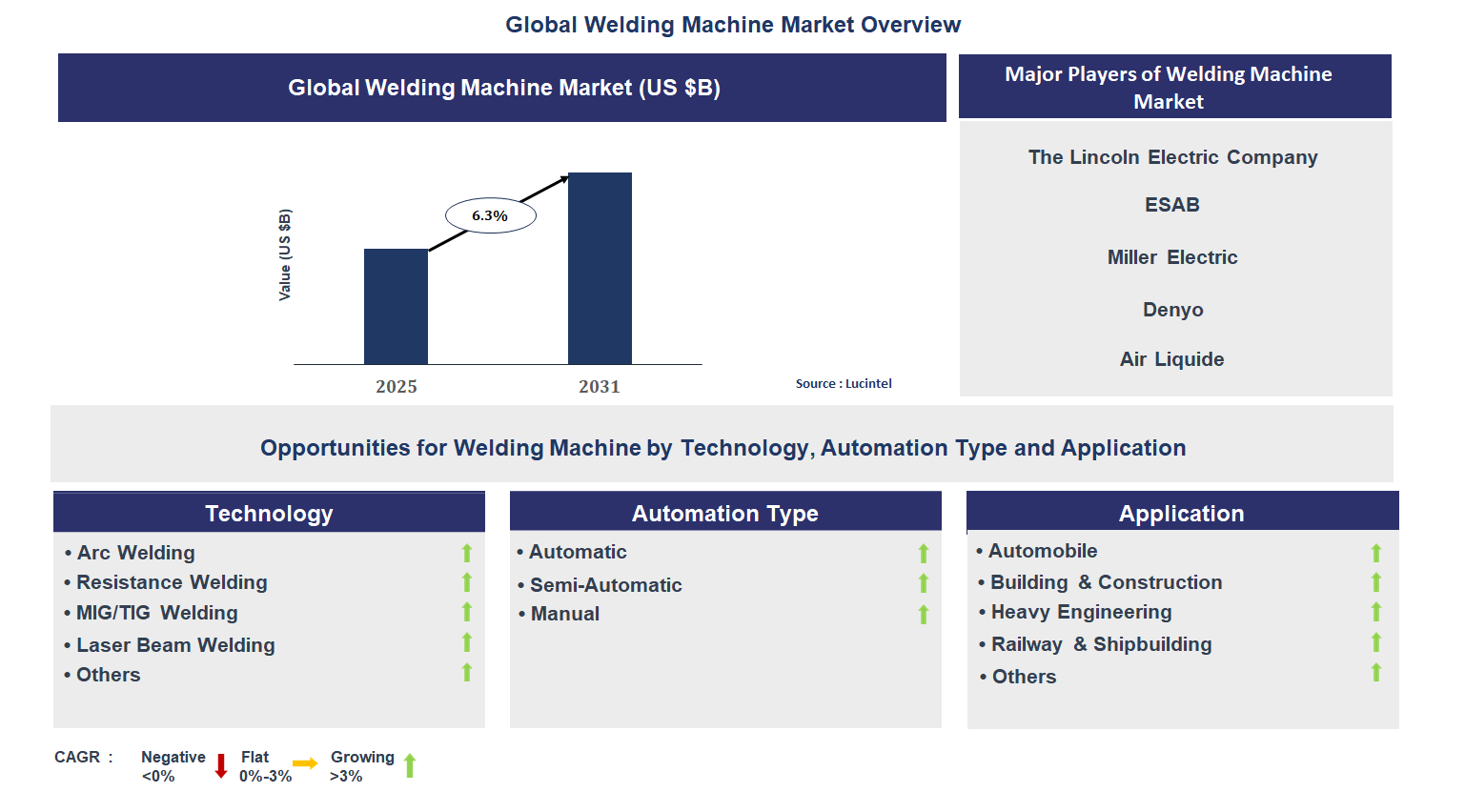
Key data points: The growth forecast = 6.3% annually for the next 7 years. Scroll below to get more insights. This market report covers trends, opportunities and forecasts in welding machine market to 2031 by technology (arc welding, resistance welding, MIG/TIG welding, laser beam welding, and others), automation type (automatic, semi-automatic, and manual), application (automobile, building & construction, heavy engineering, railway & shipbuilding, and others), and region (North America, Europe, Asia Pacific, and the Rest of the World)
We'll send your sample report shortly.
• Lucintel forecasts that, within the technology category, arc welding is expected to witness the highest growth over the forecast period.
• Within the application category, heavy engineering is expected to witness the highest growth.
• In terms of region, APAC is expected to witness the highest growth over the forecast period. Gain valuable insights for your business decisions with our comprehensive 150+ page report. Sample figures with some insights are shown below.
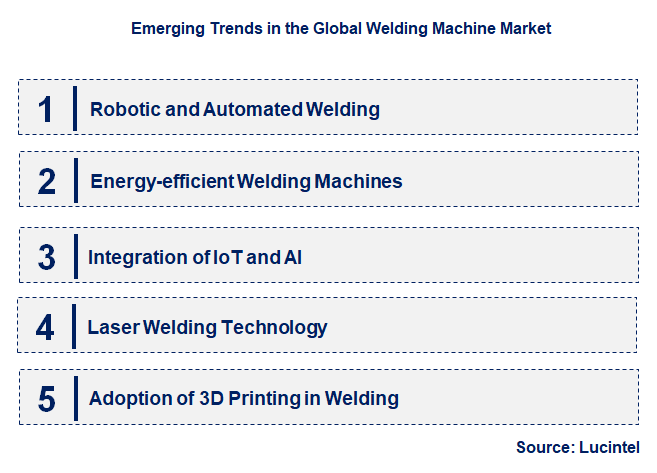
• Robotic and Automated Welding: The increasing adoption of robotic welding systems is streamlining production lines, reducing labor costs, and improving precision in industries like automotive and aerospace. These systems integrate AI and machine learning for enhanced quality control and predictive maintenance.
• Energy-efficient Welding Machines: The rising demand for energy-efficient solutions in manufacturing has led to innovations in welding machines that consume less power. These machines reduce operational costs while providing high-quality results, making them highly attractive to industries focused on sustainability.
• Integration of IoT and AI: Welding machines are becoming smarter with the integration of IoT and AI technologies. This allows for real-time data collection, predictive maintenance, and process optimization, making welding operations more efficient and less prone to errors.
• Laser Welding Technology: Laser welding is gaining popularity in precision welding applications, particularly in industries like aerospace and automotive. This technology provides higher precision, speed, and quality, making it ideal for complex and delicate applications.
• Adoption of 3D Printing in Welding: The integration of 3D printing with welding technologies is opening new possibilities in prototyping and small-batch production. This trend is particularly evident in the aerospace and automotive sectors, where intricate parts can be fabricated with greater precision and efficiency. These emerging trends are reshaping the welding machine market by enhancing efficiency, precision, and cost-effectiveness. Automation and AI integration are revolutionizing the way welding processes are conducted, while energy-efficient machines are reducing the overall environmental footprint of welding operations. Additionally, new technologies like laser welding and 3D printing are enabling higher-quality and more complex applications.
• Automation and Robotic Welding Systems: The introduction of robotic welding systems has revolutionized production lines, particularly in the automotive industry. These systems improve precision, speed, and safety, while reducing labor costs. Companies are investing heavily in automation to enhance production capabilities and maintain quality control.
• Energy-efficient Welding Machines: Manufacturers are focusing on developing energy-efficient welding machines to meet the growing demand for sustainable solutions. These machines consume less power while delivering superior performance, which is crucial for industries looking to reduce operational costs and improve sustainability.
• Laser and Precision Welding Technologies: Laser welding technology is becoming increasingly popular in industries requiring high-precision and high-quality results, such as aerospace and automotive. It allows for faster processing times, reduced thermal distortion, and cleaner welds, which are essential in high-performance applications.
• Smart Welding Machines with IoT Integration: IoT-enabled welding machines are providing manufacturers with real-time data on machine performance, weld quality, and operational status. This connectivity enables predictive maintenance, reducing downtime and ensuring greater consistency in weld quality.
• Collaborative Robots in Welding: Collaborative robots, or cobots, are being used alongside human workers in welding applications. These robots are designed to work safely and efficiently in shared spaces with human operators, improving productivity and reducing risks associated with manual welding tasks. The developments in automation, energy efficiency, and smart technologies are transforming the welding machine market. Robotic welding systems, energy-efficient machines, and laser technologies are driving greater efficiency, while IoT integration enhances operational control and predictive maintenance. These innovations are allowing industries to meet rising demand for high-precision and high-quality welding applications.
• Automotive Industry Adoption: The automotive industry continues to be a key driver for welding machine growth, with increased demand for robotic welding systems to enhance production lines. Manufacturers are adopting automated solutions for better quality, faster production, and reduced costs.
• Renewable Energy and Infrastructure: The growing focus on renewable energy projects, such as wind and solar power, is creating opportunities for advanced welding technologies in construction and infrastructure development. High-performance welding machines are required for building durable and safe renewable energy structures.
• Aerospace Industry Innovation: The aerospace sector’s need for high-precision welding applications is driving demand for laser and automated welding systems. As the industry moves towards lighter materials and more complex designs, there is an increasing demand for advanced welding technologies.
• Construction and Heavy Industries: With increasing infrastructure development, particularly in emerging markets, the construction industry is expected to continue demanding reliable welding machines for large-scale projects. Robotic and automated systems are improving productivity and quality in welding tasks for large structures.
• Shipbuilding and Marine Applications: The demand for welding machines in the shipbuilding industry is growing as the sector focuses on building more durable, fuel-efficient, and eco-friendly ships. Robotic and automated welding systems are ideal for large and complex marine structures. The strategic growth opportunities in automotive, renewable energy, aerospace, construction, and shipbuilding are expanding the scope of the welding machine market. These applications are driving innovation in automation, precision welding technologies, and energy-efficient solutions. Manufacturers that capitalize on these opportunities will be well-positioned to meet the growing demand for high-quality, cost-effective welding equipment.
• The Lincoln Electric Company
• ESAB
• Miller Electric
• Denyo
• Air Liquide
• KOBE STEEL
• Ador Welding
• ACRO Automation Systems
• voestalpine Bohler Welding
• Panasonic Industry Europe
• Arc Welding
• Resistance Welding
• MIG/TIG Welding
• Laser Beam Welding
• Others
• Automatic
• Semi-Automatic
• Manual
• Automobile
• Building & Construction
• Heavy Engineering
• Railway & Shipbuilding
• Others
• North America
• Europe
• Asia Pacific
• The Rest of the World
• United States: In the United States, the welding machine market is benefitting from Industry 4.0 advancements, such as robotics and automation. Increased demand in construction, automotive, and aerospace is driving technological innovation, with companies adopting advanced welding technologies like laser and robotic welding. Moreover, the push for cleaner, more efficient welding methods is influencing the shift toward energy-efficient machines.
• China: China remains one of the largest producers and consumers of welding machines globally. The nations industrialization, growth in the automotive sector, and infrastructure development have boosted the demand for high-tech welding equipment. The growing focus on automation and artificial intelligence (AI) in manufacturing is driving the adoption of advanced welding machines for higher productivity and quality control.
• Germany: Germany continues to lead in the development of precision welding technologies, particularly for automotive and manufacturing applications. The emphasis on high-quality standards, energy efficiency, and automation is driving the market. German manufacturers are investing heavily in robotic welding systems and automated solutions, offering advanced capabilities for complex applications in automotive, aerospace, and industrial manufacturing sectors.
• India: India’s growing industrial sector and expanding manufacturing base are fueling the demand for welding machines. The automotive, construction, and power sectors are adopting welding technologies to improve production efficiency and quality. As automation gains traction, there is a shift towards robotic welding systems, which are becoming increasingly popular in industries like automotive, metal fabrication, and infrastructure development.
• Japan: Japan continues to innovate in robotic and automated welding systems, particularly for the automotive and electronics industries. The country’s technological prowess has led to the development of high-precision and energy-efficient welding machines. Japan is also a major exporter of welding equipment, with a focus on integrating AI and IoT for advanced welding processes and predictive maintenance in industrial applications.


• The Lincoln Electric Company
• ESAB
• Miller Electric
• Denyo
• Air Liquide
• KOBE STEEL
• Ador Welding
• ACRO Automation Systems
• voestalpine Bohler Welding
• Panasonic Industry Europe Q5. Which welding machine market segment will be the largest in future? Answer: Lucintel forecasts that, within the technology category, arc welding is expected to witness the highest growth over the forecast period. Q6. In welding machine market, which region is expected to be the largest in next 5 years? Answer: In terms of region, APAC is expected to witness the highest growth over the forecast period. Q7. Do we receive customization in this report? Answer: Yes, Lucintel provides 10% customization without any additional cost.


Choose a license that fits your team. Instant PDF delivery.
Prices exclude taxes. Instant delivery. Custom licensing available on request.
Market Report · July 31, 2026
Market Report · July 22, 2026
Market Report · July 20, 2026
Trusted partner for strategic intelligence and business growth


Receive a complimentary market analysis tailored to your industry. Our analysts will identify key growth opportunities and competitive dynamics specific to your business.

Market size, growth rate, and key trend analysis for your specific sector.

Top competitor positioning and market share analysis.

Strategic recommendations backed by data-driven insights.
Get curated market intelligence and competitive moves straight to your inbox.
By subscribing, you agree to receive our monthly insights. Unsubscribe anytime.
Receive a complimentary market analysis tailored to your industry. Our analysts will identify key growth opportunities and competitive dynamics specific to your business.
Market size, growth rate, and key trend analysis for your specific sector.
Top competitor positioning and market share analysis.
Strategic recommendations backed by data-driven insights.
Get curated market intelligence, emerging trends, and competitive moves straight to your inbox each month.
By subscribing, you agree to receive our monthly insights. Unsubscribe anytime.
We'll send your sample report shortly.