Close Lucintel Chat
Didn't Find What You're Looking for?
Call us at +1972 636 5056 or write at helpdesk@Lucintel.com
Ask an Expert Provide Custom Requirements Download Sample Report Search Available Reports
  • helpdesk@Lucintel.com
  • |
  • Call Lucintel +1 972 636 5056
  • |
  • Login
  • |
  • Register
  • |
  • Search
  • |
'
...

The Impact of COVID-19 is included in Weft Sensors Market Report. Buy it today to get an advantage.

Request the impact of COVID-19 on your product or industry


Weft Sensors Trends and Forecast

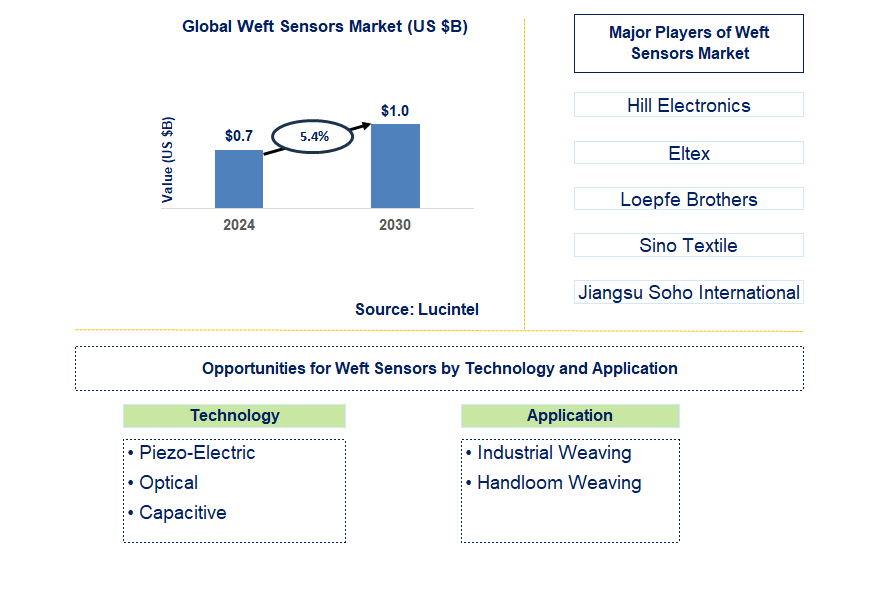
The future of the global weft sensors market looks promising with opportunities in the industrial weaving and handloom weaving markets. The global weft sensors market is expected to reach an estimated $1.1 billion by 2031 with a CAGR of 5.4% from 2025 to 2031. The major drivers for this market are increasing demand of the textile industry, rising adoption of industry 4.0 and automation, and growing demand for customized weft sensor solutions in respect to the specific customer needs.

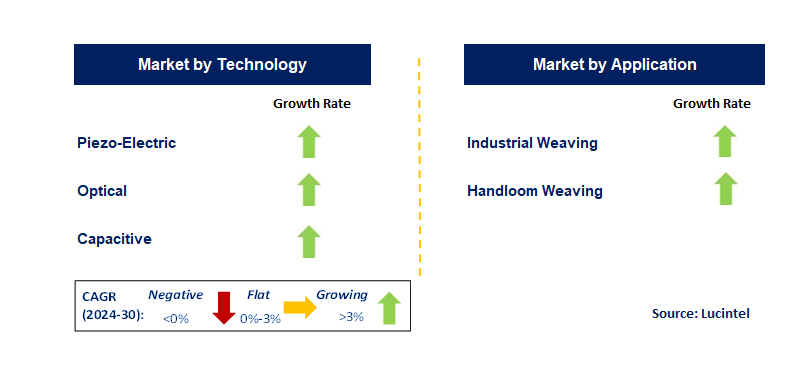
• Lucintel forecast that, within the technology category, piezo-electric is expected to witness the highest growth over the forecast period because the sensors are highly accurate and sensitive, making them ideal for detecting small changes in the weft yarn.
• Within the application, industrial weaving will remain the largest segment because the industrial weavers are increasingly using weft sensors to ensure the quality of their fabrics, as well as, weft sensors can detect defects in fabrics, such as broken yarns and uneven weaving, which can help to improve the quality of the final product.
• In terms of regions, APAC is expected to witness the highest growth over the forecast period.


Gain valuable insights for your business decisions with our comprehensive 150+ page report.
Weft Sensors Trends and Forecast

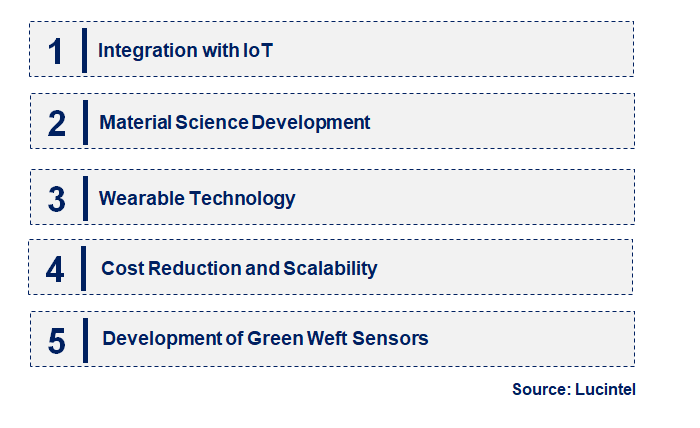
Emerging Trends in the Weft Sensors Market

The weft sensors area is consolidating, and it has several key trends that shape the future. These trends represent major technological advancements, industry needs, and driving forces in innovation and adoption for several sectors.

• Integration with IoT: The integration of weft sensors into IoT provides the facility for real-time collection and analysis of data. This trend enhances the functionality of sensors in smart textiles by providing insights into relevant applications in healthcare, sports, and industrial monitoring.
• Material Science Development: There is a development of new materials that will provide more durability to the weft sensors and enhance their performance. Improvements in nanotechnology and smart materials are enabling sensing mechanisms to be more robust and sensitive to environmental changes.
• Wearable Technology: The demand for wearable technology is expected to witness innovations in weft sensors. The sensors are being designed to be lightweight, flexible, and highly sensitive for integration into clothing and accessories for health monitoring and personal safety purposes.
• Cost Reduction and Scalability: Efforts are underway to decrease the cost of weft sensors and increase their scalability. This will involve the development of manufacturing processes that lower production costs and increase the availability of these sensors for a wider range of applications.
• Development of Green Weft Sensors: Manufacturers are increasingly focusing on the development of green weft sensors, using environmentally friendly materials in their structure and reducing the environmental impact of their manufacturing processes, aligning with global sustainability trends.

These trends are also pushing the weft sensor industry toward improved applications, performance enhancements, and increased access. Integration with IoT and material advancements will increase functionality, while cost-effectiveness and eco-friendly solutions will address economic and environmental concerns.
Emerging Trends in the Weft Sensors Market

Recent Developments in the Weft Sensors Market

The weft sensor industry is observing structural shifts in its capabilities and applications. These reflect a balance between technological innovation and market demands that help shape progress in the industry.

• Integration of Smart Textiles: One of the significant developments in this field of sensing is the embedding of weft sensors into smart textiles. This enables fabrics to display a wide range of parameters in real time, including temperature and humidity. It finds applications in military, healthcare, and sports.
• Enhanced Durability: Advances in materials science now make it possible to create more robust weft sensors. New materials and coatings are improving the service life of sensors for use in harsh environments and challenging applications.
• Wireless Technology: The latest use of wireless technology in weft sensors allows for easier transmission and integration with other systems. This development enables the integration of sensors for wider functionality in smart garments and industrial applications.
• Miniaturization: A key trend toward miniaturization is leading to smaller, compact weft sensors. Such developments allow the integration of sensors into wearable technologies and other applications where space reduction is essential, without loss of performance.
• Cost Efficiency: There have been significant improvements in cost efficiency regarding the development of weft sensors. Alongside manufacturing process advancements and new materials, production costs have been greatly reduced, making sensors more affordable and accessible across various application fields.

These innovations in the weft sensor field are expanding its applications and enhancing performance, cost efficiency, and longevity. The developments in the weft sensor industry, including smart textiles, wireless technology, miniaturization, and cost efficiency, are driving growth and innovation in the industry.

Strategic Growth Opportunities in the Weft Sensors Market

The weft sensor market is growing with continuously emerging opportunities across various applications. Identifying and leveraging these opportunities can significantly impact the development and growth in the adoption of weft sensors.

• Healthcare: Weft sensors are in demand for healthcare applications, especially for vital monitoring and the management of chronic conditions. The sensors embedded in patients’ clothing can maintain continuous monitoring and data collection to enhance patient care.
• Smart Textiles: Smart textiles present a key growth opportunity. Weft sensors in fabrics can easily provide functions such as temperature control, activity tracking, and environmental monitoring, thereby spurring various innovations in fashion and sportswear.
• Automotive Industry: Weft sensors are in demand in the automotive industry, primarily for driver monitoring systems and smart seat fabrics. These sensors help ensure both safety and comfort by monitoring driver behavior and adjusting seat conditions.
• Industrial Monitoring: Weft sensors are used for real-time monitoring of machinery and equipment in industrial settings to ensure predictive maintenance and operational efficiency, which, in turn, saves time and increases productivity.
• Environmental Monitoring: Integrating weft sensors with environmental monitoring systems enables the measurement of pollutants and environmental conditions. This capability is useful for both regulatory purposes and sustainability requirements.

These growth opportunities are transforming the weft sensor market through technological innovations and increased usage. Healthcare, smart textiles, automotive, industrial, and environmental monitoring continuously enhance the performance and importance of weft sensors across various sectors.

Weft Sensors Market Driver and Challenges

The various driving factors and challenges that exist in the weft sensor market determine its growth and development. Factors acting as drivers for weft sensors include technological advancements, economic conditions, and regulatory considerations.
The factors responsible for driving the weft sensor market include:

• Technological Advancement: Advances in sensor technology, including improvements in materials and integration with the Internet of Things, have been a driving force for growth in weft sensors. This increases their performance and expands application areas.
• Growing Demand for Smart Textiles: The interest in smart textiles and wearable technology creates demand for weft sensors. Consumers seek added value in the form of performance and functionality in advanced fabrics.
• Growth in the Healthcare Industry: Increasing focus on healthcare and wellness opens significant avenues for weft sensors in medical comfort and health management. The ability to embed sensors within clothing for continuous health monitoring is a major driver.
• Reduced Cost: Improvements in manufacturing processes and materials are helping to lower the cost of weft sensors. This makes the sensors more appealing and accessible across a wider range of applications in various industries.
• Environmental Regulations: Recently, there has been an increase in environmental regulations, which has driven market demand for environmentally friendly sensor solutions. Companies are focusing on manufacturing components with sustainable materials and reducing carbon footprints associated with sensor production.
Challenges in the weft sensor market include:
• High Development Costs: Developing advanced weft sensors involves significant research and development costs. Consequently, this discourages many companies, particularly startups and small businesses.
• Technical Limitations: Sensor accuracy, durability, and integration issues with textiles pose challenges that affect the performance and reliability of weft sensors. Addressing these technical limitations is essential for achieving market success.
• Market Competition: The increasing number of entrants into the weft sensor market heightens competition. Firms need to differentiate their products and offer unique features to gain a competitive advantage.
• Regulatory Compliance: Complex sensor safety requirements and environmental impact regulations can be time-consuming and difficult to achieve. Market entry typically requires strict compliance with these regulations.
• Consumer Acceptance: New technology often struggles to gain acceptance in the market due to consumers’ reluctance. Market education is vital for widespread acceptance of weft sensor applications.
The major drivers, such as technological innovations coupled with growing demand, are rapidly advancing the weft sensor market. However, many challenges, particularly high development costs and technical limitations, remain prevalent. Understanding and managing these factors is crucial for successful weft sensor development and adoption.

List of Weft Sensors Companies

Companies in the market compete on the basis of product quality offered. Major players in this market focus on expanding their manufacturing facilities, R&D investments, infrastructural development, and leverage integration opportunities across the value chain. With these strategies weft sensors companies cater increasing demand, ensure competitive effectiveness, develop innovative products & technologies, reduce production costs, and expand their customer base. Some of the weft sensors companies profiled in this report include-
• Hill Electronics
• Eltex
• Loepfe Brothers
• Sino Textile
• Jiangsu Soho International
• Mahlo

Weft Sensors by Segment

The study includes a forecast for the global weft sensors by technology, application, and region

Weft Sensors Market by Technology [Analysis by Value from 2019 to 2031]:


• Piezo-Electric
• Optical
• Capacitive

Weft Sensors Market by Application [Analysis by Value from 2019 to 2031]:


• Industrial Weaving
• Handloom Weaving

Weft Sensors Market by Region [Analysis by Value from 2019 to 2031]:


• North America
• Europe
• Asia Pacific
• The Rest of the World

Country Wise Outlook for the Weft Sensors Market

Weft sensors are vital in many industries for monitoring and controlling textiles. They are experiencing rapid advancement globally, influenced by innovations in technology, market demand dynamics, and industrial development needs. The countries leading this development include the United States, China, Germany, India, and Japan. Each of these countries uniquely contributes to the future direction of weft sensors, particularly in research and development and the introduction of more advanced applications.

• United States: Recently, U.S. developments related to weft sensors have targeted advanced material integration and wireless technology. Companies are innovating in smart textiles embedded with IoT capabilities, enabling real-time monitoring of fabrics’ performance and environmental conditions. Development focuses on improving durability and accuracy for broader applications within the medical and defense industries.
• China: In China, there has been tremendous development of weft sensor technologies, particularly in mass production and cost-effective pricing. High-precision sensors offered at affordable prices have become a key focus, making applications in manufacturing lines and consumer products very popular and boosting its position as a leading supplier of weft sensors.
• German Advances: German advancements primarily focus on integrating high technology and achieving sustainability. Currently, German researchers are pioneering developments with environmentally friendly materials for sensors, integrating them with Industry 4.0 technologies. This involves enhancing the accuracy and durability of sensors to improve performance for high-value applications, including automotive and aerospace.
• India: In India, attention has been directed toward low-cost sensor solutions that can be scaled for local textile industry applications. Innovations include developing sensors suitable for various climatic conditions. This relevance is directly related to the need for quality control and efficiency in the expanding textile sector.
• Japan: Weft sensors in Japan are at the forefront of development, focusing on miniaturization and potential integration with robotics. Companies in Japan are producing ultra-sensitive and compact sensors to be integrated into fabrics for specific requirements, such as wearable technology and smart textiles. Compactness is a key focus, along with improved functionality.
Lucintel Analytics Dashboard

Features of the Global Weft Sensors Market

Market Size Estimates: Weft sensors market size estimation in terms of value ($B).
Trend and Forecast Analysis: Market trends (2019 to 2024) and forecast (2025 to 2031) by various segments and regions.
Segmentation Analysis: Weft sensors market size by technology, application, and region in terms of value ($B).
Regional Analysis: Weft sensors market breakdown by North America, Europe, Asia Pacific, and Rest of the World.
Growth Opportunities: Analysis of growth opportunities in different technology, application, and regions for the weft sensors market.
Strategic Analysis: This includes M&A, new product development, and competitive landscape of the weft sensors market.
Analysis of competitive intensity of the industry based on Porter’s Five Forces model.

If you are looking to expand your business in this market or adjacent markets, then contact us. We have done hundreds of strategic consulting projects in market entry, opportunity screening, due diligence, supply chain analysis, M & A, and more.
Lucintel Consulting Services

FAQ

Q.1 What is the weft sensors market size?
Answer: The global weft sensors market is expected to reach an estimated $1.1 billion by 2031.
Q.2 What is the growth forecast for weft sensors market?
Answer: The global weft sensors market is expected to grow with a CAGR of 5.4% from 2025 to 2031.
Q.3 What are the major drivers influencing the growth of the weft sensors market?
Answer: The major drivers for this market are increasing demand of the textile industry, rising adoption of industry 4.0 and automation, and growing demand for customized weft sensor solutions in respect to the specific customer needs.
Q4. What are the major segments for weft sensors market?
Answer: The future of the global weft sensors market looks promising with opportunities in the industrial weaving and handloom weaving markets.
Q5. Who are the key weft sensors market companies?
Answer: Some of the key weft sensors companies are as follows:
• Hill Electronics
• Eltex
• Loepfe Brothers
• Sino Textile
• Jiangsu Soho International
• Mahlo
Q6. Which weft sensors market segment will be the largest in future?
Answer: Lucintel forecast that piezo-electric is expected to witness the highest growth over the forecast period because the sensors are highly accurate and sensitive, making them ideal for detecting small changes in the weft yarn.
Q7. In weft sensors market, which region is expected to be the largest in next 5 years?
Answer: APAC is expected to witness the highest growth over the forecast period.
Q.8 Do we receive customization in this report?
Answer: Yes, Lucintel provides 10% customization without any additional cost.

This report answers following 11 key questions:

Q.1. What are some of the most promising, high-growth opportunities for the weft sensors market by technology(Piezo-Electric, Optical, and Capacitive), application(Industrial Weaving and Handloom Weaving), and region (North America, Europe, Asia Pacific, and the Rest of the World)?
Q.2. Which segments will grow at a faster pace and why?
Q.3. Which region will grow at a faster pace and why?
Q.4. What are the key factors affecting market dynamics? What are the key challenges and business risks in this market?
Q.5. What are the business risks and competitive threats in this market?
Q.6. What are the emerging trends in this market and the reasons behind them?
Q.7. What are some of the changing demands of customers in the market?
Q.8. What are the new developments in the market? Which companies are leading these developments?
Q.9. Who are the major players in this market? What strategic initiatives are key players pursuing for business growth?
Q.10. What are some of the competing products in this market and how big of a threat do they pose for loss of market share by material or product substitution?
Q.11. What M&A activity has occurred in the last 5 years and what has its impact been on the industry?
For any questions related to weft sensors market or related to weft sensors companies, weft sensors market size, weft sensors market share, weft sensors market growth, weft sensors market research, write Lucintel analyst at email: helpdesk@lucintel.com we will be glad to get back to you soon.

                                                            Table of Contents

            1. Executive Summary

            2. Global Weft Sensors Market : Market Dynamics
                        2.1: Introduction, Background, and Classifications
                        2.2: Supply Chain
                        2.3: Industry Drivers and Challenges

            3. Market Trends and Forecast Analysis from 2019 to 2031
                        3.1. Macroeconomic Trends (2019-2024) and Forecast (2025-2031)
                        3.2. Global Weft Sensors Market Trends (2019-2024) and Forecast (2025-2031)
                        3.3: Global Weft Sensors Market by Technology
                                    3.3.1: Piezo-Electric
                                    3.3.2: Optical
                                    3.3.3: Capacitive
                        3.4: Global Weft Sensors Market by Application
                                    3.4.1: Industrial Weaving
                                    3.4.2: Handloom Weaving

            4. Market Trends and Forecast Analysis by Region from 2019 to 2031
                        4.1: Global Weft Sensors Market by Region
                        4.2: North American Weft Sensors Market
                                    4.2.1: North American Market by Technology : Piezo-Electric, Optical, and Capacitive.
                                    4.2.2: North American Market by Application: Industrial Weaving and Handloom Weaving
                                    4.2.3: The United States Weft Sensors Market
                                    4.2.4: Canadian Weft Sensors Market
                                    4.2.5: Mexican Weft Sensors Market
                        4.3: European Weft Sensors Market
                                    4.3.1: European Market by Technology :Piezo-Electric, Optical, and Capacitive.
                                    4.3.2: European Market by Application: Industrial Weaving and Handloom Weaving
                                    4.3.3: German Weft Sensors Market
                                    4.3.4: French Weft Sensors Market
                                    4.3.5: The United Kingdom Weft Sensors Market
                        4.4: APAC Weft Sensors Market
                                    4.4.1: APAC Market by Technology : Piezo-Electric, Optical, and Capacitive.
                                    4.4.2: APAC Market by Application: Industrial Weaving and Handloom Weaving
                                    4.4.3: Chinese Weft Sensors Market
                                    4.4.4: Japanese Weft Sensors Market
                                    4.4.5: Indian Weft Sensors Market
                                    4.4.6: South Korean Weft Sensors Market
                                    4.4.7: Taiwan Weft Sensors Market
                        4.5: ROW Weft Sensors Market
                                    4.5.1: ROW Market by Technology : Piezo-Electric, Optical, and Capacitive.
                                    4.5.2: ROW Market by Application: Industrial Weaving and Handloom Weaving
                                    4.5.3: Brazilian Weft Sensors Market
                                    4.5.4: Argentine Weft Sensors Market

            5. Competitor Analysis
                        5.1: Product Portfolio Analysis
                        5.2: Operational Integration
                        5.3: Porter’s Five Forces Analysis
                        5.4: Market Share Analysis

            6. Growth Opportunities and Strategic Analysis
                        6.1: Growth Opportunity Analysis
                                    6.1.1: Growth Opportunities for the Global Weft Sensors Market by Technology
                                    6.1.2: Growth Opportunities for the Global Weft Sensors Market by Application
                                    6.1.3: Growth Opportunities for the Global Weft Sensors Market by Region
                        6.2: Emerging Trends in the Global Weft Sensors Market
                        6.3: Strategic Analysis
                                    6.3.1: New Product Development
                                    6.3.2: Capacity Expansion of the Global Weft Sensors Market
                                    6.3.3: Mergers, Acquisitions, and Joint Ventures in the Global Weft Sensors Market
                                    6.3.4: Certification and Licensing

            7. Company Profiles of Leading Players
                        7.1: Hill Electronics
                        7.2: Eltex
                        7.3: Loepfe Brothers
                        7.4: Sino Textile
                        7.5: Jiangsu Soho International
                        7.6: Mahlo
.

Buy full report or by chapter as follows

Limited Time Offer

Price by License Type:
[-] Hide Chapter Details
[Chapter Number] [Chapter Name] [Chapter Number Of Pages] [Chapter Price]
Title/Chapter Name Pages Price
Full Report: Weft Sensors Market Report: Trends, Forecast and Competitive Analysis to 2031 Full Report $ 2,990
150 - page report
Lucintel has been in the business of market research and management consulting since 2000 and has published over 1000 market intelligence reports in various markets / applications and served over 1,000 clients worldwide. This study is a culmination of four months of full-time effort performed by Lucintel's analyst team. The analysts used the following sources for the creation and completion of this valuable report:
  • In-depth interviews of the major players in this market
  • Detailed secondary research from competitors’ financial statements and published data 
  • Extensive searches of published works, market, and database information pertaining to industry news, company press releases, and customer intentions
  • A compilation of the experiences, judgments, and insights of Lucintel’s professionals, who have analyzed and tracked this market over the years.
Extensive research and interviews are conducted across the supply chain of this market to estimate market share, market size, trends, drivers, challenges, and forecasts. Below is a brief summary of the primary interviews that were conducted by job function for this report.
 
Thus, Lucintel compiles vast amounts of data from numerous sources, validates the integrity of that data, and performs a comprehensive analysis. Lucintel then organizes the data, its findings, and insights into a concise report designed to support the strategic decision-making process. The figure below is a graphical representation of Lucintel’s research process. 
 

Please sign in below to get report brochure - Weft Sensors Market Report.

At Lucintel, we respect your privacy and maintain the confidentiality of information / data provided by you
(Please enter your corporate email. * These fields are mandatory )

Follow us on