
Report Feature
Water Bottle with Filter Market Trends and Forecast
The future of the global water bottle with filter market looks promising with opportunities in the residential, commercial, and industrial markets. The global water bottle with filter market is expected to grow with a CAGR of 8.1% from 2025 to 2031. The major drivers for this market are the increasing awareness of waterborne diseases, the rising health consciousness among consumers, and the growing demand for portable filtration bottles.• Lucintel forecasts that, within the product type category, plastic is expected to witness the highest growth over the forecast period.
• Within the end use category, residential is expected to witness the highest growth.
• In terms of region, APAC is expected to witness the highest growth over the forecast period. Gain valuable insights for your business decisions with our comprehensive 150+ page report. Sample figures with some insights are shown below.

Emerging Trends in the Water Bottle with Filter Market
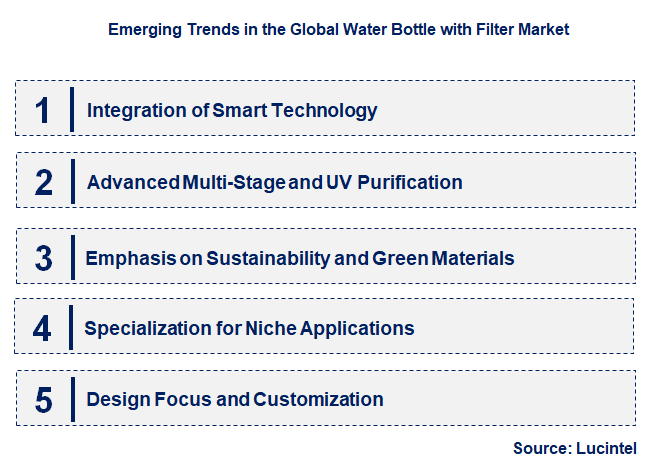
The water bottle with filter market is at a tipping point, changing quickly as a result of convergence of global consumer trends. The overarching background for these emerging trends is the growing public concern about water quality threats (from microplastics to old infrastructure) and the imperative to solve the global plastic trash problem. This twin pressure from health and environmental issues is compelling manufacturers to think more than just straightforward carbon filtration, and theyre thinking up more intelligent, more sustainable, and highly advanced products.• Integration of Smart Technology: There are smart features like IoT sensors and Bluetooth connectivity being integrated into filtered water bottles. This consists of features like monitoring of water consumption, calculation and display of filter life, and even real-time analysis of water quality. This technology transforms the filtered bottle from a passive add-on to an active tool for health and hydration management. Its influence is substantial because it appeals to the health-conscious, technology savvy consumer, promoting regular filter replacement for best performance and making hydration a measurable, data-driven wellness metric, as a means to boost product value and consumer interest.
• Advanced Multi-Stage and UV Purification: Companies are going beyond simple activated carbon filters with multi-stage filtration (such as ion exchange, ceramic pre-filters, and ultra-membrane filters) and UV-C light sterilization. This innovation offers military-grade filtration against a wider range of contaminants, such as microplastics, heavy metals, viruses, and bacteria, rendering water from practically any source safe for consumption. This movement heavily affects the market by increasing customer trust in the safety of the product for consumption while traveling internationally, engaging in outdoor recreation, and in an emergency situation, which is a direct challenge to the perceived safety of bottled water.
• Emphasis on Sustainability and Green Materials: The market is experiencing a strong shift toward bottles produced from sustainable materials, including recycled plastics (e.g., Tritan Renew), stainless steel, and glass, as well as attention to biodegradable or recyclable filter cartridges. This is an immediate reaction to the world anti-single-use plastic movement. Its effect is two-fold: it offers consumers a physical means to minimize their carbon footprint, which determines purchasing habits for the eco-friendly segment, and forces brands to embrace circular economy thinking, making the filter bottle a mainstream, long-term reusable option to single-use bottled water.
• Specialization for Niche Applications: Products are becoming increasingly specialized for specific activities and user groups. These consist of bottles tailored for outdoor survival (high-flow, high-capacity virus/bacteria removal), sport (insulated, ergonomic handle), and city commuting (thin, taste-centric filtration). This differentiation is central to addressing diverse consumer segments by fulfilling particular functional requirements. The effect is a market segmentation where brands can command a premium for function-specific features since the product is best optimized for its destined, high-value use, thereby expanding the aggregate addressable market.
• Design Focus and Customization: The filtered water bottle is becoming a lifestyle piece. This movement has a design focus, with clean lines, high-end finishes (such as matte colors and textures), and a variety of customizable features in color, size, and even the type of filter. Excellent ergonomics and durability are also emphasized. The effect of this change is that the product is bought not only for its utility, but as a fashion or status symbol. This increases adoption amongst a wider consumer base that appreciates style and customization, results in higher replacement rates and stronger brand loyalty. These five trends are really transforming the water bottle with filter industry from a niche function product to a mainstream, high-value consumer technology and lifestyle product. The push toward smart technology and sophisticated purification has raised the products purpose, while the emphasis on sustainability, specialization, and design has raised its emotional and functional appeal. The cumulative effect is a market that is more segmented, innovative, and deeply aligned with modern consumer values of health, convenience, and environmental responsibility, ensuring robust and sustained future growth.
Recent Development in the Water Bottle with Filter Market
The market for water bottle with filter is witnessing tremendous advancements, fueled mainly by consumer concerns regarding water quality and the worlds drive to eradicate single-use plastic pollution. This environment has encouraged large companies to put investment into state-of-the-art filtration systems and eco-friendly product design. Current advancements demonstrate an across-the-board industry reaction, shifting from simple, one-time solutions to long-term, high-performance, and technologically advanced hydration systems.• Introduction of UV-C Self-Cleaning Technology: This innovation is extremely impactful since it fulfills a key consumer need: the cleaning and maintenance of refillable bottles. It hugely increases the safety and convenience value proposition, particularly for travelers and the outdoor fraternity who will depend on multiple water sources. By providing verifiable sterilization, it increases the perceived quality and credibility of the product, creating a new, premium category in the market.
• Microplastic and Chemical-Specific Filtration: This directly addresses increasing public health concern and regulatory pressure regarding emerging waterborne pollutants. The capability to sell verifiable removal of microplastics and sophisticated chemicals provides a strong competitive advantage, compelling consumers to replace their current filtered bottles and fuel the growth rate in developed markets where municipal water is the top-of-mind concern.
• Adoption of Certified Sustainable Materials: This innovation solidifies the filtered bottles position as a central sustainable solution to bottled water. It strongly appeals to the enormous segment of green consumers, particularly younger generations. By emphasizing sustainability, brands are able to develop greater brand loyalty and ethical positioning, enabling them to charge higher prices for their eco-friendly offerings.
• Growth of High-Capacity/Adventure-Grade Filters: This is essential to address the rapidly expanding adventure and survivalist market segments. By providing extremely reliable, proven, and certified high-volume purification, manufacturers are substituting old, single-use water treatment products (such as tablets or drops) and establishing a committed, high-value niche. This is offering a stable, repeat revenue stream through sales of long-life, purpose-designed filter replacements.
• Growth through Direct-to-Consumer and Subscription Models: The innovation radically alters the business model of the market. The subscription model guarantees a steady, recurring revenue source for the most lucrative part—the filter cartridge—hitherto dependent on occasional consumer recall. D2C makes possible direct customer input and enhanced brand management, reducing customer acquisition cost and enhancing the long-term profitability of each customer. All of these five most important developments together are leading the water bottle with filter industry into a future characterized by high-tech performance, greenness, and maximized consumer lifetime value. UV sterilization and multi-contaminant removal emphases enhance customer trust and broaden application range. At the same time, sustainable material commitment and subscription-style filter replacement create a more long-lasting and lucrative business model. This development is positioning the filtered bottle not as a product, but as a necessity, intelligent, and eco-friendly personal drinking device.
Strategic Growth Opportunities in the Water Bottle with Filter Market
The water bottle with filter market is ready for strategic growth, moving away from an overall consumer product to one heavily embedded in targeted user lifestyles and uses. The major impetuses for sizing these growth opportunities are world mobility (outdoor recreation and travel) on low and rising and the universal consumer need for clean, delicious-tasting water wherever they go. By targeting unique application segments, firms can use specialized marketing, product formulating, and distribution channels in order to maximize profitability and market penetration.• Outdoor/Adventure Travel Segment: This application is a high-margin opportunity based on the premium prices paid for certified survival and emergency preparedness equipment. It creates brand credibility through functionality in extreme environments and earns a consistent revenue stream from the specialized, high-volume filter cartridges needed for this segments heavy usage.
• Corporate Wellness and Office Use: It is a significant B2B growth route that enables large-volume, recurring sales with reduced customer acquisition expense. By linking the product to corporate Environmental, Social, and Governance (ESG) objectives and employee well-being programs, businesses are able to win long-term, high-margin contracts and institutionalize their brand presence, which can generate robust word-of-mouth promotion.
• Fitness and Sports Hydration: This category rides the huge, image-driven health and fitness market. Growth is generated from associating the filter bottle with performance and best hydration for premium pricing over every day-use bottles. Deals with gyms, athletic clubs, and sporting goods retailers are important distribution channels offering high brand visibility.
• Education and Student Market: This segment is a large, high-volume market for introductory models, driving early brand adoption by a new generation of users. Success in this area early on can translate to a lifetime of brand loyalty. Targeting affordability and sustainability messaging resonates strongly with students, so it is a good growth channel for mass market.
• Emergency and Disaster Relief Applications: Although not a solely consumer-oriented market, this use offers a socially beneficial and secure income stream, typically consisting of bulk, one-time orders. Perhaps most importantly, successful utilization in emergency applications offers unwavering endorsement of the products purification capability, which can subsequently be used for effective, credible marketing to the consumer market. These growth opportunities, which are strategic in nature, are significantly influencing the water bottle with filter industry by converting it from an umbrella retail category to a series of highly niche, value-added solutions. With their focus on the high-margin adventure market, high-volume corporate arena, and lifestyle-driven fitness channel, companies are fueling product innovation and diversification. This focused strategy is driving the total revenue potential of the market to new highs and providing long-term growth by fulfilling the specific, unique hydration and safety requirements of various consumer application segments.
Water Bottle with Filter Market Driver and Challenges
The water bottle with filter market is influenced by an intricate interplay of forces, whose direction is guided by strong incentives as well as daunting challenges. The key drivers and hinderances are multiple technological, economic, and regulatory variables that affect consumer acceptance, product development, and market penetration in global regions. On the positive side, increasing health and environmental awareness is a robust tailwind that obliges consumers to opt for alternatives to single-use plastics and municipal water of dubious quality. The factors responsible for driving the water bottle with filter market include: 1. Increasing Global Health and Water Quality Issues: Buyers all over the world are more and more concerned about tap water contaminants such as lead from old pipes, byproducts of chlorine, and microplastics. Health awareness fuels the need for personal, portable filtration to make water safe at home and on the move. This trend is reinforced by research into microplastic consumption and publicity surrounding municipal water supply scandals, propelling filtered bottles into the "must-have health item" bracket. 2. Robust Anti-Single-Use Plastic Movement: Public and regulatory impetus toward decreasing plastic waste is a huge impetus for reusable filter bottles. As people grow increasingly environmentally aware, they take deliberate steps toward finding sustainable alternatives to bottled water. The filtered bottle is an appealing, affordable, and moral way to lower ones environmental impact, encouraged by company sustainability commitments and plastic-cut campaigns. 3. Increase in Outdoor Recreation and Travel: The global surge in activities like hiking, camping, and adventure tourism, combined with the practicality of filtered water for international travel, significantly boosts demand. Consumers in this segment require reliable, certified, and compact purification to safely drink from varied or remote sources. This application drives the demand for advanced filtration technologies capable of removing biological threats (bacteria, protozoa, viruses). 4. Technological Advancements in Filtration: Ongoing innovation in filter media (e.g., finer pore sizes, improved carbon) and built-in technologies (e.g., UV-C sterilization, intelligent sensors) is making the products better, more compact, and easier to use. These developments enable products to address a wider range of contaminants and have features such as self-cleaning, which overcome product limitations in the past and raise consumer willingness to pay a premium. 5. Accessibility of Global Markets Through E-commerce: The growth of online shopping and D2C platforms has significantly enhanced the availability of filtered water bottles and, more significantly, replacement filters worldwide. This convenience element minimizes the friction of long-term ownership, guaranteeing ongoing filter changes. E-commerce websites further provide niche brands with global access, enhancing competition and decreasing consumer prices. Challenges in the water bottle with filter market are: 1. High Initial Cost and Ongoing Filter Costs: The initial cost of a high-quality, high-end filtered bottle is much greater than a regular reusable bottle, which may discourage price-sensitive customers. Additionally, the repeat cost and perceived inconvenience of replacing the filter may result in abandonment of the product or usage of an old, out-of-date filter, eroding the products fundamental value proposition and limiting mass market penetration. 2. Consumer Skepticism and Perception of Efficacy: Most consumers are still wary that a bottle filter can achieve the same visual purity as home systems or bottled water. This is compounded by a disintegrated regulatory landscape and the absence of guidelines for standardized, easily interpretable filter ratings against all types of contaminants, thereby making it hard to believe claims and compare product efficiency on a fair basis. 3. Competition from Traditional Alternatives: The market is under intense competition from entrenched alternatives: low-cost bottled water (valued on convenience and low cost), and home filtration systems with high capacity (valued on whole-house purity). Changing consumers behavior demands substantial marketing investment to establish clearly the distinct value of portability, cost, and environmental advantage over these deep-seated habits and technology. The combined effect of these drivers and challenges is a dynamic, highly competitive market trending toward premiumization and specialization. The drivers (health, sustainability, technology) are so strong that they guarantee healthy long-term growth and ongoing innovation, especially in developed markets and specialized application segments. Yet, the obstacles (cost, skepticism, competition) call for strategic mitigation, including providing subscription models to reduce replacement cost friction and obtaining transparent, third-party certification to establish consumer trust.List of Water Bottle with Filter Companies
Companies in the market compete on the basis of product quality offered. Major players in this market focus on expanding their manufacturing facilities, R&D investments, infrastructural development, and leverage integration opportunities across the value chain. With these strategies water bottle with filter companies cater increasing demand, ensure competitive effectiveness, develop innovative products & technologies, reduce production costs, and expand their customer base. Some of the water bottle with filter companies profiled in this report include-• Brita
• LifeStraw
• GRAYL
• Hydro Flask
• CamelBak Products
• Seychelle Water Filtration
• Sawyer Products
• Katadyn Products
• Aquasana
• Bobble
Water Bottle with Filter Market by Segment
The study includes a forecast for the global water bottle with filter market by product type, filter type, distribution channel, end use, and region.Water Bottle with Filter Market by Product Type [Value from 2019 to 2031]:
• Plastic
• Stainless Steel
• Glass
• Others
Water Bottle with Filter Market by Filter Type [Value from 2019 to 2031]:
• Activated Carbon
• UV
• Ceramic
• Others
Water Bottle with Filter Market by Distribution Channel [Value from 2019 to 2031]:
• Online Stores
• Supermarkets/Hypermarkets
• Specialty Stores
• Others
Water Bottle with Filter Market by End Use [Value from 2019 to 2031]:
• Residential
• Commercial
• Industrial
Water Bottle with Filter Market by Region [Value from 2019 to 2031]:
• North America
• Europe
• Asia Pacific
• The Rest of the World
Country Wise Outlook for the Water Bottle with Filter Market
The international water bottle with filter industry is being revolutionized by mounting consumer health awareness and worldwide pressure towards sustainability. Developments in recent times across prominent economies such as the United States, China, Germany, India, and Japan indicate a convergence of technological advancements, green awareness, and increasing demand for portable, safe water drinking solutions. The industry is moving away from simple filtration and toward more sophisticated, multi-stage, and intelligent technologies, providing consumers with convenience, safety guarantee, and an environmentally friendly option to single-use plastic bottles.• United States: US market is dominated by solid demand for premium, feature-laden filtered bottles, especially among outdoor and recreation users and health-focused city residents. Major trends are the common use of bottles with sophisticated filtration for microplastics and up-and-coming contaminants (such as PFAS), and the growing popularity of smart bottles that monitor water consumed and filter life through smartphone apps. There is also a discernible tilt towards stainless steel and hard-wearing, sustainable materials to match green consumer values, cementing the markets upscale segment.
• China: Chinas market is growing very fast, driven by escalating urbanization, growing disposable incomes, and deep-seated concerns regarding municipal water quality. Products are centered around high-efficiency, portable filtration to be applied to travel and everyday life. Local manufacturers are spending significantly on R&D to enhance filter life and purification efficiency, often combining UV sterilization with conventional multi-stage carbon filters.
• Germany: Germany, being already highly environmentally conscious and having strict quality standards, is leading the way with eco-friendly material and design innovation. Consumers are trending towards long-lasting, top-quality products, and there is particularly high demand for filter bottles that are made from stainless steel and glass. Tested and certified filtration systems are recent innovations, ones that specialize in taste improvement and removal of chlorine and heavy metals, appealing to a consumer market highly critical of plastic waste and interested in better water taste.
• India: The Indian market is highly prospective for growth due to its fast urbanization, unreliable tap water quality, and increasing middle-class concern for health and hygiene. Products target the development of cost-effective, highly efficient water purification products for everyday use, particularly those addressing biological pollutants (bacteria and viruses) commonly present in diverse water sources. E-commerce growth is central to penetration of the market, accompanied by the launch of less complex, affordable plastic models appealing to a wider, more price-conscious consumer.
• Japan: Japans market is defined by a need for small, beautiful, and technology-such-that-it-does-not-show products that can be seamlessly integrated into daily life. Improvements center on intuitive design, simplicity, and super-fine microfiltration membranes that provide high-purity water. There is a distinct focus on bottles that are efficient at eliminating trace chemicals while being highly portable and durable, a culture that places very great store in convenience, quality, and precision engineering.

Features of the Global Water Bottle with Filter Market
Market Size Estimates: Water bottle with filter market size estimation in terms of value ($B). Trend and Forecast Analysis: Market trends (2019 to 2024) and forecast (2025 to 2031) by various segments and regions. Segmentation Analysis: Water bottle with filter market size by various segments, such as by product type, filter type, distribution channel, end use, and region in terms of value ($B). Regional Analysis: Water bottle with filter market breakdown by North America, Europe, Asia Pacific, and Rest of the World. Growth Opportunities: Analysis of growth opportunities in different product types, filter types, distribution channels, end uses, and regions for the water bottle with filter market. Strategic Analysis: This includes M&A, new product development, and competitive landscape of the water bottle with filter market. Analysis of competitive intensity of the industry based on Porter’s Five Forces model.
FAQ
Q1. What is the growth forecast for water bottle with filter market? Answer: The global water bottle with filter market is expected to grow with a CAGR of 8.1% from 2025 to 2031. Q2. What are the major drivers influencing the growth of the water bottle with filter market? Answer: The major drivers for this market are the increasing awareness of waterborne diseases, the rising health consciousness among consumers, and the growing demand for portable filtration bottles. Q3. What are the major segments for water bottle with filter market? Answer: The future of the water bottle with filter market looks promising with opportunities in the residential, commercial, and industrial markets. Q4. Who are the key water bottle with filter market companies? Answer: Some of the key water bottle with filter companies are as follows:• Brita
• LifeStraw
• GRAYL
• Hydro Flask
• CamelBak Products
• Seychelle Water Filtration
• Sawyer Products
• Katadyn Products
• Aquasana
• Bobble Q5. Which water bottle with filter market segment will be the largest in future? Answer: Lucintel forecasts that, within the product type category, plastic is expected to witness the highest growth over the forecast period. Q6. In water bottle with filter market, which region is expected to be the largest in next 5 years? Answer: In terms of region, APAC is expected to witness the highest growth over the forecast period. Q7. Do we receive customization in this report? Answer: Yes, Lucintel provides 10% customization without any additional cost.
Table of Contents
List of Figures
List of Tables
Methodology
- In-depth interviews of the major players in this market
- Detailed secondary research from competitors’ financial statements and published data
- Extensive searches of published works, market, and database information pertaining to industry news, company press releases, and customer intentions
- A compilation of the experiences, judgments, and insights of Lucintel’s professionals, who have analyzed and tracked this market over the years.


Buy Now
Choose a license that fits your team. Instant PDF delivery.
Prices exclude taxes. Instant delivery. Custom licensing available on request.
Key Questions
- • What are some of the most promising, high-growth opportunities for the water bottle with filter market by product type (plastic, stainless steel, glass, and others), filter type (activated carbon, UV, ceramic, and others), distribution channel (online stores, supermarkets/hypermarkets, specialty stores, and others), end use (residential, commercial, and industrial), and region (North America, Europe, Asia Pacific, and the Rest of the World)?
- • Which segments will grow at a faster pace and why?
- • Which region will grow at a faster pace and why?
- • What are the key factors affecting market dynamics? What are the key challenges and business risks in this market?
- • What are the business risks and competitive threats in this market?
- • What are the emerging trends in this market and the reasons behind them?
- • What are some of the changing demands of customers in the market?
- • What are the new developments in the market? Which companies are leading these developments?
- • Who are the major players in this market? What strategic initiatives are key players pursuing for business growth?
- • What are some of the competing products in this market and how big of a threat do they pose for loss of market share by material or product substitution?
- • What M&A activity has occurred in the last 5 years and what has its impact been on the industry? For any questions related to Water Bottle with Filter Market, Water Bottle with Filter Market Size, Water Bottle with Filter Market Growth, Water Bottle with Filter Market Analysis, Water Bottle with Filter Market Report, Water Bottle with Filter Market Share, Water Bottle with Filter Market Trends, Water Bottle with Filter Market Forecast, Water Bottle with Filter Companies, write Lucintel analyst at email: helpdesk@lucintel.com. We will be glad to get back to you soon.


